









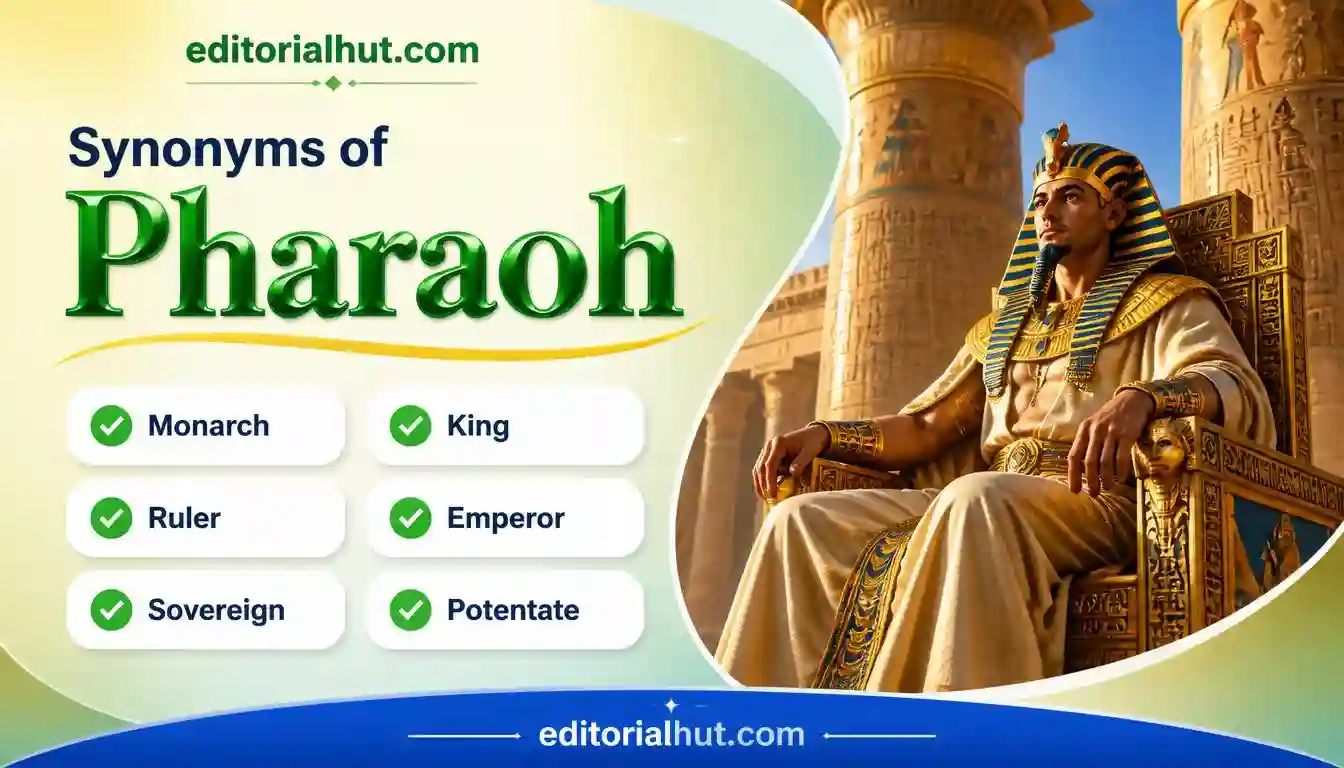
The best synonyms of pharaoh depend on whether you are writing about ancient Egyptian history or describing a ruler in a broader sense. King and monarch are the closest general alternatives because a pharaoh was the ruler of ancient Egypt. However words such as sovereign and supreme ruler emphasize authority while Egyptian ruler provides a more historically specific description.
Not every royal title is interchangeable with pharaoh. A sultan or emperor may also rule a kingdom or empire but belongs to a different historical or political context. Choosing the right alternative helps make your writing more accurate and natural.
Quick Answer: What Are the Best Synonyms of Pharaoh?
The most useful alternatives for pharaoh include:
- King — the simplest general synonym.
- Monarch — a formal term for a sovereign ruler.
- Ruler — a broad word for someone who governs a country or territory.
- Sovereign — a person who holds supreme authority.
- Egyptian king — a historically specific description.
- Egyptian ruler — a clear alternative for historical writing.
- Supreme ruler — emphasizes the highest level of authority.
- Head of state — a modern political description that may not fully capture the religious and royal role of a pharaoh.
- Royal sovereign — a formal descriptive phrase.
- Ancient Egyptian monarch — a precise alternative for educational and historical content.
A Best general replacement: King.
Best formal alternative: Monarch.
The Best historical alternative: Ancient Egyptian ruler.
What Does Pharaoh Mean?
A pharaoh was a king of ancient Egypt. The title is associated with the rulers of ancient Egyptian civilization who held political authority and important religious responsibilities.
Pharaohs governed Egyptian territory and were closely connected with temples and traditional beliefs about kingship. Some commissioned monumental structures such as pyramids and temples while others became known for military campaigns or administrative reforms.
The word pharaoh is a noun. Its plural form is pharaohs.
Example: The pharaoh ordered the construction of a magnificent temple along the Nile.
In modern English the word can also appear figuratively when someone describes a powerful or authoritarian leader as a pharaoh. In this usage the word may suggest wealth and grandeur or excessive control depending on the context.
Core Synonym Resource for Pharaoh
The following table distinguishes close alternatives from related titles and descriptive phrases.
| Alternative | Meaning | Relationship | Tone | Best Use |
| King | Male monarch who rules a kingdom | Close general synonym | Neutral | General writing |
| Monarch | Sovereign ruler of a monarchy | Close synonym | Formal | Academic writing |
| Ruler | Person who governs a territory | Near-synonym | Neutral | Broad historical contexts |
| Sovereign | Supreme independent ruler | Near-synonym | Formal | Political and legal discussion |
| Egyptian king | King who rules Egypt | Contextual alternative | Historical | Ancient Egyptian history |
| Egyptian ruler | Person who governs Egypt | Contextual alternative | Neutral | Educational writing |
| Ancient Egyptian monarch | Monarch of ancient Egypt | Contextual alternative | Academic | History articles |
| Supreme ruler | Person holding the highest authority | Descriptive alternative | Formal | Emphasizing power |
| Royal sovereign | A sovereign with royal status | Descriptive phrase | Formal | Literary writing |
| Head of state | Person representing a state at its highest level | Related term | Political | Government comparisons |
| Emperor | Ruler with an imperial title | Related title | Formal | Comparative history |
| Queen | Female monarch | Related royal title | Neutral | Female rulers and historical comparisons |
| Monarch of Egypt | Sovereign who rules Egypt | Contextual alternative | Formal | Historical explanation |
| Despot | Ruler exercising oppressive power | Contextual alternative | Negative | Critical descriptions |
| Autocrat | Ruler with concentrated personal power | Contextual alternative | Negative or neutral | Political analysis |
| Tyrant | Oppressive or unjust ruler | Contextual alternative | Strongly negative | Critical writing |
| Potentate | Powerful ruler or political figure | Near-synonym | Formal | Literary and historical writing |
| Sovereign monarch | Independent monarch | Descriptive phrase | Formal | Political discussion |
| Royal ruler | A ruler with royal status | Descriptive phrase | Neutral | General historical prose |
| Ancient king | A king from an earlier historical period | Contextual alternative | Neutral | General history |
Accuracy note: King and monarch are the most practical general alternatives. Words such as tyrant and despot describe a particular kind of ruler rather than the meaning of pharaoh itself. A pharaoh was not necessarily a tyrant.
Meaning-Based Alternatives for Pharaoh
Closest Synonyms for Pharaoh
King
A king is a male monarch who rules a kingdom. This is the simplest replacement when the exact Egyptian context is already clear.
Example: The king expanded the kingdom’s trade networks.
Monarch
A monarch is a sovereign who holds a hereditary or otherwise established royal position. It is suitable for formal and academic writing.
Example: The monarch played a central role in religious ceremonies.
Ruler
A ruler is anyone who governs a country or territory. Unlike pharaoh this term does not necessarily imply royal status.
Example: The ruler strengthened the administration of ancient Egypt.
Egyptian king
This phrase preserves the historical connection with Egypt while avoiding repetition of the word pharaoh.
Example: The Egyptian king commissioned monuments to honor the gods.
Formal and Academic Alternatives
Sovereign
Meaning: A person with supreme authority over a state or territory.
Difference: A sovereign may hold a different political title from a pharaoh.
Tone: Formal and political.
Best Use: Comparative discussions of kingship and government.
Example: The sovereign exercised authority over the kingdom’s territories.
Ancient Egyptian monarch
Meaning: A monarch who ruled ancient Egypt.
Difference: This phrase is more descriptive than the specific title pharaoh.
Tone: Academic and precise.
Best Use: History essays and educational resources.
Example: The ancient Egyptian monarch maintained close ties with the religious establishment.
Egyptian sovereign
Meaning: A sovereign ruler associated with Egypt.
Difference: The phrase stresses sovereignty rather than the traditional Egyptian royal title.
Tone: Formal.
Best Use: Historical analysis.
Example: The Egyptian sovereign held both political influence and religious responsibilities.
Supreme ruler
Meaning: A person who holds the highest governing authority.
Difference: This phrase describes a position of power rather than a particular royal office.
Tone: Authoritative.
Best Use: Explaining the status of a powerful ancient ruler.
Example: The supreme ruler directed the kingdom’s major affairs.
Alternatives That Emphasize Power
Potentate
A potentate is a powerful ruler or political figure. The word sounds formal and somewhat literary.
Example: The potentate summoned his advisers to discuss the kingdom’s future.
Autocrat
An autocrat is a ruler who exercises concentrated personal power. The term focuses on how authority is exercised rather than on royal identity.
Example: The historian examined whether the ruler governed as an autocrat.
Despot
A despot is a ruler who exercises power in an oppressive or arbitrary way.
Example: The story portrayed the despot as a leader who ignored the needs of his people.
Tyrant
A tyrant is a cruel or oppressive ruler. This word carries a strong negative judgment.
Example: The novel describes a tyrant whose people lived in fear.
These alternatives are useful when writing about a ruler’s behavior. They should not be used as neutral substitutes for every historical pharaoh.
25 Important Alternatives Explained
The following entries provide additional guidance on meaning and usage. Some are direct alternatives while others are descriptive phrases for specific contexts.
1. King
Meaning: A male monarch who rules a kingdom.
Difference: King is broader and does not specifically identify an ancient Egyptian royal title.
Tone: Neutral.
Best Use: General explanations and introductory history.
Example: The king ordered a new temple to be built.
2. Monarch
Meaning: A sovereign ruler of a monarchy.
Difference: It emphasizes the type of office rather than the ruler’s Egyptian identity.
Tone: Formal.
Best Use: Academic essays and historical comparisons.
Example: The monarch oversaw major religious ceremonies.
3. Ruler
Meaning: Someone who governs a territory or people.
Difference: A ruler may be a king or may hold another form of political authority.
Tone: Neutral.
Best Use: General descriptions.
Example: The ruler introduced new administrative practices.
4. Sovereign
Meaning: A person holding supreme governing authority.
Difference: The term emphasizes independence and authority.
Tone: Formal.
Best Use: Political and constitutional discussions.
Example: The sovereign exercised power throughout the kingdom.
5. Egyptian king
Meaning: A king who ruled Egypt.
Difference: It describes the historical role without using the title itself.
Tone: Clear and neutral.
Best Use: School assignments and history articles.
Example: The Egyptian king strengthened diplomatic relations.
6. Egyptian ruler
Meaning: A person who governed Egypt.
Difference: It does not necessarily specify a royal title.
Tone: Neutral.
Best Use: Historical summaries.
Example: The Egyptian ruler maintained control over important trade routes.
7. Ancient Egyptian monarch
Meaning: A monarch of ancient Egypt.
Difference: It explicitly identifies the historical period and political role.
Tone: Academic.
Best Use: Research and educational content.
Example: The ancient Egyptian monarch sponsored major building projects.
8. Supreme ruler
Meaning: The highest-ranking governing authority.
Difference: It describes a position of power rather than a specific title.
Tone: Formal.
Best Use: Explanations of royal authority.
Example: The supreme ruler approved the kingdom’s major decisions.
9. Emperor
Meaning: A ruler who holds the title of emperor.
Difference: Pharaohs and emperors are not the same historical office. The term is appropriate only when discussing an actual emperor or making a qualified comparison.
Tone: Formal.
Best Use: Comparative history.
Example: The historian compared the Egyptian king with a Roman emperor.
10. Queen
Meaning: A female monarch or a woman holding a royal position.
Difference: It is not a direct synonym for pharaoh. Some women ruled Egypt as pharaohs but the titles and historical circumstances vary.
Tone: Neutral.
Best Use: Discussions of female Egyptian rulers.
Example: The female ruler strengthened her position at court.
11. Potentate
Meaning: A powerful ruler.
Difference: It emphasizes political power rather than Egyptian royal tradition.
Tone: Literary and formal.
Best Use: Historical narratives.
Example: The potentate received visitors from neighboring lands.
12. Autocrat
Meaning: A ruler who holds concentrated personal power.
Difference: It describes a style of government rather than a royal title.
Tone: Political and sometimes critical.
Best Use: Political analysis.
Example: The author questioned whether the leader acted as an autocrat.
13. Despot
Meaning: A ruler who exercises power oppressively.
Difference: It carries a negative judgment absent from the word pharaoh.
Tone: Strongly critical.
Best Use: Descriptions of oppressive government.
Example: The play depicts the ruler as a despot.
14. Tyrant
Meaning: A cruel or oppressive ruler.
Difference: It focuses on abusive behavior rather than royal identity.
Tone: Strongly negative.
Best Use: Critical writing and fiction.
Example: The people eventually rebelled against the tyrant.
15. Royal sovereign
Meaning: A sovereign with royal status.
Difference: It is a descriptive phrase rather than a specific historical title.
Tone: Formal.
Best Use: Literary or ceremonial writing.
Example: The royal sovereign received the delegation.
16. Monarch of Egypt
Meaning: The sovereign ruler of Egypt.
Difference: It identifies the country rather than the traditional title.
Tone: Formal.
Best Use: Historical explanations.
Example: The monarch of Egypt supervised important state ceremonies.
17. King of ancient Egypt
Meaning: A king who ruled ancient Egypt.
Difference: It is a straightforward explanatory phrase.
Tone: Neutral.
Best Use: Educational writing.
Example: The king of ancient Egypt commissioned monuments to honor the gods.
18. Dynastic ruler
Meaning: A ruler associated with a ruling dynasty.
Difference: It emphasizes dynastic membership rather than a specific title.
Tone: Academic.
Best Use: Discussions of succession and royal families.
Example: The dynastic ruler secured the succession through established traditions.
19. Royal ruler
Meaning: A ruler with royal status.
Difference: The phrase is broad and may sound repetitive because royalty already implies a royal position.
Tone: Neutral.
Best Use: Occasional descriptive writing.
Example: The royal ruler maintained a large ceremonial court.
20. Head of state
Meaning: The person who occupies the highest representative office of a state.
Difference: This modern political term does not fully convey the traditional religious functions of an ancient Egyptian pharaoh.
Tone: Political and formal.
Best Use: Comparisons between ancient and modern government.
Example: The historian compared the pharaoh’s responsibilities with those of a modern head of state.
21. Monarch of the Nile
Meaning: A poetic description of an Egyptian monarch.
Difference: It is a literary expression rather than an established synonym.
Tone: Poetic.
Best Use: Creative writing and historical storytelling.
Example: The tale introduces the monarch of the Nile as a guardian of the ancient kingdom.
22. Egyptian sovereign
Meaning: A sovereign ruler associated with Egypt.
Difference: It stresses supreme authority rather than a particular Egyptian royal title.
Tone: Formal.
Best Use: Academic historical prose.
Example: The Egyptian sovereign held considerable political influence.
23. Ancient king
Meaning: A king who lived in an earlier historical period.
Difference: It does not identify Egypt specifically.
Tone: Neutral.
Best Use: General history.
Example: The ancient king established new laws for his territory.
24. Supreme monarch
Meaning: A monarch regarded as holding the highest authority.
Difference: It is a descriptive phrase rather than a distinct historical title for Egyptian rulers.
Tone: Formal.
Best Use: Literary descriptions and general discussions of power.
Example: The supreme monarch addressed the royal court.
25. Pharaoh-like ruler
Meaning: A ruler whose behavior or authority resembles popular images of a pharaoh.
Difference: It is an analogy rather than a direct synonym and can imply grandeur or excessive control.
Tone: Figurative.
Best Use: Literary commentary and carefully framed comparisons.
Example: The writer portrays the executive as a pharaoh-like ruler who demands unquestioning obedience.
Pharaoh vs. King vs. Monarch vs. Sovereign
These words overlap but have different levels of specificity.
| Word | Main Meaning | Historical Specificity | Tone |
| Pharaoh | Traditional title for a ruler of ancient Egypt | Very high | Historical |
| King | Male monarch who rules a kingdom | Moderate | Neutral |
| Monarch | Sovereign ruler of a monarchy | Broad | Formal |
| Sovereign | Holder of supreme authority | Broad | Formal |
| Ruler | Person who governs people or territory | Broad | Neutral |
| Emperor | Holder of an imperial title | Different royal office | Formal |
| Tyrant | Oppressive ruler | Depends on behavior | Negative |
Is pharaoh interchangeable with king?
Often, yes, when explaining the basic role of an ancient Egyptian ruler. However pharaoh is more historically specific and carries cultural and religious associations that the general word king does not.
Is pharaoh the same as emperor?
No. An emperor holds an imperial title while a pharaoh held the traditional kingship of ancient Egypt. The terms can be compared but should not be treated as identical.
Sentence Transformations Using Pharaoh Synonyms
Replacing pharaoh with another term can make a sentence simpler, more formal or more specific.
Original: The pharaoh built a magnificent temple.
Simpler: The king built a magnificent temple.
The replacement keeps the general meaning but removes the specifically Egyptian royal title.
Original: The pharaoh held great authority over the kingdom.
Formal: The monarch held great authority over the kingdom.
The second sentence sounds more general and academic.
Original: The pharaoh governed ancient Egypt.
Historically descriptive: The ancient Egyptian ruler governed the kingdom.
This version explains the ruler’s role without relying on the title.
Original: The pharaoh controlled every decision.
Critical: The autocrat controlled every decision.
The replacement emphasizes concentrated personal power. It is appropriate only if the context supports that interpretation.
Original: The story presents the pharaoh as cruel.
Stronger: The story presents the ruler as a tyrant.
The revised sentence makes the negative judgment more explicit.
Best Alternative to Pharaoh by Situation
| If You Want to… | Choose | Why |
| Use a simple word | King | Clear and familiar |
| Sound more formal | Monarch | Suitable for academic prose |
| Explain the historical role | Egyptian ruler | Specific without being complicated |
| Avoid repeating the title | Ancient Egyptian monarch | Maintains historical context |
| Emphasize political authority | Sovereign | Focuses on supreme power |
| Describe a powerful leader | Potentate | Formal and literary |
| Criticize oppressive behavior | Tyrant | Clearly negative |
| Discuss concentrated power | Autocrat | Focuses on governing style |
| Create a poetic description | Monarch of the Nile | Evocative but nonstandard |
| Compare ancient and modern government | Head of state | Useful with a clear historical qualification |
Real-World Examples of Pharaoh Synonyms
In Academic Writing
The ancient Egyptian monarch played an important role in political administration and religious life.
In Everyday Conversation
The king of ancient Egypt was called a pharaoh.
In Historical Storytelling
The Egyptian ruler watched the sun set over the Nile as his advisers gathered in the palace.
In Political Commentary
The writer compared the leader to an autocrat because power remained concentrated in his hands.
In Creative Writing
The monarch of the Nile entered the great hall as the royal court fell silent.
In Critical Writing
The story portrays the ruler as a tyrant who values personal power above the welfare of the people.
These examples show why the context matters. A neutral historical sentence usually calls for king or Egyptian ruler while a critical sentence may require autocrat or tyrant.
Common Mistakes When Choosing a Synonym for Pharaoh
Treating Every Royal Title as Identical
A pharaoh was not simply another name for an emperor or sultan. These titles developed in different historical and political settings.
Assuming Every Pharaoh Was a Tyrant
The word tyrant carries a negative judgment about a ruler’s behavior. It should not replace pharaoh unless the description is justified.
Using Sovereign When King Would Be Clearer
Sovereign is useful in formal writing but may sound unnecessarily technical in a simple explanation for general readers.
Confusing Pharaoh With a Modern Head of State
A pharaoh’s position combined royal authority with important religious and ceremonial responsibilities. A modern head of state may have a very different role.
Using Creative Phrases as Standard Synonyms
Expressions such as monarch of the Nile can add style to fiction but are not established historical titles. Use them only when a poetic effect is intended.
Word Formation of Pharaoh
The English word pharaoh is a borrowed word with a long history of transmission through other languages. It is not formed from an ordinary English root with a productive prefix or suffix.
Affixation Pattern
Pattern: Borrowed base word — pharaoh.
There is no commonly recognized English prefix-plus-root or root-plus-suffix pattern in the word itself. Its plural is formed regularly by adding -s:
- Singular: pharaoh
- Plural: pharaohs
The plural ending marks number rather than creating a new word with a different core meaning.
Syllables in Pharaoh
Syllable division: pha-raoh
Number of syllables: 2
The spelling may look unfamiliar to English learners but the word is commonly pronounced as two syllables.
Pronunciation of Pharaoh
- US pronunciation: /ˈfɛə.roʊ/ or /ˈfer.oʊ/
- UK pronunciation: /ˈfeə.rəʊ/
Pronunciation varies by accent. The first syllable carries the main stress. The British form often has a vowel similar to the one in care while American pronunciations commonly use a vowel closer to fair.
Etymology of Pharaoh
The English word pharaoh ultimately comes from ancient Egyptian per-aa, meaning “great house.” The expression originally referred to the royal palace or institution of kingship before becoming a designation for the Egyptian king.
The word entered English through forms transmitted by other languages, including Greek and later historical and biblical traditions. Its development reflects the way a term associated with a royal institution came to refer directly to the ruler.
Short History of the Word Pharaoh
Pharaoh is strongly associated with the political and religious history of ancient Egypt. Egyptian kingship developed over many centuries and changed in form across different dynasties.
The word’s history also reflects a distinction between the ancient Egyptian institution and the terminology later used by other cultures. In modern English pharaoh commonly identifies an ancient Egyptian ruler and appears in history books, archaeology, literature and popular culture.
Connotative Meaning of Pharaoh
The word pharaoh has a denotative meaning and a range of possible connotations.
Denotation: A ruler of ancient Egypt.
Neutral connotations: Ancient history, Egyptian civilization, royal authority and dynastic rule.
Positive or grand associations: Monumental architecture, wealth, ceremony and political power.
Negative associations: In certain stories or figurative uses the word may suggest arrogance, domination or excessive authority.
These associations depend on context. The word itself does not automatically mean a cruel or oppressive ruler.
Antonyms of Pharaoh
There is no exact antonym for pharaoh because it is a historical royal title rather than a simple adjective with an opposite.
Depending on the intended contrast, useful opposing concepts include:
- Commoner — a person who does not belong to the ruling or noble class.
- Subject — a person who lives under the authority of a monarch.
- Citizen — a member of a political community or state.
- Peasant — a person associated historically with agricultural labor and rural society.
- Republican leader — a leader of a republic rather than a hereditary monarchy.
These words are not direct opposites. They describe contrasting social positions or political systems.
Frequently Asked Questions
What is the closest synonym for pharaoh?
King is the closest general synonym. Egyptian ruler is a useful descriptive alternative when historical accuracy matters.
What is another word for pharaoh in ancient Egypt?
You can use Egyptian king, ancient Egyptian monarch or ruler of ancient Egypt. These phrases retain the historical context.
What is a formal synonym for pharaoh?
Monarch is a strong formal alternative. Sovereign is also appropriate when the sentence emphasizes supreme authority rather than Egyptian royal tradition.
What is a stronger word for pharaoh?
There is no universally stronger synonym. Supreme ruler emphasizes authority while tyrant or despot adds a negative judgment about a ruler’s conduct.
Is king another word for pharaoh?
Yes in a broad explanatory sense. However pharaoh is the historically specific title associated with ancient Egyptian kingship.
Is emperor a synonym for pharaoh?
Not exactly. An emperor holds an imperial title while a pharaoh was a ruler of ancient Egypt. The terms are useful for comparison rather than direct substitution.
What is the difference between a pharaoh and a monarch?
A pharaoh was a specific type of ruler associated with ancient Egypt. A monarch is a general term for a sovereign ruler of a monarchy.
Can I use ruler instead of pharaoh?
Yes. Ruler works when the sentence focuses on governing authority. However it is less precise because rulers can hold many different titles.
What is the plural of pharaoh?
The plural is pharaohs.
What does pharaoh mean figuratively?
Figuratively the word can describe someone who behaves like a powerful ancient ruler. Depending on the context it may suggest grandeur, authority, arrogance or authoritarian behavior.
Final Takeaway
The best synonym for pharaoh depends on the meaning you want to preserve. King is the simplest replacement while monarch suits formal writing and Egyptian ruler works well in historical explanations. Use sovereign to emphasize authority and reserve words such as tyrant and despot for contexts that genuinely suggest oppressive behavior.
The key is to preserve the distinction between a specific historical title and a general description of political power. Choosing the right alternative makes your writing more accurate and helps readers understand the intended meaning.

Shahid Imran is an English language and vocabulary specialist at EditorialHut.com, focusing on synonyms, word meanings, alternative words, and practical example sentences. He helps readers discover better words, expand their vocabulary, and communicate more clearly and confidently.