








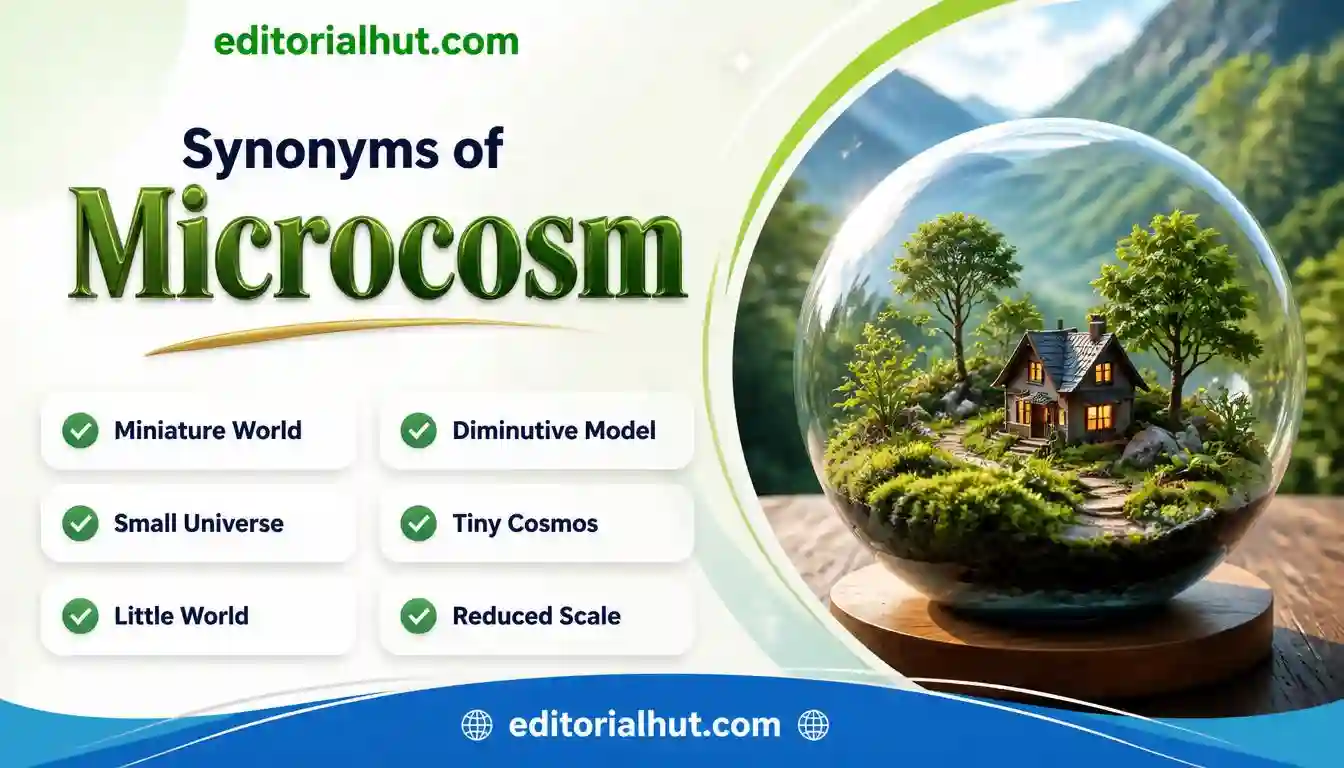
The best synonyms of microcosm include miniature world, small-scale representation, model, reflection, epitome, cross-section, and miniature. Each word expresses a slightly different idea, so the right choice depends on whether you are describing a smaller version of something, a representative sample, or a small system that reflects a larger one.
The word microcosm appears in literature, philosophy, education, science, and everyday communication. It can describe a classroom that reflects society, a garden that represents a larger ecosystem, or a small community that reveals broader social patterns. Understanding its synonyms helps you communicate these ideas with greater accuracy and variety.
In this guide, you will discover the meaning of microcosm, its most useful synonyms, important related terms, example sentences, word origins, and answers to frequently asked questions.
What Does Microcosm Mean?
Microcosm is a noun that describes a small system, place, group, or representation that reflects the characteristics of a much larger system or the world as a whole.
In simple words, a microcosm is a small world that represents a bigger world.
For example, a school can be a microcosm of society because it contains different personalities, social groups, rules, relationships, and challenges found in the wider community.
Definition: A small-scale representation of a larger system, society, or universe.
Part of speech: Noun
Pronunciation: MY-kroh-koz-um
Syllables: Mi-cro-cosm (3 syllables)
Example sentence: The university campus was a microcosm of modern society, bringing together people from different backgrounds and cultures.
Best Synonyms for Microcosm and Their Meanings
The following words are useful alternatives to microcosm. Although they share related meanings, some are more suitable than others depending on the context.
1. Miniature World
Meaning: A small version of a larger world or environment.
A miniature world is one of the closest descriptive alternatives to microcosm. It emphasizes the idea of a smaller environment that contains recognizable features of something much larger.
Example: The children’s museum created a miniature world where visitors could explore how a city works.
Best for: Describing small environments, fictional settings, and simplified versions of larger worlds.
2. Small-Scale Representation
Meaning: A reduced or limited representation of a larger system.
This phrase is particularly useful in academic writing, research, and explanations. It highlights how a smaller example can illustrate the characteristics of a larger subject.
Example: The neighborhood served as a small-scale representation of the country’s changing demographics.
Best for: Research papers, formal explanations, and analytical writing.
3. Model
Meaning: A representation of a system, structure, or process.
A model can demonstrate how something works or show the arrangement of a larger system. However, unlike a microcosm, it does not necessarily contain the real characteristics of the thing it represents.
Example: The laboratory used a simplified model of an ecosystem to explain how different species interact.
Best for: Science, education, engineering, and theoretical explanations.
4. Reflection
Meaning: Something that shows or expresses the qualities of another thing.
A reflection can reveal the characteristics, values, or problems of a larger group or society.
Example: The family drama became a reflection of the social changes affecting the entire community.
Best for: Social commentary, literature, and discussions of culture.
5. Epitome
Meaning: A perfect or highly representative example of a particular quality or type.
Epitome is useful when you want to emphasize that something embodies the essential qualities of a larger idea. However, it does not necessarily mean a small-scale system.
Example: The small town was considered the epitome of traditional rural life.
Best for: Descriptive writing, formal communication, and characterizing an ideal example.
6. Cross-Section
Meaning: A representative selection of people, things, or characteristics from a larger group.
A cross-section is especially useful when discussing a diverse population or a sample that reflects the wider community.
Example: The survey included a cross-section of residents from different age groups and occupations.
Best for: Sociology, journalism, surveys, and population studies.
7. Microcosm in Miniature
Meaning: A small representation that reproduces important features of a larger system.
This phrase emphasizes both the reduced scale and the presence of recognizable characteristics from the larger whole.
Example: The model village was a microcosm in miniature of the region’s traditional architecture and daily life.
Best for: Descriptive prose, educational exhibits, and detailed representations.
8. Mirror
Meaning: Something that reflects the characteristics or condition of another thing.
A mirror is a figurative alternative when a smaller group reveals the strengths, weaknesses, or behavior of a broader society.
Example: The workplace became a mirror of the country’s wider economic inequalities.
Best for: Essays, literary analysis, and social commentary.
9. Sample
Meaning: A portion selected to represent or provide information about a larger group.
A sample is often used in research and statistics. It can represent a broader population, although it does not automatically reproduce all the characteristics of a microcosm.
Example: The small coastal town provided a useful sample for studying regional tourism patterns.
Best for: Scientific research, surveys, and statistical analysis.
10. Self-Contained System
Meaning: A system that operates as a distinct or relatively independent unit.
This phrase can describe a small community or environment with its own relationships, rules, and processes. It emphasizes internal organization more than representation of a larger whole.
Example: The remote research station functioned as a self-contained system with its own routines and responsibilities.
Best for: Systems theory, organizational studies, and technical writing.
Microcosm Synonyms for Different Contexts
Choosing the best synonym depends on what you want to communicate. The following alternatives help you match the word to your intended meaning.
| Context | Best synonym or phrase | Why it works |
| Everyday English | Small world | Simple and accessible |
| Literature | Reflection | Emphasizes shared themes or qualities |
| Sociology | Cross-section | Highlights a representative group |
| Science | Model | Describes a representation of a system |
| Research | Representative sample | Focuses on a selected portion of a larger population |
| Philosophy | World in miniature | Expresses the idea of a small world reflecting a larger reality |
| Formal writing | Small-scale representation | Clearly describes the relationship between a part and a whole |
| Descriptive writing | Miniature world | Creates a vivid image of a smaller environment |
| Social analysis | Mirror of society | Emphasizes the reflection of broader social conditions |
| Systems analysis | Small-scale system | Focuses on the structure and behavior of a smaller system |
Formal and Academic Synonyms for Microcosm
In formal writing, it is important to select a replacement that preserves the original meaning rather than simply choosing a sophisticated word.
Here are several useful alternatives:
- Small-scale representation: A reduced representation of a larger system.
- Representative sample: A selected portion that reflects a larger population.
- Micro-level system: A system examined at a small or individual scale.
- Condensed representation: A shortened or compressed depiction of a larger subject.
- Miniature model: A reduced version of an object or system.
- Systemic reflection: A representation that reveals features of a broader system.
- Representative cross-section: A selection that reflects the variety within a larger group.
- Reduced-scale model: A smaller version of a structure or process.
Example: Instead of writing, “The village was a microcosm of the nation,” you could write, “The village offered a small-scale representation of the nation’s social structure.”
The alternative should match your intended emphasis. A model illustrates a system, while a microcosm often reflects the characteristics of a larger reality.
Simple Words to Use Instead of Microcosm
If you want an easier word or phrase, consider these alternatives:
- Small world: A simple expression for a smaller environment.
- Miniature: A smaller version of something.
- Model: A representation of an object, structure, or system.
- Example: A particular instance that illustrates a general idea.
- Sample: A portion taken from a larger group.
- Reflection: Something that shows similar qualities.
- Snapshot: A brief picture of a situation at a particular time.
- Little world: An informal expression for a small environment with its own characteristics.
Example: Instead of saying, “The classroom was a microcosm of society,” you could say, “The classroom was a little world that reflected society.”
With Detail
Miniature World
A miniature world is a small environment that reflects the features, activities, or relationships of a much larger world. It is one of the most descriptive alternatives to microcosm because it emphasizes how a small place or group can represent a broader reality.
For example, a school can be a miniature world because it brings together different personalities, cultures, social groups, rules, and relationships similar to those found in society. Likewise, a small village may reflect the traditions, challenges, and values of an entire region.
Example sentence: The university campus was a miniature world, reflecting the diversity and complexity of modern society.
Best used for: Literature, storytelling, social commentary, and descriptions of small communities that resemble larger environments.
Small-Scale Model 📘
A small-scale model is a reduced representation of a larger object, structure, process, or system. It allows people to examine something complicated in a smaller or more manageable form.
This phrase is useful when discussing science, education, architecture, and research. However, a small-scale model does not always represent the real-world relationships or characteristics of the larger system as fully as a microcosm does.
For example, a miniature city built for an urban planning project can show roads, buildings, and public spaces. If researchers use a small community to study broader social patterns, the term microcosm may be more appropriate.
Example sentence: The research team developed a small-scale model to demonstrate how the proposed transportation system would operate.
Best used for: Scientific explanations, engineering, architecture, education, and technical writing.
Miniature 📘
A miniature is a small version of an object, place, or structure. It emphasizes reduced size rather than the relationship between a small system and a larger world.
A miniature house, for instance, reproduces the appearance of a full-sized house on a smaller scale. A miniature garden may contain tiny plants, pathways, and decorative features that resemble a larger landscape.
Although miniature can sometimes replace microcosm, the words are not always interchangeable. Something can be miniature without representing the broader characteristics of a larger system.
Example sentence: The museum displayed a miniature castle with remarkably detailed towers and walls.
Best used for: Small replicas, models, decorative objects, toy structures, and descriptions of reduced-size environments.
Model
A model is a representation of an object, idea, process, or system. It may be physical, mathematical, conceptual, or digital. Models help people understand how something is structured or how it works.
The word is a possible synonym for microcosm when a smaller representation illustrates a larger system. However, a model may simplify or omit important characteristics, while a microcosm generally emphasizes the presence of meaningful features of the larger whole.
For example, a model of the solar system demonstrates the arrangement of planets, while a small community may function as a microcosm of society by reflecting broader social relationships.
Example sentence: The teacher used a model of the human heart to explain how blood circulates through the body.
Best used for: Science, education, research, planning, and explanations of complex systems.
Representation 📘
A representation is something that depicts, expresses, or stands for another thing. It can communicate the characteristics of an object, group, concept, or larger system without necessarily reproducing every detail.
This word is useful when a smaller group or setting illustrates a broader idea. For instance, a diverse classroom may provide a representation of the cultural differences found in a wider community.
However, representation is broader than microcosm. A photograph can be a representation of a city, but it is not necessarily a small system that reflects the city’s social structure.
Example sentence: The novel’s fictional town offered a compelling representation of the social tensions affecting the wider country.
Best used for: Academic writing, literature, media analysis, research, and discussions of how one thing portrays another.
Cross-Section 📘
A cross-section is a representative selection of people, objects, or characteristics drawn from a larger group. It is especially useful when describing diversity within a population or examining different parts of a community.
For example, a survey involving teachers, students, administrators, and parents may provide a cross-section of the school community. The selection gives researchers an opportunity to understand different perspectives within the larger group.
Unlike microcosm, which often describes a small system reflecting a larger one, cross-section emphasizes the range of people or characteristics included in a selection. A cross-section may be representative without reproducing the complete relationships of the larger system.
Example sentence: The documentary presented a cross-section of residents whose experiences reflected the challenges facing the city.
Best used for: Sociology, journalism, surveys, demographic research, and descriptions of diverse groups.
Snapshot 📘
A snapshot is a brief picture or account of a situation at a particular moment. It can be literal, such as a photograph, or figurative, such as a short description of a community’s economic or social conditions.
In some contexts, a snapshot can serve a similar purpose to a microcosm by illustrating broader patterns through a limited example. However, a snapshot usually emphasizes a particular moment or a brief overview rather than a complete, small-scale system.
For instance, a report describing one day’s activities at a busy hospital might provide a snapshot of the pressures experienced by the wider healthcare system.
Example sentence: The annual survey offered a snapshot of changing attitudes toward remote work.
Best used for: Journalism, reports, research summaries, social analysis, and descriptions of temporary situations.
Sample 📘
A sample is a portion of a larger group selected for observation, testing, or analysis. Samples help researchers study populations without examining every individual or item.
A sample can be similar to a microcosm when it reflects the characteristics of a larger group. For example, a carefully selected group of households may help researchers understand the spending habits of an entire region.
However, a sample does not necessarily reflect the larger population accurately. Its usefulness depends on how it was selected and whether it captures the relevant characteristics of the whole.
Example sentence: The researchers examined a sample of local businesses to identify trends affecting the national economy.
Best used for: Scientific studies, statistical analysis, surveys, market research, and academic writing.
Embodiment 📘
An embodiment is a person, object, or example that expresses or represents a particular quality, idea, or principle. It emphasizes the visible expression of an abstract characteristic rather than the structure of a smaller system.
For example, a community center may be described as an embodiment of cooperation if it demonstrates how people work together to support one another. Similarly, a character in a novel may embody the values or conflicts of a particular society.
Embodiment is a context-dependent alternative to microcosm. It works best when the focus is on how something expresses an idea or set of qualities, rather than how a small world reflects a larger one.
Example sentence: The small town became an embodiment of the resilience and community spirit that defined the wider region.
Best used for: Literature, philosophy, descriptive writing, cultural analysis, and discussions of abstract qualities expressed through real examples.
Microcosm Synonyms in Literature and Philosophy
In literature, a microcosm is often a small setting or group that reflects the themes, conflicts, and relationships of a larger society.
For example, a novel set in a single apartment building might explore inequality, friendship, cultural differences, and generational conflict. The building becomes a miniature world that reflects the larger community.
Useful literary alternatives include:
- Mirror of society: A setting or group that reflects social conditions.
- Reflection of the world: Something that reveals broader human experiences.
- World in miniature: A small setting that represents a larger reality.
- Microcosmic representation: A small-scale expression of a broader system.
- Condensed world: A setting that brings many wider experiences into a limited space.
In philosophy, microcosm is frequently discussed alongside macrocosm, the larger world or universe. The traditional microcosm–macrocosm relationship explores how a smaller entity may reflect, resemble, or correspond to a larger whole.
For instance, a philosophical discussion might examine whether human nature reflects patterns found in the wider universe.
Examples of Microcosm in Sentences
Understanding microcosm in context makes it easier to select the right synonym.
- The classroom was a microcosm of society, reflecting differences in personality, culture, and social background.
- The small island functioned as a miniature world with its own economy, traditions, and community relationships.
- The research team studied a representative sample of households to understand broader living conditions.
- The school play became a reflection of society, exploring themes of inequality and belonging.
- The science museum displayed a model of the solar system to help visitors understand planetary relationships.
- The neighborhood offered a small-scale representation of the city’s cultural diversity.
- The survey included a cross-section of workers from different industries.
- The isolated village was a self-contained system with distinct customs and local responsibilities.
- The novel’s small seaside town served as a mirror of the wider world, revealing universal human conflicts.
- The experimental garden provided a small-scale system for observing relationships between plants, insects, and soil.
These examples show that the most appropriate synonym depends on whether the sentence emphasizes resemblance, representation, sampling, or internal organization.
How to Choose the Right Synonym for Microcosm
Follow these simple guidelines when deciding which word to use.
A Choose a miniature world when you want to describe a small environment that resembles a larger one.
The Choose small-scale representation when writing a formal explanation about how a smaller subject reflects a broader system.
Choose a model when the main purpose is to demonstrate a structure, process, or theory.
A Choose a cross-section when describing a group that represents different parts of a larger population.
Choose reflection or mirror when discussing how a smaller setting reveals broader social, cultural, or human characteristics.
A Choose epitome when emphasizing a particularly representative or exemplary instance rather than a miniature system.
Choose a sample when referring to a portion of a population selected for examination.
Remember that synonyms are not always interchangeable. A microcosm typically combines the ideas of a small system and its relationship to a larger whole. Your replacement should preserve whichever of these ideas matters most.
Microcosm vs. Miniature vs. Model
These three words are related, but they have different meanings.
| Word | Main meaning | Example |
| Microcosm | A small system that reflects a larger one | A school reflecting society |
| Miniature | A reduced-size version of something | A miniature castle |
| Model | A representation used to explain, study, or demonstrate something | A model of a city |
A miniature castle is not automatically a microcosm because it may simply be a smaller object. A model of a city may demonstrate its layout without reflecting its real social relationships.
A microcosm is most appropriate when the smaller subject reveals meaningful characteristics of a larger system.
Origin and Etymology of Microcosm
The word microcosm comes from the Greek words mikros, meaning “small,” and kosmos, meaning “world” or “universe.”
The word developed through Latin and later European usage to describe a small world that corresponds to a larger one. It became particularly important in philosophical traditions exploring relationships between human beings, nature, and the universe.
The related word macrocosm combines the idea of something large with the concept of a world or universe. Together, microcosm and macrocosm express the contrast between a smaller entity and the greater whole.
Understanding this origin explains why a microcosm is more than just a small object: the word often suggests a meaningful relationship between the small and the large.
Connotation and Usage of Microcosm
The word microcosm generally has a neutral, analytical, or descriptive connotation. Its tone depends on the context in which it appears.
An academic writing, it can suggest a useful example for understanding a complicated system. The literature, it can make a small setting seem meaningful because it reflects universal experiences. In social commentary, it can reveal how problems in a small community resemble those in the wider world.
For example, describing a town as a microcosm of a country suggests that the town displays some of the country’s broader characteristics. It does not necessarily mean the town represents every part of the country perfectly.
The word is especially useful when you want to connect a specific example with a wider idea.
Frequently Asked Questions About Synonyms of Microcosm
1. What is the best synonym for microcosm?
Small-scale representation is one of the most useful alternatives in formal writing. Miniature world is a good descriptive choice when you want to emphasize a smaller environment that reflects a larger one.
2. What is another word for microcosm?
Other words and phrases for microcosm include miniature world, small-scale representation, model, reflection, cross-section, mirror, and representative sample. The best choice depends on the sentence.
3. What is a simple word for microcosm?
Small world is a simple, accessible alternative. You can also use miniature when referring to a smaller version of something, although the meanings are not identical.
4. What does microcosm mean in simple terms?
A microcosm is a small world or system that reflects the characteristics of something much larger. For example, a classroom can reflect the diversity and relationships found in society.
5. Is miniature a synonym for microcosm?
Miniature can be a synonym in some contexts, especially when describing a smaller version of a larger environment. However, a miniature does not always reflect the characteristics of the larger thing, whereas a microcosm usually does.
6. What is the difference between microcosm and macrocosm?
A microcosm is a small system or world that reflects a larger one. A macrocosm is the larger world or system itself. The terms are often used together in philosophical discussions about relationships between small and large systems.
7. What is an example of a microcosm?
A school can be a microcosm of society because it contains people with different backgrounds, interests, roles, and relationships. These features can resemble patterns found in the wider community.
8. How is microcosm used in a sentence?
Example: “The small coastal town was a microcosm of the country, reflecting its cultural diversity and economic challenges.”
In this sentence, microcosm explains how the town represents broader national characteristics.
9. What is a synonym for microcosm in literature?
Mirror of society, miniature world, and reflection of the wider world are useful alternatives in literary analysis. They describe settings or groups that reveal broader human experiences or social conditions.
10. Is microcosm a noun or an adjective?
Microcosm is a noun. The related adjective is microcosmic, which describes something that represents or resembles a larger system on a smaller scale.
11. What is the opposite of microcosm?
There is no single perfect opposite in every context. Macrocosm is the closest conceptual counterpart because it refers to the larger world or system. Large-scale system may also work in ordinary writing.
12. When should I use microcosm instead of model?
Use microcosm when a smaller system reflects characteristics of a larger one. Use model when the main idea is to represent, explain, or demonstrate a structure or process. A model does not always reproduce the real-world characteristics of the system it represents.
Conclusion
The best synonyms of microcosm include miniature world, small-scale representation, model, reflection, cross-section, mirror, and representative sample. Each alternative highlights a different aspect of the original word, from resemblance and representation to sampling and system structure.
For everyday English, the small world is easy to understand. A formal writing, small-scale representation is often precise. For literature and social analysis, reflection or mirror of society may communicate the intended idea more effectively.
Ultimately, choosing the right synonym means understanding how a smaller subject relates to a larger whole. When that relationship is central to your meaning, microcosm remains a distinctive and valuable word.

Shahid Imran is an English language and vocabulary specialist at EditorialHut.com, focusing on synonyms, word meanings, alternative words, and practical example sentences. He helps readers discover better words, expand their vocabulary, and communicate more clearly and confidently.