







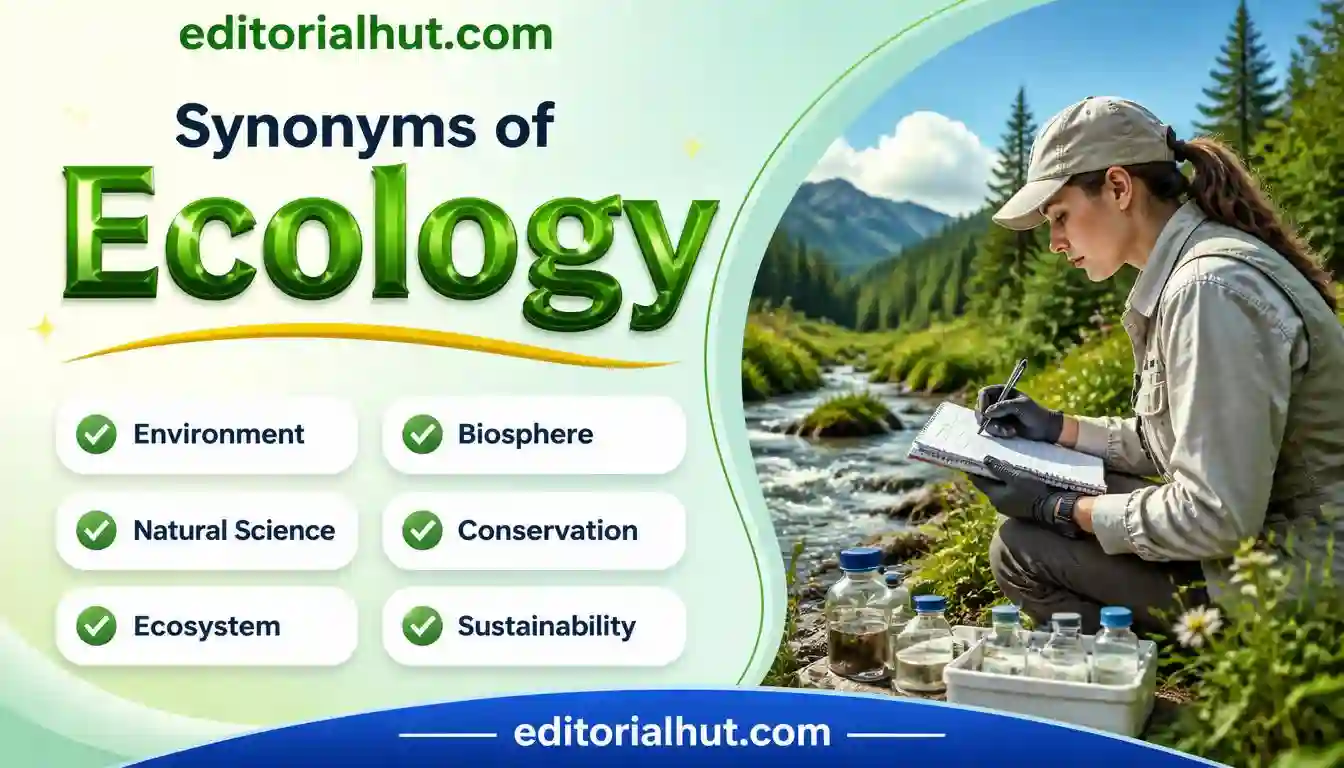
Ecology is the scientific study of how living organisms interact with one another and with their surroundings. When looking for synonyms for ecology you may need a word for an academic paper, a school assignment, an environmental article or a professional discussion about nature. The best alternative Synonym for ecology depends on the context because ecology has a specific scientific meaning that many related environmental words do not fully capture.
Words such as environmental science and environmental biology can work in certain contexts. Terms such as ecosystem studies and conservation science are also useful when discussing particular aspects of ecology. However these expressions are not always interchangeable with the original word.
This guide explains the closest alternatives, their meanings and differences along with pronunciation word origins, natural examples and practical tips for choosing the right term.
Quick Answer: What Are the Best Synonyms for Ecology?
The closest alternatives to ecology include environmental biology Synonym for ecology and ecological science in suitable scientific contexts. Environmental science is a broader term while ecosystem studies emphasizes relationships within ecosystems.
- Closest scientific alternative: Ecological science
- Best broader alternative: Environmental science
- Best biology-focused alternative: Environmental biology
- Best for ecosystem relationships: Ecosystem studies
- Best for protecting nature: Conservation science
- Best for everyday writing: The study of nature and living things
There is no perfect substitute for ecology in every sentence. Choose a term that preserves the meaning you intend.
Synonyms for Ecology: A Comparison of Useful Alternatives
| Alternative | Meaning | Relationship to Ecology | Best Use |
| Ecological science | Scientific study of ecological relationships | Very close alternative | Scientific writing |
| Environmental biology | Study of how organisms interact with their environments | Close but biology-focused | Biology papers |
| Environmental science | Study of environmental systems and issues | Broader related field | Education and research |
| Ecosystem studies | Study of ecosystems and their processes | Context-specific alternative | Ecosystem research |
| Ecosystem science | Scientific investigation of ecosystem structure and function | Closely related term | Academic writing |
| Biological ecology | Study of organisms and their ecological relationships | Closely related expression | Biology discussions |
| Conservation science | Research supporting the protection of species and habitats | Related specialized field | Wildlife protection |
| Environmental studies | Broad study of environmental issues including social and scientific aspects | Broader field | School and university courses |
| Population biology | Study of biological populations | Related subfield | Population research |
| Community ecology | Study of interactions among species in a community | Specific branch of ecology | Biodiversity research |
| Landscape ecology | Study of ecological patterns across landscapes | Specific branch of ecology | Land management |
| Marine ecology | Study of relationships in marine environments | Specific branch of ecology | Ocean research |
| Forest ecology | Study of forest organisms and processes | Specific branch of ecology | Forest management |
| Aquatic ecology | Study of freshwater and other aquatic ecosystems | Specific branch of ecology | Water environments |
| Terrestrial ecology | Study of land-based ecosystems | Specific branch of ecology | Land ecosystems |
| Ecosystem research | Research into ecosystem structure and function | Descriptive alternative | Reports and research |
| Ecological research | Research into ecological processes | Close contextual alternative | Academic papers |
| Environmental research | Research into environmental conditions and problems | Broader alternative | Environmental reports |
| Nature studies | Study of nature and natural processes | Informal broad expression | General education |
Important distinction: These alternatives have different scopes. Some refer to ecology itself while others name specific branches of ecology or neighboring disciplines. For formal scientific writing the original term may remain the most accurate choice.
What Does Ecology Really Mean?
Ecology is a branch of biology that examines relationships between organisms and their living and nonliving environments. It explores how plants, animals, microorganisms , water soil air and climate influence one another.
For example an ecologist might investigate how rising temperatures affect a forest how predators influence animal populations or how pollution changes the health of a lake.
Ecology operates at several levels:
- Organism: How an individual living thing responds to its environment.
- Population: How members of one species interact in a particular area.
- Community: How different species interact with one another.
- Ecosystem: How organisms interact with each other and with nonliving elements.
- Biosphere: How life interacts with the environments across Earth.
The word is a noun. Its plural form is ecologies which can refer to different ecological systems or particular environmental contexts.
Denotation and Connotation of Ecology
The denotation of ecology is the scientific study of relationships between organisms and their environments.
Its connotations often include nature biodiversity, environmental balance sustainability and the protection of wildlife. These associations are common but they do not define the full scientific meaning of the term.
Ecology itself is neutral. It describes a field of study rather than automatically expressing support for a particular environmental policy or movement.
List of Synonyms (Synonym for ecology)
The following words and phrases can help you choose a more precise expression for research, writing education and everyday communication.
1. Ecological Science
Meaning: The scientific study of organisms and their relationships with the environment.
Difference: This is one of the closest alternatives to ecology. It emphasizes the scientific nature of the discipline.
Tone: Formal and academic.
Best Use: Scientific reports and educational materials.
Example: Ecological science helps researchers understand how drought changes plant communities.
2. Environmental Biology
Meaning: The study of how living organisms interact with environmental conditions.
Difference: This phrase emphasizes biological processes. Its scope may overlap with ecology without covering every ecological topic.
Tone: Scientific and professional.
Best Use: Biology classes and research papers.
Example: Environmental biology examines how water pollution affects aquatic organisms.
3. Environmental Science
Meaning: An interdisciplinary field that studies the natural environment and environmental problems.
Difference: Environmental science is broader than ecology because it can include chemistry geology physics and human influences.
Tone: Academic and professional.
Best Use: Environmental policy reports and university courses.
Example: Environmental science combines several disciplines to investigate climate change.
4. Ecosystem Studies
Meaning: The investigation of ecosystems and the relationships operating within them.
Difference: This expression focuses on ecosystems rather than every level of ecological organization.
Tone: Neutral and academic.
Best Use: Research on forests wetlands lakes and other ecosystems.
Example: Ecosystem studies reveal how nutrient cycles influence wetland health.
5. Ecosystem Science
Meaning: The scientific study of ecosystem structure function and change.
Difference: It often emphasizes energy flows nutrient cycling and interactions among organisms and their physical surroundings.
Tone: Technical and scientific.
Best Use: Environmental research and ecosystem management.
Example: Ecosystem science helps explain how forests store carbon.
6. Biological Ecology
Meaning: A phrase emphasizing the biological study of organisms in their environments.
Difference: It is closely related to ecology but is less common than the simple term ecology in many contexts.
Tone: Academic.
Best Use: Explanatory writing where the biological perspective needs emphasis.
Example: Biological ecology examines how competition affects the survival of different species.
7. Conservation Science
Meaning: The scientific study of methods for protecting biodiversity species and natural habitats.
Difference: Conservation science focuses on understanding and addressing threats to nature. Ecology can also study systems without directly focusing on conservation.
Tone: Professional and research-oriented.
Best Use: Wildlife protection and habitat restoration.
Example: Conservation science guides efforts to protect endangered animals.
8. Environmental Studies
Meaning: An interdisciplinary field examining environmental issues from scientific social political and economic perspectives.
Difference: It is broader than ecology and may include human behavior environmental law and public policy.
Tone: Academic and accessible.
Best Use: University programs and environmental policy discussions.
Example: Environmental studies explores how communities respond to water shortages.
9. Population Biology
Meaning: The study of biological populations and the processes affecting their size and structure.
Difference: It focuses on populations rather than all relationships between organisms and their environments.
Tone: Technical.
Best Use: Wildlife population research and species management.
Example: Population biology helps researchers estimate how rapidly a threatened species may decline.
10. Community Ecology
Meaning: The study of interactions among species living in the same area.
Difference: It is a specific branch of ecology rather than a complete replacement for the entire discipline.
Tone: Scientific.
Best Use: Research on competition predation and mutualism.
Example: Community ecology explains how the arrival of a new predator can change a local food web.
11. Landscape Ecology
Meaning: The study of ecological patterns and processes across connected or fragmented landscapes.
Difference: It emphasizes spatial patterns and relationships among habitats.
Tone: Technical and professional.
Best Use: Land planning habitat connectivity and conservation.
Example: Landscape ecology helps planners identify corridors that allow wildlife to move between forests.
12. Marine Ecology
Meaning: The study of relationships among organisms and their marine environments.
Difference: It is limited to marine systems rather than all environments.
Tone: Scientific.
Best Use: Ocean research and marine conservation.
Example: Marine ecology investigates how warmer ocean water affects coral reef communities.
13. Forest Ecology
Meaning: The study of organisms and ecological processes within forests.
Difference: It concentrates on forest systems and their distinctive conditions.
Tone: Scientific and practical.
Best Use: Forestry biodiversity research and forest restoration.
Example: Forest ecology examines how tree diversity influences ecosystem resilience.
14. Aquatic Ecology
Meaning: The study of relationships among organisms and their aquatic environments.
Difference: It focuses on water-based ecosystems including freshwater and marine environments.
Tone: Scientific.
Best Use: Water quality research and aquatic habitat management.
Example: Aquatic ecology helps explain how excess nutrients contribute to algal blooms.
15. Terrestrial Ecology
Meaning: The study of ecological relationships in land-based environments.
Difference: It focuses on terrestrial systems such as grasslands deserts and forests rather than aquatic environments.
Tone: Technical.
Best Use: Land conservation and habitat research.
Example: Terrestrial ecology examines how changing rainfall affects grassland species.
16. Ecosystem Research
Meaning: Research into how ecosystems operate and respond to change.
Difference: This is a descriptive phrase for research activity rather than the name of a complete scientific discipline.
Tone: Neutral and professional.
Best Use: Research summaries and project descriptions.
Example: Ecosystem research can reveal how soil changes influence plant growth.
17. Ecological Research
Meaning: Scientific investigation of ecological relationships and processes.
Difference: This phrase describes the work being conducted rather than the field itself.
Tone: Formal.
Best Use: Academic reports and research proposals.
Example: Ecological research identified a decline in pollinator activity across the study area.
18. Environmental Research
Meaning: Investigation of environmental conditions and the processes affecting them.
Difference: It is broader than ecology and can include pollution chemistry atmospheric science and environmental engineering.
Tone: Professional.
Best Use: Environmental assessments and scientific reports.
Example: Environmental research examined the effects of industrial waste on nearby waterways.
19. Nature Studies
Meaning: A broad expression for learning about nature and natural processes.
Difference: It is less precise and less technical than ecology.
Tone: Informal and educational.
Best Use: Children’s education and introductory learning materials.
Example: Nature studies introduced students to local birds insects and plants.
20. Study of Living Systems
Meaning: An explanatory phrase for investigating living organisms and how they interact with their surroundings.
Difference: It is not a fixed technical synonym. Its meaning depends on the context and may include biological topics beyond ecology.
Tone: Accessible and descriptive.
Best Use: General explanations for readers unfamiliar with scientific terminology.
Example: The course explores the study of living systems in forests and freshwater habitats.
21. Habitat Studies
Meaning: The investigation of habitats and the conditions they provide for organisms.
Difference: It focuses on places where organisms live rather than the full range of ecological interactions.
Tone: Scientific and practical.
Best Use: Wildlife surveys and habitat assessment.
Example: Habitat studies showed that the wetland provided shelter for several bird species.
22. Biodiversity Science
Meaning: The scientific study of biological diversity and the processes that maintain or reduce it.
Difference: Biodiversity science overlaps with ecology but can also draw on genetics evolution and other disciplines.
Tone: Academic.
Best Use: Biodiversity monitoring and species conservation.
Example: Biodiversity science helps explain why diverse habitats can support many forms of life.
23. Biogeography
Meaning: The study of the geographic distribution of organisms through space and time.
Difference: Biogeography emphasizes where species live and how their distributions develop. Ecology often focuses more directly on interactions and processes.
Tone: Scientific.
Best Use: Research on species ranges migration and geographic patterns.
Example: Biogeography helps researchers understand why certain plant species occur only in particular regions.
24. Environmental Biology Research
Meaning: Research into biological processes affected by environmental conditions.
Difference: This is a descriptive phrase rather than a standard one-word synonym. It emphasizes biological investigation within environmental contexts.
Tone: Formal and technical.
Best Use: Scientific reports and research project descriptions.
Example: Environmental biology research investigated how heavy metals affect freshwater plants.
25. Study of Ecosystems
Meaning: The investigation of interactions between organisms and their physical surroundings within ecosystems.
Difference: This plain-language expression closely reflects an important part of ecology but does not always communicate the entire breadth of the discipline.
Tone: Neutral and accessible.
Best Use: School assignments and explanations for general readers.
Example: The study of ecosystems helps students understand the connections between soil plants, insects and birds.
Formal and Academic Alternatives to Ecology
When writing a university assignment or scientific report the right alternative should preserve the original meaning.
- Ecological science: Best when emphasizing the scientific discipline.
- Environmental biology: Useful when discussing organisms and environmental conditions.
- Ecosystem science: Suitable for ecosystem processes and functions.
- Community ecology: Appropriate when studying interactions among species.
- Environmental science: Best when the discussion extends beyond biology into physical sciences and human activities.
- Biogeography: Useful when the main subject is the distribution of organisms across geographic areas.
Examples in Academic Writing
Original: The research explores ecology in tropical forests.
Alternative: The research explores forest ecology in tropical forests.
Original: Ecology helps scientists understand environmental changes.
Alternative: Ecological science helps scientists understand changes in relationships between organisms and their environments.
Original: The university offers a course in ecology.
Alternative: The university offers a course in environmental science.
The final example changes the meaning slightly because environmental science covers more than ecology alone.
Casual and Easy-to-Understand Alternatives
For general audiences of synonym for ecology a simple explanation may work better than a technical term.
- Study of nature: A broad expression for learning about natural systems.
- Study of ecosystems: A clear phrase for understanding how ecosystems work.
- Environmental science: A familiar educational term.
- Study of living things and their surroundings: An accessible explanation of ecology.
- Nature studies: A general educational expression rather than a precise scientific equivalent.
For example instead of writing “Ecology examines interactions between organisms and abiotic factors” you could write “Ecology studies how living things interact with one another and with their surroundings.”
The second version communicates the same central idea in simpler language.
Ecology vs. Environmental Science vs. Ecosystem Science
These terms overlap but have different meanings.
| Word | Main Focus | Scope |
| Ecology | Relationships between organisms and their environments | A branch of biology |
| Environmental science | Environmental systems and environmental problems | Interdisciplinary |
| Ecosystem science | Ecosystem structure processes and functioning | Focused on ecosystems |
| Conservation science | Protecting biodiversity and natural resources | Applied and multidisciplinary |
| Environmental studies | Environmental issues including social and policy dimensions | Broad and interdisciplinary |
| Biogeography | Geographic distribution of organisms | Focused on spatial patterns |
Which words are interchangeable?
Ecology and ecological science are the closest alternatives in many contexts. Ecosystem science can work when the topic concerns ecosystem processes. Environmental science is suitable when the subject includes pollution climate or other broader environmental issues.
Conservation science is not a direct replacement for ecology because conservation has a more specific purpose.
Sentence Transformations Using Ecology Synonyms
Choosing a replacement can improve precision or make a sentence easier to understand.
Example 1: Scientific Writing
Original: Ecology explains how species interact within a habitat.
Revised: Community ecology explains how species interact within a habitat.
Difference: The revised sentence is more specific because community ecology focuses on interactions among species.
Example 2: Environmental Research
Original: The project focuses on ecology and pollution.
Revised: The project focuses on environmental science and pollution.
Difference: The revised version suggests a broader investigation that may include chemical and physical processes.
Example 3: Forest Research
Original: The team studies ecology in woodland areas.
Revised: The team studies forest ecology.
Difference: The revised sentence is more concise and identifies the particular environment being studied.
Example 4: General Education
Original: Children learn about ecology at school.
Revised: Children learn how living things interact with their surroundings at school.
Difference: The revised version explains the concept instead of relying on scientific terminology.
Example 5: Wildlife Protection
Original: Ecology supports efforts to protect endangered species.
Revised: Conservation science supports efforts to protect endangered species.
Difference: The revised version emphasizes the practical application of scientific knowledge to species protection.
Best Alternative to Ecology by Situation
| If You Want to… | Choose… |
| Preserve the scientific meaning | Ecological science |
| Discuss biology and environmental conditions | Environmental biology |
| Cover broad environmental problems | Environmental science |
| Study ecosystem processes | Ecosystem science |
| Focus on interactions among species | Community ecology |
| Investigate forests | Forest ecology |
| Research oceans | Marine ecology |
| Discuss species distribution | Biogeography |
| Focus on wildlife protection | Conservation science |
| Explain the concept to children | Study of living things and their surroundings |
| Describe research activity | Ecological research |
| Discuss habitats | Habitat studies |
Common Collocations and Natural Phrases
Synonym for ecology frequently appears with words that describe research methods scientific concepts and environmental relationships.
Common Adjective Combinations
- Marine ecology: The study of marine organisms and their environments.
- Forest ecology: The study of ecological relationships in forests.
- Urban ecology: The study of ecological processes in urban environments.
- Human ecology: The study of relationships between humans and their environments.
- Landscape ecology: The study of ecological patterns across landscapes.
- Behavioral ecology: The study of how behavior relates to ecological conditions and evolutionary pressures.
- Chemical ecology: The study of how chemical interactions influence organisms and their relationships.
Common Verb Combinations
- Study ecology
- Research ecology
- Teach ecology
- Understand ecology
- Apply ecological principles
- Examine ecological relationships
- Investigate ecological processes
- Protect ecological diversity
- Monitor ecological changes
Natural Academic Phrases
- Principles of ecology
- Ecology of a forest
- Ecology of freshwater systems
- Ecological balance
- Ecological interactions
- Ecological relationships
- Ecological processes
- Ecological communities
- Ecological research methods
- Ecological consequences
These combinations are useful when expanding vocabulary without replacing the original word unnecessarily.
Word Formation of Ecology
The word ecology entered English through scientific terminology based on the Greek word oikos meaning “household” or “home” and -logia meaning a study or account.
The modern term describes the study of organisms in their natural home or environment.
Related word forms include:
- Ecology: A noun referring to the scientific field.
- Ecologist: A noun for a person who studies ecology.
- Ecological: An adjective describing something related to ecology.
- Ecologically: An adverb describing something in ecological terms.
- Ecologies: The plural form of ecology.
Affixation Pattern
The word ecology is historically formed from Greek elements rather than by simply adding a modern English prefix or suffix to an English base.
A useful simplified pattern is:
Greek oikos + Greek -logia → ecology
The related word ecological uses the suffix -ical to form an adjective. The word ecologist uses -ist to identify a person associated with the field.
Syllables in Ecology
The word ecology has four syllables:
e-col-o-gy
The stress falls on the second syllable: e-COL-o-gy.
Pronunciation of Ecology
- US IPA: /iˈkɑːlədʒi/
- UK IPA: /iˈkɒlədʒi/
The main difference is the vowel sound in the stressed syllable. American English generally uses the vowel heard in father while British English commonly uses the vowel heard in lot.
Etymology and Short History of Ecology
Synonym for ecology Ecology derives from Greek elements associated with the home and the study of a subject. German biologist Ernst Haeckel introduced the term Ökologie in 1866 to describe the study of relationships between organisms and their environments.
The term later became established in English scientific writing. As biological research developed, ecology expanded to cover populations, communities, ecosystems and the biosphere.
Today the discipline includes areas such as urban ecology marine ecology behavioral ecology and landscape ecology. Its applications range from studying natural processes to understanding biodiversity loss and helping manage ecosystems.
Common Mistakes When Using Ecology Synonyms
Treating Environmental Science as an Exact Synonym
Environmental science includes ecology but also covers subjects such as environmental chemistry and atmospheric science. Use the broader term only when it matches the subject.
Confusing Ecology With Environmentalism
Ecology is a scientific discipline. Environmentalism is a movement or set of beliefs concerned with protecting the environment. The terms are related but not interchangeable.
Using Conservation Science for Every Ecological Topic
Conservation science emphasizes protecting biodiversity and natural resources. Ecology also investigates processes that are not directly related to conservation.
Using Biogeography When You Mean Ecology
Biogeography focuses on the geographic distribution of organisms. It may explain where species occur but it does not cover every ecological relationship.
Replacing a Precise Scientific Term With a Vague Phrase
“Nature studies” can be useful for general audiences but may be too broad for a scientific paper. In academic writing choose a term that identifies the actual research subject.
Assuming Every Related Term Is a Synonym
Marine ecology forest ecology and community ecology are specialized branches of ecology. They should replace the general term only when the narrower focus is appropriate.
Antonyms of Ecology
Ecology does not have a direct antonym because it names a scientific field rather than a quality with an opposite meaning.
Some expressions contrast with particular ecological concepts but they are not true opposites of ecology itself.
- Habitat destruction: The damaging or removal of natural habitats.
- Environmental degradation: The deterioration of environmental quality.
- Ecosystem disruption: A disturbance that changes an ecosystem’s structure or functioning.
- Biodiversity loss: A reduction in the variety of living organisms.
These terms describe environmental problems that ecologists may study. They do not mean the opposite of ecology.
Frequently Asked Questions About Synonyms for Ecology
What is the closest synonym for ecology?
Ecological science is one of the closest alternatives. It refers to the scientific study of relationships between organisms and their environments.
What is another word for ecology?
Environmental biology is a useful alternative in biology-focused contexts. Environmental science is another option when the subject covers broader environmental processes.
What is a formal synonym for ecology?
Ecological science is suitable for formal writing. Ecosystem science is appropriate when the discussion specifically concerns how ecosystems function.
Is environmental science the same as ecology?
No. Ecology is a branch of biology that studies relationships between organisms and their environments. Environmental science is broader and includes several scientific disciplines.
What is a simpler way to say ecology?
You can say “the study of how living things interact with their surroundings.” This phrase explains the concept clearly without relying on technical vocabulary.
What is the difference between ecology and conservation science?
Ecology investigates relationships and processes in nature. Conservation science applies scientific knowledge to protecting species habitats and biodiversity.
Is ecosystem science a synonym for ecology?
It is a closely related term. Ecosystem science focuses on the structure and functioning of ecosystems while ecology has a broader scope.
What is the adjective form of ecology?
The adjective is ecological. For example “ecological research” refers to research involving ecological processes or relationships.
What is the plural of ecology?
The plural is ecology. It can refer to different ecological systems or contexts in which organisms interact with their surroundings.
What is the opposite of ecology?
Ecology has no direct antonym. Terms such as environmental degradation and habitat destruction describe environmental problems rather than opposites of the scientific discipline.
Final Takeaway
The best synonym for ecology depends on the subject and the level of precision you need. Ecological science is a close alternative while environmental science covers a wider range of topics. Ecosystem science works well for research on ecosystem processes and conservation science is more appropriate when the focus is protecting wildlife and biodiversity.
For scientific papers preserve the precise meaning of the original term. Synonym for ecology For general audiences a clear phrase such as “the study of how living things interact with their surroundings” may communicate the idea more effectively.

Shahid Imran is an English language and vocabulary specialist at EditorialHut.com, focusing on synonyms, word meanings, alternative words, and practical example sentences. He helps readers discover better words, expand their vocabulary, and communicate more clearly and confidently.