








Looking for synonyms for cursed? The word covers more ground than most people realize. It can describe a ring touched by an ancient spell, a week of terrible luck, or a photo that feels strangely wrong online.
Each meaning calls for a different replacement. Damned sounds serious, jinxed sounds playful, and accursed sounds like a gothic novel. Picking the wrong one can quietly change the tone of your sentence completely.
This guide sorts the best alternatives by meaning, tone and situation, with clear meanings and real examples, so you can choose the right word that fits your writing with confidence.
Quick Answer
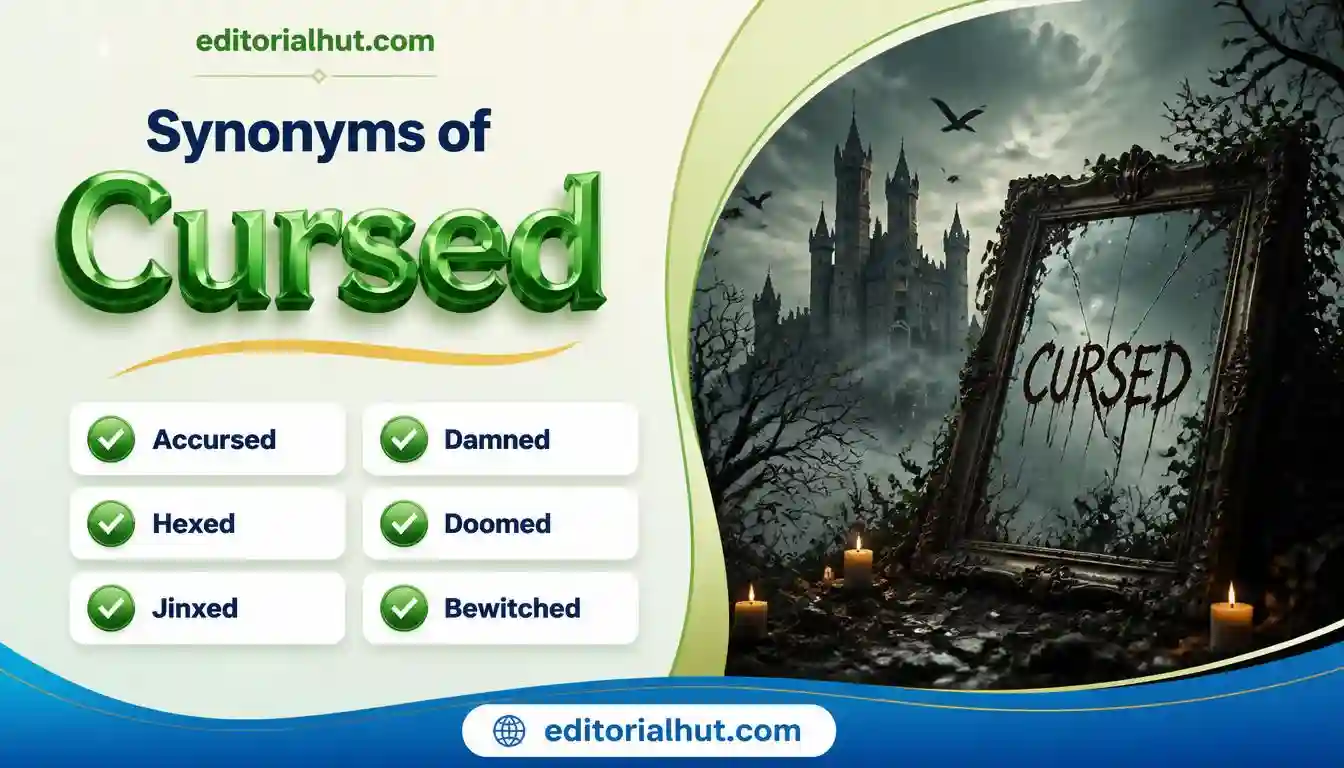
The closest synonyms for cursed are damned, doomed, jinxed, hexed and accursed.
- Best general replacement: damned (serious) or jinxed (light)
- Formal or literary: accursed, ill-fated, ill-starred
- Casual: jinxed, unlucky, hexed
- Annoying meaning: blasted, confounded, wretched
- Opposite: blessed
Cursed is not a single idea. Some alternatives mean “under a supernatural curse.” Others only mean “very unlucky.” A few simply mean “annoying.”
Core Word List
| Alternative | Meaning | Relationship | Tone | Best Use |
| Damned | Condemned by fate or God | Close synonym | Serious and strong | Dark fiction and religion |
| Accursed | Under a curse | Exact synonym | Formal and literary | Myth and gothic writing |
| Hexed | Put under a spell | Close synonym | Playful or magical | Fantasy and casual speech |
| Jinxed | Marked by bad luck | Near synonym | Casual | Everyday bad luck |
| Doomed | Certain to fail or suffer | Near synonym | Grim | Plans and fates |
| Ill-fated | Destined for misfortune | Near synonym | Formal | Journeys and stories |
| Ill-starred | Born under a bad star | Near synonym | Literary | Lovers and voyages |
| Unlucky | Having bad luck | Weak alternative | Neutral | Everyday speech |
| Bewitched | Under a witch’s spell | Contextual alternative | Old-fashioned | Folk tales |
| Haunted | Troubled by spirits | Contextual alternative | Eerie | Places and objects |
| Blighted | Damaged by a harmful force | Contextual alternative | Formal | Hopes and places |
| Blasted | Annoying or hateful | Meaning-specific alternative | Dated and mild | Irritation |
The relationship column matters most here. “Unlucky” and “cursed” are not equal. Unlucky suggests chance. Cursed suggests a cause that is hidden and often supernatural.
What Does “Cursed” Really Mean?
Cursed is an adjective. It comes from the verb curse and describes something under a curse. A curse is a wish or spell that brings harm.
The Supernatural Meaning
This is the oldest sense. A person or object carries a spell that brings suffering. The ring was cursed and everyone who wore it fell ill.
The Bad Luck Meaning
Here nothing magical has to happen. People say it jokingly. I must be cursed because my phone dies every time I need it. The tone is light and a little dramatic.
The Annoying Meaning
This meaning is older. It works as an intensifier for something hateful. I can’t find that cursed key. Modern speakers now use words like or “darn” for the same job.
The Internet Meaning
On social media a cursed image or object is one that feels eerie or wrong. Think of a badly lit photo with odd details. The word here means “unsettling” and has nothing to do with spells. Good alternatives are uncanny, eerie and disturbing.
Connotative Meaning
The dictionary meaning is simple: harmed by a curse. The feeling is stronger. Cursed implies that bad things were put there on purpose. Unlucky implies bad things happen by accident.
That difference gives the word emotional weight. Cursed suggests helplessness. The victim did not cause the problem and cannot easily fix it. In formal writing it sounds dramatic. In casual speech it can sound funny because people use it to exaggerate small troubles.
Word Formation
Cursed is built from the base word curse plus the ending -ed. The ending makes a past participle. English then lets that participle work as an adjective. Grammarians call this participial adjective formation.
Affixation Pattern
The pattern is Root + Suffix.
- Root: curse
- Suffix: -ed
There is no prefix. The related word accursed adds the prefix a- to the same base.
Syllables
As an adjective cursed has two syllables: curs-ed.
As a verb form (she cursed loudly) it has one syllable and sounds like “curst.”
Pronunciation
- Adjective, US IPA: /ˈkɝːsɪd/
- Adjective, UK IPA: /ˈkɜːsɪd/
- Verb form, US IPA: /kɝːst/
- Verb form, UK IPA: /kɜːst/
The difference is mainly the “r” sound. Americans pronounce it. Many British speakers do not. The adjective and the verb form are not pronounced the same way, and that is a common trap for learners.
Etymology
Curse goes back to Old English curs for the noun and cursian for the verb. Its deeper origin is uncertain. Scholars have not agreed on a source, so any firm claim about it would be a guess. The adjective cursed grew from the past participle of the verb and has been in English for many centuries.
Short History
Early uses were religious. A curse was an official act of condemnation, sometimes pronounced by a church. Over time the word spread to folk magic and then to general misfortune. By the modern era people used it for comic bad luck. The internet then added the eerie sense.
Synonyms Grouped by Meaning
For Supernatural Curses
Accursed is the closest exact synonym. It feels old and literary.
Hexed sounds lighter and fits fantasy settings.
Bewitched points to a witch specifically. It does not cover other kinds of curses.
For Bad Luck
Jinxed is the natural casual choice. The team felt jinxed after three straight losses.
Ill-fated works well in formal writing. The ill-fated expedition never returned.
Unlucky is the simplest word. It lacks the dark weight of cursed.
For Doom and Ruin
Doomed looks forward. It says failure is certain.
Damned adds moral or religious force.
Blighted describes something already damaged. A blighted neighborhood.
For Annoyance
Blasted and confounded are dated but still readable. Today most people would say “damn”
For the Internet Sense
Uncanny fits a thing that looks almost normal but not quite.
Eerie fits an image that feels haunting.
Unsettling works in neutral writing.
Key Alternatives Explained
Damned
It means condemned. Damned is stronger than cursed in most settings because it implies final judgment. The damned souls wandered the shore. In casual speech it works as a mild swear word.
Accursed
This is cursed with a formal coat. It suits gothic novels and old myths. In plain writing it can sound theatrical.
Jinxed
Jinxed says bad luck is following a person. A jinx can also be caused by a careless comment. I said we would win and now we are jinxed. It almost never means real magic.
Doomed
Doomed tells the reader how things will end. Cursed tells the reader why things go wrong. The two often appear together. A cursed and doomed voyage.
Ill-starred
It sounds poetic. It comes from the old belief that stars shaped a person’s fate. Use it for lovers or voyages in elevated prose.
Haunted
Haunted points to spirits. A haunted house is not always cursed. A cursed house might simply bring bad luck to its owners with no ghost at all.
15 Synonyms for Cursed Explained
Accursed
Meaning: Under a curse or marked for harm.
Tone: Formal and literary.
Best use: Gothic fiction, myths and dramatic storytelling.
Example: The accursed castle stood empty for two hundred years.
Damned
Meaning: Condemned to suffering by fate or divine judgment.
Tone: Serious and strong.
Best use: Dark fiction and religious or moral themes.
Example: The damned crew sailed on with no hope of rest.
Hexed
Meaning: Put under a spell meant to cause harm.
Tone: Playful or magical.
Best use: Fantasy writing and joking talk about bad luck.
Example: My garden is hexed because every plant I buy dies.
Jinxed
Meaning: Followed by bad luck that seems to have a cause.
Tone: Casual and light.
Best use: Everyday mishaps and sports.
Example: The team felt jinxed after losing five games in a row.
Doomed
Meaning: Certain to fail or suffer.
Tone: Grim and final.
Best use: Plans and journeys with a bleak outcome.
Example: The mission was doomed from the moment the engine failed.
Ill-fated
Meaning: Destined for misfortune.
Tone: Formal and neutral.
Best use: News writing and history.
Example: The ill-fated ship sank on its first voyage.
Ill-starred
Meaning: Born under an unlucky star.
Tone: Poetic and old-fashioned.
Best use: Literary prose about love or travel.
Example: Their ill-starred romance ended before spring.
Star-crossed
Meaning: Kept apart or ruined by fate.
Tone: Romantic and tragic.
Best use: Love stories.
Example: The star-crossed pair never met again.
Bewitched
Meaning: Under the control of a witch’s spell.
Tone: Old-fashioned and magical.
Best use: Folk tales and fantasy.
Example: The bewitched mirror showed only sorrow.
Blighted
Meaning: Damaged or ruined by a harmful force.
Tone: Formal and heavy.
Best use: Hopes and places that suffered long decline.
Example: The blighted town never recovered from the floods.
Haunted
Meaning: Troubled by spirits or lingering memories.
Tone: Eerie and emotional.
Best use: Houses and objects with a ghostly feel. It also suits people tormented by the past.
Example: She lived in a haunted cottage by the sea.
Condemned
Meaning: Sentenced to a bad fate or declared unfit.
Tone: Stern and formal.
Best use: Legal contexts and serious fiction.
Example: The condemned village was left to crumble.
Unlucky
Meaning: Having bad luck by chance.
Tone: Neutral and plain.
Best use: Everyday speech when no hidden cause is implied.
Example: He was unlucky to miss the train by seconds.
Blasted
Meaning: Annoying or hateful.
Tone: Dated and mild.
Best use: Irritation in old-style dialogue.
Example: I can’t find that blasted key anywhere.
Wretched
Meaning: Miserable or deserving pity. It can also mean hateful in an annoyed way.
Tone: Emotional and a little dramatic.
Best use: Suffering or frustration.
Example: The wretched car broke down again.
If you want these in a table or a document file, just say so.
Real-World Examples
Everyday talk: My laptop crashes whenever I have a deadline. It is jinxed.
Workplace: The project felt doomed from the first meeting.
Journalism: The ill-fated ferry had been repaired twice that year.
Creative writing: She carried the accursed locket for twenty years.
Social media: That photo is so eerie. Who took it?
School: The poem describes a doomed love affair.
Word Comparisons
Cursed vs Jinxed
Cursed suggests a strong cause that is often magical. Jinxed is lighter. People use jinxed for sports teams and gadgets. People use cursed for rings and tombs.
Cursed vs Damned
Damned carries moral weight. A cursed person might be innocent. A damned person is often judged guilty.
Cursed vs Unlucky
Unlucky is neutral and plain. It does not suggest any hidden force. If nothing mystical is involved unlucky is the safer word.
Cursed vs Haunted
Haunted needs a ghost or lingering presence. Cursed needs only a spell or bad fate.
Sentence Transformations
Original: The family was cursed.
Alternative: The family was ill-fated.
The meaning shifts from a spell to a destiny. The tone becomes more formal.
Original: That cursed printer jammed again.
Alternative: That wretched printer jammed again.
Wretched keeps the irritation but sounds less old-fashioned than cursed does here.
Original: That cursed photo gave me chills.
Alternative: That eerie photo gave me chills.
The internet sense becomes clearer and no longer hints at magic.
Best Word by Situation
| If you want to sound… | Consider… |
| More formal | accursed or ill-fated |
| More natural | jinxed or unlucky |
| More literary | ill-starred or bewitched |
| Stronger | damned or doomed |
| Softer | unlucky |
| Playful | hexed |
| Creepy | haunted or eerie |
Collocations and Natural Phrases
- cursed with (bad luck or a gift that feels like a burden)
- cursed by (a witch or a god or fate)
- a cursed object
- a cursed land
- a cursed family
- feel cursed
- seem cursed
- cursed from the start
The pattern cursed with has a special use. It can describe a trait that sounds like a blessing but feels like a burden. She was cursed with a perfect memory.
Common Mistakes
Treating unlucky as an exact match. Unlucky has no hidden cause. Cursed has one.
Using damned when you mean annoying. Damned sounds harsher and can sound like profanity.
Mixing up the two pronunciations. The adjective has two syllables. The verb form has one.
Overusing accursed. It sounds natural in fantasy but forced in an email.
Using haunted as a replacement. Haunted needs a presence. Cursed does not.
Antonyms
The main opposite is blessed. For luck the opposites are fortunate and lucky. For spell-related meanings use charmed or favored. Each one flips a different layer of cursed.
Frequently Asked Questions
What is the closest synonym for cursed?
Accursed is the closest exact match. Damned and hexed are strong near matches.
What is another word for cursed in casual speech?
Jinxed is the most natural choice. Unlucky also works.
What is a formal synonym for cursed?
Accursed and ill-fated both suit formal writing.
What is a stronger word than cursed?
Damned carries more force. Doomed is also stronger when you want to stress a certain bad outcome.
Can unlucky replace cursed?
Only when no hidden force is involved. Unlucky is plainer and lighter.
What does cursed mean on social media?
It describes something that feels eerie or wrong. It is slang and not about magic.
How do you pronounce cursed?
The adjective sounds like “KUR-sid.” The verb form sounds like “kurst.”
What is the opposite of cursed?
Blessed is the standard antonym. Lucky and fortunate work for bad luck contexts.
Conclusion
Cursed is a flexible word, and that is exactly why replacing it takes care. The right alternative depends on what you actually mean. Use accursed for old myths and gothic tales. Choose jinxed for everyday mishaps and sports talk. Reach for doomed when failure feels certain, and pick eerie or uncanny when a photo or place simply feels wrong.
Remember that unlucky and cursed are not twins. Unlucky points to chance, while cursed points to a hidden cause. A small change in wording can move a sentence from ordinary to supernatural, so match the word to the tone and meaning you want your reader to feel.

Shahid Imran is an English language and vocabulary specialist at EditorialHut.com, focusing on synonyms, word meanings, alternative words, and practical example sentences. He helps readers discover better words, expand their vocabulary, and communicate more clearly and confidently.