









Finding the right synonym for immortal depends on what you want to describe. You might mean a being that cannot die, a person whose legacy will never be forgotten, a story that lasts through generations, or an idea that seems to exist forever. Words such as everlasting, eternal, undying and imperishable express related ideas, but each carries a slightly different meaning.
This guide explores the closest synonyms for immortal with clear definitions and practical examples. It also explains formal alternatives, literary expressions, contextual differences and antonyms so you can choose the most natural word for your writing.
Quick Answer: What Are the Best Synonyms for Immortal?
The best synonyms for immortal include:
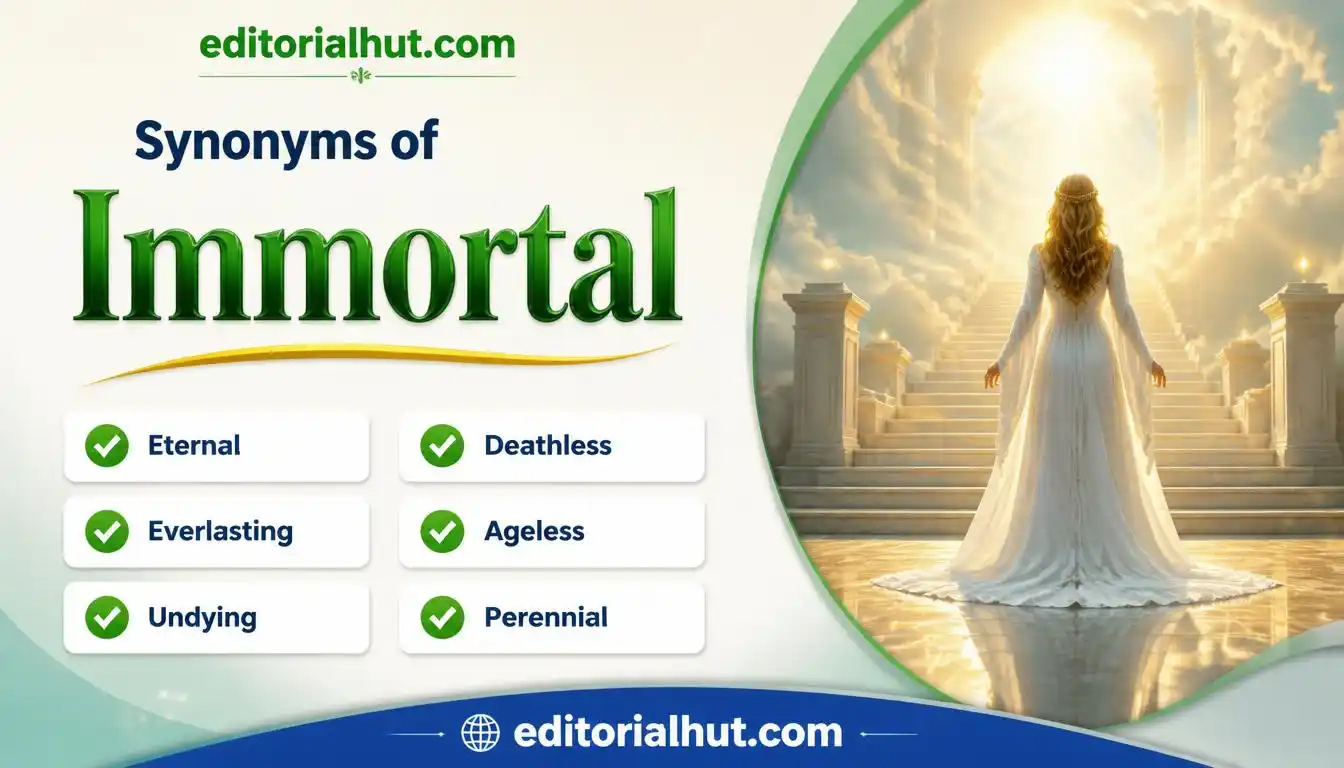
- Eternal — lasting forever
- Everlasting — continuing without end
- Undying — never fading or disappearing
- Deathless — not subject to death
- Imperishable — incapable of being destroyed or forgotten in a lasting sense
- Perpetual — continuing indefinitely or without interruption
- Ageless — not showing the effects of age
- Timeless — remaining meaningful or attractive across generations
- Enduring — lasting over a long period
- Unfading — not losing its brightness or intensity
Best general alternative: Eternal is an excellent choice when you mean lasting forever. Use deathless when referring specifically to freedom from death and undying when describing lasting love or admiration.
Core Synonyms for Immortal
The following table distinguishes close synonyms from words that express immortality in a more specific way.
| Synonym | Meaning | Relationship to Immortal | Best Use |
| Eternal | Having no end | Very close | Time and existence |
| Everlasting | Lasting forever | Very close | Love and life |
| Deathless | Not subject to death | Very close | Mythology and literature |
| Undying | Never fading or disappearing | Close | Love and loyalty |
| Imperishable | Not capable of being destroyed or lost | Contextual | Legacy and reputation |
| Perpetual | Continuing indefinitely | Near synonym | States and processes |
| Ageless | Unaffected by age | Contextual | Beauty and appearance |
| Timeless | Not limited by a particular era | Contextual | Art and ideas |
| Enduring | Continuing over time | Near synonym | Influence and relationships |
| Unfading | Not losing strength or brightness | Contextual | Memories and affection |
| Death-defying | Appearing to challenge or escape death | Related expression | Courage and dangerous feats |
| Undyingly | In a manner that never fades | Related word form | Literary descriptions |
| Ever-living | Continuing to live forever | Very close | Mythical beings |
| Perennial | Returning or lasting for many years | Contextual | Themes and recurring qualities |
| Indestructible | Impossible or extremely difficult to destroy | Near synonym | Objects and fictional beings |
| Inextinguishable | Impossible to extinguish or suppress | Contextual | Hope and passion |
| Unending | Having no end | Close | Time and experiences |
| Infinite | Without limits or boundaries | Related concept | Space and abstract ideas |
| Perennial | Lasting or recurring over a long period | Contextual | Traditions and interests |
| Unforgettable | Impossible to forget easily | Figurative alternative | People and experiences |
Important distinction: Not every word in this table means literally incapable of dying. Timeless describes lasting relevance while unforgettable describes a lasting impression. Choose a word that matches the intended meaning rather than substituting words simply because they sound similar.
What Does Immortal Really Mean?
Immortal is an adjective that describes someone or something that cannot die or that continues to exist in a lasting way. It can also describe a person whose achievements or reputation survive long after their death.
The word has two main uses.
Literal Meaning of Immortal
In mythology and fantasy stories an immortal being does not die from ordinary causes or lives forever. The precise meaning depends on the fictional or religious tradition.
Example: The legend tells of an immortal king who ruled for thousands of years.
Figurative Meaning of Immortal
In everyday English immortal often describes something that remains famous, influential or memorable across generations.
Example: Her groundbreaking work made her an immortal figure in the history of science.
In this sentence immortal does not mean that the scientist cannot physically die. It means that her reputation is likely to endure.
Connotative Meaning of Immortal
The word immortal often carries powerful associations with permanence and significance.
- Positive connotation: It can suggest greatness, extraordinary achievement and a legacy that survives through time.
- Mystical connotation: It can evoke gods, supernatural beings, legends and fantasy worlds.
- Emotional connotation: It can express love or loyalty that never fades.
- Literary connotation: It can describe classic works of art and literature that remain relevant across generations.
For example the phrase immortal love sounds more poetic and emotionally intense than long-lasting love. The phrase immortal fame suggests a reputation that survives long after a person’s lifetime.
List of Synonyms .
1. Eternal
Meaning: Lasting forever without an end.
Difference: Eternal focuses on endless duration. Immortal more directly suggests freedom from death or a legacy that survives death.
Tone: Formal and philosophical.
Best Use: Use eternal for time, existence, love or spiritual concepts.
Example: The poem explores the idea of eternal love.
2. Everlasting
Meaning: Continuing forever or for an apparently unlimited time.
Difference: Everlasting often sounds warmer and more emotional than immortal.
Tone: Romantic and expressive.
Best Use: Use it for affection, friendship, peace or hope.
Example: Their friendship became an everlasting source of comfort.
3. Deathless
Meaning: Not subject to death or described as living beyond death.
Difference: Deathless is one of the closest alternatives when the focus is specifically on the absence of death.
Tone: Literary and dramatic.
Best Use: Use it for mythical characters and enduring literary fame.
Example: The hero became a deathless figure in ancient legend.
4. Undying
Meaning: Continuing without fading or weakening.
Difference: Undying usually emphasizes an emotion or quality rather than literal physical immortality.
Tone: Emotional and powerful.
Best Use: Use it for love, loyalty, devotion or admiration.
Example: Her family remembered her with undying affection.
5. Imperishable
Meaning: Not capable of being destroyed or permanently lost.
Difference: Imperishable emphasizes resistance to destruction or loss rather than an inability to die.
Tone: Formal and literary.
Best Use: Use it for enduring works of art, treasured ideas or lasting cultural achievements.
Example: The novel secured an imperishable place in literary history.
6. Perpetual
Meaning: Continuing indefinitely or occurring repeatedly.
Difference: Perpetual does not necessarily mean forever. It can describe an ongoing condition or repeated activity.
Tone: Neutral and professional.
Best Use: Use it for ongoing states or processes.
Example: The machine requires perpetual maintenance to operate safely.
7. Ageless
Meaning: Not appearing to grow older or not losing relevance with age.
Difference: Ageless focuses on appearance or freedom from the visible effects of aging.
Tone: Positive and descriptive.
Best Use: Use it for beauty, style or qualities that do not seem to age.
Example: Her ageless elegance impressed everyone at the event.
8. Timeless
Meaning: Not restricted to a particular period and remaining relevant over time.
Difference: Timeless does not mean that something literally lives forever. It means that its appeal or value lasts.
Tone: Positive and sophisticated.
Best Use: Use it for music, fashion, art, stories and advice.
Example: The film remains a timeless classic.
9. Enduring
Meaning: Lasting over a long period despite difficulties or change.
Difference: Enduring emphasizes persistence rather than an infinite lifespan.
Tone: Thoughtful and professional.
Best Use: Use it for relationships, influence, achievements and traditions.
Example: The teacher had an enduring influence on her students.
10. Unfading
Meaning: Not losing brightness, strength or intensity.
Difference: Unfading emphasizes the continued strength of something that might otherwise weaken.
Tone: Poetic and expressive.
Best Use: Use it for memories, affection, beauty or hope.
Example: She kept an unfading memory of her childhood home.
11. Ever-living
Meaning: Living forever or continuing to live without an end.
Difference: Ever-living is more explicitly connected to continued life than timeless or enduring.
Tone: Mythical and literary.
Best Use: Use it for supernatural beings and poetic descriptions of life.
Example: The story features an ever-living guardian of the forest.
12. Unending
Meaning: Having no apparent or defined end.
Difference: Unending describes duration but does not imply that a person is immune to death.
Tone: Neutral to emotional.
Best Use: Use it for journeys, struggles, affection or a seemingly endless process.
Example: The family offered unending support during difficult times.
13. Infinite
Meaning: Having no limit or boundary.
Difference: Infinite is about limitless extent or quantity. Immortal concerns death or survival beyond a lifetime.
Tone: Technical, philosophical or poetic.
Best Use: Use it for space, possibilities or abstract concepts.
Example: The night sky seemed to reveal an infinite universe.
14. Indestructible
Meaning: Impossible or extremely difficult to destroy.
Difference: Something indestructible can resist destruction without necessarily being alive or immortal.
Tone: Strong and forceful.
Best Use: Use it for fictional characters, materials or figurative descriptions of resilience.
Example: The superhero appeared indestructible in battle.
15. Inextinguishable
Meaning: Impossible to extinguish or suppress completely.
Difference: Inextinguishable is often used for abstract qualities such as hope or determination.
Tone: Formal and expressive.
Best Use: Use it when describing a powerful quality that refuses to disappear.
Example: She maintained an inextinguishable hope for a better future.
16. Perennial
Meaning: Lasting for many years or recurring regularly.
Difference: Perennial does not mean eternal. It often refers to something that returns or remains relevant repeatedly.
Tone: Neutral and sometimes academic.
Best Use: Use it for recurring questions, traditions or long-standing interests.
Example: The novel addresses the perennial question of human identity.
17. Unforgettable
Meaning: Difficult or impossible to forget.
Difference: Unforgettable describes the effect something has on memory, not its literal lifespan.
Tone: Emotional and conversational.
Best Use: Use it for people, experiences, performances and special occasions.
Example: Her performance was unforgettable.
18. Legendary
Meaning: Famous or celebrated through stories and widespread recognition.
Difference: Legendary emphasizes fame and reputation. It does not necessarily imply immortality.
Tone: Admiring and dramatic.
Best Use: Use it for influential people, remarkable achievements and famous characters.
Example: The athlete became a legendary figure in the sport.
19. Iconic
Meaning: Widely recognized and strongly associated with a particular style, person or idea.
Difference: Iconic emphasizes recognition and cultural importance rather than endless existence.
Tone: Modern and positive.
Best Use: Use it for influential designs, public figures and memorable cultural moments.
Example: The singer’s iconic style influenced a generation of performers.
20. Monumental
Meaning: Exceptionally important, impressive or significant.
Difference: Monumental describes the scale or importance of an achievement rather than its duration.
Tone: Formal and emphatic.
Best Use: Use it for major accomplishments and historical contributions.
Example: The discovery was a monumental achievement for medical science.
21. Undiminished
Meaning: Remaining as strong or great as before.
Difference: Undiminished focuses on retaining strength or intensity rather than lasting forever.
Tone: Formal and descriptive.
Best Use: Use it for influence, enthusiasm, affection or public interest.
Example: Her enthusiasm for learning remained undiminished.
22. Unconquerable
Meaning: Impossible or extremely difficult to defeat or overcome.
Difference: Unconquerable suggests resistance to defeat rather than freedom from death.
Tone: Bold and heroic.
Best Use: Use it for determination, courage or fictional heroes.
Example: The story portrays an unconquerable warrior who never abandons his people.
23. Immune to Death
Meaning: Not susceptible to death within a specified fictional or conceptual context.
Difference: This phrase is more explicit than immortal but can sound technical or unusual outside fantasy and speculative writing.
Tone: Explanatory and direct.
Best Use: Use it when you need to explain a character’s supernatural condition.
Example: The ancient being was believed to be immune to death.
24. Everlasting in Memory
Meaning: Continuing to be remembered for a very long time.
Difference: This phrase describes remembrance rather than literal immortality.
Tone: Sentimental and commemorative.
Best Use: Use it for tributes, memorials and descriptions of a person’s legacy.
Example: Her kindness will be everlasting in the memory of those she helped.
25. Deathless in Fame
Meaning: Remaining celebrated or remembered long after one’s lifetime.
Difference: This literary expression refers to lasting reputation, not physical survival.
Tone: Elevated and poetic.
Best Use: Use it in literary criticism, historical writing or ceremonial tributes.
Example: The poet achieved deathless fame through works that continue to inspire readers.
Formal and Academic Synonyms for Immortal
In formal writing the best alternative depends on whether you are discussing physical immortality, historical reputation or lasting influence.
- Eternal — suitable for philosophical and theological discussions about existence without end.
- Imperishable — useful for describing cultural achievements or ideas that resist being forgotten.
- Enduring — appropriate for academic discussions of long-term influence.
- Perpetual — suitable for ongoing conditions or processes.
- Deathless — useful in literary analysis when discussing lasting fame or mythological life.
Example of academic usage:
Original: The writer’s work has an immortal influence on modern literature.
Improved: The writer’s work has an enduring influence on modern literature.
The revised sentence sounds more natural because enduring describes influence that continues over time.
Literary and Poetic Alternatives to Immortal
Writers often choose alternatives that create a particular mood or emotional effect.
| Word or Phrase | Literary Effect | Example |
| Undying | Intense emotion | They shared an undying devotion. |
| Deathless | Mythic greatness | The warrior became a deathless hero. |
| Ever-living | Supernatural life | An ever-living spirit watched over the valley. |
| Eternal | Timeless existence | They dreamed of eternal peace. |
| Unfading | Persistent beauty or memory | His courage left an unfading impression. |
| Timeless | Lasting artistic appeal | Her timeless poetry still resonates. |
| Everlasting | Lasting affection | Their bond felt everlasting. |
For creative writing, choose the alternative that matches the scene. Deathless sounds heroic, undying feels emotional and timeless suggests lasting relevance.
What Is the Difference Between Immortal and Eternal?
Although these words overlap, they are not interchangeable in every sentence.
| Word | Main Meaning | Natural Example |
| Immortal | Unable to die or remembered beyond death | The legend made the warrior immortal. |
| Eternal | Having no end | They searched for eternal peace. |
| Everlasting | Continuing forever | Their love seemed everlasting. |
| Undying | Never fading in intensity | She expressed undying gratitude. |
| Timeless | Remaining relevant across eras | The design has timeless appeal. |
| Ageless | Not appearing to grow old | The character possesses ageless beauty. |
A Use immortal when death or survival beyond death is central. The Use eternal when the emphasis is on endless existence or duration. Use timeless when something remains relevant despite changes in fashion or culture.
Word Formation of Immortal
The word immortal comes from Latin immortalis, meaning not subject to death. It is formed from a negative prefix and a base related to mortality.
- Prefix: im- — a variant of the negative prefix in-
- Base element: mortal — subject to death
- Part of speech: Adjective
- Related noun: Immortality
- Related adverb: Immortally
Affixation Pattern
The basic pattern is:
im- + mortal = immortal
The negative prefix reverses the meaning of mortal.
The noun immortality is formed from immortal with the suffix -ity, which creates a noun describing a state or quality.
Examples:
- The story describes an immortal creature.
- The character’s immortality changes the course of the plot.
- The artist’s work lives on immortally in the figurative sense.
Syllables in Immortal
Immortal has three syllables:
im-mor-tal
The stress falls on the second syllable: im-MOR-tal.
Pronunciation of Immortal
- US IPA: /ɪˈmɔːrtəl/
- UK IPA: /ɪˈmɔːtəl/
The main difference is the pronunciation of the letter r. In most standard American accents it is pronounced, while in many standard British accents it is not pronounced after the vowel in this word.
Etymology and Short History of Immortal
Immortal entered English through French and Latin linguistic traditions. Its Latin source immortalis combines the negative prefix in- with mortalis, meaning mortal or subject to death. The prefix appears as im- before the initial m through a regular sound and spelling adjustment.
The concept has ancient roots in mythology and philosophy. Many cultures have told stories about gods, spirits or extraordinary beings that escape ordinary death. Over time the English word also developed a figurative use for people whose work or achievements remain celebrated after death.
Today immortal can refer to supernatural life, lasting fame, enduring art or an unforgettable legacy.
Real-World Sentence Examples Using Immortal and Its Synonyms
Everyday Conversation
- Her kindness left an unforgettable impression on everyone.
- Their friendship feels everlasting.
- That song has a timeless quality.
Academic Writing
- The philosopher examined the concept of an eternal soul.
- The author’s enduring influence remains evident in modern literature.
- The study explores cultural beliefs about immortality.
Professional Writing
- The company’s founder established an enduring legacy.
- The design became an iconic symbol of the brand.
- Her contribution had a lasting effect on the organization.
Creative Writing
- The immortal queen guarded the kingdom for centuries.
- His undying devotion guided him through every hardship.
- The ancient forest sheltered an ever-living spirit.
Social Media and Captions
- A timeless moment with my favorite people.
- Some memories are truly unforgettable.
- An everlasting bond that distance cannot weaken.
Sentence Transformations: Better Ways to Use Immortal
Changing immortal to a more precise alternative can improve clarity.
Original: Their love was immortal.
Alternative: Their love was everlasting.
Why it works: Everlasting emphasizes a love that continues without end.
Original: The artist became immortal through her paintings.
Alternative: The artist achieved lasting fame through her paintings.
Why it works: Lasting fame directly communicates the figurative meaning without suggesting literal immortality.
Original: His immortal contribution changed the industry.
Alternative: His enduring contribution changed the industry.
Why it works: Enduring is more natural for describing a contribution that continues to have an effect.
Original: She has an immortal sense of style.
Alternative: She has a timeless sense of style.
Why it works: Timeless is the more conventional word for style that remains attractive across generations.
Best Word for Different Situations
| If You Want to Describe… | Best Choice | Why |
| A being that cannot die | Immortal or deathless | Refers to freedom from death |
| Something that lasts forever | Eternal | Emphasizes endless duration |
| Love that never fades | Undying or everlasting | Expresses emotional permanence |
| A famous historical figure | Legendary or immortal | Emphasizes lasting recognition |
| Art that remains relevant | Timeless | Highlights lasting appeal |
| A long-term influence | Enduring | Emphasizes continuing impact |
| A person who looks young | Ageless | Refers to appearance |
| Something that cannot be destroyed | Indestructible | Emphasizes resistance to destruction |
| A memory that remains vivid | Unfading or unforgettable | Focuses on remembrance |
| An ongoing process | Perpetual | Describes continuation |
Collocations and Natural Phrases With Immortal
Certain combinations sound more natural than others.
- Immortal soul — a soul believed to survive physical death.
- Immortal gods — deities that do not die.
- Immortal fame — fame that survives a person’s lifetime.
- Immortal legacy — an enduring legacy that remains significant.
- Immortal words — words that continue to be remembered.
- Immortal love — love portrayed as endless.
- Immortal legend — a legend that remains celebrated across generations.
- Immortal masterpiece — a work regarded as enduring in value or reputation.
Common expressions with related words include eternal peace, everlasting love, undying loyalty, timeless beauty and enduring influence.
Common Mistakes When Choosing a Synonym for Immortal
1. Using timeless to mean unable to die
Timeless describes lasting relevance rather than literal freedom from death.
Incorrect: The immortal creature could never die because it was timeless.
Better: The immortal creature could never die because it was deathless.
2. Using perpetual for a person’s inability to die
Perpetual usually describes something that continues indefinitely. It is not the clearest word for supernatural life.
Better: The character possessed immortality.
3. Treating unforgettable as an exact synonym
Unforgettable refers to memory. A person can be unforgettable without being immortal or famous.
4. Confusing ageless with eternal
Ageless refers to the absence of visible aging or a quality that seems unaffected by age. Eternal refers to having no end.
5. Choosing dramatic language for ordinary situations
Calling a small achievement immortal may sound exaggerated unless you are writing humorously or poetically. Words such as lasting, memorable or enduring may be more suitable.
Antonyms of Immortal
The best antonym depends on the meaning you intend.
| Antonym | Meaning | Example |
| Mortal | Subject to death | Every mortal creature has a finite lifespan. |
| Perishable | Capable of spoiling or deteriorating | Fresh food is perishable. |
| Temporary | Lasting for a limited time | The arrangement was temporary. |
| Fleeting | Lasting for a very short time | It was a fleeting moment of happiness. |
| Transient | Passing or short-lived | Fame can be transient. |
| Ephemeral | Lasting for a brief period | The beauty of the bloom was ephemeral. |
| Short-lived | Existing for only a short time | Their success was short-lived. |
Closest opposite: Mortal is the clearest antonym when immortal means incapable of dying. Ephemeral and fleeting are more appropriate when the intended meaning is lasting forever.
Frequently Asked Questions About Synonyms for Immortal
What is the closest synonym for immortal?
Deathless is one of the closest synonyms when immortal means incapable of dying. Eternal is often a better choice when the emphasis is on lasting forever.
What is another word for immortal?
Other words include eternal, everlasting, deathless, undying and ever-living. The best choice depends on whether you mean physical immortality or lasting influence.
What is a formal synonym for immortal?
Eternal, imperishable and enduring can work in formal writing. Use eternal for endless duration and enduring for a lasting influence.
What is a stronger word for immortal?
There is no universally stronger synonym because immortal already expresses an extreme idea. Deathless may be more direct in mythology while indestructible suggests resistance to destruction rather than immunity to death.
What is a poetic synonym for immortal?
Undying, deathless, ever-living and everlasting are useful poetic alternatives. They can communicate devotion, supernatural life or a legacy that never fades.
Is eternal the same as immortal?
No. Eternal means having no end while immortal usually means unable to die or remembered beyond death. The words overlap in some philosophical and literary contexts.
What is the difference between immortal and timeless?
Immortal refers to freedom from death or figurative survival beyond death. Timeless describes something that remains relevant or attractive across different eras.
Can immortal describe a person’s achievements?
Yes. In figurative usage an immortal achievement is one that secures lasting recognition. It does not mean the achievement itself is alive.
What is the noun form of immortal?
The noun is immortality. It refers to the state or quality of being immortal.
What is the opposite of immortal?
Mortal is the direct opposite when discussing the ability to die. Words such as temporary, fleeting and ephemeral are suitable when contrasting immortality with short duration.
Final Takeaway
The most effective synonym for immortal is the one that expresses your intended meaning precisely. Choose deathless for freedom from death, eternal for endless existence, undying for powerful emotions, timeless for lasting relevance and enduring for continuing influence.
These distinctions help you write with greater accuracy and avoid treating related words as interchangeable. A precise alternative makes your message clearer whether you are writing an academic essay, a story, a tribute or an everyday sentence.

Shahid Imran is an English language and vocabulary specialist at EditorialHut.com, focusing on synonyms, word meanings, alternative words, and practical example sentences. He helps readers discover better words, expand their vocabulary, and communicate more clearly and confidently.