






Synonyms for Park: Better Alternatives With Meanings and Examples
Introduction
Park is a word that began as a fence. Long ago it meant an enclosed piece of land where deer were kept for the hunt. Today it still carries that old idea of a space set apart, but it has grown wider. A park is the green heart of a city, where children play and families picnic. It is also the ground where games are played, the place where cars are left, and the land kept wild so nature can live in peace. The right synonym depends on which park you mean, and this guide explains all sixteen alternatives in full.
Park is both a noun and a verb, used in everyday speech, in travel writing, in sport and in descriptions of towns and cities. No single synonym covers it all, so each entry in this guide says which sense it fits.
Quick Answer
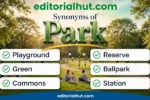
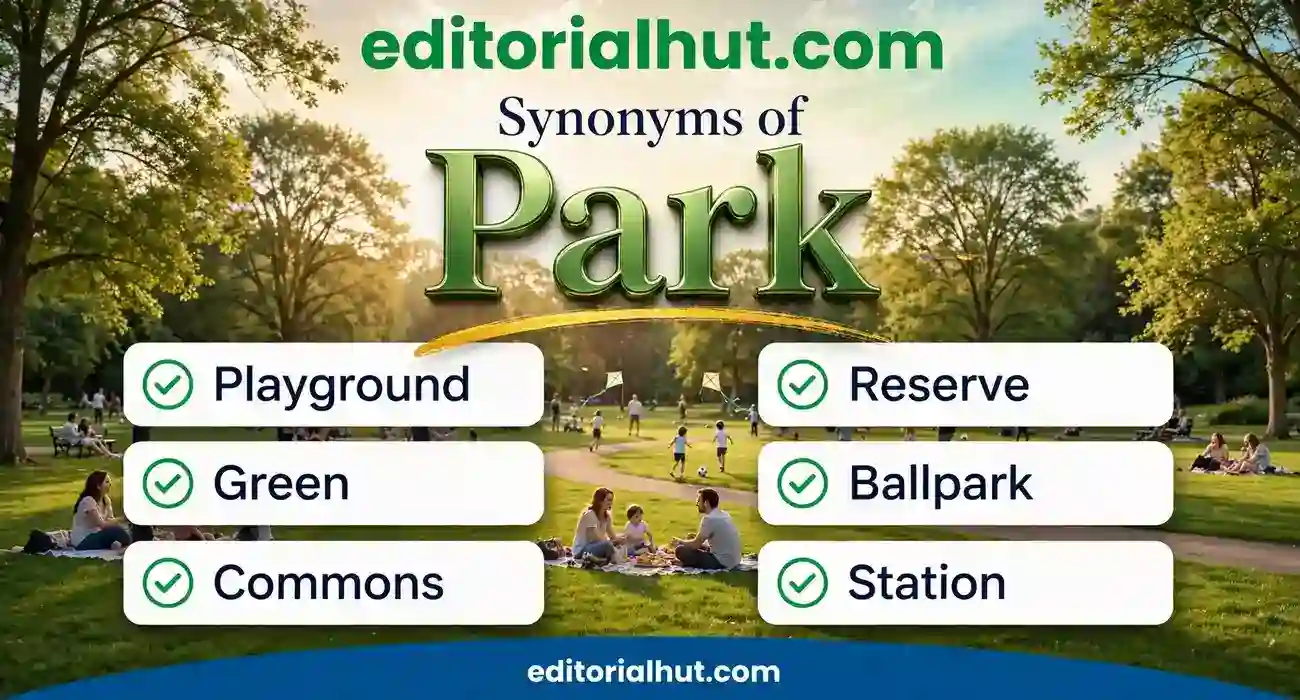
The best synonym for park depends on the sense you mean. For a public green space, use playground, green or commons. For land kept wild for nature, use reserve or sanctuary. For a ground where games are played, use ballpark. For the verb, to leave a vehicle somewhere, use station or leave. For most green spaces, playground is the safest choice where children play, and green is the safest for a grassy open space.
Core Synonym Resource
| Synonym | Meaning | Best Use |
|---|---|---|
| Playground | An outdoor area with equipment for children to play on (green-space sense) | Children, schools and housing areas |
| Green | An area of grass in a town, open to everyone (green-space sense) | Towns, villages and descriptions |
| Commons | Public land shared by a whole community (green-space sense) | Towns, villages and history |
| Public garden | A planted public space with flowers, paths and seats (green-space sense) | Cities, tourism and descriptions |
| Greenspace | Open land with grass and trees in a built-up area (green-space sense) | Planning, nature and city writing |
| Recreation ground | Land set aside for play and sport (green-space sense) | Sport, schools and local areas |
| Reserve | Land protected by law so nature can live undisturbed (preserved-area sense) | Nature, wildlife and travel |
| Sanctuary | A protected place where wild animals and birds are safe (preserved-area sense) | Wildlife, nature and conservation |
| Preserve | Land kept in its natural state, protected from building (preserved-area sense) | Nature, countryside and travel |
| Fairground | An enclosed ground where fairs and rides are held (enclosed-area sense) | Fairs, festivals and fun |
| Ballpark | A ground where ball games, especially baseball, are played (enclosed-area sense) | Sport, America and stadiums |
| Parking lot | An open area where cars are left, usually outdoors (enclosed-area sense) | Cars, towns and American English |
| Station | To place a vehicle in a position and leave it there (verb sense) | Cars, formal and military use |
| Leave | To put a vehicle somewhere and go away from it (verb sense) | Everyday speech and writing |
| Deposit | To put something down in a place until it is needed (verb sense) | Formal use and objects |
| Stow | To put something away neatly in a place (verb sense) | Luggage, boats and careful packing |
What Does Park Really Mean
Park means three different things, all grown from one old idea, a piece of land shut in by a fence. The first and most common sense today is a public green space. A park in a city is an area of grass and trees, with paths, benches and often a playground, where anyone can walk, sit, play or rest.
The second sense is an enclosed area kept for a special purpose. A national park is a large area of natural beauty protected by law. An amusement park is a fenced ground full of rides and games. A car park is an area where cars are left. A ballpark is a ground where ball games are played. In each case the park is a piece of land set apart for one use.
The third sense is the verb, to leave a vehicle in a place for a time. You park a car in a street, in a car park or in a driveway. The verb grew from the military sense of the noun, an area where wagons and guns were arranged in camp. In informal speech, people also park themselves, meaning they sit down somewhere for a while.
Connotative Meaning
Park is warm and positive in its green-space sense. It suggests fresh air, trees, open sky and time spent outdoors. A park is where children laugh, where families eat lunch on the grass, where old people sit in the sun. A town with a good park feels kinder than a town without one.
The other senses are neutral. A car park suggests order and convenience. A national park suggests wild beauty and protection. The verb is plain and practical. To park a car is an everyday act, just part of getting somewhere.
Word Formation
Park is a base word, not a word built from parts. It comes from the Old French parc, meaning an enclosed wood or heath used as a game preserve, and from the Medieval Latin parricus, meaning an enclosure. Behind those words lies a West Germanic word, parruk, meaning an enclosed tract of land, related to the German Pferch, a sheep fold, and to the Old English pearroc, the root of paddock.
The word is both a noun and a verb, with a large family. Parks, parked and parking are the verb forms. A parker is a person who parks a car, and in older use a keeper of a park, which is also the origin of the surname Parker. Parking is both the verb form and a noun, as in parking is difficult here. Compounds are common: car park, national park, amusement park, ballpark, parkway and parkland.
Affixation Pattern
Park follows the regular pattern for a short base word. The verb forms add s, ed and ing, giving parks, parked and parking, with no spelling change, because the word ends in k. This is the same pattern as mark, bark and dark.
Suffixes change the word in clear ways. The suffix er makes a person word, so parker means a person who parks a car, or in older use a keeper of a park. The suffix ing makes the noun parking, the act of leaving a car or the space where cars are left. The prefix un makes the verb unpark, to move a car out of a parked position, though this word is rare.
Compounds are common with park. Park bench, park ranger, park keeper and parkland all join park to another word, and park tells you the thing belongs to a park.
Syllables
Park has one syllable, park, with the stress on the only syllable. The word is short and strong, a single beat, PARK. English learners sometimes stretch the word into two syllables by mistake. Saying pa ark with a pause in the middle sounds wrong to a native ear. The correct sound is one quick beat, rhyming with dark, mark and shark in American English, and with dark, mark and stark in British English.
Pronunciation
The standard American pronunciation of park is /pɑːrk/, and the standard British pronunciation is /pɑːk/. The two accents differ only in the r sound. American speakers pronounce the r, as in dark and mark. British speakers drop the r, so the word sounds like “pahk”, rhyming with dark in a British accent.
A common mistake is to pronounce the vowel as in pork, giving a long o sound. The correct vowel is the open a sound, as in father and calm. Another common mistake is to add an extra syllable, saying par uk.
Etymology
Park entered English in the mid thirteenth century from the Old French parc, meaning an enclosed wood or heath land used as a game preserve. The Old French word comes from the Medieval Latin parricus, meaning an enclosure or a park, recorded as early as the eighth century. Behind that lies a West Germanic word, parruk, meaning an enclosed tract of land, from the Proto-Germanic parrukaz, meaning an enclosure or a fence. The same root gives the Old English pearroc, the root of paddock, and the German Pferch, a sheep fold.
The word was at first a legal term. A park was land held by royal grant or by prescription, enclosed for keeping game animals, especially deer, and it was distinct from a forest or a chase, because it had no special laws or officers of its own. The word originally meant the fencing itself, not the place enclosed.
Short History
The oldest sense of park is the hunting ground. In the thirteenth century, a park was a tract of land enclosed by a fence or a wall, held by a king or a lord, where deer were kept for hunting. The surname Parker, meaning keeper of a park, is recorded from the mid twelfth century.
In the 1660s the meaning widened. The royal parks of London, once hunting grounds for kings, were opened to the public, and park began to mean an enclosed lot in or near a town, set aside and kept for public recreation. In American English it was applied to sporting fields from 1867, giving us the ballpark.
The verb grew from a military sense. In the late seventeenth century, a park was the space in a camp where artillery, wagons and stores were arranged. From that sense came the verb, first recorded in 1812, meaning to arrange military vehicles in a park, and by the mid nineteenth century it meant to leave a vehicle in a place. The car park sense followed in the early twentieth century. The greatest parks of the modern world are the national parks, the first of which, Yellowstone, was created in the United States in 1872.
Closest Synonyms
The closest synonyms for park, in the green-space sense, are playground, green and commons. Playground is the closest for a place where children play, because it names the equipment and the play. Green is the closest for a grassy open space, because it names the grass itself. Commons is the closest for land shared by a community, because it names the shared ownership.
For the preserved-land sense, the closest synonym is reserve, land protected by law so nature can live undisturbed. Sanctuary is close too, but it stresses safety for animals rather than protection of the land.
For the verb sense, the closest synonym is station, to place a car in a position and leave it there. Leave is close too, but it is plainer and less formal.
How to Use Park Correctly
Use park as a noun with in and at, as in in the park and at the park, and with to, as in go to the park. Use the fixed phrases a walk in the park, meaning an easy task, and a ballpark figure, meaning a rough estimate. Use the verb park with an object, as in park the car, and with in, as in park in the car park.
Do not use park for a small private garden. A garden is usually smaller and often belongs to one house, while a park is public and open to everyone. Do not use the verb park for leaving things in general, except in the informal phrase park yourself, meaning sit down somewhere for a while.
Formal Alternatives
In formal writing, greenspace, reserve, sanctuary and preserve are the best choices. Greenspace suits reports about towns and cities, because it is the word planners use. Reserve suits writing about nature and the law. Sanctuary suits writing about wildlife. Preserve suits writing about land kept in its natural state.
Academic Alternatives
In academic writing, greenspace, reserve, commons and preserve are the safest choices. Greenspace appears in papers about cities, health and the environment. Reserve is useful in papers about conservation and land use. Commons is useful in papers about history and shared land. Preserve is useful in studies of ecology and geography.
Professional Alternatives
In professional and business writing, greenspace, recreation ground, parking lot and station work best. Greenspace is useful for property and planning documents. Recreation ground is useful for local council and school documents. Parking lot is useful for American business writing about cars and buildings. Station is useful in formal instructions, as in station the vehicle here.
Casual Alternatives
In casual speech, playground, green, ballpark and leave are the most natural choices. Playground is the simplest word for a place where children play, as in “meet me at the playground”. Green is warm and simple, as in “the village green”. Ballpark is bright and American, as in “meet me at the ballpark”. Leave is friendly and everyday, as in “just leave the car there”.
Stronger Alternatives
When you want a stronger effect than park, use sanctuary, reserve or national park. Sanctuary suggests a holy or protected place, not just a pleasant green. Reserve suggests land protected by law, with rules and rangers. National park suggests a great landscape, mountains, forests and wild animals, protected by a whole country.
Softer Alternatives
When you want a softer effect than park, use green, square or public garden. Green suggests a small grassy place, quiet and simple. Square suggests a modest open space in a town, with benches and trees. Public garden suggests flowers, paths and seats, a place to stroll rather than a place to play sport.
16 Important Alternative Explanations
1. Playground
Meaning: An outdoor area with swings, slides and climbing frames where children play.
Difference: Playground is narrower than park. It names only the part with play equipment.
Tone: Cheerful, simple and everyday.
Best Use: Places where children play, in schools, housing areas and parks.
Example: The children ran to the playground as soon as school ended.
Sense: Green-space sense.
2. Green
Meaning: An area of grass in a town or village, open to everyone.
Difference: Green is the plainest synonym for park. It names the grass itself, often a small space.
Tone: Plain, warm and traditional.
Best Use: Small grassy spaces in towns and villages.
Example: The fair was held on the village green, under the old oak tree.
Sense: Green-space sense.
3. Commons
Meaning: Public land that belongs to a whole community, where anyone may walk or graze animals.
Difference: Commons is older and more formal than park. It stresses shared ownership, while park stresses pleasure.
Tone: Old, formal and historical.
Best Use: Historic towns, villages and writing about shared land.
Example: The sheep still graze on the commons, as they have done for hundreds of years.
Sense: Green-space sense.
4. Public garden
Meaning: A planted public space with flowers, paths and seats, kept for walking and rest.
Difference: Public garden stresses flowers and planting, while park stresses grass and open space.
Tone: Elegant, calm and pleasant.
Best Use: Cities, tourism and descriptions of planted spaces.
Example: The public garden was full of roses, and old men played chess under the trees.
Sense: Green-space sense.
5. Greenspace
Meaning: Open land with grass and trees in a built-up area, kept for nature and recreation.
Difference: Greenspace is a modern planning word for any green land in a city.
Tone: Modern, technical and official.
Best Use: Town planning, health and environment writing.
Example: The city plans to protect its greenspace, so that every home is near grass and trees.
Sense: Green-space sense.
6. Recreation ground
Meaning: Land set aside for play and sport, often with pitches and courts.
Difference: Recreation ground is more formal than park and stresses sport, with pitches and courts.
Tone: Formal, official and local.
Best Use: Schools, local councils and sports grounds.
Example: The recreation ground was busy on Saturday, with three football matches at once.
Sense: Green-space sense.
7. Reserve
Meaning: Land protected by law, so nature and wildlife can live undisturbed.
Difference: Reserve is stricter than park, with rules, fences and wardens.
Tone: Serious, official and protective.
Best Use: Nature, wildlife and travel writing.
Example: The reserve protects the last wild forest in the valley, and no building is allowed there.
Sense: Preserved-area sense.
8. Sanctuary
Meaning: A protected place where wild animals and birds are safe from harm.
Difference: Sanctuary stresses safety for animals, while park stresses land for people.
Tone: Gentle, protective and caring.
Best Use: Wildlife, birds and conservation.
Example: The island is a sanctuary for seabirds, and visitors must stay on the marked paths.
Sense: Preserved-area sense.
9. Preserve
Meaning: Land kept in its natural state, protected from building and farming.
Difference: Preserve is an American word for protected nature. It stresses keeping the land as it is.
Tone: Plain, American and protective.
Best Use: Nature, countryside and American travel writing.
Example: The preserve covers five hundred acres of marsh, woodland and open water.
Sense: Preserved-area sense.
10. Fairground
Meaning: An enclosed ground where fairs are held, with rides, stalls and games.
Difference: Fairground is a park open only when a fair is on.
Tone: Bright, noisy and festive.
Best Use: Fairs, festivals and funfairs.
Example: The fairground was full of lights and music, with a big wheel turning over the town.
Sense: Enclosed-area sense.
11. Ballpark
Meaning: A ground where ball games, especially baseball, are played.
Difference: Ballpark is an American word for a sports ground, not a green space.
Tone: American, sporty and casual.
Best Use: Baseball, American sport and stadiums.
Example: The crowd filled the ballpark on the first day of the season.
Sense: Enclosed-area sense.
12. Parking lot
Meaning: An open area where cars are left, marked out in spaces.
Difference: Parking lot is the American name for a car park, for cars only.
Tone: Plain, American and practical.
Best Use: Cars, towns and American English.
Example: The parking lot behind the shops was full by nine in the morning.
Sense: Enclosed-area sense.
13. Station
Meaning: To place a vehicle in a position and leave it there.
Difference: Station is more formal than park. Soldiers station vehicles, drivers park cars.
Tone: Formal, precise and official.
Best Use: Formal instructions, military use and careful writing.
Example: The driver stationed the lorry by the gate and went inside to sign the papers.
Sense: Verb sense.
14. Leave
Meaning: To put a vehicle somewhere and go away from it for a time.
Difference: Leave is the plainest verb synonym for park. It says the car stays behind.
Tone: Plain, simple and everyday.
Best Use: Everyday speech and writing about cars.
Example: Just leave the car by the church and walk the rest of the way.
Sense: Verb sense.
15. Deposit
Meaning: To put something down in a place until it is needed again.
Difference: Deposit is a formal verb for things, not cars. It stresses careful placing.
Tone: Formal, careful and polite.
Best Use: Formal writing, luggage and objects left in a place.
Example: He deposited his bags at the hotel desk and went out to see the town.
Sense: Verb sense.
16. Stow
Meaning: To put something away neatly, so that it is safe and out of the way.
Difference: Stow is used for luggage and boats, not cars. You stow a bag under a seat.
Tone: Neat, practical and seafaring.
Best Use: Luggage, boats and careful packing.
Example: She stowed her suitcase under the bed and went down to breakfast.
Sense: Verb sense.
Real World Sentence Examples
- The children played in the park all afternoon, and the old men sat on the benches.
- The national park protects the mountains, the forests and the wild animals.
- Please park the car in the car park behind the shops, not on the pavement.
- A walk in the park is easy, but a walk through the mountains is hard work.
Word Comparisons
Park and garden are the closest pair, but they are not identical. A garden is usually smaller and often belongs to one house, with flowers and a fence. A park is public and open to everyone, with lawns, trees and paths.
Park and playground differ in size and in use. A playground is the part of a park with swings and slides, made for children. A park is the whole green space, made for everyone. A playground is inside a park, a park is not inside a playground.
Sentence Transformations
- Original: The children played in the park.
- With playground: The children played on the playground.
- With green: The children played on the village green.
- With public garden: The children played in the public garden.
- Original: The town protects its park.
- With reserve: The town protects its nature reserve.
- With greenspace: The town protects its greenspace.
- Original: Park the car here.
- With station: Station the car here.
- With leave: Leave the car here.
Best Word by Situation
| Situation | Best Word | Why It Fits |
|---|---|---|
| A place where children play | Playground | Swings, slides and climbing frames |
| A grassy space in a town | Green | Grass, open to everyone |
| Land shared by a community | Commons | Shared ownership, old rights |
| Flowers, paths and seats | Public garden | Planted, calm, for strolling |
| Green land in a city plan | Greenspace | Modern, official, planning word |
| Land for play and sport | Recreation ground | Pitches, courts and formal use |
| Land protected for nature | Reserve | Protected by law, wardens |
| A safe place for wild animals | Sanctuary | Safety for animals and birds |
| Land kept in its natural state | Preserve | Nature first, people second |
| Rides, stalls and games | Fairground | Fairs and festivals |
| A baseball ground in America | Ballpark | Diamond, pitch and stands |
| A place to leave cars in America | Parking lot | Marked spaces, outdoors |
| A formal order to place a vehicle | Station | Official, precise, military |
| Everyday speech about a car | Leave | Plain, simple, friendly |
| A formal way to put things down | Deposit | Careful, polite, formal |
| Luggage put away neatly | Stow | Neat, safe, out of the way |
Collocations
Park is often used with in and at, as in in the park and at the park, and with to, as in go to the park. Common phrases are a walk in the park, meaning an easy task, a ballpark figure, meaning a rough estimate, park bench, park ranger, national park, amusement park, car park and park the car. Common subjects are children, families, dogs and picnics. Common verbs are play, walk, sit and stroll.
Common Mistakes
The most common mistake is using park for any garden. A garden is usually smaller and often belongs to one house, while a park is public and open to everyone. Save park for public green spaces, and use garden for planted ground around a house.
Another common mistake is confusing park with parking. Park is the place or the act of leaving a car, while parking is the noun for the act or the space.
A third mistake is using the verb park for leaving anything anywhere. Park is for vehicles, and in informal use for sitting down, as in park yourself on that chair. For bags and boxes, use leave, deposit or stow.
Antonyms
There is no true single word antonym for park in the green-space sense. The nearest ideas are phrases. Built-up area describes land covered with houses and roads instead of grass and trees. Concrete jungle describes a city with no green space at all. Wasteland describes empty, barren land with nothing growing on it.
For the verb to park, the opposites are drive on, to keep moving instead of stopping, move, to take a vehicle away, and remove, to take something out of a place. The rare verb unpark means to move a car out of a parked position.
Search Driven FAQs
What is a synonym for park?
Playground, green and commons for a public green space, reserve and sanctuary for protected land, ballpark for a sports ground, and station and leave for the verb.
What does park mean in simple words?
It means a public green space with grass and trees where people walk, play and rest, or an enclosed area kept for a special use, or leaving a vehicle in a place.
Is playground a good synonym for park?
Yes, for the part of a park where children play, but playground is narrower. A park has lawns, trees and paths as well, so use playground only for the play area.
What is the difference between a park and a garden?
A park is public and open to everyone, with lawns, trees and paths. A garden is usually smaller and often belongs to one house, with flowers and a fence.
What is the verb form of park?
Park is already a verb, meaning to leave a vehicle in a place. Its forms are parks, parked and parking.
What is the opposite of park?
There is no true single antonym. The nearest ideas are built-up area and concrete jungle for the green space, and drive on, move and remove for the verb.
How do you pronounce park?
Park, with one syllable and a long a sound, as in father. The American pronunciation is /pɑːrk/. The British pronunciation is /pɑːk/.
Is park formal or informal?
Park is neutral, used in formal and informal writing alike. In formal writing, use greenspace or reserve. In casual speech, use playground, green or ballpark.
Final Takeaway
Park is a word that began as a fence and grew into a green space, a sports ground, a car park and a verb. For a public green space, choose playground, green or commons. For land kept wild, choose reserve or sanctuary. For a sports ground, choose ballpark. For the verb, choose station or leave.

Shahid Imran is an English language and vocabulary specialist at EditorialHut.com, focusing on synonyms, word meanings, alternative words, and practical example sentences. He helps readers discover better words, expand their vocabulary, and communicate more clearly and confidently.