






Synonyms for Charm: Better Alternatives With Meanings and Examples
Introduction
Charm is a word that began as a song. Long ago it meant a magic chant, a verse sung to cast a spell. Today it still carries that old magic, but it has grown into something wider. A person has charm when their manner wins you over without effort. A village has charm when its quiet streets please you at once. A small silver horse on a bracelet is a charm too, carried for luck. Few words cover so much ground, from a smile to a spell, so writers often need a different word for it. The right synonym depends on which charm you mean, and this guide explains all eighteen alternatives in full.
Charm is both a noun and a verb, used in everyday speech, in stories, in business and in descriptions of places. No single synonym covers it all, so each entry in this guide says which sense it fits.
Quick Answer
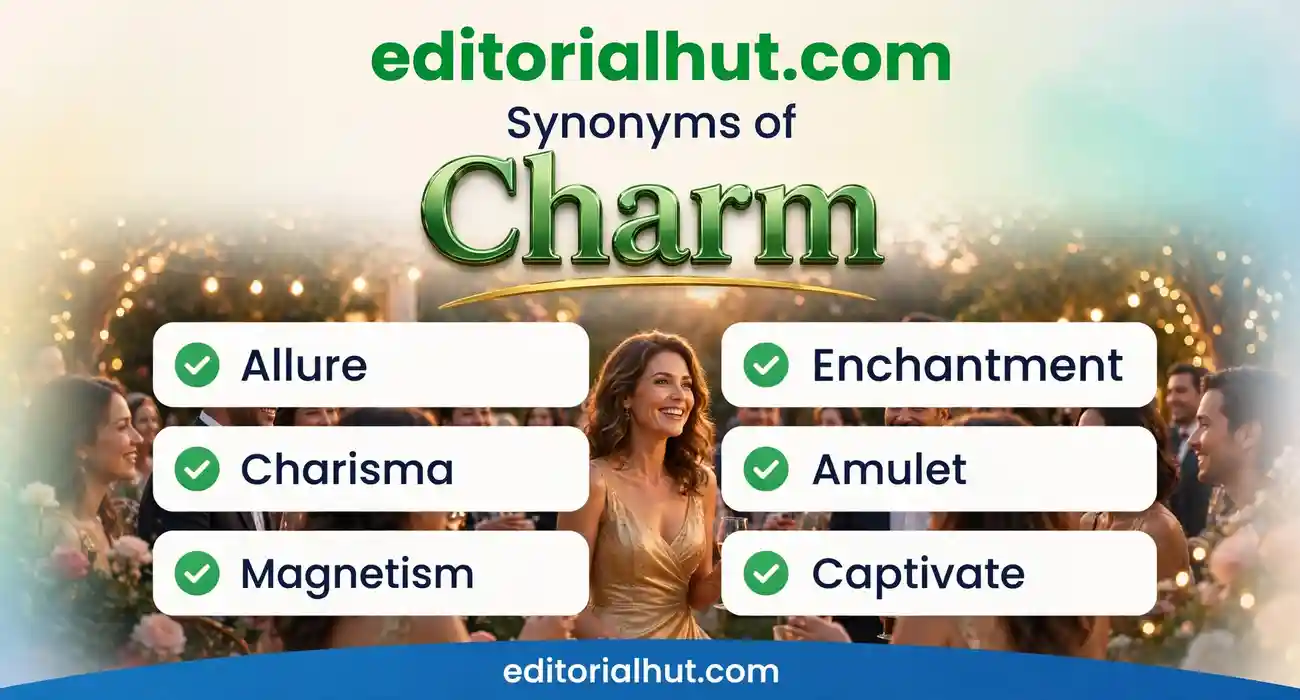
The best synonym for charm depends on the sense you mean. For personal appeal, use allure or charisma. For a magic spell, use enchantment or spell. For a lucky trinket, use amulet or talisman. For the verb, to win someone over, use enchant or captivate.
Core Synonym Resource
| Synonym | Meaning | Best Use |
|---|---|---|
| Allure | A strong, mysterious pull that draws people in (appeal sense) | People, places and things |
| Charisma | Personal magnetism that wins trust and attention (appeal sense) | Leaders and speakers |
| Magnetism | A natural force of attraction in a person (appeal sense) | Personality and presence |
| Fascination | A powerful hold on the attention (appeal sense) | Stories, people and ideas |
| Appeal | A quality that pleases or attracts people (appeal sense) | General use, all writing |
| Attraction | The power to draw people or things closer (appeal sense) | People, places and offers |
| Grace | Elegant, pleasing movement and manner (appeal sense) | People and behaviour |
| Glamour | A dazzling, almost magical beauty (appeal sense) | Style, fame and beauty |
| Enchantment | A magic spell, or a state of delight (spell sense) | Stories, fantasy and wonder |
| Spell | A magic charm spoken or cast (spell sense) | Magic and fairy tales |
| Incantation | A set of magic words chanted aloud (spell sense) | Rituals and old tales |
| Bewitchment | The state of being under a magic charm (spell sense) | Dark magic and old stories |
| Amulet | A small object worn to bring luck or protection (trinket sense) | Jewellery and folk belief |
| Talisman | A lucky object believed to hold magic power (trinket sense) | Jewellery and keepsakes |
| Trinket | A small, pretty ornament, often on a bracelet (trinket sense) | Jewellery and gifts |
| Enchant | To delight someone as if by magic (verb sense) | People, places and art |
| Captivate | To hold attention completely (verb sense) | Audiences and readers |
| Delight | To give great pleasure (verb sense) | Everyday speech and writing |
What Does Charm Really Mean
Charm means four different things, and they grew from one old idea, a song with magic power. The first and most common sense today is personal appeal. A person with charm pleases others easily, with warmth, humour and grace. The charm of a village is the quiet pleasure it gives, the charm of a story is the way it holds you. In this sense charm is a quality, not a thing you can touch.
The second sense is a magic spell. In the oldest English uses, a charm was a verse chanted to heal, to protect or to win love. A witch casts a charm. A hero falls under a charm. This sense lives on in fairy tales and fantasy, and in phrases like “charmed by the music”.
The third sense is a small object worn for luck or protection. A lucky charm can be a horseshoe, a rabbit foot or a silver heart on a bracelet. A charm bracelet carries a row of tiny ornaments, each one a small memory or a wish. In this sense a charm is a thing you can hold in your hand.
The fourth sense is the verb, to enchant, to delight, to win over. A singer charms the crowd. A host charms the guests. A clever speaker charms voters into agreement. The verb keeps the old magic picture, because the person charmed feels won over as if by a spell.
Connotative Meaning
Charm is warm and positive in almost every use. It suggests pleasure given without effort. A charming person does not push or demand, they please. A charming place does not shout for attention, it quietly wins you. The word carries ease, grace and goodwill.
The magic sense adds wonder. A charm in a story suggests powers beyond the everyday, a song that changes the world. Even in the appeal sense, a little of that magic remains, because charm works on people in a way that feels almost like a spell, though no spell is cast.
Word Formation
Charm is a base word, not a word built from parts. It comes from the Old French charme, meaning a magic spell or a song, and from the Latin carmen, meaning a song, a verse or an incantation. The modern word keeps that old idea of a song with power. A charm is a verse, a manner or a trinket that wins you over, as a song wins the ear.
The word is both a noun and a verb, with a large family. Charms, charmed and charming are the verb forms. A charmer is a person who charms others, and charmless means without charm. Charming is both the verb form and an adjective, as in a charming smile. A charm bracelet holds small charms, a charm school once taught manners, and a lucky charm brings good fortune.
Affixation Pattern
Charm follows the regular pattern for a short base word. The verb forms add s, ed and ing, giving charms, charmed and charming, with no spelling change, because the word ends in m. This is the same pattern as harm and harms, farm and farms, and alarm and alarms.
Suffixes change the word in clear ways. The suffix er makes a person word, so charmer means a person who charms others. The suffix less means without, so charmless means without charm. The suffix ing makes the adjective charming, and the suffix ly makes the adverb charmingly.
Compounds are common with charm. Charm bracelet, charm school, lucky charm and charm offensive are all built by joining charm to another word, and in each case charm tells you what the thing is for or what quality it carries.
Syllables
Charm has one syllable, charm, with the stress on the only syllable. The word is short and strong, a single beat, CHARM. There is no weak syllable and no second beat. English learners sometimes stretch the word into two syllables by mistake. Saying cha arm with a pause in the middle sounds wrong to a native ear. The correct sound is one quick beat, rhyming with farm, harm and alarm in American English, and with calm, palm and balm in British English.
Pronunciation
The standard American pronunciation of charm is /tʃɑːrm/, and the standard British pronunciation is /tʃɑːm/. The two accents differ only in the r sound. American speakers pronounce the r, as in farm and harm. British speakers drop the r, so the word sounds like “chahm”, rhyming with calm.
A common mistake is to pronounce the first sound as sh, giving sharm. The correct sound is ch, as in church and chair, with the tongue touching the roof of the mouth.
Etymology
Charm entered English around 1300 from the Old French charme, meaning a magic charm, a magic spell, an incantation or a song. The Old French word comes from the Latin carmen, meaning a song, a verse, an enchantment or a religious formula. Carmen itself comes from the verb canere, meaning to sing or to chant, from an older root meaning to sing.
The noun was first recorded in the thirteenth century, in the meaning of a magic spell. The verb followed in the fourteenth century, meaning to recite or cast a magic spell. The sense of personal attractiveness grew from the magic sense, because a charming person wins others over as if by magic. The trinket sense came from the spell sense too, because a charm worn on the body was believed to carry the power of the spell.
Short History
The oldest sense of charm is the magic spell. Before the year 1300, a charm was a verse sung to heal the sick, to protect a traveller or to win love. Charms were spoken aloud, often in Latin or in a secret tongue, and people believed the words themselves held power.
In the fourteenth century the verb grew from the noun, and to charm meant to cast a spell on a person or a thing. By the sixteenth and seventeenth centuries, the meaning had widened. A person could be charmed in the sense of delighted, and a charming manner was one that pleased without effort. The magic had become a picture for personal appeal.
In the nineteenth century the phrases of charm multiplied. To work like a charm, meaning to succeed perfectly, is recorded from 1824. To be charmed, as a polite reply on meeting someone, is attested from 1825.
Closest Synonyms
The closest synonyms for charm, in the appeal sense, are allure, charisma and fascination. Allure is the closest for a mysterious pull that draws people in. Charisma is the closest for personal magnetism in a leader or a speaker. Fascination is the closest for a powerful hold on the attention, as when a story fascinates its readers.
For the spell sense, the closest synonym is enchantment. Enchantment keeps the magic picture of charm and works for both the spell and the delight it causes.
For the trinket sense, the closest synonym is amulet. An amulet is a small object worn for luck or protection, and it carries the old belief that the object holds power. Talisman is close too, but it stresses the magic power more than the wearing.
For the verb sense, the closest synonym is enchant. To enchant is to delight someone as if by magic, which is the very picture behind the verb to charm.
How to Use Charm Correctly
Use charm as a noun with of, as in the charm of the old town, and with by, as in charmed by her kindness. Use the fixed phrases win over with charm, fall under someone’s charm, and a charmed life. Use the verb charm with an object, as in she charmed the audience, and with into, as in he charmed them into helping.
Do not use charm for beauty alone. A beautiful person may have no charm, and a plain person may have great charm, because charm is about manner, warmth and grace, not about looks. Save charm for the quality that wins people over, and use beauty for looks.
Formal Alternatives
In formal writing, allure, enchantment, fascination and magnetism are the best choices. Allure suits descriptions of people, places and ideas, because it is precise and it names a pull that draws people in. Enchantment suits formal writing about art, literature and history, because it keeps the magic picture. Fascination suits formal writing about attention and interest, because it names a powerful hold on the mind. Magnetism suits formal writing about leaders and speakers, because it describes a natural force of attraction.
Academic Alternatives
In academic writing, allure, fascination, magnetism and enchantment are the safest choices. Allure appears in papers about tourism, literature and social life. Fascination is useful when you write about attention, curiosity and the mind. Magnetism is useful in papers about leadership and social influence. Enchantment is useful in studies of folklore, literature and religion, where the magic sense matters.
Professional Alternatives
In professional and business writing, appeal, charisma, attraction and allure work best. Appeal is the most useful, because business writing often deals with what pleases customers. Charisma is useful for writing about leaders, because it names the personal magnetism that wins trust. Attraction is useful for marketing, because it describes what draws buyers to a product. Allure is useful for writing about brands and places, because it suggests a pull that is hard to resist.
Casual Alternatives
In casual speech and informal writing, appeal, grace, delight and glamour are the most natural choices. Appeal is the simplest word of all, as in “the flat has a lot of appeal”. Grace is warm and simple, as in “she moves with such grace”. Delight is friendly and everyday, as in “the garden was a delight”. Glamour is bright and fun, as in “the old film star had real glamour”.
Stronger Alternatives
When you want a stronger effect than charm, use bewitchment, enchantment, captivation or magnetism. Bewitchment is stronger because it suggests a real spell, not just a pleasant manner. Enchantment is stronger because it suggests wonder and delight at full power. Magnetism is stronger because it suggests a force that pulls people in whether they want it or not.
Softer Alternatives
When you want a softer effect than charm, use grace, appeal, delight or attraction. Grace is soft because it suggests gentle elegance rather than power. Appeal is soft because it suggests pleasing rather than winning over. Delight is soft because it suggests simple pleasure. Attraction is soft because it suggests a mild pull rather than a spell.
18 Important Alternative Explanations
1. Allure
Meaning: A strong, mysterious pull that draws people in, often without them knowing why.
Difference: Allure is the closest synonym for charm in the appeal sense, but it stresses the pull, while charm stresses the pleasing quality.
Tone: Elegant, mysterious and attractive.
Best Use: People, places, ideas and things that draw others in.
Example: The allure of the old city kept travellers returning year after year.
Sense: Appeal sense.
2. Charisma
Meaning: Personal magnetism that wins trust, attention and loyalty, especially in a leader.
Difference: Charisma is narrower than charm. It belongs to leaders, speakers and public figures, while charm belongs to anyone with a warm manner.
Tone: Powerful, public and confident.
Best Use: Leaders, speakers and public figures.
Example: The young mayor won the election with her charisma and her clear ideas.
Sense: Appeal sense.
3. Magnetism
Meaning: A natural force of attraction in a person, as if they pulled others toward them like a magnet.
Difference: Magnetism is a picture word. It describes the effect, a pull, rather than the manner that causes it.
Tone: Strong, natural and vivid.
Best Use: Personality, presence and stage appeal.
Example: His personal magnetism filled the hall before he said a single word.
Sense: Appeal sense.
4. Fascination
Meaning: A powerful hold on the attention, so that a person cannot look away or stop thinking about something.
Difference: Fascination is stronger than charm and narrower. Charm pleases, fascination grips.
Tone: Intense, curious and gripping.
Best Use: Stories, people, ideas and mysteries.
Example: The fascination of the ancient city kept the historians working late into the night.
Sense: Appeal sense.
5. Appeal
Meaning: A quality that pleases or attracts people, so that they like something or want it.
Difference: Appeal is the plainest synonym for charm. It says that something pleases, but it says nothing about magic, grace or mystery.
Tone: Plain, neutral and safe.
Best Use: General use, in all kinds of writing.
Example: The little cottage has great appeal, with its garden and its quiet street.
Sense: Appeal sense.
6. Attraction
Meaning: The power to draw people or things closer, as a magnet draws iron.
Difference: Attraction is wider than charm. It covers physical pull, romantic interest and the draw of a place or an offer.
Tone: Neutral, clear and direct.
Best Use: People, places, offers and ideas that draw others in.
Example: The main attraction of the fair was the old steam train, shining in the sun.
Sense: Appeal sense.
7. Grace
Meaning: Elegant, pleasing movement and manner, a natural ease in the way a person speaks and moves.
Difference: Grace is quieter than charm. Charm wins people over, grace pleases the eye and the ear.
Tone: Gentle, elegant and refined.
Best Use: People, movement, speech and behaviour.
Example: She accepted the prize with grace, and thanked everyone who had helped her.
Sense: Appeal sense.
8. Glamour
Meaning: A dazzling, almost magical beauty and excitement, often linked to fame, fashion and film.
Difference: Glamour is brighter and more showy than charm. Charm is warm and personal, glamour is bright and public.
Tone: Bright, dazzling and stylish.
Best Use: Style, fame, beauty and film.
Example: The old film star kept her glamour long after she left the screen.
Sense: Appeal sense.
9. Enchantment
Meaning: A magic spell, or the state of delight caused by something wonderful.
Difference: Enchantment is the closest synonym for charm in the spell sense. It covers both the spell and the delight, while charm in modern use usually means the delight only. A forest can be an enchantment, and a witch can cast one.
Tone: Magical, wonderful and dreamlike.
Best Use: Stories, fantasy, gardens and wonder.
Example: The enchantment of the garden held the children silent, staring at the lights.
Sense: Spell sense.
10. Spell
Meaning: A magic charm spoken or cast, a set of words or actions believed to change the world.
Difference: Spell is the simplest word for the magic sense. It names the act, the casting, while charm names the power or the verse. A witch casts a spell, and the spell is a charm.
Tone: Simple, magical and old fashioned.
Best Use: Magic, fairy tales and fantasy stories.
Example: The witch cast a spell on the prince, and he slept for a hundred years.
Sense: Spell sense.
11. Incantation
Meaning: A set of magic words chanted aloud, often in a ritual or a ceremony.
Difference: Incantation is narrower than charm. It names only the spoken words, while charm can name the words, the power or the object. An incantation is always spoken, a charm can be silent.
Tone: Formal, ancient and ritual.
Best Use: Rituals, old tales and ceremonies.
Example: The priest spoke the incantation slowly, and the room fell silent.
Sense: Spell sense.
12. Bewitchment
Meaning: The state of being under a magic charm, held by a spell.
Difference: Bewitchment is darker than charm. It suggests a spell that controls, while charm in the appeal sense suggests delight freely given. Use bewitchment for dark magic, not for a pleasant manner.
Tone: Dark, mysterious and powerful.
Best Use: Dark magic, old stories and curses.
Example: The bewitchment of the forest kept travellers walking in circles all night.
Sense: Spell sense.
13. Amulet
Meaning: A small object worn on the body to bring luck or protection from harm.
Difference: Amulet is the closest synonym for charm in the trinket sense. It stresses protection, while charm stresses luck.
Tone: Ancient, protective and folk.
Best Use: Jewellery, folk belief and lucky objects.
Example: She wore an amulet of blue glass to protect her on the journey.
Sense: Trinket sense.
14. Talisman
Meaning: A lucky object believed to hold magic power, often a stone, a ring or a carved figure.
Difference: Talisman stresses the magic power more than the wearing. An amulet is worn for protection, a talisman is kept for power. Both are charms, but a talisman sounds grander and more mysterious.
Tone: Mysterious, powerful and precious.
Best Use: Jewellery, keepsakes and lucky objects.
Example: The old ring was his talisman, and he never travelled without it.
Sense: Trinket sense.
15. Trinket
Meaning: A small, pretty ornament, often worn on a bracelet or a chain, or kept as a souvenir.
Difference: Trinket is the plainest word for the object sense. It says nothing about magic or luck, only that the thing is small and pretty. A charm on a bracelet is a trinket, but a lucky charm is more than a trinket.
Tone: Small, pretty and everyday.
Best Use: Jewellery, gifts and souvenirs.
Example: Her bracelet was full of tiny trinkets, a star, a heart and a little key.
Sense: Trinket sense.
16. Enchant
Meaning: To delight someone as if by magic, to win them over completely.
Difference: Enchant is the closest verb synonym for charm. To enchant is to charm by magic or as if by magic. It is stronger than to please and warmer than to impress.
Tone: Magical, warm and delightful.
Best Use: People, places, music and art that delight.
Example: The singer enchanted the crowd, and nobody left before the final song.
Sense: Verb sense.
17. Captivate
Meaning: To hold someone’s attention completely, so that they cannot look away or think of anything else.
Difference: Captivate is stronger than charm. Charm pleases, captivate holds. A charming speaker pleases the room, a captivating speaker holds it silent.
Tone: Strong, gripping and impressive.
Best Use: Audiences, readers and listeners.
Example: The storyteller captivated the children with tales of dragons and distant seas.
Sense: Verb sense.
18. Delight
Meaning: To give great pleasure, to make someone very happy.
Difference: Delight is the gentlest verb synonym for charm. It names the pleasure only, without the magic picture. A garden delights, a singer charms, and both make people smile.
Tone: Gentle, warm and happy.
Best Use: Everyday speech and writing about pleasure.
Example: The spring flowers delighted everyone who walked through the garden.
Sense: Verb sense.
Real World Sentence Examples
- The old town charmed every visitor with its quiet streets and its flower filled squares.
- She wore a silver charm on her bracelet, a tiny key her grandmother had given her.
- The witch cast a charm over the castle, and the whole court fell asleep.
- His charm won over the committee, and the plan was approved the same day.
Word Comparisons
Charm and allure are the closest pair in the appeal sense, but they are not identical. Allure describes a pull that draws people in, often mysterious, while charm describes the pleasing quality that does the drawing. A city has allure when travellers dream of it. A host has charm when guests feel at home.
Charm and charisma differ in scale and in setting. Charisma belongs to leaders and public figures, and it wins trust and loyalty on a large scale. Charm belongs to anyone, in a shop, in a home or in a small meeting, and it wins liking. A leader needs charisma, a neighbour needs charm.
Sentence Transformations
- Original: The village charmed every visitor.
- With allure: The allure of the village drew every visitor in.
- With enchant: The village enchanted every visitor.
- With delight: The village delighted every visitor.
- Original: She has great charm.
- With charisma: She has great charisma.
- With grace: She has great grace.
- Original: He wore a lucky charm.
- With amulet: He wore a lucky amulet.
- With talisman: He carried a talisman for luck.
- Original: The witch cast a charm.
- With spell: The witch cast a spell.
- With incantation: The witch spoke an incantation.
Best Word by Situation
| Situation | Best Word | Why It Fits |
|---|---|---|
| A mysterious pull to a place | Allure | Draws people in, mysterious |
| A leader who wins trust | Charisma | Personal magnetism in public life |
| A strong natural presence | Magnetism | A force that pulls people close |
| A story you cannot stop reading | Fascination | Grips the attention completely |
| A general pleasing quality | Appeal | Plain, safe, works everywhere |
| A fair or a shop that draws crowds | Attraction | The power to draw people in |
| Elegant movement and manners | Grace | Quiet, refined, pleasing |
| Dazzling style and fame | Glamour | Bright, magical beauty |
| A magic spell in a story | Enchantment | The spell and the delight together |
| A witch casting magic | Spell | Simple, direct, magical |
| Magic words in a ritual | Incantation | The spoken words of a spell |
| Dark magic that controls | Bewitchment | Dark, powerful, controlling |
| A lucky object worn for safety | Amulet | Protection, worn on the body |
| A precious object with power | Talisman | Magic power, grand and mysterious |
| A small pretty bracelet ornament | Trinket | Small, pretty, everyday |
| To delight as if by magic | Enchant | Warm, magical, delightful |
| To hold an audience silent | Captivate | Attention held completely |
| To give simple pleasure | Delight | Gentle, warm, happy |
Collocations
Charm is often used with of, as in the charm of the village and the charm of her smile, and with by, as in charmed by his kindness. Common phrases are win over with charm, fall under someone’s charm, a charmed life, a lucky charm, a charm bracelet, a charm offensive, work like a charm and third time is a charm.
Common Mistakes
The most common mistake is using charm for beauty alone. A beautiful person may have no charm, and a plain person may have great charm, because charm is about manner, warmth and grace, not about looks. Save charm for the quality that wins people over.
Another common mistake is confusing charmed with charming. Charming describes the person or thing that charms, as in a charming host. Charmed describes the person who has been charmed, as in “I am charmed to meet you”, or a life protected by luck, as in a charmed life.
Antonyms
There is no true single word antonym for charm in the appeal sense. The nearest ideas are repulsion, the quality of driving people away, and repulsiveness, the state of being unpleasant to others. Ugliness is an opposite only for looks, not for manner, and dullness is an opposite only for interest, not for warmth. For the verb to charm, the opposites are repel, as in a manner that repels people, disgust, as in behaviour that disgusts, and bore, as in a speaker who bores the room. For the spell sense, the opposites are curse, hex and jinx, all harmful spells.
Search Driven FAQs
What is a synonym for charm?
Allure, charisma and magnetism for personal appeal, enchantment and spell for magic, amulet and talisman for a lucky trinket, and enchant and captivate for the verb.
What does charm mean in simple words?
It means a pleasing quality that wins people over, a magic spell, or a small lucky object worn on the body.
Is charisma a good synonym for charm?
Yes, for the appeal sense, but charisma is narrower. It belongs to leaders and public figures, while charm belongs to anyone with a warm manner.
What is the difference between charm and charisma?
Charisma is personal magnetism on a large, public scale, winning trust and loyalty. Charm is a warm, pleasing manner on a small, personal scale, winning liking.
What is the opposite of charm?
There is no true single antonym. The nearest words are repulsion and repulsiveness for appeal, repel and bore for the verb, and curse, hex and jinx for the magic sense.
How do you pronounce charm?
Charm, with one syllable and a long a sound, as in father. The American pronunciation is /tʃɑːrm/. The British pronunciation is /tʃɑːm/.
Is charm formal or informal?
Charm is neutral, and it is used in formal and informal writing alike. In formal writing, use allure or enchantment. In casual speech, use appeal, grace or delight.
What is the difference between charm and enchantment?
Enchantment belongs to magic and wonder, to spells, forests and fairy tales. Charm in modern use belongs mostly to people and places.
Final Takeaway
Charm is a word that began as a song and grew into a spell, a quality and a keepsake. For personal appeal, choose allure, charisma or magnetism. For magic, choose enchantment or spell. For a lucky object, choose amulet or talisman. For the verb, choose enchant or captivate.

Shahid Imran is an English language and vocabulary specialist at EditorialHut.com, focusing on synonyms, word meanings, alternative words, and practical example sentences. He helps readers discover better words, expand their vocabulary, and communicate more clearly and confidently.