








Synonyms for Terrain: Better Alternatives With Meanings and Examples
Introduction
Terrain is a word that takes you outside. It describes the land under your feet, the hills that rise in front of you, the valleys that open below, the flat plains that stretch to the horizon and the rocky slopes that make every step harder. Writers use it when the land itself matters, when a journey, a battle, a race or a building project depends on what the ground looks like.
Terrain is a noun, and it appears in writing about travel, geography, sport, the military, farming and the outdoors. A hiker studies it before a climb, and a driver chooses a car that can handle rough terrain. Because the word is used in so many fields, writers often need a different word for it. The right synonym depends on whether you mean the look of the land, the shape of the land or the land as a place, and this guide explains all twenty alternatives in full.
Quick Answer
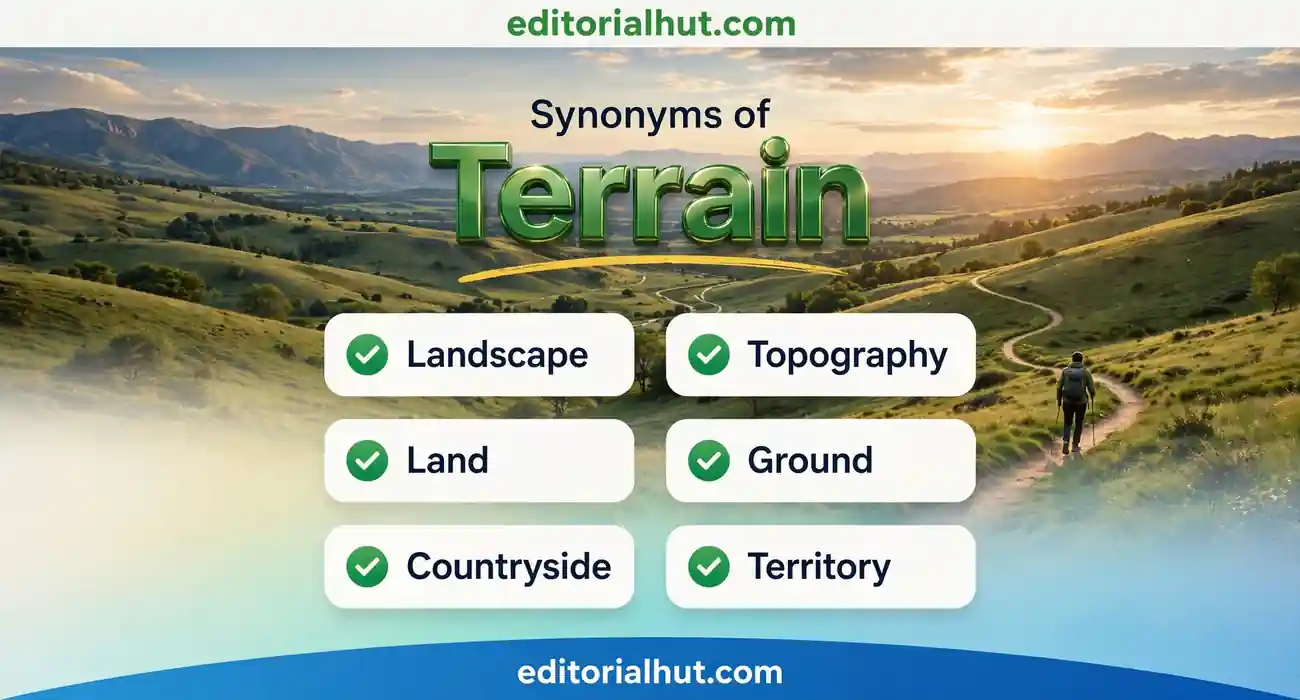
The best synonym for terrain depends on what you want to stress. For the look of the land, use landscape. For the shape and height of the land, use topography. For the land itself in plain speech, use land or ground. For open land away from towns, use countryside. If you want one word that works in most cases, landscape is the safest choice. For a formal or technical text, topography is the most precise.
Core Synonym Resource
| Synonym | Meaning | Best Use |
|---|---|---|
| Landscape | The visible features of an area of land | The look of the land |
| Topography | The shape and height of the land surface | Maps and geography |
| Land | An area of ground, often owned or used | General use |
| Ground | The surface of the earth underfoot | Walking and building |
| Countryside | Open land away from towns and cities | Rural scenes |
| Earth | The ground or soil, the planet’s surface | General and poetic use |
| Soil | The top layer of earth where plants grow | Farming and gardening |
| Territory | Land under control or ownership | Politics and sport |
| Region | A large area with its own character | Geography |
| Area | A part of a place or a piece of land | General use |
| Landform | A natural feature of the land surface | Geography and science |
| Tract | A large area of land, often for sale | Property and farming |
| Expanse | A wide, open stretch of land | Descriptive writing |
| Geography | The features and layout of a place | Study and travel |
| District | A defined part of a town or region | Official and local use |
| Zone | An area set apart for a purpose | Planning and military use |
| Stretch | A continuous length of land | Journeys |
| Field | Open land, often for farming | Farming and sport |
| Locale | The place where something happens | Stories and reports |
| Setting | The land or place around something | Stories |
What Does Terrain Really Mean
Terrain means a stretch of land, especially with regard to its physical features. It is the land as you find it, flat or hilly, smooth or rocky, wet or dry, open or covered with trees. The word is used when the character of the land matters more than who owns it or what it is called.
In its most common sense, terrain describes the natural shape of the ground. Mountainous terrain is steep and hard to cross. Flat terrain is easy to walk or drive across. Rough terrain slows a vehicle down and tests a walker. The word often appears with adjectives such as difficult, rocky, hilly, uneven and steep, because writers use it to show how hard the land is to cross.
In a second sense, terrain means a piece of land or a geographic area, without stressing its shape. A race runs over varied terrain. Terrain is both countable and uncountable. You can speak of a terrain, meaning one area, or of terrain in general, meaning land of a certain kind.
Connotative Meaning
Terrain has a neutral and practical connotation. It is a plain, factual word, and it carries no feeling of beauty or ugliness on its own. A landscape can be beautiful. A wilderness can be frightening. Terrain simply describes the land as it is, and the feeling comes from the adjectives around it. Rough terrain sounds hard. Gentle terrain sounds easy.
The word also suggests challenge and effort. When writers choose terrain instead of land, they usually mean land that must be crossed, climbed, mapped or survived. A runner trains for hilly terrain. A soldier studies the terrain. A scientist surveys the terrain. The word belongs to the world of boots, maps and engines, and it gives a sentence a practical, outdoor feeling.
Word Formation
Terrain is a noun that came into English from French. The French word terrain means land or ground, and it comes from the Latin terrenum, meaning land or ground, the neuter form of the adjective terrenus, meaning consisting of earth. That Latin word comes from terra, meaning earth, one of the oldest and most useful roots in the language.
English borrowed terrain in the early eighteenth century. At first it was used in a narrow sense, for part of the training ground in a riding school, where horses were exercised. From there it spread to a general word for a stretch of land, and by the nineteenth century it was used in military writing, in travel books and in geography.
The root terr gives English a large family of words about the earth. Terrace, terrestrial, territory and subterranean all come from the same root.
Affixation Pattern
Terrain is built from the root terr, meaning earth, plus the ending ain. The ending comes from the Latin ending anum, which turned into ain in Old French and then in English. The same ending appears in words such as mountain, from the Latin montana, and fountain, from the Latin fontana. In each case the ending turns a root into a noun that names a place or a thing.
The root terr appears in many English words with the same meaning. Terrene means of the earth. The prefix sub joins terr in subterranean, meaning under the earth. The suffix ory joins terr in territory, meaning land under control.
Syllables
Terrain has two syllables, ter rain, with the stress on the second syllable, ter RAIN. The first syllable is weak, a quick tuh sound, and the second syllable carries the beat, a clear rayn sound that rhymes with rain and train. English learners sometimes stress the first syllable by mistake. Saying TER rain sounds wrong to a native ear. The correct rhythm is weak strong, with a clear beat on rain.
Pronunciation
The standard American pronunciation of terrain is /təˈreɪn/, and the standard British pronunciation is the same, /təˈreɪn/. Both accents stress the second syllable, and both use the same vowel sounds. A common mistake is to stress the first syllable, or to pronounce the second syllable with a short vowel. The correct sound is rayn, rhyming with rain, train and plain.
Etymology
Terrain entered English in the early eighteenth century from the French terrain, meaning land or ground. The French word comes from the Old French terrein, from the Vulgar Latin terranum, an alteration of the Latin terrenum, meaning land or ground, the neuter of terrenus, meaning consisting of earth, from terra, meaning earth. The first known use in English dates to 1766, in the sense of a geographic area.
The word kept its French spelling, including the double vowel ai in the second syllable, and English speakers kept the French pattern of stress on the last syllable.
Short History
The earliest English uses of terrain describe the training ground of a riding school, a flat piece of land where horses were exercised. In the eighteenth century the word was still a specialist term, known mainly to riders and to military men. By the nineteenth century it had spread into general use, and travel writers used it to describe the land they crossed on foot and on horseback.
In the twentieth century terrain became a key word in military writing. Generals studied the terrain before a battle, because hills, rivers and forests decided where an army could move. Today terrain is used in walking guides, in sport and in geography, wherever the shape of the land decides what people can do.
Closest Synonyms
The closest synonyms for terrain are landscape, topography and land. Landscape is the closest when you mean the visible look of the land. Topography is the closest when you mean the measured shape of the land, its heights, slopes and contours. Land is the closest when you mean the ground itself in plain speech, without any stress on its shape or its beauty.
Ground is also very close, but it stresses the surface under your feet rather than the wider area. A walker feels the ground. A traveller looks at the landscape. A mapmaker records the topography. The right choice depends on whether your sentence is about seeing, walking or measuring the land.
How to Use Terrain Correctly
Use terrain when the physical character of the land matters. Write rough terrain, hilly terrain, mountainous terrain or flat terrain when you want to show how hard the land is to cross. Use terrain with the prepositions over, across and through, as in over rough terrain, across open terrain and through difficult terrain. The word often follows verbs of movement, such as cross, cover, climb and traverse.
Do not use terrain for land in general when a simpler word would do. A farmer owns land, not terrain. Save terrain for sentences where the shape of the land is the point.
Formal Alternatives
In formal writing, topography, territory and region are the best choices. Topography suits scientific, geographic and military writing, because it is precise and it names the measured shape of the land. Territory suits formal writing about ownership and control, because it names land under a person, a group or a state. Region suits formal writing about large areas, because it is neutral and it covers both land and its character.
Academic Alternatives
In academic writing, topography, landform and geography are the safest choices. Topography is the most academic of the three, and it appears in papers about maps, geology and the environment. Landform is useful when you name one feature, such as a hill, a valley or a ridge. Geography is useful when you write about the layout and character of a place as a whole. Academic writers should avoid countryside and setting, because those words are too vague for a research paper.
Professional Alternatives
In professional and business writing, territory, district and zone work best. Territory is the most useful, because business writing often deals with sales areas and regions under control. District is useful for planning and local government, because it names a defined part of a town or a region. Zone is useful for planning and logistics, because it names an area set apart for one purpose. Terrain itself is common in professional writing about construction, farming and transport, so a synonym mainly avoids repetition.
Casual Alternatives
In casual speech and informal writing, land, ground and countryside are the most natural choices. Land is the simplest word of all, as in a piece of land. Ground is the most everyday, as in the ground was wet. Countryside is warm and friendly, as in a walk in the countryside. Avoid topography and landform in casual speech, because they sound stiff and bookish.
Stronger Alternatives
When you want a stronger effect than terrain, use expanse, territory or landform. Expanse is stronger because it suggests a wide, open sweep of land that goes on and on. Territory is stronger because it suggests land that is claimed, defended or controlled. Landform is stronger in a different way, because it names one bold feature of the land, a ridge, a cliff or a valley, and makes the reader see it. Use these words when the land itself is the hero of the sentence.
Softer Alternatives
When you want a softer effect than terrain, use setting, locale or area. Setting is soft because it suggests the land around a house, a story or a scene, rather than land that must be crossed. Locale is soft because it is vague and gentle, naming a place without describing its hardness. Area is the softest of all, because it says almost nothing about the land itself. Use these words when the land is only the background, not the subject.
20 Important Alternative Explanations
1. Landscape
Meaning: The visible features of an area of land.
Difference: Landscape is about looks, terrain is about crossing. A landscape is seen. Terrain is walked.
Tone: Neutral and pleasant.
Best Use: The look of the land in travel writing.
Example: The landscape of rolling hills drew painters to the valley.
2. Topography
Meaning: The shape and height of the land surface.
Difference: Topography is the measured form of terrain. A map shows topography. A walker feels terrain.
Tone: Formal, technical and precise.
Best Use: Maps, geography, science and military writing.
Example: The team mapped the topography before the road was built.
3. Land
Meaning: An area of ground, often owned or used.
Difference: Land is the plainest word. It says nothing about hills or valleys.
Tone: Plain, simple and everyday.
Best Use: A safe general word for ground.
Example: The farmer bought land beside the river and planted wheat.
4. Ground
Meaning: The surface of the earth under your feet.
Difference: Ground is the surface you stand on. Terrain is the wider area.
Tone: Plain, direct and everyday.
Best Use: Walking, building and sport.
Example: The ground was wet, and the players slipped on the mud.
5. Countryside
Meaning: Open land away from towns and cities.
Difference: Countryside always means rural land. Terrain can be anywhere.
Tone: Warm, pleasant and rural.
Best Use: Rural scenes and walks.
Example: They spent the weekend in the countryside, walking through quiet woods.
6. Earth
Meaning: The ground or soil under our feet.
Difference: Earth is wider and more poetic than terrain. It can mean the whole planet.
Tone: General, natural and sometimes poetic.
Best Use: General and poetic writing.
Example: The earthquake shook the earth, and cracks opened in the fields.
7. Soil
Meaning: The top layer of earth where plants grow.
Difference: Soil is the material of the ground, not its shape.
Tone: Practical and earthy.
Best Use: Farming and gardening.
Example: The rich soil of the valley gave a fine crop of wheat.
8. Territory
Meaning: Land under the control of a person, group or animal.
Difference: Territory stresses ownership and control. Terrain stresses shape.
Tone: Formal, strong and political.
Best Use: Politics, animals and sport.
Example: The wolf marked its territory along the edge of the forest.
9. Region
Meaning: A large area with its own character.
Difference: Region is wider than terrain. A region can hold many kinds of terrain.
Tone: Neutral and formal.
Best Use: Geography and large areas.
Example: The mountain region is cold in winter and cool in summer.
10. Area
Meaning: A part of a place or a piece of land.
Difference: Area is the vaguest synonym. It says nothing about hills or beauty.
Tone: Plain and neutral.
Best Use: A safe word when details do not matter.
Example: The picnic area beside the lake was full on Sunday.
11. Landform
Meaning: One natural feature of the land surface.
Difference: Landform names one feature. Terrain names the whole stretch of land.
Tone: Technical and scientific.
Best Use: Geography and science.
Example: The canyon is the most famous landform in the park.
12. Tract
Meaning: A large area of land, often bought or sold.
Difference: Tract suggests size and ownership. Terrain suggests shape.
Tone: Formal and practical.
Best Use: Property and farming.
Example: The company bought a large tract of forest land.
13. Expanse
Meaning: A wide, open stretch of land.
Difference: Expanse stresses width and openness. Terrain stresses physical features.
Tone: Grand, poetic and descriptive.
Best Use: Descriptive writing about open land.
Example: They looked out over a vast expanse of golden grassland.
14. Geography
Meaning: The features and layout of a place.
Difference: Geography is the whole picture. Terrain is one part of it.
Tone: Formal and academic.
Best Use: Study and travel writing.
Example: The geography of the island shaped the lives of its people.
15. District
Meaning: A defined part of a town or region.
Difference: District is an official division. Terrain is a natural stretch of land.
Tone: Official and local.
Best Use: Official and local writing.
Example: The old district is full of narrow streets and small shops.
16. Zone
Meaning: Land set apart for a particular purpose.
Difference: Zone stresses purpose and rules. Terrain stresses natural features.
Tone: Official, technical and practical.
Best Use: Planning and military writing.
Example: The car park is in the loading zone.
17. Stretch
Meaning: A continuous length of land.
Difference: Stretch stresses length. Terrain stresses character.
Tone: Simple, natural and descriptive.
Best Use: Journeys and descriptions.
Example: They walked a long stretch of sandy beach.
18. Field
Meaning: Open land, often used for farming or sport.
Difference: Field is smaller than terrain. A field is planted or played on.
Tone: Plain, rural and everyday.
Best Use: Farming and sport.
Example: The cows grazed in the field beside the farmhouse.
19. Locale
Meaning: The place where something happens.
Difference: Locale is about the place of an event. Terrain is about the land.
Tone: Formal and literary.
Best Use: Stories and reports.
Example: The village was the locale of the famous battle.
20. Setting
Meaning: The land or place around something.
Difference: Setting is the background. Terrain is the land itself.
Tone: Neutral, gentle and descriptive.
Best Use: Stories and descriptions.
Example: The cottage stood in a beautiful setting by the lake.
Real World Sentence Examples
- The army moved slowly over the rough terrain, and the heavy trucks sank into the mud.
- The race will be run over a variety of terrain, including grass, sand and rocky paths.
- The builders studied the terrain carefully before they chose a place for the new road.
Word Comparisons
Terrain and landscape are the closest pair, but they are not identical. Landscape describes what the land looks like from one viewpoint, the hills, fields and trees that fill the eye. Terrain describes what the land is like to cross, its slopes, rocks and mud. A painter loves a landscape. A soldier studies the terrain.
Terrain and topography differ in the same way. Topography is the measured shape of the land, recorded on a map with contour lines and heights. Terrain is the land itself as you meet it on foot. A map shows topography. A boot meets terrain.
Sentence Transformations
- Original: The soldiers crossed the rough terrain.
- With landscape: The soldiers crossed a landscape of rocky hills and deep valleys.
- With topography: The soldiers crossed ground whose topography was steep and broken.
- With ground: The soldiers crossed the rough ground.
- Original: The terrain was difficult to cross.
- With landform: The landforms made the route difficult to cross.
- With expanse: The vast expanse was difficult to cross.
- Original: We hiked through varied terrain.
- With countryside: We hiked through varied countryside.
- With stretch: We hiked through a long stretch of changing land.
Best Word by Situation
| Situation | Best Word | Why It Fits |
|---|---|---|
| The look of the land | Landscape | Hills, fields and trees |
| Maps and measurements | Topography | Precise and measured |
| A plain general word | Land | Simple and everyday |
| The surface underfoot | Ground | Direct and physical |
| Rural life and walks | Countryside | Warm and rural |
| Poetic writing | Earth | Wide and timeless |
| Farming and planting | Soil | Plants grow in it |
| Land under control | Territory | Ownership and power |
| A large named area | Region | Wide and formal |
| A vague general space | Area | Safe and vague |
| One natural feature | Landform | A hill or valley |
| A large piece for sale | Tract | Size and property |
| Wide open land | Expanse | Grand and sweeping |
| The character of a place | Geography | Layout and features |
| An official local part | District | Named and governed |
| A planned purpose area | Zone | Rules and planning |
| A long piece of land | Stretch | Length and journey |
| Farming or sport | Field | Enclosed and worked |
| The place of an event | Locale | Formal and literary |
| The background of a scene | Setting | Gentle and soft |
Collocations
Terrain is often used with adjectives that describe how hard the land is to cross, such as rough terrain, difficult terrain, hilly terrain, mountainous terrain, rocky terrain, uneven terrain and flat terrain. It is also used with verbs of movement, such as cross the terrain, cover the terrain, traverse the terrain and survey the terrain.
Common Mistakes
The most common mistake is using terrain for any piece of land, even when the shape of the land does not matter. A farmer owns land, not terrain. Save terrain for sentences where the physical character of the land is the point.
Another common mistake is stressing the wrong syllable. Terrain is stressed on the second syllable, ter RAIN, not on the first. Saying TER rain is the most frequent pronunciation error.
A third mistake is spelling the word as terrane. Terrane is a different word, a geological term for a rock formation, and it is not a synonym for terrain in everyday use. Write terrain for a stretch of land, and leave terrane to geologists.
Antonyms
There is no true single word antonym for terrain, because no one word means the exact opposite of a stretch of land with its physical features. Terrain names a real thing, a piece of the earth, and its opposite would have to be the absence of land itself. The closest opposites are words for what is not land. Water and sea describe what covers land. Air and sky describe what is above land.
Search Driven FAQs
What is a synonym for terrain?
Landscape, topography and land are the closest. Landscape suits the look of the land, topography its measured shape, and land plain general use.
What does terrain mean in simple words?
It means a stretch of land, especially its physical features, such as hills, valleys, rocks and flat ground.
Is landscape a good synonym for terrain?
Yes, when you mean the visible look of the land. Terrain stresses how hard the land is to cross, landscape how beautiful it looks.
What is the difference between terrain and topography?
Topography is the measured shape of the land, recorded on maps. Terrain is the land itself as you meet it on foot.
Can terrain be used for land in a city?
Yes, but it is rare. Terrain is mostly used for natural land outside towns. In a city, say ground, district or area.
What is the opposite of terrain?
There is no true single word antonym. The closest opposites are water and sea, which cover land, and air and sky, which are above land.
How do you pronounce terrain?
Ter RAYN, with the stress on the second syllable. The American and British pronunciations are the same, /təˈreɪn/.
Is terrain formal or informal?
Terrain is formal and technical, but it is used in everyday speech too. In casual speech, use land, ground or countryside.
Final Takeaway
Terrain is a word about the land as it really is, its hills and valleys, its rocks and mud, its flat plains and steep slopes. The right synonym depends on what you want to show. For the look of the land, choose landscape. For the measured shape of the land, choose topography. For the land itself in plain speech, choose land or ground. For open land away from towns, choose countryside.
The best writers match the word to the ground they describe. A painter sees a landscape. A mapmaker records the topography. A farmer works the soil. A soldier studies the terrain. Choose the word that fits the land, and your sentence will stand on solid ground.

Shahid Imran is an English language and vocabulary specialist at EditorialHut.com, focusing on synonyms, word meanings, alternative words, and practical example sentences. He helps readers discover better words, expand their vocabulary, and communicate more clearly and confidently.