








Synonyms for Match: Better Alternatives With Meanings and Examples
Introduction
Match is a word that wears several hats. It can name a football game on a Saturday afternoon, a pair of colours that go well together, a person who is your equal in skill, or a small wooden stick that lights a fire. Few words cover so much ground, so writers often need a different word for it. A sports writer reaches for game or contest, a business writer reaches for counterpart, and a poet reaches for twin. The right synonym depends on which match you mean, and this guide explains all fifteen alternatives in full.
Match is both a noun and a verb, used in sport, business, fashion and everyday life. A team plays a match, a colour matches a shirt, a player meets his match, and a camper strikes a match. No single synonym covers it all, so each entry in this guide says which sense it fits.
Quick Answer
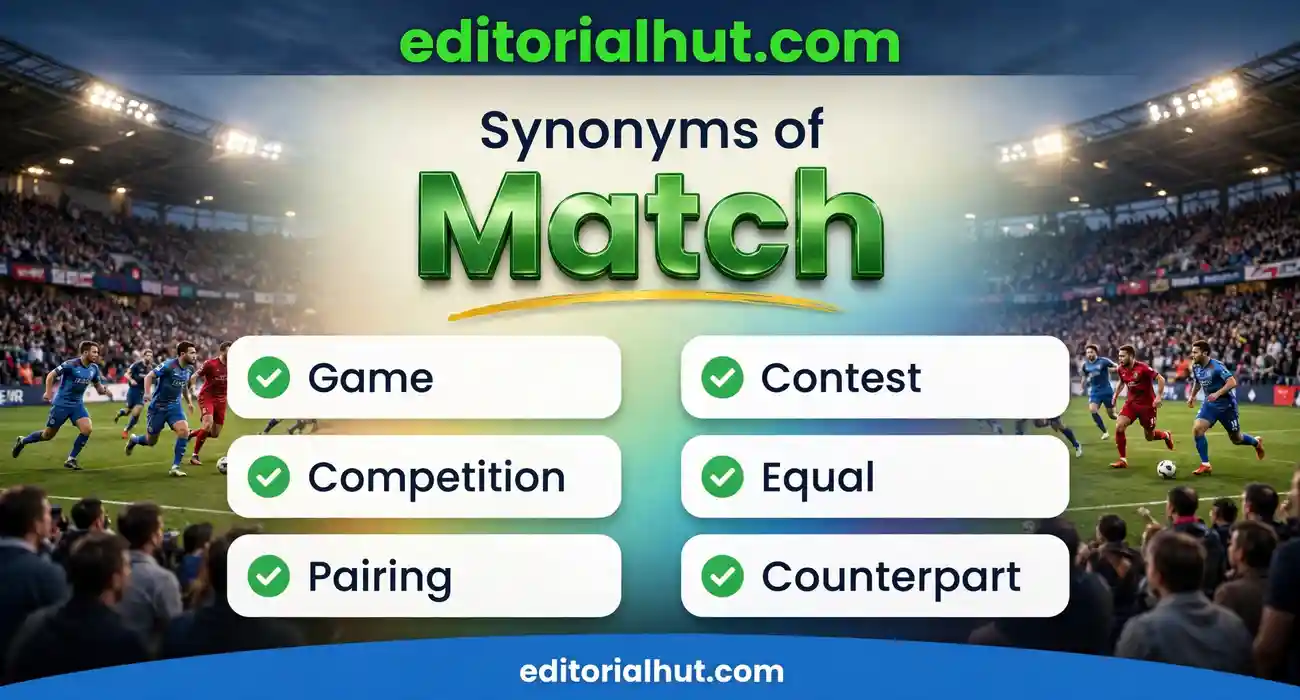
The best synonym for match depends on the sense you mean. For a sports contest, use game or contest. For a person or thing that is your equal, use equal or counterpart. For two things put together as a pair, use pairing or mate. Game is the safest choice for sport, and equal is the safest choice for the equal sense.
Core Synonym Resource
| Synonym | Meaning | Best Use |
|---|---|---|
| Game | A contest played for sport or fun (contest sense) | Sport and play |
| Contest | A competition where people try to win (contest sense) | Formal competitions |
| Competition | An event where people compete to win (contest sense) | Organised sport and business |
| Bout | A short contest, especially in boxing (contest sense) | Boxing and wrestling |
| Duel | A contest between two opponents (contest sense) | Two-person contests |
| Fixture | A sports match set for a date (contest sense) | Football schedules |
| Tie | A match in a knockout cup (contest sense) | Cup matches |
| Clash | A match between strong rivals (contest sense) | Big rivalry games |
| Pairing | Two people or things put together (equal sense) | Teams, food and colours |
| Equal | A person or thing as good as another (equal sense) | Skill and strength |
| Counterpart | A person or thing matching another elsewhere (equal sense) | Business and politics |
| Twin | One of two things that are alike (equal sense) | Identical pairs |
| Parallel | A thing similar to another (equal sense) | Comparisons |
| Mate | A companion or partner, one of a pair (equal sense) | Partners and friends |
| Companion | A person or thing that goes with another (equal sense) | Partners and pairs |
What Does Match Really Mean
Match means four different things, and they belong to two different words that happen to look the same. The first and most common sense is a contest between two opponents. A football match is a game between two teams. In this sense a match needs two sides, and the two sides must be roughly equal, or the contest is not worth watching.
The second sense is the verb, to correspond or to be equal. Colours match when they look good together. To meet your match means to find someone as strong or as clever as you are.
The third sense is a person or thing that is equal to another, or a suitable pair. She is a good match for him, and they are a perfect match. In this sense a match is about fitting together, in skill, in character or in looks.
The fourth sense is a matchstick, a small stick with a chemical head that lights when it is struck. This is a different word from the other three, coming from a word for a candle wick, not from the word for an equal.
Connotative Meaning
Match is neutral and practical, but each sense adds its own feeling. The contest sense suggests excitement, rivalry and fairness, because both sides start equal and the better side wins.
The equal sense suggests balance and harmony. A good match feels right, whether it is two colours that please the eye or two people who please the heart.
The matchstick sense is plain and everyday, used in the simplest sentences, such as “strike a match” and “light a match”.
Word Formation
Match is a base word, not a word built from parts. It comes from the Old English gemæcca, meaning a mate, a companion or an equal. The modern word keeps that old idea of two things fitting together. A match is two sides, two colours, two people or two halves that belong together.
The word is both a noun and a verb, with a large family. Matching and matched are the verb forms. A mismatch is a bad pairing, and a rematch is a second contest between the same opponents. Matchless means without an equal. A matchmaker brings two people together, a matchbox holds matches, and a matchstick lights a fire. Match point is the last point needed to win a game, and matchday is the day of a sports match.
Affixation Pattern
Match follows the regular pattern for a short base word. The verb forms add ing, ed and es, giving matching, matched and matches, with no spelling change, because the word ends in ch. This is the same pattern as watch and watches, catch and catches, and patch and patches.
Prefixes change the meaning in clear ways. The prefix mis means wrong or bad, so mismatch means a bad pairing. The prefix re means again, so rematch means a second match between the same opponents. The suffix less means without, so matchless means without an equal. The suffix er makes a person word, so matcher is a rare word for a person who matches things, though matchmaker is far more common.
Compounds are common with match. Matchbox, matchstick, matchmaker, match point and matchday are all built by joining match to another word, and in each case match tells you what the thing is for.
Syllables
Match has one syllable, match, with the stress on the only syllable. The word is short and strong, a single beat, MATCH. There is no weak syllable and no second beat. English learners sometimes stretch the word into two syllables by mistake. Saying ma tch with a pause in the middle sounds wrong to a native ear. The correct sound is one quick beat, rhyming with catch, patch, batch and latch.
The single syllable is part of the word’s power. Short words feel direct and strong, and match is used in headlines, in sports commentary and in everyday speech.
Pronunciation
The standard American pronunciation of match is /mætʃ/, and the standard British pronunciation is the same, /mætʃ/. Both accents use the same vowel and the same final sound. The vowel is the short a sound, as in cat and hat. The final sound is the ch sound, as in church and chair.
A common mistake is to pronounce the final sound as sh, giving mash. The correct sound is ch, with the tongue touching the roof of the mouth. Another mistake is to stretch the vowel. The correct vowel is short and flat, as in cat.
Etymology
Match, in the sense of an equal and a contest, comes from the Old English gemæcca, meaning a mate, a companion or an equal. That word comes from the Proto-Germanic gamakon, meaning fitting well together, from the Proto-Indo-European root mag, meaning to knead, to fashion or to fit. The same root gives English the verb make.
The verb match appeared in the middle of the fourteenth century, meaning to be able to compete with an equal. The sense of a person or thing that exactly corresponds to another is recorded from around 1400, and the contest sense grew from the verb, because a contest is a meeting of two equals who test each other.
Match, in the sense of a stick for lighting a fire, is a different word. It appeared in the late fourteenth century as macche, meaning the wick of a candle or lamp, from the Old French meiche, meaning a wick, from the Vulgar Latin micca, probably from the Latin myxa, from the Greek myxa. The chemical tipped stick we call a match today came much later, in the nineteenth century, when friction matches were invented.
Short History
The oldest sense of match is the equal sense. Before the year 900, the Old English gemæcca already meant a mate, a fellow or an equal, a warm word used for a husband or wife, a companion or a partner. From that warm sense came the idea of two people or two things that fit together.
In the fourteenth century the verb grew from the noun, and match began to mean to compete with an equal. From that verb came the contest sense, and as organised sport grew, match became the standard word for a contest between two sides.
The fire sense has its own history. In the fourteenth century a match was a wick, in the sixteenth century a slow burning cord used to light guns, and in the nineteenth century the friction match appeared, a small wooden stick with a chemical head.
Closest Synonyms
The closest synonyms for match, in the contest sense, are game, contest and competition. Game is the closest for a sports contest played for fun or for a result. Contest is the closest for a formal competition, such as a quiz or a race. Competition is the closest for a whole event or a series of events.
For the equal sense, the closest synonyms are equal and counterpart. Equal is the closest of all, because it names the very idea of match, one thing as good as another. Counterpart is close too, but it stresses a corresponding role in a different place or group. A minister meets her counterpart in another country, while a player meets his equal on the court.
How to Use Match Correctly
Use match as a noun with between and against, as in a match between two teams, and as a verb with with and against, as in this tie matches your shirt. Use the fixed phrases meet your match and a perfect match, in both sport and everyday life.
Do not use match for a one sided event, because a match needs two sides. A race with one runner is not a match, and a team that wins by ten goals has played a walkover, not a match. Save match for contests where the two sides are roughly equal, or where the result is in doubt.
For the fire sense, use the fixed phrases strike a match and light a match. A match is the stick, not the flame.
Formal Alternatives
In formal writing, contest, competition and counterpart are the best choices. Contest suits organised events, because it is precise and it names a competition with rules and a result. Competition suits sport and business, because it covers single events and long rivalries. Counterpart suits people in matching roles, because it is polite and exact. Avoid game in a formal report, because it sounds light and playful.
Academic Alternatives
In academic writing, competition, counterpart and parallel are the safest choices. Competition appears in papers about sport, economics and education. Counterpart is useful when you compare people or institutions in different places, and parallel is useful when you compare two things that are alike but separate. Academic writers should avoid mate and clash, because those words are too casual or too journalistic for a research paper.
Professional Alternatives
In professional and business writing, competition, fixture and counterpart work best. Competition is the most useful, because business writing often deals with rivals and markets. Fixture is useful for sports business and schedules, because it names a match set for a date. Counterpart is useful for meetings, because it names the person in the matching role on the other side. Match itself is common in professional writing about sport, so a synonym mainly avoids repetition.
Casual Alternatives
In casual speech and informal writing, game, mate and twin are the most natural choices. Game is the simplest word of all, as in a game of football. Mate is warm and friendly, as in my mate from school, and twin is visual and simple, as in twin towers. Avoid counterpart and fixture in casual speech, because they sound stiff and official.
Stronger Alternatives
When you want a stronger effect than match, use duel, clash or bout. Duel is stronger because it suggests two opponents in a serious contest, often for honour. Clash is stronger because it suggests a big game between rivals, with noise and excitement. Bout is stronger in a different way, because it suggests a short, hard fight.
Softer Alternatives
When you want a softer effect than match, use game, pairing or companion. Game is soft because it suggests play rather than a serious contest. Pairing is soft because it suggests two things put together gently, such as food and wine. Companion is soft because it suggests company and warmth rather than rivalry.
15 Important Alternative Explanations
1. Game
Meaning: A contest played for sport or fun, often with rules and a winner.
Difference: Game is lighter than match and is used for sport and play.
Tone: Light, friendly and everyday.
Best Use: Sport and play.
Example: The children played a game of football in the park after school.
Sense: Contest sense.
2. Contest
Meaning: A competition in which people try to win a prize, a title or a result.
Difference: Contest is wider than match. It covers quizzes, races, elections, not only sport.
Tone: Formal, neutral and organised.
Best Use: Formal competitions of every kind.
Example: She won the singing contest with a clear and powerful voice.
Sense: Contest sense.
3. Competition
Meaning: An event, or a series of events, in which people compete to win.
Difference: Competition can mean a whole season, a league or a general rivalry, while a match is one single event.
Tone: Formal and professional.
Best Use: Organised sport, leagues and business rivalry.
Example: The competition for the cup lasts all season, and the final is in May.
Sense: Contest sense.
4. Bout
Meaning: A short contest, especially in boxing, wrestling or fencing.
Difference: Bout is used only for short, hard contests, mostly fights.
Tone: Tough, sporting and direct.
Best Use: Boxing, wrestling and other short fights.
Example: The boxer won his third bout in a row, and the crowd cheered loudly.
Sense: Contest sense.
5. Duel
Meaning: A contest between two people, once with weapons, now in sport, debate or chess.
Difference: Duel always has exactly two opponents, and it suggests honour and a serious test.
Tone: Dramatic, formal and serious.
Best Use: Two person contests, in sport, debate or chess.
Example: The two chess masters met in a final duel for the world title.
Sense: Contest sense.
6. Fixture
Meaning: A sports match arranged for a set date, used mainly in British English.
Difference: Fixture stresses the schedule, not the play. A fixture is a date in the calendar.
Tone: Official, practical and British.
Best Use: Football schedules and league calendars.
Example: Saturday’s fixture is the biggest game of the season for both clubs.
Sense: Contest sense.
7. Tie
Meaning: A match in a knockout cup competition, especially in British English, or a game that ends in a draw.
Difference: Tie is used for cup matches, where the loser leaves the competition.
Tone: Sporting, traditional and British.
Best Use: Cup matches and drawn results.
Example: The cup tie between the two rivals sold out in less than an hour.
Sense: Contest sense.
8. Clash
Meaning: A match between two strong rivals, a big game that draws attention.
Difference: Clash stresses rivalry and excitement. It is the word newspapers use for a big game.
Tone: Dramatic, journalistic and exciting.
Best Use: Big rivalry games and headline fixtures.
Example: The clash of the two league leaders drew a huge crowd to the stadium.
Sense: Contest sense.
9. Pairing
Meaning: Two people or things put together as a pair, for a game, a meal or a task.
Difference: Pairing is about putting together, while match is about being equal.
Tone: Neutral, practical and modern.
Best Use: Teams, food and wine, colours and clothes.
Example: The pairing of the two young players worked from the very first game.
Sense: Equal sense.
10. Equal
Meaning: A person or thing that is as good, as strong or as clever as another.
Difference: Equal is the closest synonym for the equal sense of match, but it is used as an adjective as well as a noun.
Tone: Plain, fair and direct.
Best Use: Skill, strength and ability.
Example: He finally met his equal on the tennis court, and lost in five sets.
Sense: Equal sense.
11. Counterpart
Meaning: A person or thing that matches another in a different place, group or country.
Difference: Counterpart is about a corresponding role, not about a contest.
Tone: Formal, polite and professional.
Best Use: Business, politics and organisations.
Example: She met her French counterpart at the trade talks in Paris.
Sense: Equal sense.
12. Twin
Meaning: One of two things that are exactly alike, a matching pair.
Difference: Twin stresses likeness, while match stresses equality.
Tone: Simple, visual and clear.
Best Use: Identical pairs and matching objects.
Example: The two towers stand like twins on the city skyline.
Sense: Equal sense.
13. Parallel
Meaning: A person or thing that is similar or equal to another in a different setting.
Difference: Parallel is about similarity at a distance.
Tone: Formal, literary and thoughtful.
Best Use: Comparisons across history, art and sport.
Example: There is no parallel to her achievement in modern sport.
Sense: Equal sense.
14. Mate
Meaning: A companion, a partner or a friend, one of a pair.
Difference: Mate is the oldest sense of match, from the Old English gemæcca. Today mate means a friend or a partner, while match means an equal or a contest.
Tone: Warm, friendly and everyday.
Best Use: Partners, friends and doubles pairs.
Example: He found his mate in the doubles tournament, and the two never lost a game.
Sense: Equal sense.
15. Companion
Meaning: A person or thing that goes with another, a partner on a journey or in life.
Difference: Companion stresses company, while match stresses equality.
Tone: Warm, gentle and loyal.
Best Use: Partners, pairs and long friendships.
Example: The old dog was his constant companion on long walks through the hills.
Sense: Equal sense.
Real World Sentence Examples
- The football match between the two rivals ended in a draw, and the crowd stayed to applaud both teams.
- The colour of her dress matches her shoes perfectly, and the whole outfit looks complete.
- He struck a match, lit the candle, and the small room filled with a warm yellow light.
Word Comparisons
Match and game are the closest pair in the contest sense, but they are not identical. Game is the wider and lighter word, used for play and for sport in American English, while match is the narrower and more formal word, used for a contest between two equal sides. Children play a game. Professionals play a match.
Match and equal are the closest pair in the equal sense, but they are not identical either. Equal is a plain word that names the idea of being as good as another, while match is richer, because it also carries the picture of two things fitting together. To meet your equal is to meet someone as good as you. To meet your match is to meet someone who fits you.
Sentence Transformations
- Original: The two teams played a match on Saturday.
- With game: The two teams played a game on Saturday.
- With contest: The two teams met in a contest on Saturday.
- With clash: The two teams met in a clash on Saturday.
- Original: She is a good match for the job.
- With equal: She is the equal of anyone in the office.
- With counterpart: She is the counterpart of the manager in the other branch.
- Original: The colours match well.
- With pairing: The pairing of the colours works well.
- With twin: The two colours are like twins, so close in tone.
- Original: He lit a match to see in the dark.
- With matchstick sense: None of the fifteen synonyms fits this sentence, because they all belong to the contest and equal senses.
Best Word by Situation
| Situation | Best Word | Why It Fits |
|---|---|---|
| A sports contest for fun | Game | Light, friendly, everyday |
| A formal organised event | Contest | Rules, judges and a result |
| A league or a season | Competition | A series of events |
| A short boxing fight | Bout | Short, hard and direct |
| A contest of two rivals | Duel | One against one, serious |
| A date in the calendar | Fixture | Scheduled and official |
| A knockout cup game | Tie | Cup ties and drawn results |
| A big rivalry game | Clash | Exciting and dramatic |
| Two things put together | Pairing | Practical and modern |
| A person as good as you | Equal | Plain and fair |
| A matching role elsewhere | Counterpart | Formal and professional |
| Two identical things | Twin | Visual and simple |
| A comparison across time | Parallel | Formal and thoughtful |
| A friend or a partner | Mate | Warm and everyday |
| A loyal partner | Companion | Gentle and warm |
Collocations
Match is often used with the nouns football, tennis, cricket, boxing and chess, as in a football match and a boxing match, and with the verbs play, win, lose, draw and watch, as in play a match and win the match. Common phrases are meet your match, a perfect match, a good match and match point, the last point needed to win a game. As a verb, match is used with colours, clothes and jobs, as in the tie matches your shirt.
For the fire sense, the fixed phrases are strike a match, light a match and a box of matches.
Common Mistakes
The most common mistake is using match for a one sided event. A team that wins by ten goals has played a walkover, not a match. Save match for contests where the result is in doubt.
Another common mistake is confusing match with fit and suit. A jacket fits you when it is the right size, suits you when it looks good on you, and matches your trousers when the two go well together.
A third mistake is forgetting that match has two different histories. The match you play comes from a word for an equal, and the match you strike comes from a word for a candle wick. Do not look for one meaning that covers both.
Antonyms
There is no true single word antonym for match in the contest sense. The nearest ideas are a walkover, a contest that one side wins without a fight, and a mismatch, a contest between sides that are not equal at all.
For the equal sense, the opposite is mismatch, a bad pairing, or unequal, a person or thing that is not as good as another. For the verb to match, in the sense of to correspond, the opposites are clash, as in colours that clash, and differ, as in opinions that differ. For the fire sense, there is no antonym, because a matchstick is an object.
Search Driven FAQs
What is a synonym for match?
Game, contest and competition for sport, and equal and counterpart for a person or thing that is your equal.
What does match mean in simple words?
It means a contest between two opponents, a person or thing that is equal to another, or a small stick for lighting a fire.
Is game a good synonym for match?
Yes, for the contest sense. Game is the closest word in American English, and it works for most sports.
What is the difference between match and game?
Game is wider and lighter, used for play and for sport. Match is narrower and more formal, used for a contest between two equal sides.
What is the opposite of match?
There is no true single word antonym for the contest sense. The nearest words are walkover and mismatch. For the equal sense, the opposite is mismatch or unequal.
How do you pronounce match?
Match, with one syllable and a short a sound, as in cat. The American and British pronunciations are the same, /mætʃ/.
Is match formal or informal?
Match is neutral, and it is used in formal and informal writing alike. In formal writing, use contest or counterpart. In casual speech, use game or mate.
What is the difference between match and contest?
Contest is wider than match. It covers quizzes, races, elections, not only sport. A match is always a contest, but a contest is not always a match.
Final Takeaway
Match is a word with several lives, and the right synonym depends on which life you mean. For a sports contest, choose game, contest or competition. For a person or thing that is your equal, choose equal or counterpart. For two things put together as a pair, choose pairing or mate.
The best writers match the word to the sense they mean. A child plays a game, a professional plays a match, a minister meets her counterpart, and a player meets his equal. Choose the word that fits the sense, and your sentence will fit as well as a good match should.

Shahid Imran is an English language and vocabulary specialist at EditorialHut.com, focusing on synonyms, word meanings, alternative words, and practical example sentences. He helps readers discover better words, expand their vocabulary, and communicate more clearly and confidently.