










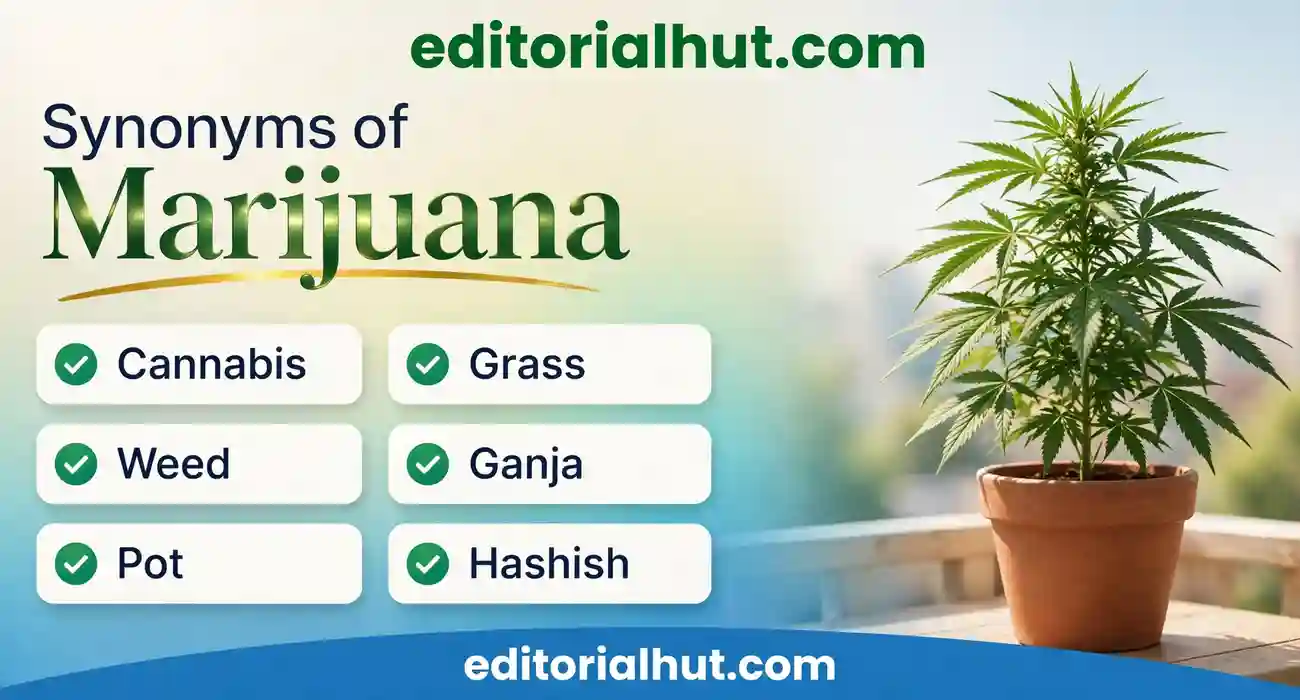
Marijuana is a word used to describe cannabis, a plant known for its effects on the mind and body. However, people use many different words and expressions to refer to it in everyday conversations, literature, music, and popular culture. If you are looking for synonyms for marijuana, you may come across familiar terms such as weed, cannabis, pot, ganja, herb, and Mary Jane. Each word has its own background, tone, and level of formality.
Some terms are commonly used in casual conversations, while others are more suitable for scientific, educational, or formal writing. Understanding these alternatives can help you choose the right word for your sentence and avoid confusion. In this guide, we explore different synonyms for marijuana, their meanings, and how they are used in everyday language.
Quick Answer
The closest general alternative to marijuana is cannabis. Cannabis is the best neutral replacement and it works in formal writing, medical writing and news reports.
If you want a casual word use weed. Weed is the most common everyday replacement in spoken English. If you want an older casual word use pot or grass. If you want a cultural word use ganja in South Asian and Caribbean contexts. You want a formal word use cannabis in every formal context.
Hashish is not an exact synonym. Hashish is a concentrated resin made from the cannabis plant and it is stronger than ordinary marijuana. Use it only when you mean that resin form.
Marijuana is not always interchangeable with cannabis. Cannabis is the name of the plant itself and it can also mean the industrial variety called hemp. Marijuana usually means the dried flowers and leaves used as a drug.
Core Synonym Resource
| Alternative | Meaning | Relationship | Tone | Best Use |
|---|---|---|---|---|
| Cannabis | The cannabis plant and its dried flowers used as a drug | Near synonym | Neutral and formal | Formal writing medical writing and news |
| Weed | Marijuana in everyday slang | Near synonym | Casual | Conversation and informal writing |
| Pot | Marijuana in older informal slang | Near synonym | Casual | Informal speech and older writing |
| Grass | Marijuana in older slang from the 1960s | Near synonym | Casual | Informal speech and period writing |
| Ganja | Marijuana especially in South Asia and the Caribbean | Near synonym | Casual and cultural | Cultural writing and informal speech |
| Hashish | Concentrated resin from the cannabis plant | Related form | Neutral | When the resin form is meant |
| Dope | Marijuana in older slang now often meaning drugs in general | Near synonym | Casual and dated | Informal speech and historical writing |
| Herb | Marijuana especially in Caribbean and Rastafari use | Near synonym | Casual and cultural | Cultural writing and informal speech |
| Mary Jane | A playful euphemism for marijuana | Near synonym | Casual and playful | Informal speech and popular culture |
| Bud | The flowering top of the cannabis plant | Part synonym | Casual | Informal speech about the plant |
| Hemp | Low THC industrial cannabis grown for fibre | Related not exact | Neutral | Industrial and botanical writing |
| Reefer | A marijuana cigarette in 1930s slang | Contextual alternative | Dated | Historical writing and jazz era writing |
| Kif | Cannabis in Moroccan and North African use | Near synonym | Casual and cultural | Cultural writing about North Africa |
| Sinsemilla | Seedless cannabis known for strength | Stronger form | Neutral | Botanical and specialist writing |
| Marihuana | An older spelling of marijuana | Spelling variant | Formal and legal | Legal and historical documents |
What Does Marijuana Really Mean
Marijuana is a noun. It means the dried flowers and leaves of the cannabis plant used as a psychoactive drug. The active compound is THC and it affects mood perception and appetite.
In simple terms marijuana is the common name for the drug form of cannabis. The plant itself is cannabis. The dried material that people use is marijuana. The two words overlap but they are not identical in every sentence.
Marijuana is usually neutral in medical and legal writing. A everyday speech it can sound formal because most people say weed instead. In some social contexts it can sound disapproving because of its long association with drug laws and crime reporting.
A grammar marijuana is used as a mass noun as in marijuana use and before a noun as in a marijuana plant or marijuana laws. It is rarely used in the plural. The word has no common opposite because it names a substance rather than a quality.
Marijuana is also used figuratively in phrases such as marijuana culture and the marijuana debate. These phrases use the word to stand for the whole subject of cannabis use and regulation.
Connotative Meaning of Marijuana
Denotation is the dictionary meaning. Connotation is the feeling the word creates. Marijuana usually creates a neutral feeling in medical and legal writing. In casual conversation it can create a slightly formal feeling because weed is the word most people use.
In a positive context marijuana sounds neutral and factual. A doctor who discusses medical marijuana sounds professional.
In a negative context marijuana can sound loaded. News reports about marijuana arrests can sound disapproving because the word has a long history in crime reporting. The same word changes with the context around it.
Socially marijuana often suggests a formal or official tone. It is the word of laws textbooks and news reports. For a warm tone weed or herb may fit better. For a scientific tone cannabis may fit better.
Word Formation of Marijuana
Marijuana is a borrowing from Mexican Spanish. It entered English as a whole word rather than being built from English parts. Its Spanish form is marihuana and the English spelling changed the h to a j.
Marijuana is not formed from a root and a suffix in English. It has no English prefix and no English suffix. A reader cannot work out its meaning from its parts in the way that fearless can be read as fear plus less.
The word is a single unit in English and its parts in Spanish do not carry a clear meaning either. The origin of the Spanish word itself is uncertain.
Affixation Pattern of Marijuana
Marijuana does not follow an affixation pattern in English because it is a borrowed word.
No prefix plus no root plus no suffix
Marihuana was borrowed whole and then respelled as marijuana
There is no prefix in marijuana. There is no English suffix in marijuana. This is worth knowing because it explains why the word looks unusual in English. It does not follow the patterns of native English words.
The only common English change is the plural form marijuanas which is rare and usually avoided. Writers normally treat marijuana as a mass noun. The adjective form is the same word used before a noun as in marijuana laws.
Syllables in Marijuana
Marijuana has four syllables.
Mar i jua na
The stress falls on the third syllable. Say mar quietly then i quietly then JUA with more force then na quietly. This four syllable shape makes marijuana longer than most of its synonyms.
Pronunciation of Marijuana
US IPA: /ˌmer.əˈwɑː.nə/
UK IPA: /ˌmær.ɪˈwɑː.nə/
The main difference is the vowel sound in the first syllable. In American English the first vowel is often the sound in merry. In British English it is often the sound in marry.
The stress is on the third syllable in both varieties. Do not stress the first syllable. MARijuana sounds unnatural and changes the rhythm of the word.
Etymology of Marijuana
Marijuana comes from Mexican Spanish marihuana. The word entered American English in the late nineteenth century and became widely known in the 1930s.
The origin of the Spanish word is uncertain. One popular story says it comes from the names María and Juana. That story is not proven and most scholars treat it as folk etymology. Another suggestion links it to a Spanish word for a type of plant but the evidence is weak.
What is clear is that marijuana is a borrowing rather than an English formation. It came into English through contact between the United States and Mexico and it still means the dried cannabis plant used as a drug.
Short History of Marijuana
The cannabis plant has been used for thousands of years. Early records from China and India describe its use in medicine and ritual. The word marijuana is much newer than the plant itself.
The early twentieth century the word crossed from Mexico into the United States. In the 1930s newspaper campaigns and the film Reefer Madness made it widely known and gave it a strong association with crime and danger.
In the 1960s and 1970s the counterculture made weed and pot the common words among young people while marijuana remained the word of laws and news reports. The recent decades debates about medical use and legalisation have made cannabis the preferred neutral term in many publications.
The meaning has not changed sharply. It has widened. Marijuana no longer belongs only to law and crime reporting. It belongs to medicine science culture and everyday conversation as well.
Closest Synonyms for Marijuana
The closest synonym is cannabis. Cannabis is the most neutral and the most accurate replacement in formal writing. It names the same plant and the same material without the slang tone.
Weed is the closest synonym in casual speech. It is the word most English speakers use in conversation. It is short simple and widely understood.
Pot and grass are also close but they sound older and they still appear in writing about the 1960s and 1970s. Ganja is close in South Asian and Caribbean contexts but it carries a cultural meaning.
Formal Alternatives for Marijuana
Formal alternatives include cannabis and cannabis flower. These words work well in academic writing medical reports legal documents and news articles.
Cannabis is the safest formal choice. Cannabis flower is more precise when the writer means the dried flowering tops rather than the whole plant.
Formal does not mean better. In a casual conversation cannabis can sound stiff. Use it where the occasion is serious and the meaning must be precise.
Academic Alternatives for Marijuana
In academic writing cannabis is the standard term. Cannabis sativa is used when the species matters. Medical cannabis is used in clinical research when the context is treatment.
Avoid using marijuana in academic writing if the point is botany or chemistry. A sentence such as the study measured cannabis consumption is more precise and more formal.
Professional Alternatives for Marijuana
In professional writing cannabis is the best choice. A medical report should say medical cannabis. A legal document should say cannabis or marijuana depending on the wording of the law it discusses. A workplace policy should use the term that appears in the relevant law.
Use weed only in direct quotes. Slang in a professional document can look careless and it can confuse readers.
Professional language values precision. Choose the word that matches the legal or medical meaning rather than the most familiar slang term.
Casual Alternatives for Marijuana
Casual alternatives include weed pot grass bud and herb. Weed is the most common and the most natural in conversation. Pot is older and less common among younger speakers. Grass is older still and now sounds dated.
Bud is useful when the talk is about the plant itself. Herb is common in Caribbean contexts and in Rastafari culture.
Weed works in almost every casual context. It is the safest casual alternative because it does not sound dated and it does not carry a strong cultural meaning.
Stronger Alternatives for Marijuana
Stronger alternatives in effect include hashish sinsemilla and kief. These are not stronger words in praise. They are stronger forms of cannabis with a higher concentration of THC.
Hashish is a resin pressed from the plant and it is much stronger than ordinary dried marijuana. Sinsemilla is seedless cannabis grown for potency.
Use these words only when you mean those forms. Calling ordinary marijuana hashish is a factual mistake.
Softer Alternatives for Marijuana
Softer alternatives include herb grass and bud. Herb sounds gentle and natural. Grass sounds light and old fashioned. Bud sounds plain and practical because it names a part of the plant.
These words soften the tone because they avoid the legal and medical weight of marijuana. They are useful in casual writing and in conversation where a lighter tone fits.
Alternatives for Writing
For writing choose cannabis for formal use and weed for casual dialogue. Use ganja for cultural writing about South Asia or the Caribbean. Use hashish only for the resin form.
Avoid repeating marijuana in every sentence. The sentence is about the plant use cannabis. If the sentence is about informal use use weed. If the sentence is about the resin use hashish.
Alternatives for Conversation
In conversation weed is the most natural choice. Pot works with older speakers. Grass works when you want a light old fashioned tone. Ganja works among friends who share a South Asian or Caribbean background.
In conversation do not use cannabis unless the talk is serious or medical. It can sound stiff among friends. Do not use dope in conversation with strangers because it can sound rude or dated.
15 Important Alternative Explanations
Cannabis
Meaning: Cannabis means the cannabis plant and its dried flowers used as a drug.
Difference: Cannabis is the scientific name while marijuana is the popular name for the same material.
Tone: Neutral and formal.
Best Use: Formal writing medical writing news reports and academic work.
Example: The clinic published a guide to medical cannabis for patients with chronic pain.
Weed
Meaning: Weed means marijuana in everyday slang.
Difference: Weed is casual while marijuana sounds more formal and official.
Tone: Casual and everyday.
Best Use: Conversation informal writing and dialogue.
Example: He told his friend that he had stopped smoking weed two years earlier.
Pot
Meaning: Pot means marijuana in older informal slang.
Difference: Pot is less common now than weed and it sounds like the 1960s and 1970s.
Tone: Casual and slightly dated.
Best Use: Informal speech and writing about the 1960s and 1970s.
Example: The old film showed young people passing a pot pipe at a party.
Grass
Meaning: Grass means marijuana in older slang.
Difference: Grass is one of the oldest slang terms and it now sounds dated.
Tone: Casual and dated.
Best Use: Informal speech and writing set in the 1960s.
Example: The song from 1969 used the word grass for marijuana.
Ganja
Meaning: Ganja means marijuana especially in South Asia and the Caribbean.
Difference: Ganja comes from Hindi and it carries a cultural meaning that weed does not.
Tone: Casual and cultural.
Best Use: Cultural writing informal speech and music writing.
Example: The reggae singer sang about ganja as part of his faith and culture.
Hashish
Meaning: Hashish means a concentrated resin made from the cannabis plant.
Difference: Hashish is stronger than ordinary marijuana and it is a different form.
Tone: Neutral.
Best Use: When the resin form is meant in any kind of writing.
Example: The customs report listed hashish among the items seized at the border.
Dope
Meaning: Dope means marijuana in older slang and now often means drugs in general.
Difference: Dope is vague because it can mean many drugs and also a foolish person.
Tone: Casual and dated.
Best Use: Informal speech and historical writing only.
Example: The 1970s novel used dope for marijuana in almost every chapter.
Herb
Meaning: Herb means marijuana especially in Caribbean and Rastafari use.
Difference: Herb sounds gentle and natural and it carries a spiritual meaning for Rastafari.
Tone: Casual and cultural.
Best Use: Cultural writing and informal speech.
Example: The elder spoke of herb as a natural plant given for healing.
Mary Jane
Meaning: Mary Jane is a playful euphemism for marijuana.
Difference: Mary Jane plays on the sound of marijuana and it is used for humour.
Tone: Casual and playful.
Best Use: Informal speech popular culture and song lyrics.
Example: The comedian made a joke about Mary Jane in his routine.
Bud
Meaning: Bud means the flowering top of the cannabis plant.
Difference: Bud names a part of the plant rather than the drug in general.
Tone: Casual and practical.
Best Use: Informal speech about growing or buying the plant material.
Example: The grower showed the class a fresh bud from the plant.
Hemp
Meaning: Hemp means low THC industrial cannabis grown for fibre and seed.
Difference: Hemp is not an exact synonym because it has almost no THC.
Tone: Neutral.
Best Use: Industrial botanical and agricultural writing.
Example: Farmers in the region grow hemp for rope cloth and seed oil.
Reefer
Meaning: Reefer means a marijuana cigarette in 1930s slang.
Difference: Reefer is tied to the jazz era and the film Reefer Madness.
Tone: Dated.
Best Use: Historical writing and writing about 1930s culture.
Example: The museum display explained how a reefer was rolled in the 1930s.
Kif
Meaning: Kif means cannabis in Moroccan and North African use.
Difference: Kif comes from Arabic and it usually means a mixture of cannabis and tobacco.
Tone: Casual and cultural.
Best Use: Cultural writing about North Africa.
Example: The travel writer described kif sellers in the old markets of Morocco.
Sinsemilla
Meaning: Sinsemilla means seedless cannabis grown for strength.
Difference: Sinsemilla is stronger because the plant puts its energy into the flowers.
Tone: Neutral.
Best Use: Botanical and specialist writing.
Example: The guide explained that sinsemilla has a higher THC level than seeded cannabis.
Marihuana
Meaning: Marihuana is an older spelling of marijuana.
Difference: Marihuana is the original Spanish spelling and it now appears mainly in legal documents.
Tone: Formal and legal.
Best Use: Legal documents and historical writing.
Example: The old law used the spelling marihuana in every clause.
Real World Sentence Examples
Everyday conversation: He asked his friend if weed was legal in their state.
School: The health teacher explained that marijuana can affect memory and concentration.
Academic writing: The study measured cannabis use among adults over a period of ten years.
Workplace communication: The company policy states that cannabis use is not allowed on company premises.
Journalism: The reporter wrote that marijuana sales had risen after the change in the law.
Formal communication: We thank the researchers who studied medical cannabis for their careful work.
Word Comparisons
Marijuana vs Cannabis
Marijuana and cannabis name the same plant material in most sentences. Cannabis is the scientific name and it sounds neutral and formal. Marijuana is the popular name and it sounds more common and sometimes more loaded. Use cannabis in formal and medical writing.
Marijuana vs Weed
Weed is the casual slang form of marijuana. A doctor would rarely say weed in a report. A friend would rarely say marijuana in a casual chat. Weed is shorter and more natural in speech. Marijuana is clearer in formal writing because it does not sound like slang.
Marijuana vs Hashish
Hashish is not the same as marijuana even though both come from the cannabis plant. Marijuana is the dried flowers and leaves. Hashish is a resin pressed from the plant and it is much stronger. A sentence about hashish means a stronger and more concentrated form. Never replace marijuana with hashish unless you mean the resin form.
Sentence Transformations
Original: The clinic offers medical marijuana to some patients.
Alternative: The clinic offers medical cannabis to some patients.
Change: Cannabis sounds more formal and more scientific. It suits a medical report better than marijuana.
Original: He stopped smoking weed last year.
Alternative: He stopped using marijuana last year.
Change: Marijuana sounds more formal and more neutral. It suits a written report better than the slang word weed.
Original: The police found hashish in the car.
Alternative: The police found marijuana in the car.
Change: This change is wrong. Hashish is a resin form and marijuana is the dried plant. The two words do not mean the same thing and the change would alter the facts.
Best Word by Situation
| If you want to sound | Consider |
|---|---|
| More formal | Cannabis |
| More natural | Weed |
| More academic | Cannabis or cannabis sativa |
| More conversational | Weed |
| Stronger in effect | Hashish or sinsemilla |
| Softer | Herb or grass |
| More cultural | Ganja or herb |
| More historical | Pot grass or reefer |
| More precise | Cannabis flower or hashish |
Collocations and Natural Phrases
Natural combinations include medical marijuana and recreational marijuana. People also say marijuana use and marijuana laws when they talk about regulation. Common patterns include legalise marijuana and decriminalise marijuana in debates about the law.
Common phrases include a marijuana plant and a marijuana cigarette. Marijuana is often used with nouns for law and medicine such as policy debate and treatment.
Avoid unnatural combinations such as a marijuana table or a marijuana colour. Marijuana describes a plant a drug and a subject of law and medicine. It does not describe ordinary objects unless the object is linked to the plant in a clear way.
Common Mistakes With Marijuana
A common mistake is using hashish as an exact synonym for marijuana. Hashish is a concentrated resin and it is stronger than ordinary marijuana. The word choice changes the facts completely.
Another mistake is calling hemp marijuana. Hemp is a low THC industrial variety grown for fibre and seed. It is not used as a drug and calling it marijuana is wrong.
A third mistake is using dope in formal writing. Dope is vague and dated and it can also mean a foolish person. Use cannabis in formal writing instead.
A fourth mistake is using the old spelling marihuana in modern writing. The modern spelling is marijuana. Use marihuana only when you quote an old law or a historical document.
Antonyms of Marijuana
Marijuana has no true antonym because it names a substance rather than a quality. Words such as brave and cowardly are opposites because they describe qualities. A substance cannot have an opposite in the same way.
The nearest contrast is hemp which is the same plant grown for fibre with almost no THC. Hemp is not the opposite of marijuana. It is a different use of the same plant.
Another contrast is sobriety which means the state of not using drugs or alcohol. Sobriety is the opposite of drug use rather than the opposite of the word marijuana. Use it when the point is abstinence rather than the substance itself.
FAQs
What is the closest synonym for marijuana
The closest general synonym is cannabis. Weed is the closest synonym in casual speech. Cannabis works in formal writing and weed works in conversation.
What is another word for marijuana
Another word depends on tone. Cannabis works for formal writing. Weed works for casual speech. Pot works for older informal speech. Ganja works in South Asian and Caribbean contexts.
What is a formal synonym for marijuana
Cannabis is the safest formal synonym. Cannabis flower is also formal and more precise when the dried flowering tops are meant.
What is the difference between marijuana and cannabis
Cannabis is the name of the plant and the scientific term. Marijuana is the popular name for the dried flowers and leaves used as a drug. In most sentences they overlap but cannabis is more formal and more precise.
What is ganja
Ganja is a word from Hindi for marijuana. It is common in India South Asia and the Caribbean. It carries a cultural meaning that cannabis does not carry.
Is hashish the same as marijuana
No. Hashish is a concentrated resin made from the cannabis plant and it is stronger than ordinary marijuana. It is a related form rather than an exact synonym.
What is weed
Weed is the most common casual slang word for marijuana. It is short simple and widely understood in spoken English.
Is hemp the same as marijuana
No. Hemp is a low THC industrial variety of cannabis grown for fibre and seed. It has almost no psychoactive effect and it is not used as a drug.
Final Takeaway
Marijuana is a common word but it is not a universal replacement for every cannabis term. The Choose cannabis for formal writing and weed for everyday conversation. A Choose pot or grass for older informal speech and ganja for South Asian and Caribbean contexts. Choose hashish only for the resin form and hemp only for the industrial plant.
The best synonym is not the most impressive word on the list. It is the word that matches the meaning involved the tone you want and the situation you describe. When you choose with that care your writing sounds more accurate and more human.

Shahid Imran is an English language and vocabulary specialist at EditorialHut.com, focusing on synonyms, word meanings, alternative words, and practical example sentences. He helps readers discover better words, expand their vocabulary, and communicate more clearly and confidently.