









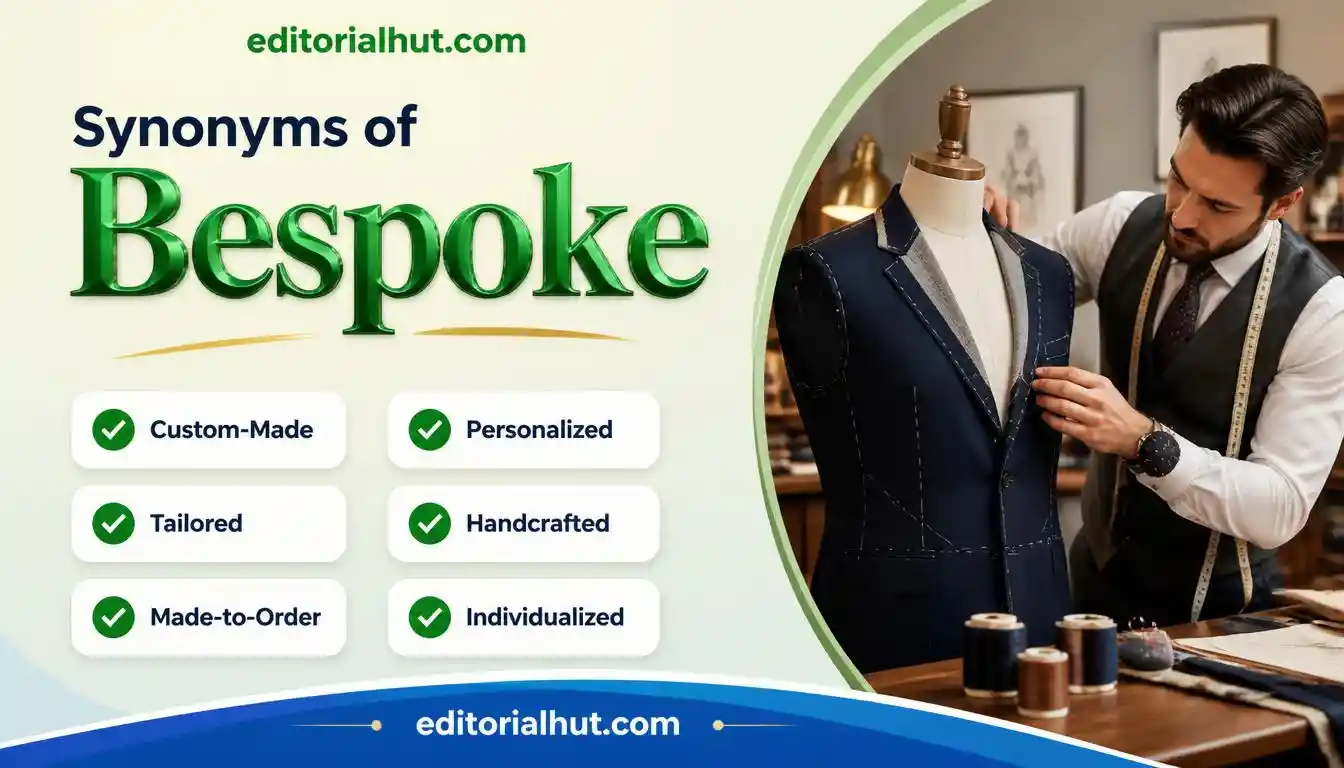
Bespoke means specially made or designed for a particular person, customer, or purpose. The closest synonyms for bespoke include custom-made, tailor-made, customized, made-to-order, and personalized.
Each alternative has a slightly different meaning: custom-made emphasizes individual creation, tailor-made suggests a precise fit, and personalized highlights individual preferences. Choosing the right word depends on whether you are describing clothing, furniture, business services, software, or a unique customer experience.
Quick Answer: What Are the Best Synonyms for Bespoke?
The most useful alternatives to bespoke are:
- Custom-made — made according to an individual’s requirements.
- Tailor-made — designed to fit a particular person or need.
- Customized — modified to suit specific preferences or requirements.
- Made-to-order — produced after a customer places an order.
- Personalized — adapted to an individual, often with personal details or preferences.
- Custom-designed — designed specifically for a particular customer or purpose.
- Made-to-measure — created using an individual’s measurements, especially clothing.
- One-of-a-kind — unique, with no identical counterpart.
- Specially crafted — carefully created for a specific purpose or customer.
- Purpose-built — designed and built for a particular function.
For most situations, custom-made is the closest general alternative. However, bespoke often conveys a premium, exclusive, or highly individualized service, so the best replacement depends on the context.
Closest Synonyms for Bespoke
Not every word associated with bespoke is an exact synonym. Some describe how a product is created, while others emphasize personal preferences, fit, uniqueness, or quality.
| Synonym | Meaning | Best use |
| Custom-made | Made to a customer’s specifications | Furniture, clothing, products |
| Tailor-made | Designed to fit particular needs | Services, solutions, clothing |
| Customized | Modified for a specific customer or purpose | Software, products, experiences |
| Made-to-order | Produced after an order is placed | Clothing, furniture, food |
| Personalized | Adapted to an individual’s preferences or details | Gifts, messages, services |
| Made-to-measure | Made using specific measurements | Suits, dresses, garments |
| Custom-designed | Designed for a particular person or purpose | Interiors, websites, products |
| Individually crafted | Created individually rather than as a standard item | Handmade goods, jewelry |
| Purpose-built | Built for a particular function | Equipment, buildings, software |
| Specially made | Created for a specific requirement | General products and services |
| Handcrafted | Made by hand, often with skilled workmanship | Jewelry, furniture, accessories |
| Exclusive | Restricted to a particular person or group, or not widely available | Luxury goods and services |
| Unique | Different from others or distinctive | Designs, gifts, experiences |
| One-of-a-kind | The only one of its particular kind | Artwork, collectibles, special items |
| Personal-fit | Designed around an individual’s fit or needs | Context-specific product descriptions |
Best general choice: Use custom-made when you need a clear, widely understood replacement for bespoke. Use tailor-made when emphasizing suitability, and personalized when individual preferences are central.
What Does Bespoke Mean?
Bespoke is an adjective that describes something made or designed specifically for an individual customer, organization, or purpose. It suggests that the product or service is created according to particular requirements rather than simply selected from standard options.
The word is especially common in British English and formal business language. In American English, custom-made and custom are often more familiar alternatives. Bespoke is also widely used in luxury retail, interior design, technology, and professional services.
Examples:
- Bespoke clothing: A suit created to fit a particular customer.
- Bespoke furniture: A table designed for a specific room and its dimensions.
- Bespoke software: A program developed to meet an organization’s particular needs.
- Bespoke services: Services planned around an individual client’s requirements.
- Bespoke travel: An itinerary designed around a traveler’s interests and schedule.
The central idea is individual suitability. However, a bespoke product is not automatically handmade, luxurious, expensive, or completely unique. Those qualities depend on how it is designed and produced.
Formal Synonyms for Bespoke
When writing professionally or formally, choose alternatives that communicate customization clearly without making unsupported claims about quality.
1. Custom-made
Meaning: Produced according to a customer’s specific instructions or requirements.
Difference: This is one of the closest general synonyms. It communicates individualized production without necessarily suggesting luxury.
Tone: Neutral and professional.
Example: The homeowner commissioned a custom-made dining table for the new kitchen.
Best for: Product descriptions, formal writing, furniture, clothing, and consumer goods.
2. Tailor-made
Meaning: Specifically adapted to meet a particular person’s needs or a particular situation.
Difference: It emphasizes suitability and fit. It can describe both physical products and abstract solutions.
Tone: Professional, polished, and approachable.
Example: The consultant developed a tailor-made plan for the growing business.
Best for: Business solutions, training, services, education, and clothing.
3. Made-to-order
Meaning: Produced after a customer requests or orders it.
Difference: This expression describes the production process rather than necessarily describing how much the product is customized.
Tone: Clear and practical.
Example: Each made-to-order cabinet is produced after the customer approves the specifications.
Best for: Manufacturing, retail, furniture, fashion, and food.
4. Custom-designed
Meaning: Designed specifically for an individual, organization, or purpose.
Difference: It emphasizes the design process, but the finished item does not necessarily have to be manufactured from scratch.
Tone: Formal and business-friendly.
Example: The company introduced a custom-designed website for its international customers.
Best for: Websites, interiors, products, graphics, and branding.
5. Individually crafted
Meaning: Created as an individual piece, often with attention to detail or skilled workmanship.
Difference: It emphasizes the creation of the item rather than simply its suitability for a customer’s needs.
Tone: Refined and craftsmanship-focused.
Example: The jeweler produced an individually crafted pendant using the client’s chosen stones.
Best for: Jewelry, art, decorative objects, and specialty goods.
List of Synonyms
1. Custom-Made
Meaning: Made according to a particular customer’s specifications or requirements.
Best Use: Clothing, furniture, jewelry, accessories, and other products created for individual customers.
Example: She ordered a custom-made wedding dress that matched her preferred style.
2. Tailor-Made
Meaning: Specifically designed or adapted to suit a person’s needs or a particular purpose.
Best Use: Business solutions, training programs, clothing, and personalized services.
Example: The company developed a tailor-made marketing strategy for the small business.
3. Customized
Meaning: Modified or designed to meet specific requirements or preferences.
Best Use: Software, vehicles, websites, products, and professional services.
Example: We purchased a customized laptop with the features we needed.
4. Personalized
Meaning: Adapted to an individual’s preferences, identity, or personal details.
Best Use: Gifts, invitations, customer experiences, messages, and accessories.
Example: He gave his sister a personalized necklace engraved with her initials.
5. Made-to-Order
Meaning: Produced after a customer places an order rather than being made in advance as standard stock.
Best Use: Furniture, clothing, baked goods, and specialty products.
Example: The furniture company sells made-to-order dining tables in several sizes.
6. Made-to-Measure
Meaning: Made using measurements taken for a particular person, especially in clothing.
Best Use: Suits, dresses, trousers, and other fitted garments.
Example: He bought a made-to-measure suit for his graduation ceremony.
7. Custom-Designed
Meaning: Designed specifically for a particular person, organization, or purpose.
Best Use: Websites, logos, interiors, buildings, and product development.
Example: The restaurant hired a designer to create a custom-designed logo.
8. Handcrafted
Meaning: Made by hand, usually with care and skill.
Best Use: Jewelry, pottery, furniture, leather goods, and decorative items.
Example: She decorated her home with handcrafted wooden ornaments.
9. Individually Crafted
Meaning: Created as an individual piece rather than simply selected from a standard range.
Best Use: Artwork, jewelry, specialty furniture, and artisan products.
Example: Each individually crafted ring features a distinctive design.
10. Purpose-Built
Meaning: Designed and built specifically for a particular function or requirement.
Best Use: Buildings, equipment, software, facilities, and technical systems.
Example: The company installed a purpose-built storage system to organize its inventory.
11. Specially Made
Meaning: Created for a particular person, need, or situation.
Best Use: Everyday descriptions, gifts, special equipment, and customized products.
Example: The tailor created a specially made jacket for the performance.
12. One-of-a-Kind
Meaning: Unique or unlike any other item of its kind.
Best Use: Artwork, collectibles, jewelry, distinctive gifts, and creative designs.
Example: The artist created a one-of-a-kind sculpture for the exhibition.
13. Exclusive
Meaning: Available only to a particular person or group, or restricted in availability.
Best Use: Luxury products, private services, limited collections, and special offers.
Example: The designer launched an exclusive collection for a select group of customers.
Note: Exclusive does not necessarily mean custom-made; a product can be exclusive without being individually designed.
14. Tailored
Meaning: Adapted to meet particular needs, circumstances, or preferences.
Best Use: Professional advice, education, business strategies, and customer services.
Example: The consultant provided tailored advice to help the company improve its performance.
15. Bespoke-Designed
Meaning: Designed specifically around an individual customer’s requirements or a particular purpose.
Best Use: Premium product descriptions, interior design, specialized services, and commissioned creative work.
Example: The architect developed a bespoke-designed kitchen to suit the family’s space and lifestyle.
Usage note: Bespoke-designed is understandable, but bespoke design or custom-designed is often more natural and concise.
Academic Alternatives to Bespoke
In academic writing, the best replacement depends on whether you are describing an intervention, a research method, a product, or a solution.
- Customized: Appropriate when an established method or product has been modified to meet specific requirements. Example: The researchers used a customized questionnaire for the study.
- Individualized: Emphasizes adaptation to a particular person’s characteristics or needs. Example: Each participant received an individualized learning plan.
- Tailored: Describes an approach adapted to a particular objective or population. Example: The intervention was tailored to the needs of older adults.
- Purpose-specific: Highlights a clearly defined function. Example: The team developed a purpose-specific measurement tool.
- Context-specific: Emphasizes suitability for a particular setting or set of circumstances. Example: The researchers selected a context-specific evaluation framework.
These are generally contextual alternatives, not exact replacements in every sentence. For instance, individualized instruction is natural academic English, while bespoke instruction may sound unnecessarily specialized.
Professional Alternatives to Bespoke
The term bespoke appears frequently in consulting, technology, design, and premium services. Here are the best alternatives for workplace communication.
| Alternative | Professional meaning | Example |
| Customized solution | A solution adapted to stated requirements | We created a customized solution for the client’s reporting needs. |
| Tailored service | A service adapted to a particular client | Our team provides tailored support to small businesses. |
| Client-specific | Designed or selected for one particular client | The proposal includes client-specific recommendations. |
| Purpose-built | Built specifically for a defined function | The company uses a purpose-built inventory system. |
| Made to fit | Adapted to practical needs or dimensions | The storage units are made to fit the available space. |
| Specialized | Developed for a particular field or function | The department offers specialized technical support. |
| Personalized service | Service adapted to an individual’s preferences or circumstances | Customers receive personalized assistance throughout the process. |
Writing tip: In business proposals, customized, client-specific, and tailored often communicate the intended meaning more clearly than bespoke, particularly for an American audience.
Casual Alternatives to Bespoke
If you want simpler language for everyday conversations, use familiar expressions rather than formal vocabulary.
Custom-made
“We ordered a custom-made shelf for the bedroom.”
This sounds natural and clearly communicates that the shelf was created according to specific requirements.
Made just for you
“The necklace was made just for you.”
This is warm, direct, and suitable for personal messages, gifts, and casual product descriptions.
Specially made
“They had a specially made case for the equipment.”
This phrase is straightforward and works when the details of customization are not important.
Made to fit
“I bought a desk made to fit the small office.”
Use this expression when dimensions, shape, or practical suitability matter most.
Personalized
“I ordered a personalized notebook with my initials.”
This is particularly useful when a product includes a name, initials, photograph, message, or selected preferences.
Custom
“We got a custom desk for the studio.”
In American English, custom is often the simplest choice. It can function as an adjective in phrases such as custom furniture, custom software, and custom design.
Stronger or Softer Alternatives to Bespoke
Bespoke does not have a direct scale of strength, but some alternatives emphasize particular qualities more strongly.
- One-of-a-kind: Strongly emphasizes uniqueness. Use it only when the item is genuinely distinctive or singular.
- Exclusive: Emphasizes restricted access or availability, not necessarily individual production.
- Handcrafted: Highlights manual skill and workmanship, but does not automatically mean the product was designed for one customer.
- Custom-built: Emphasizes construction according to specific requirements.
- Purpose-built: Highlights the function for which something was built.
- Personalized: Emphasizes individual details or preferences and can sound warmer and less formal.
- Specially made: A softer, simpler expression that avoids the premium tone associated with bespoke.
For example, a bespoke watch emphasizes individualized creation, a handcrafted watch highlights workmanship, and a one-of-a-kind watch makes a stronger claim about uniqueness.
Use the word that accurately describes the product rather than choosing the most impressive-sounding expression.
Important Synonym Differences
Several words can replace bespoke in some situations, but they are not interchangeable in every context.
Bespoke vs. Custom-Made
Both describe products created according to specific requirements.
- Bespoke: Often has a refined or premium tone, especially in British English.
- Custom-made: A straightforward description of individualized production.
Example:
- Bespoke: The designer created a bespoke evening gown for the client.
- Custom-made: The customer ordered a custom-made cabinet.
Which is better? Choose custom-made for general American English and bespoke when the intended style or industry makes it natural.
Bespoke vs. Tailor-Made
These terms overlap, but tailor-made places particular emphasis on suitability.
- Bespoke: Often suggests an individually commissioned product or service.
- Tailor-made: Can describe anything adapted to specific needs, including plans, solutions, and experiences.
Example:
- The tailor created a bespoke suit.
- The instructor developed a tailor-made course for beginners.
The second example emphasizes adapting a course to learners rather than manufacturing something.
Bespoke vs. Customized
The main difference is between individualized creation and modification.
- Bespoke: Often implies that something was specially created for a particular requirement.
- Customized: Usually means that an existing product, system, or approach has been adjusted, although it can also describe a product designed from the beginning for a customer.
Example:
- The company commissioned bespoke software for its operations.
- The company customized its existing software to include new reporting features.
The distinction is useful, but not absolute. A customized product can involve extensive original design.
Bespoke vs. Personalized
These words emphasize different aspects of individual attention.
- Bespoke: Focuses on making or designing something for a particular customer or purpose.
- Personalized: Focuses on adapting something to an individual’s identity, preferences, or circumstances.
Example:
- She ordered a bespoke wedding dress.
- She received a personalized wedding invitation bearing her name.
A personalized item may be mass-produced with individual details added, so it is not necessarily bespoke.
Bespoke vs. Made-to-Order
Both can refer to products created in response to a customer’s order.
- Bespoke: Emphasizes individual specifications or design.
- Made-to-order: Emphasizes when production happens.
Example:
A bakery may offer made-to-order cakes from a standard menu. A bespoke cake may involve a design developed around a customer’s specific theme and requirements.
A made-to-order item is not necessarily bespoke, and a bespoke product may also be made-to-order.
Bespoke vs. Made-to-Measure
These expressions are especially relevant to clothing.
- Bespoke: Traditionally associated with individually commissioned tailoring and a garment made to a customer’s specifications.
- Made-to-measure: Usually refers to adapting an existing pattern or sizing framework to a customer’s measurements.
In specialist tailoring, the distinction can be important. In general marketing, however, businesses sometimes use these terms less precisely, so check what the service actually includes.
Word Formation of Bespoke
The modern adjective bespoke developed from the older verb bespeak. It is not formed by simply adding a modern suffix to the word speak.
Historically, bespoke was the past-tense form of bespeak. Over time, it developed into an adjective describing goods arranged or commissioned in advance and eventually products made to individual specifications.
In contemporary English, it is used mainly as an adjective:
- A bespoke suit
- Bespoke furniture
- A bespoke service
- Bespoke software
It can also describe a person or business that creates such products, as in a bespoke tailor.
Affixation Pattern of Bespoke
Bespoke does not have a transparent modern prefix-and-root structure that learners need to memorize. Its historical relationship with bespeak explains its formation more accurately than treating it as a word built from a productive prefix and suffix.
The spelling should remain bespoke when used as an adjective. Avoid inventing forms such as bespoked to mean custom-made.
Syllables in Bespoke
be-spoke — 2 syllables
The stress falls on the second syllable: be-SPOKE.
Pronunciation of Bespoke
- US IPA: /bɪˈspoʊk/
- UK IPA: /bɪˈspəʊk/
The main difference is the vowel sound in the second syllable. In American English, it sounds like the vowel in go; in standard British English, it has the vowel represented by /əʊ/.
A simple pronunciation guide is bih-SPOHK. The second syllable receives the emphasis.
Etymology of Bespoke
The word comes from bespeak, an older English verb meaning to speak for, arrange, or order something beforehand. The adjective developed from the past-tense form bespoke and its earlier form bespoken.
The connection to custom-made goods became established in the eighteenth century. The word became particularly associated with tailored clothing, especially suits, before expanding into other industries.
Short History of Bespoke
Originally connected with the idea of arranging or ordering something in advance, bespoke became associated with goods commissioned for an individual customer. Tailoring helped establish its modern meaning.
Today, the term is used well beyond clothing. Businesses describe bespoke software, travel plans, interior designs, educational services, and professional solutions. Its broader use reflects the idea of creating something around particular requirements rather than relying entirely on a standard offering.
The word still carries a formal or premium tone in many settings, although its meaning ultimately depends on the product or service being described.
Real-World Examples of Bespoke Synonyms
The following examples show how to choose a natural alternative in different situations.
Everyday Conversation
- Bespoke: They ordered a bespoke sofa for their living room.
- Custom-made: They ordered a custom-made sofa for their living room.
- Personalized: She gave her friend a personalized photo album.
Custom-made is the clearest everyday replacement for bespoke, while personalized is appropriate when personal details are involved.
Business and Workplace
- Bespoke: The agency offers bespoke marketing strategies.
- Tailored: The agency offers tailored marketing strategies.
- Customized: We developed a customized reporting system for the client.
- Client-specific: The report contains client-specific recommendations.
Tailored is particularly natural for services and strategies, whereas customized works well for products, systems, and processes.
Fashion and Clothing
- Bespoke: He wore a bespoke suit to the formal event.
- Made-to-measure: She ordered a made-to-measure jacket.
- Custom-made: The designer created a custom-made wedding dress.
- Handcrafted: The artisan produced a handcrafted leather belt.
These words emphasize different characteristics: individual design, measurements, customized production, and manual workmanship.
Technology and Software
- Bespoke: The company commissioned bespoke software.
- Custom-built: The developers created a custom-built application.
- Purpose-built: The organization installed a purpose-built database.
- Customized: The team customized the existing platform.
Choose custom-built when construction is central, purpose-built when the intended function matters most, and customized when an existing system has been adapted.
Academic and Educational Writing
- Bespoke: The school introduced bespoke learning materials.
- Individualized: The school introduced individualized learning plans.
- Tailored: The program offers tailored instruction.
- Context-specific: The researchers developed a context-specific assessment.
These alternatives sound natural when the focus is on adapting educational or research methods to particular needs.
Sentence Transformations Using Bespoke Synonyms
Here are practical ways to replace bespoke without changing the intended meaning unnecessarily.
Original: The designer created a bespoke dress for the customer.
Alternative: The designer created a custom-made dress for the customer.
Difference: The alternative is more direct and widely understood.
Original: The company offers bespoke solutions for small businesses.
Alternative: The company offers tailored solutions for small businesses.
Difference: Tailored emphasizes how the solutions meet business needs.
Original: We ordered bespoke furniture for the office.
Alternative: We ordered made-to-order furniture for the office.
Difference: The revised sentence emphasizes production after an order. It does not necessarily imply the same degree of customization.
Original: The developer built a bespoke application.
Alternative: The developer built a custom-built application.
Difference: Custom-built emphasizes how the application was developed. The original sentence may place more emphasis on its specific requirements.
Original: She received a bespoke gift for her birthday.
Alternative: She received a personalized gift for her birthday.
Difference: The replacement works best if the gift includes her name, preferences, or another personal detail.
Which Alternative Should You Choose?
The best synonym depends on the object, the audience, and the meaning you want to emphasize.
| If you want to describe… | Choose… |
| A product made to individual specifications | Custom-made |
| A solution designed around specific needs | Tailored |
| A product modified from a standard version | Customized |
| Production that begins after an order | Made-to-order |
| Clothing created using personal measurements | Made-to-measure |
| A product bearing personal details | Personalized |
| A product constructed for a specific function | Purpose-built |
| A product made by hand | Handcrafted |
| Something genuinely unique | One-of-a-kind |
| A straightforward everyday alternative | Custom |
| A formal, premium-sounding description | Bespoke or custom-designed |
| A method adapted to a particular research setting | Context-specific |
Remember that tone and accuracy matter more than choosing a sophisticated word. A simple, precise alternative is often more effective than a fashionable term.
Common Phrases With Bespoke
Bespoke frequently appears before nouns that describe products, services, and solutions.
- Bespoke suit: Clothing commissioned for an individual customer.
- Bespoke furniture: Furniture created for particular requirements.
- Bespoke software: Software designed or developed for specific needs.
- Bespoke solutions: Solutions developed to address particular challenges.
- Bespoke services: Services adapted to individual or organizational requirements.
- Bespoke design: A design created for a specific client or purpose.
- Bespoke website: A website designed or developed around particular requirements.
- Bespoke experience: An experience planned to suit individual preferences.
- Bespoke training: Training adapted to a learner, group, or organization.
- Bespoke package: A package assembled to meet particular requirements.
Common Sentence Patterns
- Bespoke + noun: The company offers bespoke furniture.
- A bespoke solution for + noun: We created a bespoke solution for the client.
- Designed specifically for + purpose: The equipment was designed specifically for laboratory use.
- Tailored to + needs: The program is tailored to individual needs.
- Customized to meet + requirements: The system was customized to meet the team’s requirements.
These patterns help you select an alternative that fits naturally into a sentence.
Common Mistakes With Bespoke
1. Assuming Bespoke Always Means Handmade
A bespoke product may be handmade, machine-produced, or created using a combination of methods. The word describes its relationship to specific requirements, not necessarily how it was manufactured.
2. Using Personalized and Bespoke Interchangeably
A personalized notebook may simply have a name printed on its cover. A bespoke notebook might involve a more extensive design developed around a customer’s specifications.
The distinction depends on what was customized.
3. Treating Made-to-Order as an Exact Synonym
Made-to-order describes production timing. A standard product can be made-to-order without substantial customization.
Use custom-made or bespoke when the individualized specifications are the main point.
4. Assuming Exclusive Means Custom-Made
Exclusive generally describes restricted availability, access, or distribution. An exclusive product may be mass-produced, so exclusivity alone does not make it bespoke.
5. Using Bespoke in Every Product Description
Repeatedly using bespoke can make writing sound promotional or vague. Specific descriptions such as custom-built shelving, tailored financial advice, or made-to-measure clothing often tell readers more.
6. Forgetting Regional Differences
Bespoke is especially associated with British English and formal language. In American English, custom, custom-made, and tailored are often more natural choices.
Neither usage is inherently wrong; the audience should guide your choice.
Antonyms of Bespoke
Bespoke has no single perfect opposite in every context. The most useful antonyms describe standardized or mass-produced products.
- Mass-produced: Manufactured in large quantities using standardized processes.
- Off-the-shelf: Available as a standard product without special customization.
- Ready-made: Already manufactured and available for purchase.
- Standardized: Made or organized according to established specifications.
- Generic: Not specifically adapted to an individual or particular situation.
- Pre-made: Prepared or manufactured in advance rather than created in response to a particular order.
Examples:
- Bespoke furniture vs. mass-produced furniture
- Custom software vs. off-the-shelf software
- Made-to-measure clothing vs. ready-made clothing
- A tailored plan vs. a generic plan
These opposites are context-dependent. For example, standardized can describe a process rather than a physical product, while generic may imply a lack of individual adaptation rather than mass production.
Frequently Asked Questions
1. What is the closest synonym for bespoke?
Custom-made is one of the closest general synonyms. It describes something made according to an individual’s requirements. Tailor-made is another close alternative, especially when emphasizing suitability for a particular need.
2. What is another word for bespoke in American English?
Common American English alternatives include custom, custom-made, customized, and tailor-made. Custom-made is particularly useful when describing a product created to specific requirements.
3. What is a more professional word for bespoke?
Tailored, customized, client-specific, and custom-designed are useful professional alternatives. Choose according to whether you mean an adapted service, a modified product, or a design developed for a particular client.
4. Is bespoke the same as custom-made?
The meanings overlap substantially. Both can describe something made for a particular customer. Bespoke often has a more formal or premium tone, while custom-made is a more straightforward description.
5. What is the difference between bespoke and personalized?
Bespoke emphasizes individualized design or production. Personalized emphasizes individual details or preferences. A product can be personalized without being fully custom-made.
6. Is bespoke a formal word?
Yes. Bespoke is generally considered a formal adjective, particularly in British English. It is common in luxury retail, tailoring, design, and professional services. American English often favors custom-made.
7. What is the opposite of bespoke?
Depending on the context, useful opposites include mass-produced, off-the-shelf, ready-made, and standardized. Each describes a different aspect of something that is not individually customized.
8. How do you pronounce bespoke?
In American English, bespoke is pronounced /bɪˈspoʊk/. In standard British English, it is /bɪˈspəʊk/. Both pronunciations have two syllables, with the stress on the second syllable.
Final Takeaway
The best synonyms for bespoke are custom-made, tailor-made, customized, made-to-order, and personalized, but each highlights a different aspect of individualization.
Use custom-made for products created to specific requirements, tailor-made for solutions adapted to particular needs, personalized for individual details, and made-to-order when production begins after an order. Choose bespoke when its formal tone fits your audience and the product or service genuinely reflects specific requirements.
The key is to select a word that communicates exactly what was made, how it was adapted, and whom it was designed to serve.

Shahid Imran is an English language and vocabulary specialist at EditorialHut.com, focusing on synonyms, word meanings, alternative words, and practical example sentences. He helps readers discover better words, expand their vocabulary, and communicate more clearly and confidently.