










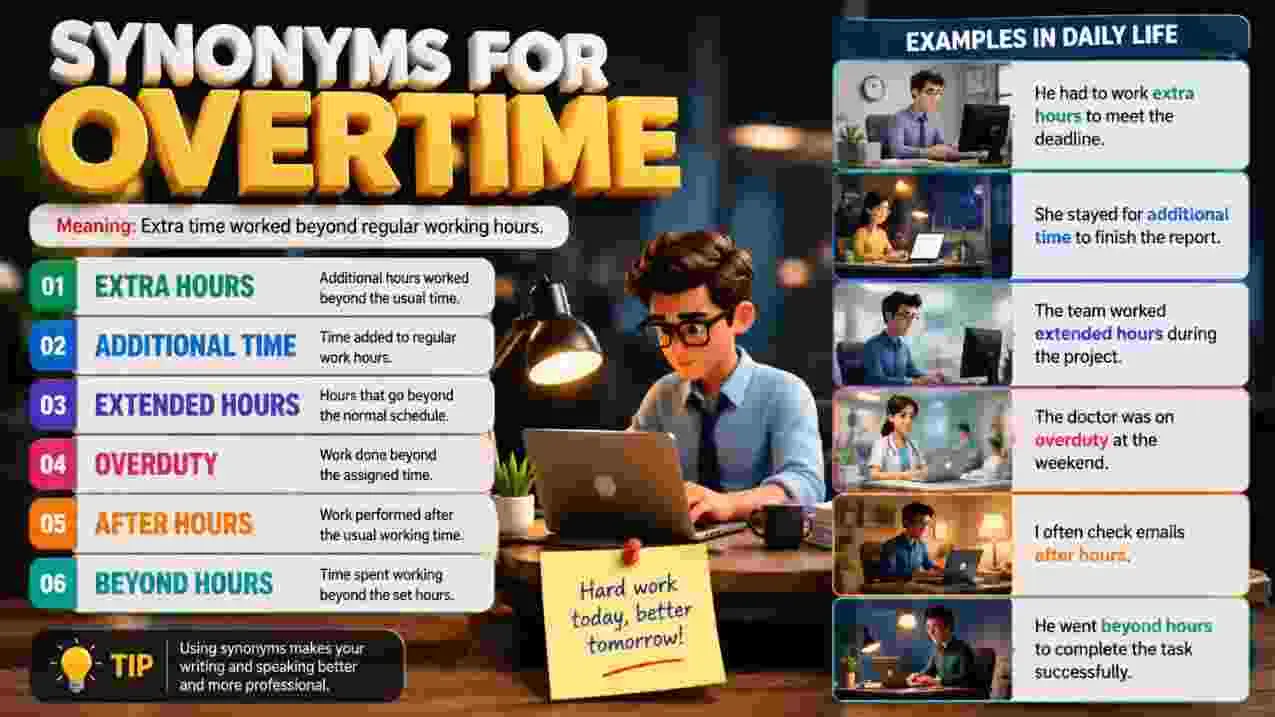
Have you ever stayed at work long after everyone else went home? That extra time you spend working is called overtime. It simply means working more hours than your normal schedule.
But writing “overtime” again and again can make your sentences feel repetitive. That’s where synonyms for overtime come in handy. They help you say the same idea in fresh, natural ways.
Learning different words for overtime is useful for many people. Students use them in essays. Bloggers use them to keep articles interesting. Content writers use them to avoid repeating the same word. ESL learners use them to build stronger vocabulary. Everyday English users use them in emails, conversations, and workplace chats.
What Are the Best Synonyms for Overtime?
The best synonyms for overtime include extra hours, extended hours, extra shift, additional work hours, and time and a half. Each word describes working beyond your normal schedule, though some focus on pay, time, or effort. Choosing the right one depends on your context, whether it’s formal writing, casual talk, or workplace communication.
Overtime Synonyms at a Glance
| Synonym | Simple Meaning | Best Used For |
| Extra hours | Time worked beyond the normal schedule | Everyday conversation |
| Extended hours | A longer-than-usual work period | Business writing |
| Extra shift | An additional work session | Workplace talk |
| Additional work hours | More hours added to a schedule | Formal writing |
| Time and a half | Pay rate for overtime work | HR and payroll topics |
| Double time | Doubled pay rate for extra work | HR and payroll topics |
| Working late | Staying at work past normal hours | Casual conversation |
| Staying late | Remaining at work longer than usual | Casual conversation |
| Extended workday | A workday that runs longer than normal | Business writing |
| Unpaid overtime | Extra work hours without extra pay | Workplace discussions |
| Paid overtime | Extra work hours with extra pay | Workplace discussions |
| Longer hours | A schedule stretched beyond normal length | Everyday conversation |
| Extra work | Additional tasks or time on the job | General writing |
| Off-the-clock work | Work done outside paid hours | Workplace discussions |
| Burning the midnight oil | Working very late into the night | Creative or casual writing |
1. Extra Hours
Meaning: Extra hours means additional time spent working beyond your normal schedule.
Examples: I worked extra hours this week to finish the project. She always puts in extra hours before a big deadline.
2. Extended Hours
Meaning: Extended hours refers to a work period that has been stretched longer than usual.
Examples: The store offers extended hours during the holiday season. Our team worked extended hours to launch the new app on time.
3. Extra Shift
Meaning: An extra shift is an additional work session added to a regular schedule.
Examples: He picked up an extra shift to earn more money. The manager asked two nurses to cover an extra shift.
4. Additional Work Hours
Meaning: Additional work hours are more hours added on top of a normal schedule.
Examples: The company approved additional work hours for the busy season. She logged additional work hours to finish the report early.
5. Time and a Half
Meaning: Time and a half is a pay rate that is one and a half times the normal hourly wage, often used for overtime.
Examples: Employees earn time and a half for any hours worked past forty. He was happy to get time and a half for the weekend shift.
6. Double Time
Meaning: Double time is a pay rate that is twice the normal hourly wage, usually for holidays or very long shifts.
Examples: Workers received double time for the holiday shift. The factory pays double time after twelve hours in one day.
7. Working Late
Meaning: Working late means staying at your job past the usual end time.
Examples: I was working late again last night to meet the deadline. My brother is working late this week because of a big order.
8. Staying Late
Meaning: Staying late means remaining at work longer than your normal schedule requires.
Examples: She stayed late to help a new coworker learn the system. We had to stay late because the printer broke down.
9. Extended Workday
Meaning: An extended workday is a full day at work that lasts longer than the standard schedule.
Examples: The extended workday left everyone tired but proud of the results. Holiday sales often mean an extended workday for retail staff.
10. Unpaid Overtime
Meaning: Unpaid overtime is extra work time that is not paid, often expected in salaried jobs.
Examples: Many employees quietly put in unpaid overtime every week. Unpaid overtime can lead to burnout if it happens too often.
11. Paid Overtime
Meaning: Paid overtime is extra work time that comes with additional pay.
Examples: He requested paid overtime instead of unpaid extra hours. The contract clearly states the rules for paid overtime.
12. Longer Hours
Meaning: Longer hours describes a work schedule that has been stretched beyond the normal length.
Examples: The restaurant needs longer hours during festival season. Working longer hours all month left her exhausted.
13. Extra Work
Meaning: Extra work refers to additional tasks or time added on top of regular duties.
Examples: The manager gave the team extra work before the audit. Doing extra work on weekends helped him get promoted.
14. Off-the-Clock Work
Meaning: Off-the-clock work is work done outside official paid hours, often without pay.
Examples: Answering emails at midnight is a form of off-the-clock work. The company was fined for requiring off-the-clock work.
15. Burning the Midnight Oil
Meaning: Burning the midnight oil is an idiom meaning to work very late into the night.
Examples: She was burning the midnight oil to finish her thesis. The design team burned the midnight oil before the product launch.
16. Extra Duty
Meaning: Extra duty means additional responsibilities or hours added to someone’s normal role.
Examples: The soldier was assigned extra duty for the weekend. Teachers sometimes take on extra duty during exam season.
17. Extended Shift
Meaning: An extended shift is a single work period that runs longer than the standard shift length.
Examples: Nurses often work an extended shift during flu season. The extended shift ended after fourteen hours on the floor.
18. Supplementary Hours
Meaning: Supplementary hours are additional hours added to support a normal work schedule.
Examples: The clinic added supplementary hours to see more patients. He earned extra income through supplementary hours on weekends.
19. Additional Duty Hours
Meaning: Additional duty hours describe extra time spent on job-related responsibilities.
Examples: Officers logged additional duty hours during the event. The report tracked additional duty hours across departments.
20. Extended Labor Hours
Meaning: Extended labor hours refer to a lengthened period of physical or manual work.
Examples: The construction crew worked extended labor hours to beat the storm. Extended labor hours are common during harvest season.
21. Extra Work Period
Meaning: An extra work period is a set block of additional time added to a schedule.
Examples: The factory scheduled an extra work period to meet demand. Employees were notified about the extra work period in advance.
22. Prolonged Work Hours
Meaning: Prolonged work hours describe a schedule that continues for an unusually long time.
Examples: Prolonged work hours can affect both health and focus. The team faced prolonged work hours during the merger.
23. Extra Work Time
Meaning: Extra work time simply means more time spent working than usual.
Examples: She used extra work time to double-check every detail. The project required extra work time from the entire team.
24. Clocking Extra Time
Meaning: Clocking extra time means officially recording additional hours worked, often for pay purposes.
Examples: He was clocking extra time every Friday before the holidays. The payroll system tracks anyone clocking extra time.
25. Putting in Extra Hours
Meaning: Putting in extra hours means voluntarily or willingly working beyond your normal schedule.
Examples: She has been putting in extra hours to earn a promotion. The whole team put in extra hours before the big release.
26. Extended Working Period
Meaning: An extended working period is a longer stretch of continuous work than usual.
Examples: The extended working period ended just before midnight. Doctors sometimes face an extended working period during emergencies.
27. Extra Shift Hours
Meaning: Extra shift hours refer to the additional hours added to a specific shift.
Examples: Extra shift hours helped cover the staff shortage. He signed up for extra shift hours to save for vacation.
28. Additional Hours on the Clock
Meaning: This phrase describes extra time officially recorded as part of a person’s work hours.
Examples: She had several additional hours on the clock this month. Additional hours on the clock meant a bigger paycheck.
29. Extended Service Hours
Meaning: Extended service hours refer to a business or worker staying available longer than usual, similar in spirit to overtime.
Note: This is a near-synonym. It fits business contexts more than personal work schedules.
Examples: The hospital offers extended service hours on weekends. Extended service hours helped the shop handle holiday crowds.
30. Overextended Schedule
Meaning: An overextended schedule describes a workload stretched well beyond normal limits, often as a result of overtime.
Note: This is a related term rather than a direct synonym, since it describes the result of overtime rather than the extra hours themselves.
Examples: His overextended schedule left little time for rest. An overextended schedule can lead to stress and mistakes.
How to Choose the Right Synonym for Overtime
Synonyms rarely mean exactly the same thing. Some words feel formal. Others feel casual. Some carry a positive tone, while others hint at stress or unfairness.
Formal vs. informal words: “Additional work hours” fits a business report. “Staying late” fits a casual chat with a friend.
Positive vs. negative meanings: “Putting in extra hours” sounds dedicated. “Unpaid overtime” can sound unfair or exhausting.
Strong vs. weak meanings: “Prolonged work hours” feels heavier than “extra hours.”
Academic writing often needs neutral, precise terms like “additional work hours.”
Business writing favors clear, professional phrases like “extended hours” or “supplementary hours.”
Casual conversation works well with simple phrases like “working late” or “staying late.”
Creative writing can use vivid expressions like “burning the midnight oil.”
Social media content benefits from short, relatable phrases like “extra hours” or “working late again.”
Choosing the right synonym keeps your writing accurate and natural.
Formal and Informal Synonyms for Overtime
| Formal Synonym | Informal Synonym | Example Context |
| Additional work hours | Extra hours | Workplace memo vs. casual chat |
| Extended workday | Staying late | HR policy vs. friendly conversation |
| Supplementary hours | Extra shift | Business report vs. break room talk |
| Prolonged work hours | Working late | News article vs. text message |
| Extended labor hours | Burning the midnight oil | Industry report vs. creative writing |
Best Synonyms for Different Contexts
Academic Writing Additional work hours, extended labor hours, prolonged work hours, extended working period, supplementary hours.
Blog Writing Extra hours, extended hours, working late, extra shift, burning the midnight oil.
Business Writing Extended hours, additional work hours, supplementary hours, extended workday, paid overtime.
Everyday Conversation Working late, staying late, extra hours, extra shift, putting in extra hours.
Creative Writing Burning the midnight oil, prolonged work hours, overextended schedule, extended working period, working late.
Common Mistakes When Using Synonyms
- Choosing a word with the wrong meaning. “Double time” refers to pay, not simply extra hours worked.
- Using a formal word in casual speech. Saying “supplementary hours” to a friend can sound stiff and unnatural.
- Replacing a word without checking context. “Extended service hours” fits businesses, not personal work schedules.
- Using a synonym that changes the tone. “Unpaid overtime” can sound negative even in a neutral sentence.
- Repeating synonyms too much in SEO content. Using the same word in every paragraph feels robotic and hurts readability.
Synonyms vs. Related Words
True synonyms share almost the same meaning. “Extra hours” and “additional hours” are true synonyms.
Near-synonyms are close in meaning but carry small differences. “Extended service hours” is close to overtime but usually describes a business, not a person’s schedule.
Related words connect to the topic without meaning the same thing. “Overextended schedule” relates to overtime but describes its effect, not the extra time itself.
Contextual alternatives only work in specific situations. “Time and a half” only makes sense when discussing pay.
Understanding these differences helps you choose words that stay accurate.
How to Use Synonyms in Your Writing
Synonyms add variety and keep readers interested. Use them wisely across different types of writing:
- Essays: Replace repeated words with terms like “additional work hours” or “prolonged work hours.”
- Blog posts: Mix casual and formal synonyms to keep the tone natural.
- Emails: Use professional terms like “extended hours” when writing to a manager.
- Website content: Vary your wording to match different search terms.
- Social media posts: Keep it short with words like “extra hours” or “working late.”
- Stories: Add color with phrases like “burning the midnight oil.”
- School assignments: Choose precise, formal synonyms for clarity.
Frequently Asked Questions About Overtime
What is another word for overtime?
Another word for overtime is “extra hours.” It simply means time worked beyond a normal schedule.
What is the best synonym for overtime?
“Extra hours” works well in most situations because it’s clear, simple, and widely understood.
Which synonym is best for formal writing?
“Additional work hours” or “extended workday” both fit formal writing well.
Which synonym is best for everyday conversation?
“Working late” or “staying late” sound natural in casual conversation.
Can I use these synonyms in academic writing?
Yes. Words like “additional work hours” and “extended labor hours” work well in academic writing because they sound neutral and precise.
Are all synonyms exactly the same?
No. Some are true synonyms, while others are near-synonyms or related words with slightly different meanings.
How can I learn synonyms easily?
Read example sentences, practice using new words in your own writing, and review word lists regularly to build memory.
How can synonyms improve my writing?
Synonyms add variety, reduce repetition, and help you express ideas more clearly and naturally.
Conclusion
Learning synonyms for overtime can make your writing clearer and more interesting. Whether you’re writing an email, a blog post, or a school essay, the right synonym helps you express your ideas with variety and precision.
Try using these words in your emails, essays, blog posts, school assignments, and daily conversations. The more you practice, the more natural they will feel.
Start small, use one new synonym today, and watch your vocabulary grow.

Shahid Imran is an English language and vocabulary specialist at EditorialHut.com, focusing on synonyms, word meanings, alternative words, and practical example sentences. He helps readers discover better words, expand their vocabulary, and communicate more clearly and confidently.