









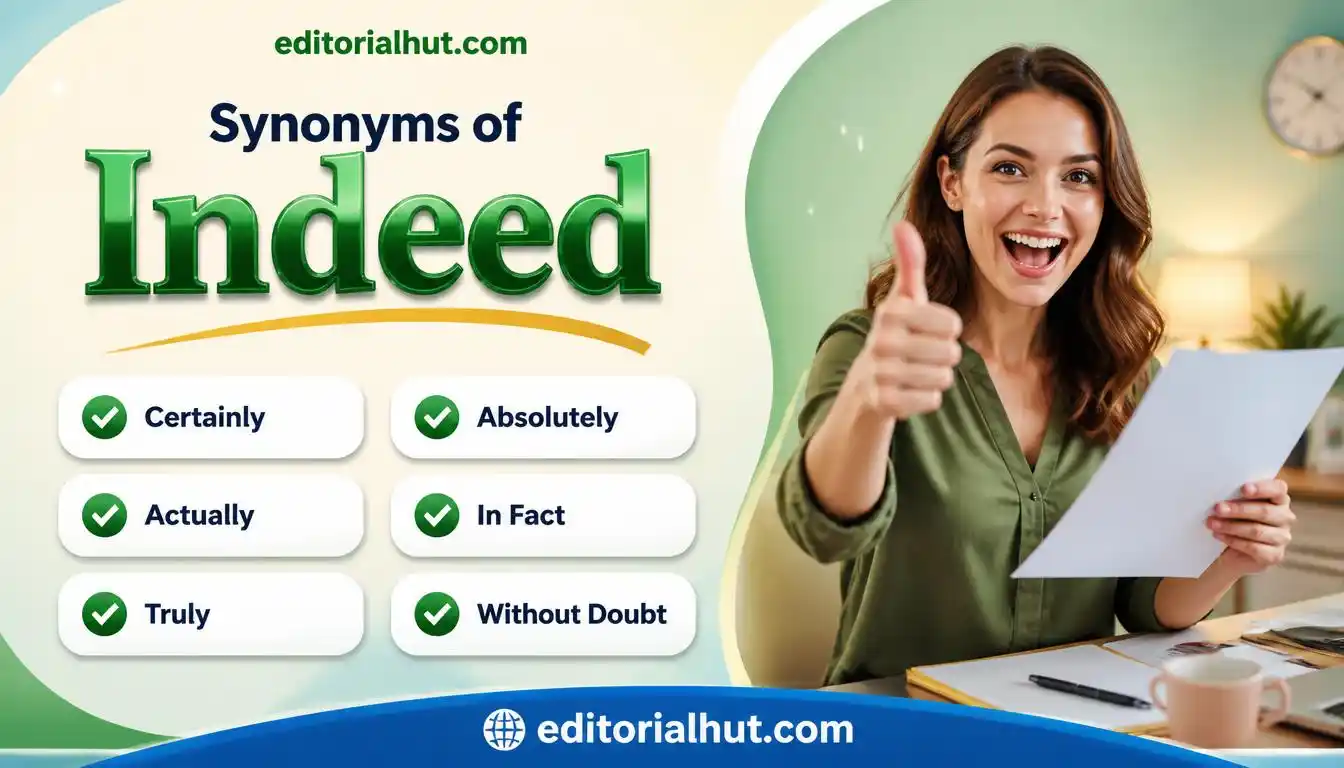
The best synonyms for indeed include certainly and truly when you want to show strong agreement or emphasize that something is true. Other useful alternatives include really and actually. The best choice depends on the sentence and the tone you want.
Although these words can have similar meanings, they are not always interchangeable. Indeed can show agreement. It can also add emphasis or confirm a statement. Understanding these small differences helps you choose a more natural word for formal writing and everyday English.
Quick Answer
Here are some useful synonyms for indeed:
| Alternative | Meaning | Tone | Best Use |
| Certainly | Without doubt | Formal and neutral | Agreement and strong confirmation |
| Truly | In a real or sincere way | Neutral | Emphasis and sincerity |
| Really | In fact or to a great degree | Casual and neutral | Everyday speech |
| Actually | In fact | Neutral | Correction or clarification |
| Definitely | Without question | Neutral | Strong agreement |
| Surely | It is reasonable to believe | Neutral | Strong expectation |
| Absolutely | Completely or certainly | Strong | Informal agreement |
| Unquestionably | Without reasonable doubt | Formal | Academic and formal writing |
| Clearly | In an obvious way | Neutral | Emphasizing evidence |
| In fact | Used to confirm a fact | Neutral | Formal and everyday writing |
The closest general alternatives are certainly and truly. However the best synonym changes according to the meaning of indeed in the sentence.
What Does Indeed Really Mean?
Indeed is an adverb used to emphasize a statement or show that something is true.
It can mean certainly or truly.
For example:
She is indeed talented.
This means that she is truly talented.
Indeed can also show strong agreement.
“That was a difficult exam.”
“Indeed it was.”
Here indeed means something close to certainly or yes.
The word can also strengthen an earlier statement.
The problem was difficult indeed.
Here indeed adds strong emphasis to the word difficult.
The Main Meanings of Indeed
The word indeed has several closely related uses.
Indeed Meaning One: Certainly
In some sentences indeed means certainly.
He is indeed the right person for the job.
The speaker strongly confirms the statement.
Possible replacement:
He is certainly the right person for the job.
Indeed Meaning Two: Truly
Indeed can mean truly when the speaker wants to emphasize that something is genuinely true.
She is indeed a talented writer.
Possible replacement:
She is truly a talented writer.
Indeed Meaning Three: In Fact
Indeed can introduce information that confirms or strengthens a previous statement.
The weather was cold. Indeed it was colder than expected.
Here indeed is close to in fact.
Indeed Meaning Four: Strong Agreement
Indeed can be used as a short response.
“This is an important issue.”
“Indeed.”
In this use it expresses agreement.
Closest Synonyms for Indeed
Certainly
Certainly is one of the closest alternatives to indeed when the meaning is strong confirmation.
She is indeed ready.
She is certainly ready.
Both sentences strongly confirm that she is ready.
Certainly is especially useful in professional and formal communication.
Truly
Truly means genuinely or really.
He is indeed kind.
He is truly kind.
Truly works well when you want to emphasize sincerity or genuine quality.
Really
Really is a common everyday alternative.
It is indeed important.
It is really important.
The second sentence sounds more conversational.
Definitely
Definitely expresses strong certainty.
I will indeed help you.
I will definitely help you.
Definitely is common in conversation and informal writing.
Actually
Actually means in fact.
The task was indeed harder than expected.
The task was actually harder than expected.
However actually often introduces a correction or clarification. It should not replace indeed in every sentence.
Surely
Surely expresses strong belief or expectation.
Surely he will indeed understand.
The word can sound more questioning or persuasive than indeed.
Absolutely
Absolutely can express very strong agreement.
“Is this the right answer?”
“Indeed.”
“Absolutely.”
Absolutely is especially natural in conversation.
Unquestionably
Unquestionably means without reasonable doubt.
She is indeed one of the best candidates.
She is unquestionably one of the best candidates.
This alternative is much more formal and stronger.
Clearly
Clearly means in an obvious way.
He was indeed upset.
He was clearly upset.
The meaning changes slightly because it clearly focuses on visible or understandable evidence.
In Fact
In fact is a useful phrase when indeed it introduces confirmation.
The book is indeed useful.
In fact the book is useful.
The two expressions can overlap but their sentence patterns are different.
Formal Alternatives to Indeed
Some alternatives work especially well in formal writing.
Certainly
Use certainly for clear confirmation.
The results certainly support the theory.
Unquestionably
Use unquestionably when the evidence or statement is presented as beyond reasonable doubt.
The discovery was unquestionably important.
Undeniably
Use undeniably when something cannot reasonably be denied.
The policy had an undeniably strong effect.
In Fact
Use in fact when adding confirmation or clarification.
The method is effective. In fact it is widely used.
Clearly
Use clearly when the evidence makes something easy to understand.
The results clearly demonstrate the difference.
Casual Alternatives to Indeed
In everyday conversation you may prefer simpler words.
Really
That is indeed interesting.
That is really interesting.
Definitely
I will indeed come tomorrow.
I will definitely come tomorrow.
Absolutely
“You agree with me?”
“Indeed.”
“Absolutely.”
Actually
I indeed wanted to ask you something.
I actually wanted to ask you something.
The meaning can shift slightly depending on context.
Stronger Alternatives to Indeed
Sometimes the writer wants stronger certainty.
Useful choices include:
- Definitely
- Absolutely
- Unquestionably
- Undeniably
- Certainly
- Clearly
These words are not exact replacements in every sentence.
For example:
She is indeed talented.
This confirms her talent.
She is unquestionably talented.
This makes a much stronger claim.
Softer Alternatives to Indeed
Indeed often adds confidence to a statement. If you want a softer tone you can choose words such as:
- Apparently
- Perhaps
- Seemingly
- Probably
These are not exact synonyms for indeed. They are useful only when you want to reduce certainty.
For example:
He is indeed responsible.
This shows strong certainty.
He is probably responsible.
This shows uncertainty.
The two sentences have very different meanings.
Synonyms for Indeed in Academic Writing
Academic writing often needs precise language rather than repetition.
Useful alternatives include:
- Certainly
- In fact
- Clearly
- Undeniably
- Unquestionably
- Demonstrably
- Truly
The correct choice depends on the evidence.
For example:
The findings indeed support the original hypothesis.
A formal alternative is:
The findings clearly support the original hypothesis.
However clearly should be used only when the evidence actually supports that level of certainty.
Synonyms for Indeed in Professional Writing
In workplace writing the most natural alternatives are often:
- Certainly
- Definitely
- In fact
- Clearly
- Absolutely
For example:
We are indeed pleased with the results.
More natural professional wording may be:
We are certainly pleased with the results.
Or:
We are very pleased with the results.
The last version removes the emphasis created by indeed.
Indeed vs Certainly
Indeed and certainly are close in meaning when they express confirmation.
She is indeed qualified.
She is certainly qualified.
Certainly usually sounds more direct when expressing certainty.
Indeed can also perform other functions such as adding emphasis or showing agreement.
“That was difficult.”
“Indeed.”
You cannot always replace this use with certainly.
Indeed vs Really
Really is more common in everyday speech.
It is indeed beautiful.
It is really beautiful.
The first sentence sounds more formal or emphatic.
The second sentence sounds more conversational.
Really can also mean to a high degree.
She is really talented.
This does not always have exactly the same tone as indeed.
Indeed vs Actually
Indeed and actually can both relate to truth or fact.
The answer is indeed correct.
The answer is actually correct.
But actually often corrects an assumption.
I thought the test was easy. Actually it was difficult.
Indeed does not normally perform this correction function.
Indeed vs Definitely
Definitely shows strong certainty.
I will indeed attend the meeting.
I will definitely attend the meeting.
The second sentence sounds more direct and conversational.
Indeed can sound more formal.
Indeed vs Absolutely
Absolutely is often stronger and more enthusiastic.
“That is a good idea.”
“Indeed.”
“Absolutely.”
The first response sounds measured.
The second sounds highly enthusiastic.
Indeed vs Truly
Truly focuses on genuine truth or sincerity.
She is indeed a remarkable person.
She is truly a remarkable person.
Both sentences work well.
Truly can sound more emotional or sincere.
Best Word by Situation
| If you want to sound | Consider |
| Formal | Certainly |
| Academic | Clearly |
| Professional | Certainly |
| Conversational | Really |
| Strong | Definitely |
| Very strong | Absolutely |
| Highly formal | Unquestionably |
| Sincere | Truly |
| Fact focused | In fact |
| Evidence focused | Clearly |
How to Use Indeed Naturally
Indeed can appear in several positions.
Indeed at the Beginning
Indeed the situation is more complicated than it appears.
This gives the statement emphasis.
Indeed in the Middle
She is indeed an excellent teacher.
This is a common formal pattern.
Indeed at the End
The task was difficult indeed.
This gives extra emphasis to the adjective.
Indeed as a Response
“You agree with the decision?”
“Indeed.”
This means something close to certainly or yes.
Bilkul. Yeh raha “20 Important Alternatives to Indeed” ka complete section jo aap apne article mein directly use kar sakte hain.
20 Important Alternatives to Indeed
Not every alternative indeed has exactly the same meaning. Some words show certainty while others add emphasis or introduce a fact. The following alternatives explain the meaning and the best context for each word.
1. Certainly
Meaning:
Certainly means without doubt or with complete confidence.
Difference:
It is one of the closest alternatives to indeed when the word is used to confirm that something is true. Certainly places more focus on certainty.
Tone:
Neutral to formal.
Best Use:
Use certainly in professional writing. formal communication and confident statements.
Example:
She is certainly qualified for the position.
2. Truly
Meaning:
Truly means genuinely or in a real way.
Difference:
Truly focuses on genuine truth or sincerity. Indeed can also show truth but can additionally express agreement or emphasis.
Tone:
Neutral and sincere.
Best Use:
Use truly when you want to emphasize that something is genuine or real.
Example:
She is truly grateful for your support.
3. Really
Meaning:
Really can mean actually or to a high degree.
Difference:
Really is more common in everyday English. Indeed often sounds more formal or deliberate.
Tone:
Casual to neutral.
Best Use:
Use really in everyday conversations and informal writing.
Example:
This book is really useful.
4. Definitely
Meaning:
Definitely means certainly or without doubt.
Difference:
Definitely usually gives a direct and strong sense of certainty. Indeed can have a wider range of uses.
Tone:
Neutral and conversational.
Best Use:
Use definitely when you want to sound confident and direct.
Example:
I will definitely attend the meeting.
5. Actually
Meaning:
Actually means in fact or in reality.
Difference:
It can replace indeed when indeed means in fact. However actually is often used to correct information or a mistaken belief.
Tone:
Neutral and conversational.
Best Use:
Use actually when you want to clarify or correct something.
Example:
I thought the store was closed but it is actually open.
6. Surely
Meaning:
Surely means certainly or in a way that seems reasonable to expect.
Difference:
Surely can express expectation or a belief about what should be true. Indeed normally confirms rather than questions an expectation.
Tone:
Neutral to formal.
Best Use:
Use surely when expressing strong belief or expectation.
Example:
Surely there must be another way to solve this problem.
7. Absolutely
Meaning:
Absolutely means completely or certainly.
Difference:
It is often stronger and more enthusiastic than it really is. It is especially common as a response showing strong agreement.
Tone:
Strong and conversational.
Best Use:
Use absolutely when you want to show enthusiastic agreement or strong certainty.
Example:
“Do you agree with the plan?”
“Absolutely.”
8. In Fact
Meaning:
In fact means actually or in reality.
Difference:
In fact, it is especially useful when adding information or confirming something that has already been mentioned. Indeed can also do this but has other functions.
Tone:
Neutral to formal.
Best Use:
Use in fact when introducing a confirming fact or additional information.
Example:
The task was difficult. In fact it took three hours to complete.
9. Unquestionably
Meaning:
Unquestionably means without reasonable doubt.
Difference:
It is much stronger than many uses of. It presents something beyond serious questions.
Tone:
Formal and academic.
Best Use:
Use unquestionably when a strong formal statement is supported by clear evidence.
Example:
The discovery was unquestionably important.
10. Undeniably
Meaning:
Undeniably means in a way that cannot reasonably be denied.
Difference:
Undeniably makes a stronger claim than indeed. It suggests that the evidence is very clear.
Tone:
Formal and strong.
Best Use:
Use it when you want to emphasize an obvious or well-supported fact.
Example:
The internet has undeniably changed modern communication.
11. Clearly
Meaning:
Clearly means in an obvious or easily understood way.
Difference:
Clearly focuses on evidence or obviousness. Indeed focuses more on confirmation or emphasis.
Tone:
Neutral to formal.
Best Use:
Use clearly when something can be understood from visible evidence or strong reasoning.
Example:
The results clearly show a difference between the two groups.
12. Evidently
Meaning:
Evidently means in a way that appears to be supported by evidence.
Difference:
Unlike indeed which can directly confirm a fact evidently often indicates that the conclusion comes from available evidence.
Tone:
Formal and academic.
Best Use:
Use evidently when something appears clear from the evidence.
Example:
She was evidently disappointed by the decision.
13. Manifestly
Meaning:
Manifestly means obviously or plainly.
Difference:
It is much more formal than indeed and is less common in everyday English.
Tone:
Very formal.
Best Use:
Use manifestly mainly in highly formal or specialized writing.
Example:
The decision was manifestly unfair.
14. Assuredly
Meaning:
Assuredly means certainly or without doubt.
Difference:
Assuredly expresses strong certainty and can sound more literary or old-fashioned than indeed.
Tone:
Formal and literary.
Best Use:
Use assuredly when a polished or literary style is appropriate.
Example:
He will assuredly remember your kindness.
15. Undoubtedly
Meaning:
Undoubtedly means certainly or without doubt.
Difference:
Undoubtedly makes a strong claim of certainty. Indeed can be less forceful.
Tone:
Formal and confident.
Best Use:
Use undoubtedly in formal writing when you want to emphasize strong certainty.
Example:
She is undoubtedly one of the most experienced members of the team.
16. Verily
Meaning:
Verily means truly or certainly.
Difference:
It has a much more old-fashioned and literary character than indeed. It is not a natural choice for ordinary modern conversation.
Tone:
Archaic and literary.
Best Use:
Use verily mainly in historical writing. religious language or deliberate literary style.
Example:
Verily I tell you that the journey will be difficult.
17. In Truth
Meaning:
In truth it means honestly or in reality.
Difference:
It emphasizes truthfulness or reality. Indeed is more flexible and is more common in modern English.
Tone:
Formal and literary.
Best Use:
Use in truth when you want to emphasize the real situation.
Example:
In truth the decision was more difficult than expected.
18. As a Matter of Fact
Meaning:
As a matter of fact means actually or in reality.
Difference:
It often introduces a fact that corrects or adds to something previously said. Indeed can confirm information without necessarily correcting anything.
Tone:
Neutral and conversational.
Best Use:
Use this phrase when you want to introduce a fact or correct an assumption.
Example:
As a matter of fact the project was completed ahead of schedule.
19. To Be Sure
Meaning:
To be sure means certainly or admittedly.
Difference:
It does not work as a direct replacement for indeed in every sentence. It is often used to acknowledge a fact before making another point.
Tone:
Formal and thoughtful.
Best Use:
Use to be sure when acknowledging something that is true before adding a qualification.
Example:
To be sure the plan has some weaknesses but it also has several advantages.
20. Without Doubt
Meaning:
Without doubt means certainly or with no reasonable uncertainty.
Difference:
It gives a very strong sense of certainty. Indeed can be much softer depending on how it is used.
Tone:
Formal and strong.
Best Use:
Use without doubt when you want to make a confident statement about something you consider certain.
Example:
She is without doubt an excellent teacher.
Common Collocations With Indeed
Some common patterns include:
- indeed important
- indeed useful
- indeed possible
- indeed true
- indeed remarkable
- indeed difficult
- indeed necessary
- indeed valuable
- indeed correct
- indeed significant
These combinations are especially common in formal English.
Sentence Examples With Indeed
Everyday Example
This is indeed a good opportunity.
Meaning:
This is truly a good opportunity.
Academic Example
The results are indeed significant.
The word emphasizes the importance of the results.
Professional Example
We are indeed grateful for your support.
The word adds emphasis and formality.
Formal Example
The issue is indeed more complex than expected.
Here indeed confirms the statement.
Conversation Example
“That was a long meeting.”
“Indeed it was.”
Here indeed expresses agreement.
Sentence Transformations
Example One
Original:
She is indeed talented.
Alternative:
She is certainly talented.
The replacement keeps almost the same meaning.
Example Two
Original:
The task was indeed difficult.
Alternative:
The task was really difficult.
The second sentence sounds more conversational.
Example Three
Original:
He is indeed responsible for the project.
Alternative:
He is definitely responsible for the project.
The alternative gives a strong sense of certainty.
Example Four
Original:
The results were indeed surprising.
Alternative:
The results were truly surprising.
The alternative adds a sense of genuine surprise.
Common Mistakes With Indeed
Mistake One: Treating Every Synonym as Exact
Words such as really and actually can overlap with indeed but they are not exact replacements in every context.
Always consider the meaning of the whole sentence.
Mistake Two: Using Indeed in Very Casual Speech
Indeed is correct in conversation but it can sometimes sound formal.
Instead of:
Indeed I agree.
A natural speaker may say:
I definitely agree.
Mistake Three: Using Indeed When You Mean Actually
If you are correcting information then it may actually be better.
Actually the meeting starts at nine.
This is different from:
Indeed the meeting starts at nine.
The second sentence does not clearly perform a correction.
Mistake Four: Overusing Indeed
Repeating indeed throughout the same paragraph can make writing sound formal or old-fashioned.
Use alternatives when they provide a better fit.
Mistake Five: Using Strong Words Without Evidence
Words such as unquestionably and undeniably express very strong certainty.
They should be used carefully.
Is Indeed Formal or Informal?
Indeed is generally neutral to formal.
It is common in:
- Formal writing
- Academic writing
- Professional communication
- Journalism
- Speeches
- Literary writing
It can also appear in conversation.
However the short response “Indeed” can sound more formal than “Absolutely” or “Definitely”.
Is Indeed a Positive or Negative Word?
Indeed is normally neutral.
It does not have a strongly positive or negative meaning by itself.
Its emotional effect comes from the statement around it.
For example:
She is indeed kind.
This creates a positive impression because kind is positive.
The situation is indeed serious.
This creates a negative or concerning impression because serious is negative in this context.
What Is the Connotative Meaning of Indeed?
The basic meaning of indeed is connected with truth and confirmation.
Its connotation can include:
- certainty
- emphasis
- agreement
- seriousness
- formality
- confidence
The exact feeling depends on context.
In formal writing indeed can make a sentence sound measured and authoritative.
In conversation Indeed can sometimes sound polished or formal.
Word Formation of Indeed
Indeed developed from the phrase in deed.
The older expression referred to something being true or real in action.
Over time the expression became the single adverb indeed.
Modern English treats indeed as one word.
Affixation Pattern of Indeed
Indeed does not have a normal modern prefix and suffix pattern.
A simple historical analysis is:
in + deed
Here in is a preposition and deed is a noun.
The modern word is a lexicalized form rather than a word created by adding a common English suffix.
Syllables in Indeed
Indeed has 2 syllables.
The syllable division is:
in-deed
The main stress falls on the second syllable.
Pronunciation of Indeed
US IPA: /ɪnˈdiːd/
UK IPA: /ɪnˈdiːd/
The pronunciation is essentially the same in standard US and UK English.
The second syllable receives the main stress.
Etymology of Indeed
Indeed comes from Middle English forms related to in deed.
The word developed from the idea of something being true in action or fact.
The noun deed comes from Old English dǣd. It referred to an act or action.
The modern adverb gradually developed its meaning of in truth or in fact.
Short History of Indeed
The expression behind indeed has a long history in English.
Earlier forms connected the idea of truth with a deed or action.
Over time in deed became more closely connected as an adverb.
Modern indeed can now express truth. It can also emphasize a statement or show agreement.
Antonyms of Indeed
There is no single perfect antonym for every use of indeed.
The opposite depends on the meaning.
When indeed expresses certainty possible opposites include:
- Perhaps
- Maybe
- Possibly
- Uncertainly
When indeed means in fact the opposite idea may be expressed through words such as:
- Apparently
- Supposedly
- Allegedly
These are not direct grammatical antonyms in every situation. They simply express less certainty.
Which Synonym for Indeed Is Best?
There is no single best replacement for every sentence.
Choose certainly when you want clear confirmation.
Choose truly when you want to emphasize genuine truth.
Choose really for natural everyday English.
Choose definitely for strong conversational certainty.
Choose actually when you are correcting or clarifying information.
Choose in fact when you want to confirm or expand on a statement.
Choose unquestionably or undeniably when a very strong formal expression is appropriate.
Frequently Asked Questions
What is the closest synonym for indeed?
Certainly and truly are among the closest synonyms for indeed. The best option depends on the sentence.
What is another word for indeed?
Other words for indeed include certainly and really and truly and definitely and actually.
What is a formal synonym for indeed?
Certainly is a useful formal alternative. Unquestionably and undeniably are stronger formal choices.
What is a simple synonym for indeed?
Really is one of the simplest everyday alternatives.
Is certainly the same as indeed?
They can have the same meaning when both words express strong confirmation. However indeed has additional uses that certainly does not always share.
Is really a synonym for indeed?
Sometimes. Really can replace indeed when the meaning is strong emphasis. The two words can differ in tone and sentence function.
Can I actually replace indeed?
Sometimes. Actually works especially well when the meaning is in fact or when correcting information. It cannot replace every use of indeed.
Is indeed formal?
Indeed is generally neutral to formal. It is common in formal writing and can also be used in everyday conversation.
What is the opposite of indeed?
There is no single opposite in every context. Words such as perhaps and possibly can express less certainty.
How many syllables does indeed have?
Indeed has two syllables: in-deed.
How is indeed pronounced?
The standard pronunciation is /ɪnˈdiːd/ in both US and UK English.
Final Takeaway
Indeed is a useful adverb for showing truth. certainty. agreement and emphasis.
The closest alternatives include certainly and truly. For everyday English really and definitely are often more natural. Actually is useful when the meaning is in fact or when correcting information. Unquestionably and undeniably create a much stronger formal tone.
The most important point is that synonyms are not always interchangeable. Choose the alternative that matches the meaning and tone of your sentence

Shahid Imran is an English language and vocabulary specialist at EditorialHut.com, focusing on synonyms, word meanings, alternative words, and practical example sentences. He helps readers discover better words, expand their vocabulary, and communicate more clearly and confidently.