








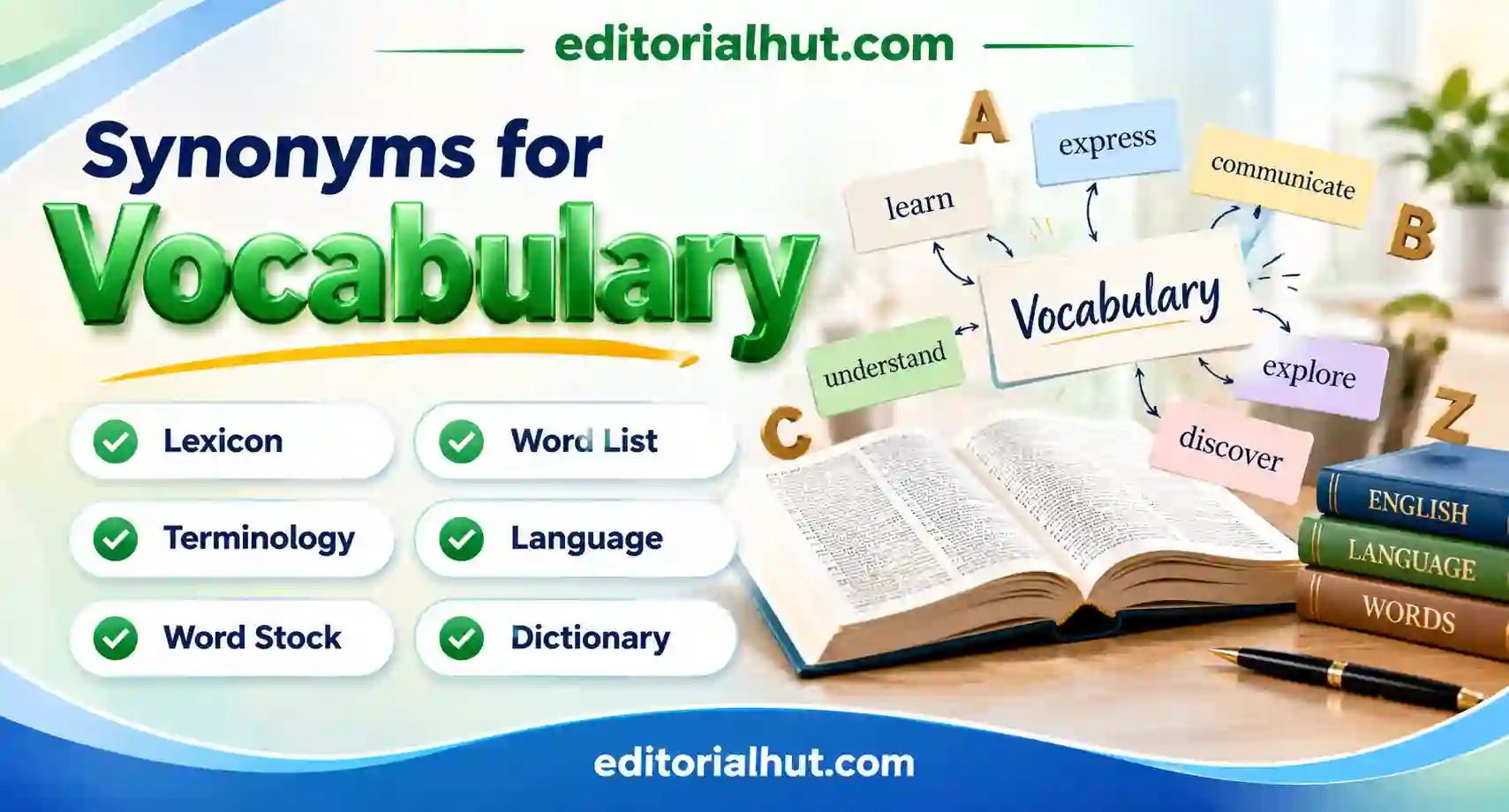
Finding the right synonyms for vocabulary can make your English more varied, natural, and interesting. Instead of repeating the same words, you can use similar words that better match the meaning, tone, and context of your sentence.
In this guide, you’ll discover useful vocabulary synonyms with simple meanings and examples. Whether you are improving your writing, speaking, schoolwork, or everyday English, these alternatives can help you choose clearer and more effective words.
Meaning of Vocabulary
Definition
Vocabulary (noun): the collection of words known, used, or associated with a person, language, subject, or field.
Examples
Her vocabulary grew quickly after she began reading novels every evening.
The professor introduced the technical vocabulary students needed for the course.
Connotative Meaning
Positive tone: Vocabulary can suggest learning, knowledge, communication skill, and intellectual growth.
Negative tone: In some contexts, a limited vocabulary may suggest difficulty expressing ideas, although the word itself is not negative.
Neutral tone: Vocabulary is usually neutral and simply describes a collection or range of words.
(Connotation means the feeling or association a word can suggest beyond its basic dictionary meaning.)
Etymology
Vocabulary entered English in the 16th century from Medieval Latin vocābulārium, meaning a collection or list of words. It is connected with Latin vocābulum, meaning “word” or “name,” which comes from vocāre, meaning “to call” or “to name.”
The original idea was closely connected with a collection or listing of words. Over time, vocabulary developed additional meanings, including the words known and used by a person, the words belonging to a language, and the specialized terms used within a particular field.
Short History
Old English (450-1100)
The modern word vocabulary did not exist in Old English. People expressed the idea of words, speech, names, and language through different native terms rather than through one direct equivalent of the modern noun.
Middle English (1100-1500)
During Middle English, English vocabulary expanded considerably through contact with French and Latin. Various words were used to discuss language, speech, names, and collections of words, but the modern word vocabulary had not yet become part of English.
Modern English (1500-Present)
Vocabulary entered English during the 16th century with the sense of a list or collection of words. Later, its meaning expanded to describe the words known or used by a person, the words belonging to a language, and the specialized terminology of a subject or profession.
Pronunciation (US & UK – IPA)
US: /voʊˈkæbjəˌlɛri/
UK: /vəˈkæbjʊləri/
Syllables
vo-cab-u-lar-y
Affixation Pattern of Vocabulary
Root: vocabul- relates to Latin vocābulum, meaning “word” or “name.”
Prefix: none
Suffix: -ary relates to something connected with or belonging to a particular thing. In vocabulary, the historical ending comes through Medieval Latin -ārium.
The word is not best understood as a modern English word formed by simply attaching a prefix and suffix to an independent English root. Its structure comes from a Latin and Medieval Latin historical development.
Word Formation
vocabulary (noun) – the collection or range of words known, used, or associated with a person, language, or subject.
vocabularies (plural noun) – more than one vocabulary or different collections of words.
vocabularied (adjective) – having a particular vocabulary or set of words. This form is uncommon in ordinary modern English.
30 Synonyms of Vocabulary
1. Lexicon (noun)
US: /ˈlɛksɪˌkɑn/
UK: /ˈlɛksɪkɒn/
Meaning: the vocabulary of a language, person, subject, or specialized field.
Usage shade: A close synonym of vocabulary, but often sounds more formal or linguistic.
Examples:
The medical lexicon contains many specialized terms.
Her professional lexicon became broader after years of experience.
2. Wordstock (noun)
US: /ˈwɜrdˌstɑk/
UK: /ˈwɜːdˌstɒk/
Meaning: the total collection of words used or known by a language, group, or person.
Usage shade: Very close to vocabulary, but less common in everyday English.
Examples:
The wordstock of English has developed through many historical influences.
Children gradually expand their wordstock through reading and conversation.
3. Word-hoard (noun)
US: /ˈwɜrdˌhɔrd/
UK: /ˈwɜːdˌhɔːd/
Meaning: a person’s collection of known words.
Usage shade: A literary or playful term that emphasizes words as something stored or treasured.
Examples:
Years of reading gave the poet a rich word-hoard.
Her growing word-hoard helped her write more expressive stories.
4. Words (noun)
US: /wɝːdz/
UK: /wɜːdz/
Meaning: the words known, used, or available for communication.
Usage shade: Very broad and informal. It can replace vocabulary only in suitable contexts.
Examples:
The child is learning new words every week.
Reading exposes students to words they may not hear in daily conversation.
5. Language (noun)
US: /ˈlæŋɡwɪdʒ/
UK: /ˈlæŋɡwɪdʒ/
Meaning: a system of communication or the particular words and expressions used by a person or group.
Usage shade: Broader than vocabulary because language includes grammar, pronunciation, and structure as well as words.
Examples:
The language of the report was easy for new employees to understand.
Legal language often contains terms that ordinary readers rarely use.
6. Terminology (noun)
US: /ˌtɝːməˈnɑːlədʒi/
UK: /ˌtɜːmɪˈnɒlədʒi/
Meaning: the specialized words and expressions used in a particular subject or profession.
Usage shade: Used for specialized vocabulary rather than someone’s general vocabulary.
Examples:
Medical terminology can be difficult for beginners.
The training course explains basic computer terminology.
7. Glossary (noun)
US: /ˈɡlɔːsəri/
UK: /ˈɡlɒsəri/
Meaning: a list of specialized or unfamiliar words with explanations.
Usage shade: A glossary is a list or reference tool, not normally the complete vocabulary of a person or language.
Examples:
The textbook includes a glossary at the end of the chapter.
Students checked the glossary before attempting the difficult exercise.
8. Wordbook (noun)
US: /ˈwɜrdˌbʊk/
UK: /ˈwɜːdˌbʊk/
Meaning: a book containing words and information about them.
Usage shade: Refers more to a word reference book than to a person’s vocabulary.
Examples:
The teacher gave each student a small wordbook.
She used the wordbook to review unfamiliar terms.
9. Diction (noun)
US: /ˈdɪkʃən/
UK: /ˈdɪkʃən/
Meaning: the choice and use of words in speech or writing.
Usage shade: Diction focuses on word choice and style rather than the total collection of words someone knows.
Examples:
The author’s simple diction makes the novel easy to read.
Careful diction helped the speaker communicate the idea clearly.
10. Wording (noun)
US: /ˈwɝːdɪŋ/
UK: /ˈwɜːdɪŋ/
Meaning: the particular choice and arrangement of words used to express something.
Usage shade: Refers to how a message is phrased, not generally to a person’s entire vocabulary.
Examples:
The wording of the announcement was clear and respectful.
Changing the wording made the instructions easier to understand.
11. Phraseology (noun)
US: /ˌfreɪziˈɑːlədʒi/
UK: /ˌfreɪziˈɒlədʒi/
Meaning: the characteristic words, phrases, or style of expression used by a person, group, or field.
Usage shade: More specialized than vocabulary and often concerned with recurring expressions or characteristic phrasing.
Examples:
The company’s phraseology reflects its formal communication style.
Legal phraseology can sound unfamiliar to ordinary readers.
12. Parlance (noun)
US: /ˈpɑːrləns/
UK: /ˈpɑːləns/
Meaning: the particular way of speaking or the words commonly used by a group.
Usage shade: Usually refers to the language or expressions of a particular community or profession.
Examples:
In business parlance, the project is considered a major success.
The phrase is common in scientific parlance.
13. Locution (noun)
US: /loʊˈkjuːʃən/
UK: /ləʊˈkjuːʃən/
Meaning: a particular expression, phrase, or style of speaking.
Usage shade: More concerned with an expression or manner of saying something than with someone’s complete vocabulary.
Examples:
The writer used an unusual locution to describe the character.
That locution sounds formal in ordinary conversation.
14. Expression (noun)
US: /ɪkˈspreʃən/
UK: /ɪkˈspreʃən/
Meaning: a word, phrase, or way of communicating an idea or feeling.
Usage shade: Much broader than vocabulary and can include a single phrase or nonverbal communication.
Examples:
The expression “break the ice” is common in English.
Her choice of expression made the message sound friendly.
15. Phrase (noun)
US: /freɪz/
UK: /freɪz/
Meaning: a group of words that forms a meaningful expression.
Usage shade: Refers to an individual group of words rather than an entire vocabulary.
Examples:
The student learned a useful phrase for ordering food.
That phrase is common in everyday English.
16. Lexis (noun)
US: /ˈlɛksɪs/
UK: /ˈlɛksɪs/
Meaning: the vocabulary or stock of words in a language or variety of language.
Usage shade: A technical linguistic term that is especially useful when discussing words as part of a language system.
Examples:
The study examines the lexis of modern newspapers.
Children develop new lexis as they encounter unfamiliar subjects.
17. Lexical Set (noun)
US: /ˈlɛksɪkəl sɛt/
UK: /ˈlɛksɪkəl sɛt/
Meaning: a group of words connected by a particular topic or meaning.
Usage shade: More specific than vocabulary because it describes a related group of words.
Examples:
The lesson introduces a lexical set related to weather.
Students practiced a lexical set about household objects.
18. Mental Lexicon (noun)
US: /ˈmɛntl ˈlɛksɪˌkɑn/
UK: /ˈmentl ˈleksɪkɒn/
Meaning: the collection of words and word knowledge stored in a person’s mind.
Usage shade: A linguistic or psychological term for an individual’s internal word knowledge.
Examples:
Reading regularly can expand a learner’s mental lexicon.
A familiar word is often retrieved quickly from the mental lexicon.
19. Word Power (noun)
US: /ˈwɜrd ˌpaʊər/
UK: /ˈwɜːd ˌpaʊə/
Meaning: a person’s ability to understand and use a wide range of words effectively.
Usage shade: Informal and often emphasizes vocabulary ability rather than the collection of words itself.
Examples:
Daily reading can improve your word power.
The class uses short exercises to build students’ word power.
20. Word Repertoire (noun)
US: /ˈwɜrd ˌrɛpərˈtwɑːr/
UK: /ˈwɜːd ˌrepətwɑː/
Meaning: the collection of words and expressions available to a person or group.
Usage shade: Emphasizes the range of language someone can draw upon.
Examples:
The writer has a broad word repertoire.
Practice gave the student a larger word repertoire for academic writing.
21. Word Range (noun)
US: /ˈwɜrd reɪndʒ/
UK: /ˈwɜːd reɪndʒ/
Meaning: the variety and extent of words a person knows or uses.
Usage shade: Useful when emphasizing breadth rather than the collection itself.
Examples:
Her word range improved after she began reading historical fiction.
A wider word range can make essays more precise.
22. Word Bank (noun)
US: /ˈwɜrd bæŋk/
UK: /ˈwɜːd bæŋk/
Meaning: a stored collection of words available for learning or use.
Usage shade: Usually refers to a deliberately collected list of words rather than natural vocabulary knowledge.
Examples:
The teacher created a word bank for the writing exercise.
Students selected suitable terms from the word bank.
23. Word List (noun)
US: /ˈwɜrd lɪst/
UK: /ˈwɜːd lɪst/
Meaning: a collection or list of selected words.
Usage shade: More limited and organized than vocabulary.
Examples:
The students reviewed the word list before the test.
The teacher prepared a word list for the new unit.
24. Terminological Stock (noun)
US: /ˌtɝːmənəˈlɑːdʒɪkəl stɑːk/
UK: /ˌtɜːmɪnəˈlɒdʒɪkəl stɒk/
Meaning: the collection of specialized terms used in a particular area.
Usage shade: Formal and specialized, so it is mainly suitable for academic or professional discussion.
Examples:
The discipline has developed a large terminological stock.
Students must learn the field’s terminological stock before reading advanced research.
25. Word Repertory (noun)
US: /ˈwɜrd ˈrɛpərˌtɔːri/
UK: /ˈwɜːd ˈrepətəri/
Meaning: a collection of words or expressions available for use.
Usage shade: Less common than vocabulary and often has a formal or literary feel.
Examples:
The poet drew from a rich word repertory.
A larger word repertory gives writers more choices.
26. Vocabulary Stock (noun)
US: /vəˈkæbjəˌlɛri stɑːk/
UK: /vəˈkæbjʊləri stɒk/
Meaning: the collection of words available to a person, group, or language.
Usage shade: Understandable and descriptive, but less natural than simply saying vocabulary or wordstock.
Examples:
Reading expanded the student’s vocabulary stock.
The dialect has a distinctive vocabulary stock.
27. Word Store (noun)
US: /ˈwɜrd stɔːr/
UK: /ˈwɜːd stɔː/
Meaning: a collection of words remembered or available for use.
Usage shade: Informal and less established as a direct synonym, often used when discussing learning.
Examples:
The exercises helped children build a useful word store.
Regular reading adds new expressions to your word store.
28. Verbal Repertoire (noun)
US: /ˈvɝːbəl ˌrɛpərˈtwɑːr/
UK: /ˈvɜːbəl ˌrepətwɑː/
Meaning: the range of words and expressions a person can use.
Usage shade: Broader and more expressive than vocabulary, with emphasis on available communication choices.
Examples:
The actor developed a strong verbal repertoire for different characters.
Practice helped the presenter expand her verbal repertoire.
29. Vocabulary Range (noun)
US: /vəˈkæbjəˌlɛri reɪndʒ/
UK: /vəˈkæbjʊləri reɪndʒ/
Meaning: the breadth and variety of words a person can understand or use.
Usage shade: Focuses on breadth rather than vocabulary as a general collection.
Examples:
The student’s vocabulary range increased during the semester.
A broad vocabulary range can help writers avoid unnecessary repetition.
30. Word Knowledge (noun)
US: /ˈwɜrd ˈnɑːlɪdʒ/
UK: /ˈwɜːd ˈnɒlɪdʒ/
Meaning: a person’s understanding of words, including their meanings and uses.
Usage shade: Broader than vocabulary because it can include depth of knowledge about individual words.
Examples:
Reading different genres can strengthen word knowledge.
Good word knowledge helps students understand difficult texts.
Prototype Meaning
The typical mental image associated with vocabulary is a collection of words that someone knows, uses, learns, or encounters in a particular language or subject. The strongest characteristic is the idea of a word stock available for communication. Vocabulary does not necessarily mean advanced or difficult words. A beginner can have a small vocabulary, while a specialist can have a large technical vocabulary. The word can describe personal language knowledge, the words of an entire language, or specialized terminology.
Prototype Categorization
General word collections: lexicon, lexis, wordstock, word-hoard
Personal word knowledge: mental lexicon, word knowledge, word range, vocabulary range
Specialized language: terminology, terminological stock, lexical set
Expression and word choice: diction, wording, phraseology, locution, expression
Reference and learning collections: glossary, wordbook, word list, word bank
Communication ability: word power, word repertoire, verbal repertoire
Grouping related terms helps writers recognize that synonyms are not always interchangeable. Choosing the right term depends on whether you mean a person’s word knowledge, specialized terminology, a reference list, or a particular style of expression.
Antonyms of Vocabulary
Silence (noun): the absence of spoken or written expression.
Inarticulacy (noun): difficulty expressing thoughts clearly in words.
Wordlessness (noun): a state in which words are absent or unavailable.
Mutism (noun): a condition or state involving an absence of spoken communication.
Nonverbal communication (noun): communication conveyed without spoken or written words.
Short Questions and Answers
What does vocabulary mean?
Vocabulary means the collection of words known or used by a person, language, group, or subject. It can also refer to specialized words used in a particular field.
When should vocabulary be used?
Use vocabulary when discussing the words someone knows or uses, the words belonging to a language, or the specialized terms of a subject. It is common in education, linguistics, writing, and everyday conversation.
Is vocabulary positive or negative?
Vocabulary is normally neutral. It can have a positive association when describing broad language knowledge, but the word itself does not carry a strongly positive or negative meaning.
How is it different from similar words?
Lexicon is very close to vocabulary and often sounds more technical or formal. Terminology refers specifically to specialized words in a subject or profession. Diction focuses on someone’s choice and style of words rather than the entire collection of words they know.
Conclusion
Understanding vocabulary helps you communicate ideas with greater clarity and precision. Although words such as lexicon, wordstock, terminology, diction, and word knowledge can sometimes overlap with vocabulary, each has its own useful shade of meaning. Learning these distinctions can help you avoid unnecessary repetition and choose language that fits the situation. A strong vocabulary is not simply about knowing difficult words. It is about understanding words well enough to use them naturally and accurately in speaking and writing. Try learning and using one new synonym each day.

Shahid Imran is an English language and vocabulary specialist at EditorialHut.com, focusing on synonyms, word meanings, alternative words, and practical example sentences. He helps readers discover better words, expand their vocabulary, and communicate more clearly and confidently.