





“Great” is one of the most overused words in English. It shows up in emails, essays, reviews, and everyday chats, but it doesn’t always say much. Was the movie great because it was emotionally powerful? Technically impressive? Just enjoyable? The word can mean a dozen different things depending on context, which is exactly why a stronger, more precise synonym often communicates your point better.
This guide breaks down the best synonyms for great, organized by meaning and situation, so you can pick a word that actually fits what you’re trying to say , whether that’s for a formal report, a casual text, or a piece of creative writing.
What Are the Best Synonyms for Great?
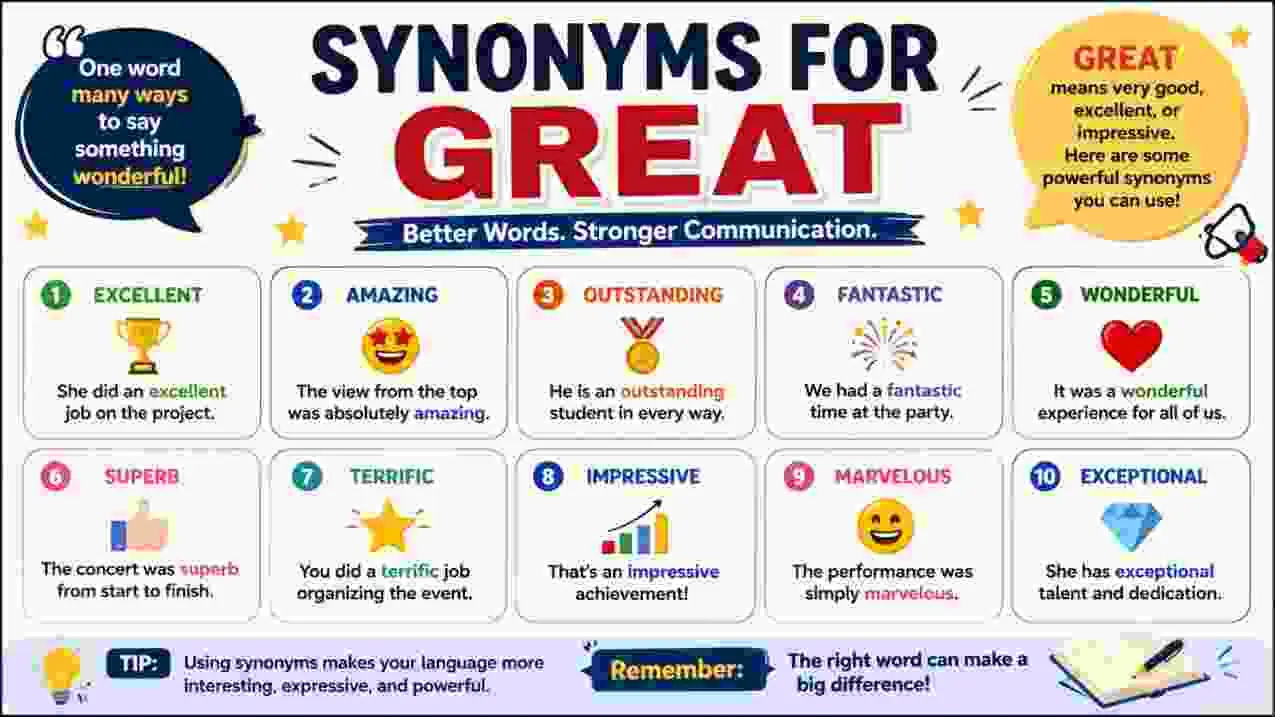
The best synonyms for great depend on which sense of the word you mean. Broadly, “great” covers a few different ideas:
- Excellent or impressive , outstanding, superb, exceptional, remarkable
- Very good or enjoyable , wonderful, fantastic, terrific, marvelous
- Large in size or degree , huge, immense, vast, considerable
- Important or significant , momentous, notable, distinguished
Some of these words can swap in for “great” almost anywhere, while others only work in specific contexts. The table and detailed guide below will help you figure out which is which.
Synonyms for Great at a Glance
| Synonym | Meaning | Best Context |
| Excellent | Extremely good in quality | Formal writing, reviews |
| Outstanding | Notably better than others | Performance, achievements |
| Superb | Impressively excellent | Formal or descriptive writing |
| Exceptional | Unusually good; rare in quality | Academic, professional |
| Wonderful | Very pleasing or delightful | Everyday conversation |
| Fantastic | Extremely good (informal) | Casual speech, social media |
| Terrific | Very good or exciting (informal) | Casual speech |
| Marvelous | Causing admiration or wonder | Descriptive, slightly formal |
| Remarkable | Worth noticing; unusual | Achievements, qualities |
| Impressive | Causing admiration due to size or quality | Skills, results |
| Magnificent | Grand and impressive | Scenery, architecture, achievements |
| Splendid | Impressively beautiful or grand | Descriptive, literary |
| Phenomenal | Extraordinary; remarkable | Performances, results |
| Stellar | Exceptionally good | Reviews, performance |
| First-rate | Of the highest quality | Business, formal writing |
| Top-notch | Excellent (informal) | Casual, business-casual |
| Amazing | Causing great surprise or wonder | Everyday conversation |
| Awesome | Extremely impressive (informal) | Casual speech |
| Huge | Very large in size or degree | Describing scale |
| Immense | Extremely large | Formal, descriptive |
| Considerable | Notably large in amount | Formal, academic |
| Momentous | Of great importance | Historic or significant events |
| Notable | Worthy of attention | Academic, professional |
| Distinguished | Respected; marked by excellence | Formal, professional |
| Grand | Impressive in size or style | Descriptive, formal |
Detailed Synonyms for Great
Excellent
Meaning: Extremely good; of the highest quality.
Best used when: You want a clear, formal way to say something is very good without sounding casual.
Example: Her presentation was excellent, with clear data and a confident delivery.
Usage note: Slightly more formal than “great.” Works well in professional and academic writing.
Outstanding
Meaning: Standing out from others due to exceptional quality.
Best used when: Describing performance, achievement, or work that clearly surpasses expectations.
Example: The team delivered an outstanding result despite the tight deadline.
Usage note: Stronger than “great.” Best for describing effort or achievement, not general enjoyment.
Superb
Meaning: Impressively excellent; of the finest quality.
Best used when: You want a polished, slightly elevated word for formal or descriptive writing.
Example: The chef prepared a superb three-course meal for the event.
Usage note: Formal tone. Less common in casual speech.
Exceptional
Meaning: Unusual; far above average in quality or ability.
Best used when: Highlighting rarity or a level of skill/quality that stands apart from the norm.
Example: He showed exceptional talent for someone so early in his career.
Usage note: Common in academic and professional writing, especially performance reviews.
Wonderful
Meaning: Inspiring delight, pleasure, or admiration.
Best used when: Talking about a positive experience or feeling, rather than technical quality.
Example: We had a wonderful time exploring the old town.
Usage note: Warmer and more emotional than “excellent.” Fits everyday conversation naturally.
Fantastic
Meaning: Extremely good; extraordinary.
Best used when: Speaking casually and wanting to express strong enthusiasm.
Example: That was a fantastic concert , best one I’ve seen all year.
Usage note: Informal. Avoid formal writing.
Terrific
Meaning: Extremely good or enjoyable.
Best used when: Reacting positively in casual, spoken English.
Example: You did a terrific job organizing the event.
Usage note: Informal, upbeat tone. Common in American English.
Marvelous
Meaning: Causing wonder or astonishment; extraordinarily good.
Best used when: Writing descriptively, especially about experiences or scenery.
Example: The view from the summit was absolutely marvelous.
Usage note: Slightly old-fashioned or literary in some contexts, but still widely understood.
Remarkable
Meaning: Worth noticing; unusual or striking.
Best used when: Emphasizing that something stands out, not just that it’s “good.”
Example: The company made remarkable progress in just six months.
Usage note: Near-synonym , focuses on being noteworthy rather than simply excellent.
Impressive
Meaning: Causing admiration through size, skill, or quality.
Best used when: Describing something that demonstrates skill, effort, or scale.
Example: His knowledge of the subject was truly impressive.
Usage note: Works in both formal and informal settings.
Magnificent
Meaning: Grand, beautiful, and impressive.
Best used when: Describing large-scale beauty , buildings, landscapes, or ceremonies.
Example: The palace’s magnificent architecture drew visitors from around the world.
Usage note: Best for visual or grand-scale descriptions, less common for everyday achievements.
Splendid
Meaning: Magnificent; impressively beautiful or successful.
Best used when: Writing in a formal or literary style.
Example: They organized a splendid celebration for the anniversary.
Usage note: Somewhat formal or old-fashioned; more common in British English.
Phenomenal
Meaning: Extraordinary; remarkable to an exceptional degree.
Best used when: Something goes far beyond normal expectations.
Example: The band’s phenomenal energy kept the crowd going all night.
Usage note: Stronger than “great.” Best for standout moments, not routine good quality.
Stellar
Meaning: Exceptionally good, especially in performance.
Best used when: Reviewing performances, results, or reputations.
Example: She has a stellar reputation in the industry.
Usage note: Common in business and media writing.
First-rate
Meaning: Of the best possible quality.
Best used when: Emphasizing quality in a professional or formal context.
Example: The hotel offered first-rate service from start to finish.
Usage note: Formal, slightly traditional phrasing.
Top-notch
Meaning: Excellent; of the highest standard.
Best used when: Speaking casually but still wanting to sound polished.
Example: Their customer support is top-notch.
Usage note: Informal, but acceptable in business-casual writing.
Amazing
Meaning: Causing great surprise or wonder.
Best used when: Expressing strong, genuine enthusiasm in everyday speech.
Example: That was an amazing trip , I’d go back in a heartbeat.
Usage note: Very common in spoken English; can sound overused if repeated too often.
Awesome
Meaning: Extremely impressive or excellent.
Best used when: Talking casually, especially with friends or on social media.
Example: Your new setup looks awesome.
Usage note: Informal. Avoid in formal writing or professional documents.
Huge
Meaning: Very large in size, extent, or degree.
Best used when: Describing scale rather than quality.
Example: Winning that contract was a huge deal for the company.
Usage note: Near-synonym , matches “great” only in the sense of size or importance, not quality.
Immense
Meaning: Extremely large or great in scale.
Best used when: Writing formally about size, effort, or impact.
Example: The project required immense coordination between teams.
Usage note: Near-synonym for the “large in degree” sense of great, not the “excellent” sense.
Considerable
Meaning: Notably large in amount or extent.
Best used when: Writing formally about measurable size or degree.
Example: The new policy had a considerable impact on sales.
Usage note: Near-synonym; used for “great” as in “a great amount,” not “great” as in “wonderful.”
Momentous
Meaning: Of great importance, especially historically.
Best used when: Describing significant events or turning points.
Example: Signing the agreement was a momentous occasion for both companies.
Usage note: Reserved for genuinely significant events , avoid using it for everyday good news.
Notable
Meaning: Worthy of attention or notice.
Best used when: Highlighting something significant in academic or professional writing.
Example: There was a notable improvement in test scores this year.
Usage note: More understated than “great”; suits formal, factual writing.
Distinguished
Meaning: Marked by excellence; respected.
Best used when: Describing a person’s reputation or career.
Example: She had a distinguished career in international law.
Usage note: Formal; typically describes people rather than objects or events.
Grand
Meaning: Impressive in size, scope, or style.
Best used when: Describing something large-scale or ceremonial.
Example: The wedding was a grand affair with over three hundred guests.
Usage note: Works for both formal descriptions and everyday enthusiasm, depending on tone.
How to Choose the Right Synonym for Great
Synonyms for “great” are not always interchangeable, even when they seem close in meaning. Before choosing one, consider:
- Meaning , Are you talking about quality, size, or importance? “Huge” and “excellent” both relate to “great,” but they mean very different things.
- Tone , Formal writing calls for words like exceptional or distinguished. Casual conversation suits awesome or fantastic better.
- Strength , Some synonyms are more intense than others. “Phenomenal” is stronger than “good,” and even stronger than a plain “great.”
- Audience , A business report and a text to a friend call for different vocabulary.
- Grammar , Make sure the synonym fits the sentence structure. “A remarkable performance” works, but “a huge performance” sounds off unless you mean physically large.
For example, “The meeting was huge” and “The meeting was great” mean very different things. The first suggests size or scale; the second suggests it went well. Swapping words without checking meaning can confuse your reader.
Synonyms for Great by Context
For Academic Writing
Exceptional, considerable, notable, momentous, distinguished , these words sound precise and objective, which fits academic tone. They also avoid the vagueness that “great” can carry in formal writing.
For Business Writing
Outstanding, first-rate, stellar, considerable, impressive , these convey professionalism and confidence without sounding casual. “Stellar performance” or “considerable growth” are common in reports and reviews.
For Everyday Conversation
Awesome, amazing, terrific, fantastic, wonderful , these feel natural in speech and text messages. They express enthusiasm without sounding stiff.
For Creative Writing
Magnificent, splendid, marvelous, phenomenal, grand , these add color and imagery, useful for setting a scene or describing something vividly.
For Social Media
Amazing, awesome, incredible, phenomenal , short, punchy, and familiar words that match the casual tone of most platforms.
Want to see about synonyms for important
Formal and Informal Alternatives
| Word | Tone | Suitable Context |
| Exceptional | Formal | Academic, professional |
| Distinguished | Formal | Professional biographies |
| Considerable | Formal | Reports, formal writing |
| Impressive | Neutral | Both formal and casual |
| Outstanding | Neutral | Reviews, performance evaluations |
| Wonderful | Neutral | Everyday, slightly warm |
| Fantastic | Informal | Casual conversation |
| Awesome | Informal | Texting, social media |
| Terrific | Informal | Casual speech |
Common Mistakes When Using Great Synonyms
- Treating size-related words as quality words. “Huge” and “immense” describe scale, not excellence. “The party was huge” doesn’t mean it was good , just large or well-attended.
- Using formal words in casual settings. Saying “That pizza was exceptional” to a friend can sound stiff or sarcastic. “That pizza was amazing” fits better.
- Overusing intensity words. Words like phenomenal or momentous lose their impact if used for everyday events. Save them for genuinely standout moments.
- Assuming all synonyms are interchangeable. “Notable” and “amazing” are both positive, but one is understated and factual, while the other is enthusiastic and emotional. Swapping them changes the tone of a sentence.
- Ignoring grammar fit. Some words pair naturally with certain nouns (“grand ceremony,” “considerable effort”) and sound awkward with others (“grand snack,” “considerable joke”).
Synonyms vs. Related Words
Not every word connected to “great” is an exact synonym. It helps to know the difference:
- Exact synonyms closely match both meaning and usage , excellent, superb, outstanding.
- Near-synonyms share part of the meaning but not all of it , huge and immense only match the “large in degree” sense of great, not the “excellent” sense.
- Related words connect to the same general idea but aren’t direct substitutes , words like success or achievement relate to greatness but function differently in a sentence.
Recognizing this difference helps you avoid awkward or inaccurate substitutions.
How to Use These Synonyms in Your Writing
Building a stronger vocabulary around “great” can improve nearly every kind of writing:
- Essays and school assignments , Precise words like notable or considerable show stronger command of language than repeating “great.”
- Business emails and reports , Words like outstanding or first-rate sound more professional and specific.
- Everyday conversation , Casual synonyms like awesome or amazing keep speech natural and expressive.
- Creative writing , Descriptive words like magnificent or splendid help set a vivid scene.
- Reviews and social posts , Short, punchy words like phenomenal or incredible grab attention without sounding repetitive.
Frequently Asked Questions About Synonyms for Great
What is another word for great?
Common alternatives include excellent, outstanding, wonderful, fantastic, and remarkable, depending on the exact meaning you want to express.
What is the best synonym for great in formal writing?
Exceptional, outstanding, and considerable tend to work well in formal or academic contexts.
Which synonym sounds most natural in everyday English?
Awesome, amazing, and fantastic are common, natural choices in casual conversation.
Are all synonyms for great interchangeable?
No. Words like huge or immense relate to size, while excellent or superb relate to quality. Always check that the meaning matches what you’re describing.
What’s the difference between great and remarkable?
“Great” is a general positive word, while “remarkable” specifically emphasizes that something is unusual or worth noticing.
Is “awesome” a professional synonym for great?
Not typically. “Awesome” is informal and works best in casual speech or writing, not in formal business or academic contexts.
Conclusion
“Great” is a useful word, but it’s often too general to carry real weight in writing or conversation. Words like excellent, outstanding, wonderful, and phenomenal let you say exactly what you mean , whether that’s quality, size, or importance. The key is matching the synonym to the right context: formal writing calls for precision, casual conversation calls for warmth, and creative writing calls for vivid imagery.
The next time you’re about to type “great,” pause for a second and ask what you actually mean. Chances are, one of the words above will say it better.

Shahid Imran is an English language and vocabulary specialist at EditorialHut.com, focusing on synonyms, word meanings, alternative words, and practical example sentences. He helps readers discover better words, expand their vocabulary, and communicate more clearly and confidently.