





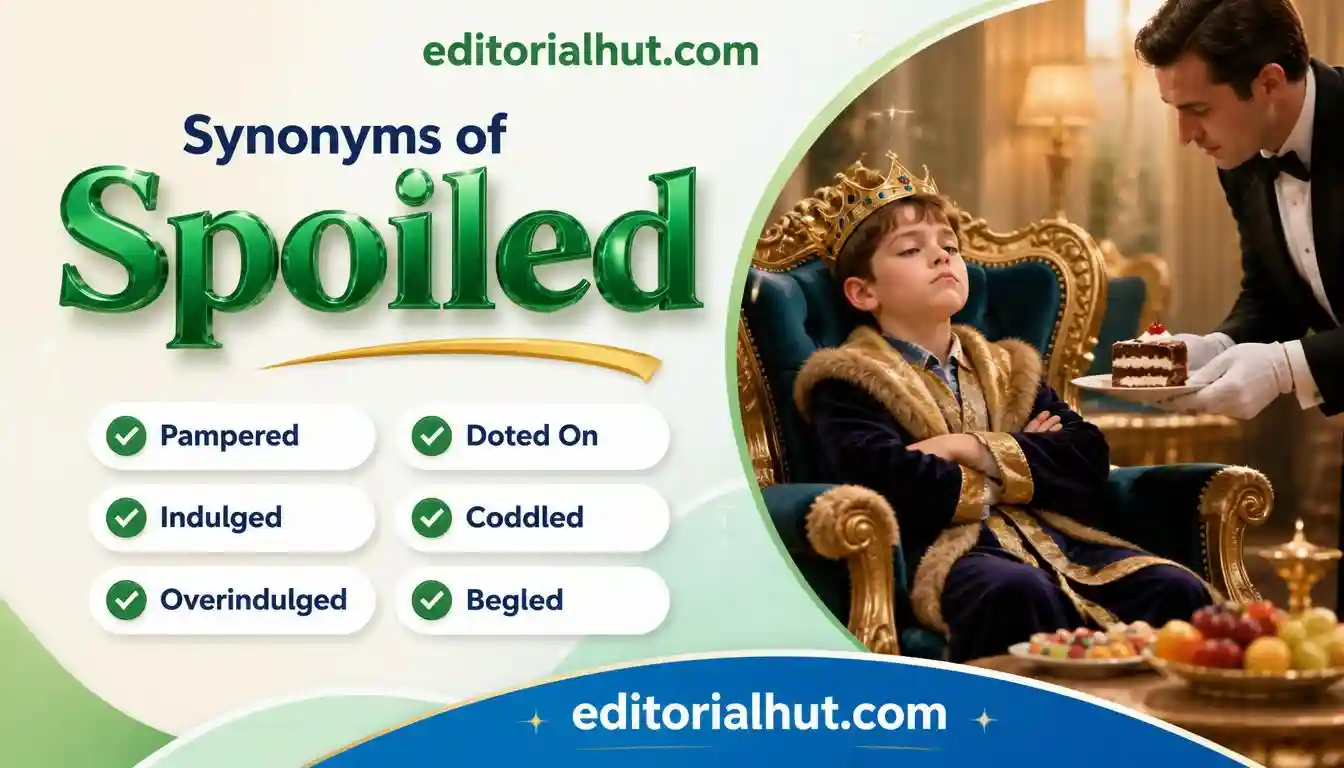
Looking for the right synonyms for spoiled can help you describe food, behavior, people, objects, and situations more precisely. The word spoiled can mean different things depending on context. Food may be spoiled when it is no longer fresh, while a child may be called spoiled when they receive too much attention or always expect to get what they want. Something can also be spoiled when it is damaged or ruined.
Common synonyms include rotten, stale, rancid, ruined, damaged, pampered, indulged, entitled, coddled, and overprotected. However, these words are not always interchangeable. Each has its own meaning, tone, and appropriate use.
Meaning of Spoiled
Definition
Spoiled (adjective): no longer fresh or usable, excessively indulged, or damaged so that something is no longer in its proper condition.
Examples
The spoiled milk had a strong smell, so we poured it down the drain.
The spoiled child expected everyone to give her whatever she wanted.
Connotative Meaning
Positive tone: In some contexts, especially when describing a person receiving special care, spoiled can suggest being pampered or treated generously, although this is less common.
Negative tone: The word often suggests something undesirable, such as rotten food, excessive indulgence, selfish behavior, or damage.
Neutral tone: When describing food or objects, spoiled can simply state that something has deteriorated or is no longer suitable for use.
(Connotation means the feeling or association a word can suggest beyond its basic dictionary meaning.)
Etymology
The word spoiled comes from spoil, which entered English through Anglo-French and Old French forms related to the Latin verb spoliare, meaning “to strip,” “plunder,” or “despoil.” The historical idea of taking something away or damaging its condition developed into several later meanings.
Over time, spoil acquired meanings connected with damaging, ruining, or causing something to lose its usefulness or quality. It also developed the sense of giving a person excessive attention, possessions, or privileges. Spoiled is the regular past-tense and past-participle form of spoil, and it is also widely used as an adjective.
Short History
Old English (450-1100)
The modern word spoil was not an ordinary Old English word in its present form. Ideas such as damaging, ruining, plundering, or taking valuable possessions existed in Old English, but they were expressed through different Germanic vocabulary. The modern word developed later through Romance-language influence.
Middle English (1100-1500)
During Middle English, English adopted many words from French following the Norman Conquest. Spoil developed from Anglo-French and Old French forms associated with stripping or plundering. Its meanings gradually expanded beyond taking possessions to include damaging or ruining something.
Modern English (1500-Present)
In Modern English, spoil developed a broad range of meanings. It can refer to food becoming unfit to eat, something being ruined, or a person becoming badly behaved through excessive indulgence. Spoiled therefore has several distinct but historically related uses.
Pronunciation (US & UK – IPA)
US: /spɔɪld/
UK: /spɔɪld/
Syllables
spoiled
Affixation Pattern of Spoiled
Root: spoil, from Anglo-French and Old French forms ultimately related to Latin spoliare, meaning “to strip” or “plunder.”
Prefix: none.
Suffix: -ed, marking the past tense and past participle of the verb spoil. In spoiled used as an adjective, the same form describes a resulting condition.
Word Formation
spoil (verb) – to damage, ruin, corrupt, or cause something to lose its quality; also to indulge someone excessively.
spoil (noun) – material removed during excavation or material regarded as waste.
spoiled (adjective) – damaged, ruined, no longer fresh, or excessively indulged.
spoiling (verb form) – damaging, ruining, or excessively indulging.
spoils (noun) – valuable goods taken from a defeated enemy or obtained through plunder.
spoiler (noun) – something that damages enjoyment, prevents success, or reveals an important part of a story.
30 Synonyms of Spoiled
1. Rotten (adjective)
US: /ˈrɑːtən/
UK: /ˈrɒtən/
Meaning: Decayed or decomposed, especially because of age or bacterial activity.
Usage shade: Commonly describes food or organic material that has become unfit for use or consumption.
Examples:
The rotten apples were removed from the basket.
A rotten smell came from the forgotten vegetables.
2. Decayed (adjective)
US: /dɪˈkeɪd/
UK: /dɪˈkeɪd/
Meaning: Gradually broken down or deteriorated.
Usage shade: More formal than rotten and often used for organic matter, buildings, wood, or other materials.
Examples:
The decayed fruit had turned dark and soft.
They replaced the decayed wooden boards.
3. Decomposed (adjective)
US: /ˌdiːkəmˈpoʊzd/
UK: /ˌdiːkəmˈpəʊzd/
Meaning: Broken down into simpler substances through natural biological processes.
Usage shade: Scientific and formal; especially useful for organic matter rather than everyday food.
Examples:
Leaves had decomposed beneath the wet soil.
The scientist examined the decomposed plant material.
4. Putrid (adjective)
US: /ˈpjuːtrɪd/
UK: /ˈpjuːtrɪd/
Meaning: Extremely rotten and producing a very unpleasant smell.
Usage shade: Much stronger and more vivid than ordinary spoiled.
Examples:
A putrid odor filled the abandoned kitchen.
The putrid meat was safely removed from the refrigerator.
5. Rancid (adjective)
US: /ˈræn.sɪd/
UK: /ˈræn.sɪd/
Meaning: Having an unpleasant smell or taste because fats or oils have deteriorated.
Usage shade: Specifically useful for butter, oils, nuts, and other fatty foods.
Examples:
The old cooking oil had become rancid.
Rancid butter gave the bread an unpleasant taste.
6. Sour (adjective)
US: /ˈsaʊr/
UK: /ˈsaʊə/
Meaning: Having developed an unpleasant acidic taste, often because food has deteriorated.
Usage shade: Common with milk and certain foods, although sour does not always mean spoiled because some foods are naturally sour.
Examples:
The milk tasted sour after sitting out overnight.
She noticed a sour smell when she opened the carton.
7. Stale (adjective)
US: /steɪl/
UK: /steɪl/
Meaning: No longer fresh, especially because it has been left for too long.
Usage shade: Common for bread, crackers, air, or ideas; stale does not always mean dangerous or rotten.
Examples:
The bread was stale but still safe to use for toast.
We threw away the stale crackers.
8. Moldy (adjective)
US: /ˈmoʊldi/
UK: /ˈməʊldi/
Meaning: Covered with or affected by mold.
Usage shade: More specific than spoiled because it identifies visible fungal growth.
Examples:
The moldy bread was discarded immediately.
A moldy orange had been hiding at the bottom of the bag.
9. Tainted (adjective)
US: /ˈteɪntɪd/
UK: /ˈteɪntɪd/
Meaning: Made impure, contaminated, or unsafe.
Usage shade: Often suggests contamination rather than ordinary natural spoilage and can also be used figuratively.
Examples:
The restaurant removed the tainted food from its kitchen.
The report was tainted by inaccurate information.
10. Off (adjective)
US: /ɔːf/
UK: /ɒf/
Meaning: No longer fresh or in good condition, especially when describing food.
Usage shade: Very common in everyday British English; American English often uses spoiled more directly for food.
Examples:
The cream smells off, so we should not use it.
The fish tasted slightly off after being stored too long.
11. Ruined (adjective)
US: /ˈruːɪnd/
UK: /ˈruːɪnd/
Meaning: Damaged or spoiled so badly that something is no longer useful, enjoyable, or successful.
Usage shade: Broader than spoiled and commonly applies to plans, objects, experiences, and situations.
Examples:
The rain ruined our outdoor picnic.
One careless mistake ruined the painting.
12. Damaged (adjective)
US: /ˈdæmɪdʒd/
UK: /ˈdæmɪdʒd/
Meaning: Harmed or physically affected so that something is less useful or valuable.
Usage shade: More neutral and precise than spoiled when physical harm is the main idea.
Examples:
The damaged package was returned to the seller.
Several pages were damaged by water.
13. Marred (adjective)
US: /mɑːrd/
UK: /mɑːd/
Meaning: Made less attractive, successful, or perfect by a flaw or problem.
Usage shade: Often used in formal writing for experiences, appearances, reputations, or achievements.
Examples:
The celebration was marred by an unexpected argument.
A small scratch marred the surface of the table.
14. Impaired (adjective)
US: /ɪmˈperd/
UK: /ɪmˈpeəd/
Meaning: Weakened or reduced in quality, effectiveness, or function.
Usage shade: Formal and usually focuses on reduced function rather than complete destruction.
Examples:
The damaged equipment had impaired performance.
Poor visibility impaired the driver’s ability to see the road.
15. Corrupted (adjective)
US: /kəˈrʌptɪd/
UK: /kəˈrʌptɪd/
Meaning: Damaged, altered, or made impure so that something no longer functions or remains trustworthy.
Usage shade: Common with computer files, information, systems, and moral or institutional contexts.
Examples:
The corrupted file could not be opened.
The virus corrupted several important documents.
16. Pampered (adjective)
US: /ˈpæmpərd/
UK: /ˈpæmpəd/
Meaning: Given excessive comfort, attention, or special treatment.
Usage shade: Usually refers to people or animals and is often less critical than spoiled.
Examples:
The pampered puppy slept on a soft blanket.
Years of pampered living made the transition difficult.
17. Indulged (adjective)
US: /ɪnˈdʌldʒd/
UK: /ɪnˈdʌldʒd/
Meaning: Given or allowed more of something than is necessary or appropriate.
Usage shade: Can describe generous treatment without necessarily suggesting that the person became badly behaved.
Examples:
The children were indulged by their grandparents during the holiday.
He was often indulged whenever he asked for a new toy.
18. Overindulged (adjective)
US: /ˌoʊvərɪnˈdʌldʒd/
UK: /ˌəʊvərɪnˈdʌldʒd/
Meaning: Given too much pleasure, attention, food, money, or freedom.
Usage shade: Clearly emphasizes excess and is often used when discussing the cause of spoiled behavior.
Examples:
The overindulged child struggled to accept the word no.
He admitted that he had overindulged his youngest son.
19. Coddled (adjective)
US: /ˈkɑːdəld/
UK: /ˈkɒdəld/
Meaning: Treated with excessive care or protected from difficulties.
Usage shade: Focuses more on overprotection than on receiving possessions or rewards.
Examples:
The coddled student found independent work challenging.
Growing up coddled had left him unprepared for setbacks.
20. Cosseted (adjective)
US: /ˈkɑːsɪtɪd/
UK: /ˈkɒsɪtɪd/
Meaning: Given excessive attention, comfort, and protection.
Usage shade: More formal or literary than pampered and especially common in British English.
Examples:
The cosseted athlete rarely had to deal with ordinary household tasks.
The young heir lived a highly cosseted life.
21. Mollycoddled (adjective)
US: /ˈmɑːlikɑːdəld/
UK: /ˈmɒlikɒdəld/
Meaning: Given too much care and protection.
Usage shade: Informal and strongly suggests that excessive protection has made someone less independent.
Examples:
The mollycoddled teenager struggled when living alone.
His parents had mollycoddled him for years.
22. Overprotected (adjective)
US: /ˌoʊvərprəˈtektɪd/
UK: /ˌəʊvəprəˈtektɪd/
Meaning: Protected from normal risks, difficulties, or responsibilities to an excessive degree.
Usage shade: Focuses specifically on protection rather than material rewards or privileges.
Examples:
The overprotected child was nervous about traveling alone.
An overprotected student may need time to develop confidence.
23. Entitled (adjective)
US: /ɪnˈtaɪtəld/
UK: /ɪnˈtaɪtəld/
Meaning: Believing that one deserves special treatment, privileges, or benefits.
Usage shade: Strongly focuses on attitude and expectations rather than the way someone was raised.
Examples:
His entitled attitude frustrated his coworkers.
The new employee seemed entitled to special treatment.
24. Bratty (adjective)
US: /ˈbræti/
UK: /ˈbræti/
Meaning: Behaving in a badly behaved, selfish, or irritating way, especially like a spoiled child.
Usage shade: Informal and strongly negative; it is usually used about children but can describe adults humorously or critically.
Examples:
The bratty child complained about every meal.
His bratty behavior annoyed everyone at the party.
25. Demanding (adjective)
US: /dɪˈmændɪŋ/
UK: /dɪˈmɑːndɪŋ/
Meaning: Expecting a great deal of attention, effort, service, or special treatment.
Usage shade: Can describe spoiled behavior, but it does not necessarily mean the person is spoiled.
Examples:
The demanding customer wanted immediate assistance.
Caring for the demanding puppy required patience.
26. Self-indulgent (adjective)
US: /ˌselfɪnˈdʌldʒənt/
UK: /ˌselfɪnˈdʌldʒənt/
Meaning: Allowing oneself excessive pleasure, comfort, or satisfaction.
Usage shade: Usually describes behavior or habits rather than a person who has been spoiled by others.
Examples:
Taking an entire weekend off felt pleasantly self-indulgent.
His self-indulgent spending created financial problems.
27. Luxurious (adjective)
US: /lʌɡˈʒʊriəs/
UK: /lʌɡˈʒʊəriəs/
Meaning: Extremely comfortable, expensive, or rich in quality.
Usage shade: This is not a direct synonym in every context, but it can overlap with spoiled when describing someone accustomed to excessive comfort. Unlike spoiled, it does not normally imply bad behavior.
Examples:
The guests enjoyed a luxurious weekend at the resort.
She had grown accustomed to a luxurious lifestyle.
28. Depraved (adjective)
US: /dɪˈpreɪvd/
UK: /dɪˈpreɪvd/
Meaning: Morally corrupt or extremely lacking in moral standards.
Usage shade: Much stronger than spoiled and appropriate only when the context involves serious moral corruption.
Examples:
The novel describes a depraved ruler who abuses his power.
The criminal’s depraved actions shocked the community.
29. Deteriorated (adjective)
US: /dɪˈtɪriəreɪtɪd/
UK: /dɪˈtɪəriəreɪtɪd/
Meaning: Become worse in condition, quality, or effectiveness.
Usage shade: More formal and broader than spoiled, especially for buildings, conditions, relationships, health, or quality.
Examples:
The condition of the old house had deteriorated rapidly.
The quality of the product deteriorated after months in storage.
30. Blemished (adjective)
US: /ˈblemɪʃt/
UK: /ˈblemɪʃt/
Meaning: Marked or damaged by a flaw or imperfection.
Usage shade: Describes an imperfection rather than complete spoilage and is often used for surfaces, appearances, records, or reputations.
Examples:
The apple was slightly blemished but still edible.
A single error blemished an otherwise successful record.
Prototype Meaning
The typical mental image of spoiled depends strongly on context. A food, it usually suggests something that was once fresh but has become unsuitable because it has deteriorated. For people, it often brings to mind someone who has received so much attention, comfort, money, or freedom that they expect special treatment. For objects or plans, it suggests damage or loss of quality. The word does not automatically imply serious damage, bad character, or danger.
Prototype Categorization
Food and freshness: rotten, decayed, putrid, rancid, sour, stale, moldy, off
Damage and deterioration: ruined, damaged, marred, impaired, corrupted, deteriorated, blemished
Excessive care or comfort: pampered, indulged, overindulged, coddled, cosseted, mollycoddled, overprotected
Demanding behavior and attitude: entitled, bratty, demanding, self-indulgent
Strong moral or lifestyle descriptions: depraved, luxurious
Grouping synonyms by meaning helps writers avoid choosing a word that is technically related but wrong for the situation. A food-related synonym may not work for a person, while a word describing excessive attention may not describe physical damage.
Antonyms of Spoiled
Fresh (adjective): In good condition and suitable for use or consumption, especially when describing food.
Unspoiled (adjective): Not damaged, corrupted, or negatively affected; still in its original good condition.
Modest (adjective): Not excessively demanding of attention, comfort, wealth, or special treatment.
Independent (adjective): Able to manage responsibilities and difficulties without excessive protection or assistance.
Prudent (adjective): Showing sensible care and good judgment, especially in the use of resources or decisions.
Short Questions and Answers
What does spoiled mean?
Spoiled can mean no longer fresh or usable, damaged or ruined, or excessively indulged. The intended meaning depends on the sentence and context.
When should spoiled be used?
Use spoiled when describing food that has gone bad, something that has been damaged or ruined, or a person who has received excessive indulgence and developed demanding behavior.
Is spoiled positive or negative?
Spoiled is usually negative when it describes rotten food, damaged things, or a person who expects excessive special treatment. However, related ideas such as being pampered can sometimes have a more neutral or mildly positive tone.
How is it different from similar words?
Rotten is stronger and more specific when food has seriously decayed. Pampered focuses on receiving excessive comfort or attention and does not necessarily suggest bad behavior. Entitled focuses on the belief that someone deserves special treatment, while spoiled can describe both the excessive treatment and its resulting behavior.
Conclusion
Understanding spoiled means more than memorizing one definition. The word can describe food that is no longer fresh, objects or plans that have been damaged, or people who have received excessive indulgence. Learning related words such as rotten, stale, ruined, pampered, coddled, entitled, and overprotected helps you communicate these differences more precisely. Using the right synonym makes writing clearer, reduces unnecessary repetition, and helps your spoken English sound more natural. Try learning and using one new synonym each day.

Shahid Imran is an English language and vocabulary specialist at EditorialHut.com, focusing on synonyms, word meanings, alternative words, and practical example sentences. He helps readers discover better words, expand their vocabulary, and communicate more clearly and confidently.