







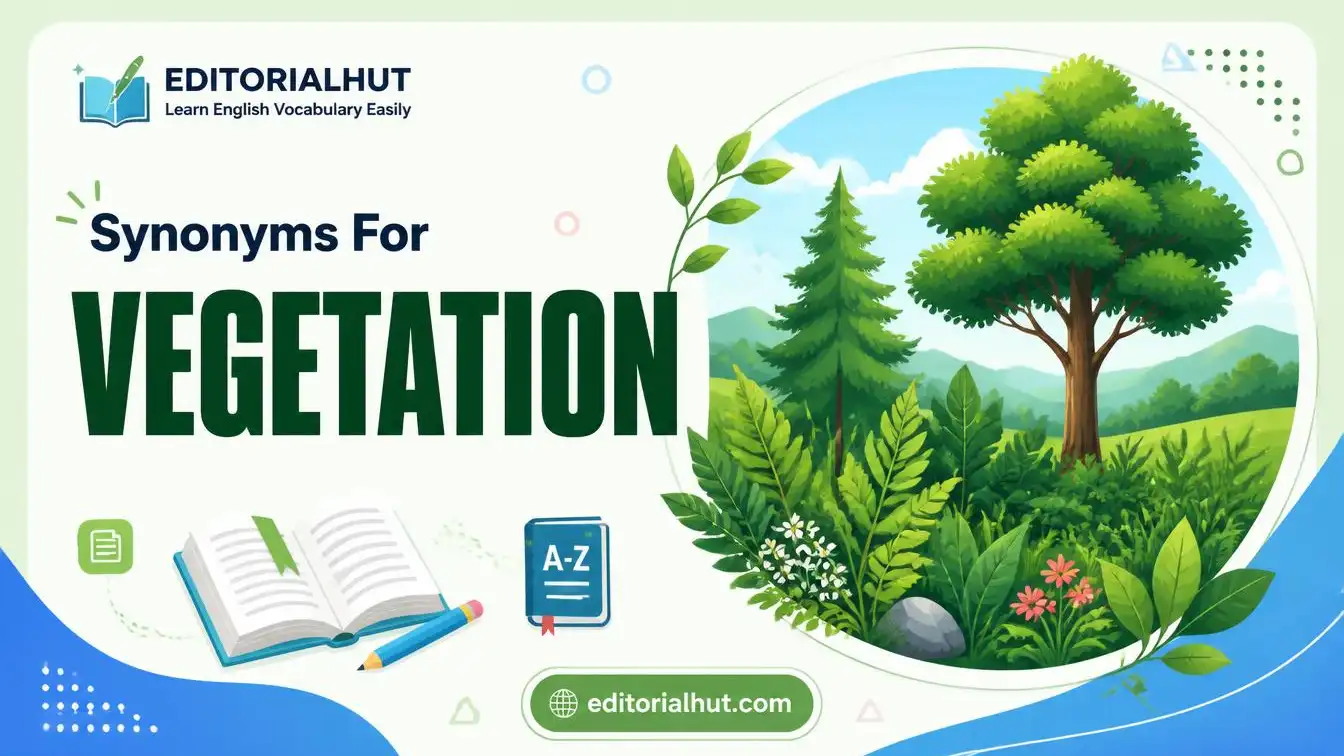
Have you ever looked out over a hillside covered in trees, grass, and wild bushes and wondered what to call it besides “vegetation“? You are not alone. Writers use this word so often that it can start to feel repetitive. That is exactly why synonyms for vegetation are so handy to have on hand.
In simple terms, vegetation means all the plants growing in a certain place , trees, grass, flowers, shrubs, and more. Learning different words for vegetation helps your writing feel fresh
What Are the Best Synonyms for Vegetation?
The best synonyms for vegetation include flora, plant life, greenery, foliage, herbage, and verdure. Each word describes plants growing in a place, but some are more formal (flora, herbage) while others are more casual and visual (greenery, foliage). Choosing the right one depends on your tone and context.
Vegetation Synonyms at a Glance
| Synonym | Simple Meaning | Best Used For |
| Flora | All the plant life in a region | Science, academic writing |
| Plant life | General term for living plants | Everyday, educational writing |
| Greenery | Green plants and leaves | Casual, descriptive writing |
| Foliage | Leaves of plants and trees | Nature descriptions |
| Verdure | Lush, green growth | Literary, creative writing |
| Herbage | Grasses and herbs together | Farming, botany |
| Growth | New or general plant development | General, informal use |
| Shrubbery | Bushes and small plants | Gardens, landscaping |
| Undergrowth | Plants beneath a forest canopy | Forest and nature writing |
| Woodland | Land covered mostly by trees | Geography, travel writing |
| Grassland | Land covered mainly by grass | Geography, science |
| Scrub | Low bushes in dry areas | Geography, environmental writing |
| Thicket | A dense clump of bushes or trees | Descriptive, adventure writing |
| Canopy | The top leafy layer of a forest | Forest, environmental writing |
| Wilderness | A wild, natural, unfarmed area | Travel, nature writing |
1. Flora
Meaning: Flora refers to all the plant life found in a particular region or time period.
Examples: The desert flora includes cactus plants that store water for months. Scientists study the local flora to understand how the ecosystem changes.
2. Plant life
Meaning: Plant life is a simple, general term for all living plants in an area.
Examples: The rainforest is home to an incredible variety of plant life. After the rain, plant life along the trail looked healthier than ever.
3. Greenery
Meaning: Greenery means green plants and leaves, especially in a way that looks pleasant.
Examples: The hotel courtyard was filled with lush greenery and hanging vines. She added some greenery to the room to make it feel more alive.
4. Foliage
Meaning: Foliage refers specifically to the leaves of plants and trees.
Examples: Autumn foliage turns bright orange and red across New England. Thick foliage blocked most of the sunlight on the forest floor.
5. Verdure
Meaning: Verdure is a more literary word for lush, healthy green plant growth.
Examples: The valley’s verdure impressed every visitor who hiked through it. Spring rains brought fresh verdure to the hillsides.
6. Herbage
Meaning: Herbage means grasses and other soft-stemmed plants growing together, often used for grazing.
Examples: The cattle grazed freely on the herbage in the open field. Dry herbage covered the meadow by the end of summer.
7. Plants
Meaning: Plants is the most basic and common word for living things like trees, flowers, and grass.
Examples: The garden was full of colorful plants and blooming flowers. He watered the plants on his balcony every morning.
8. Growth
Meaning: In this context, growth refers to plants that have developed or spread over an area.
Examples: Thick growth covered the abandoned lot within a few months. New growth appeared along the riverbank after the flood.
9. Shrubbery
Meaning: Shrubbery means a group of bushes, often planted together for decoration.
Examples: The gardener trimmed the shrubbery along the front walkway. Birds built a nest deep inside the thick shrubbery.
10. Undergrowth
Meaning: Undergrowth is the low plants, bushes, and small trees growing beneath taller trees in a forest.
Examples: Thick undergrowth made it hard to walk through the forest. Small animals hid in the undergrowth as we passed by.
11. Brush
Meaning: Brush refers to a dense area of bushes, small trees, and dry plants, often in wild or rural areas.
Examples: The deer disappeared quickly into the brush. Firefighters worked to clear the dry brush before summer.
12. Groundcover
Meaning: Groundcover means low plants that spread across the ground, often used in gardens to prevent bare soil.
Examples: We planted groundcover instead of grass to reduce mowing. Moss made a natural groundcover under the old oak tree.
13. Woodland
Meaning: Woodland is land that is mostly covered by trees; it is a near-synonym describing a place rather than the plants themselves.
Examples: The trail winds through peaceful woodland for nearly two miles. Deer are common in the woodland behind our house.
14. Grassland
Meaning: Grassland is an open area covered mainly by grass, used here as a context-specific alternative for a type of vegetation.
Examples: Wide grassland stretched across the plains for miles. The grassland turns golden brown during the dry season.
15. Scrub
Meaning: Scrub refers to low, often dry bushes and plants that grow in areas with poor soil.
Examples: Only tough scrub can survive in this rocky, dry region. The trail cut straight through low scrub and sandy ground.
16. Thicket
Meaning: A thicket is a small area densely packed with bushes, vines, or small trees.
Examples: The path disappeared into a thicket of wild berry bushes. A fox darted quickly through the thicket and out of sight.
17. Bracken
Meaning: Bracken is a type of large, spreading fern often found covering hillsides and woodland floors.
Examples: Thick bracken covered the hillside after a wet spring. The hikers pushed through waist-high bracken on the trail.
18. Weeds
Meaning: Weeds are unwanted plants growing where they are not wanted; this word often carries a negative tone.
Examples: Weeds took over the garden while we were on vacation. He spent the afternoon pulling weeds from the flower bed.
19. Canopy
Meaning: Canopy is the upper layer of leaves and branches formed by tall trees in a forest.
Examples: Sunlight barely reached the ground through the thick canopy. Monkeys moved easily through the forest canopy above us.
20. Underbrush
Meaning: Underbrush is another word for the low bushes and plants growing beneath taller trees, similar to undergrowth.
Examples: The trail crew cleared underbrush along both sides of the path. A rabbit darted through the underbrush near the campsite.
21. Copse
Meaning: A copse is a small group of trees growing close together.
Examples: A small copse of birch trees stood at the edge of the field. They set up their picnic near a shady copse of oaks.
22. Grove
Meaning: A grove is a group of trees, often planted or growing close together, sometimes of the same type.
Examples: We walked through an orange grove on our trip to Florida. The old olive grove had trees over a hundred years old.
23. Verdancy
Meaning: Verdancy is a formal, literary word describing the quality of being green and lush with plants.
Examples: The verdancy of the valley amazed every traveler who passed through. After weeks of rain, the region’s verdancy was hard to miss.
24. Green cover
Meaning: Green cover refers to the layer of plants, especially trees and grass, covering land in a region.
Examples: Cities are planting more trees to increase green cover downtown. Satellite images showed a drop in green cover over ten years.
25. Bushland
Meaning: Bushland is land covered by wild, untamed bushes and shrubs, often used in Australian and rural English.
Examples: Kangaroos are commonly spotted in the open bushland. The fire spread quickly through the dry bushland.
26. Wilderness
Meaning: Wilderness is wild, natural land largely untouched by people; it is a broader, contextual alternative rather than an exact synonym.
Examples: The national park protects thousands of acres of untouched wilderness. They spent a week hiking through remote wilderness with no roads nearby.
27. Jungle
Meaning: Jungle refers to a dense tropical area packed with trees, vines, and thick plant growth.
Examples: Thick jungle covered both sides of the narrow river. Explorers cut a path through the jungle with machetes.
28. Forest
Meaning: Forest is a large area covered mainly with trees, used here as a related term for tree-heavy vegetation.
Examples: The forest stretched for miles without a single road. Sunlight filtered softly through the tall forest trees.
29. Meadow
Meaning: A meadow is an open field covered in grass and wildflowers, a specific type of vegetation-covered land.
Examples: Butterflies drifted lazily across the sunny meadow. The meadow was full of wildflowers by late spring.
30. Shrubs
Meaning: Shrubs are small to medium-sized woody plants, similar to bushes, often used in gardens and landscapes.
Examples: Low shrubs lined both sides of the garden path. He trimmed the shrubs into neat, round shapes.
How to Choose the Right Synonym for Vegetation
Synonyms rarely mean exactly the same thing. Each word carries its own tone, formality, and context, so picking the right one matters.
- Formal vs. informal: Words like flora and herbage sound formal and scientific, while plants and greenery sound casual and everyday.
- Positive vs. negative: Greenery and verdure sound pleasant, while weeds often carries a negative meaning.
- Strong vs. weak: Jungle and wilderness suggest thick, wild growth, while groundcover suggests something low and simple.
- Academic writing: Choose precise, scientific words like flora or herbage.
- Business writing: Use neutral, clear terms like plant life or green cover.
- Casual conversation: Simple words like plants or greenery work best.
- Creative writing: Try vivid words like verdure, canopy, or thicket.
- Social media content: Short, visual words like greenery or foliage connect well with readers.
For example, calling a garden “full of weeds” sounds very different from calling it “full of greenery,” even though both describe plants.
Formal and Informal Synonyms for Vegetation
| Formal Synonym | Informal Synonym | Example Context |
| Flora | Plants | A science report vs. a casual chat |
| Herbage | Greenery | A farming study vs. a home garden blog |
| Verdure | Green stuff (informal) | A poem vs. a text message |
| Undergrowth | Bushes | A biology paper vs. a hiking story |
| Woodland | Woods | A geography essay vs. everyday speech |
Best Synonyms for Different Contexts
Academic Writing Flora, herbage, undergrowth, grassland, woodland
Blog Writing Greenery, foliage, plant life, wilderness, canopy
Business Writing Green cover, plant life, grassland, woodland, flora
Everyday Conversation Plants, greenery, bushes, weeds, grass
Creative Writing Verdure, canopy, thicket, jungle, bracken
Each context calls for a different tone. Academic writing needs precision, blog writing needs warmth and clarity, business writing needs neutrality, everyday conversation needs simplicity, and creative writing needs vivid imagery.
Common Mistakes When Using Synonyms
- Choosing a word with the wrong meaning. Calling a single houseplant “vegetation” sounds odd, since the word usually describes plants as a whole group.
- Using a formal word in casual speech. Saying “I need to trim the herbage” instead of “I need to trim the bushes” sounds unnatural in daily conversation.
- Replacing a word without checking context. “Grassland” and “jungle” both relate to vegetation, but they describe very different environments.
- Changing the tone by accident. Swapping “greenery” for “weeds” changes a positive description into a negative one.
- Repeating synonyms too much in SEO content. Cramming in every synonym on this list within a few paragraphs makes writing feel forced instead of natural.
Synonyms vs. Related Words
- True synonyms share almost the same meaning, like plants and plant life.
- Near-synonyms are close but not identical, like foliage, which specifically means leaves rather than all plant life.
- Related words connect to the topic without meaning the same thing, like botany (the study of plants) or soil (where plants grow).
- Contextual alternatives work only in certain situations, like woodland or jungle, which describe a place with vegetation rather than vegetation itself.
Knowing this difference helps you avoid using a word that sounds close but doesn’t quite fit.
How to Use Synonyms in Your Writing
Synonyms make writing feel natural instead of repetitive. In essays, they help you avoid repeating “vegetation” in every paragraph. On social media, vivid words like greenery or canopy grab attention quickly. In stories, words like thicket or verdure help readers picture the scene. In school assignments, using a few different synonyms shows a stronger vocabulary.
The goal is always clarity first. Synonyms should make your writing easier to understand, not harder.
Frequently Asked Questions About Vegetation
What is another word for vegetation?
Common alternatives include flora, plant life, greenery, and foliage. Each word works well depending on how formal or casual your writing needs to be.
What is the best synonym for vegetation?
There is no single “best” synonym , it depends on context. Flora works well for science writing, while greenery fits casual or descriptive writing.
Which synonym is best for formal writing?
Flora and herbage are strong choices for formal or academic writing, since they sound precise and scientific.
Which synonym is best for everyday conversation?
Simple words like plants or greenery sound natural in everyday conversation and are easy for most readers to understand.
Can I use these synonyms in academic writing?
Yes, but choose carefully. Words like flora, herbage, undergrowth, and grassland fit academic writing better than casual terms like weeds or bushes.
Are all synonyms exactly the same?
No. Many words on this list are near-synonyms or contextual alternatives, meaning they relate closely to vegetation but are not always perfect substitutes.
How can I learn synonyms easily?
Read example sentences, notice the tone of each word, and practice using new synonyms in your own writing until they feel natural.
How can synonyms improve my writing?
Synonyms add variety, prevent repetition, and help you match the right tone for academic, business, creative, or casual writing.
Conclusion
Learning synonyms for vegetation gives your writing more variety and precision, whether you’re working on an essay, a blog post, or a simple email. Words like flora, greenery, foliage, and undergrowth each bring their own tone and context to your sentences.
Try using a few of these synonyms the next time you write about nature, gardens, or the outdoors. With a little practice, choosing the right word will start to feel natural , and your writing will feel more alive because of it.

Shahid Imran is an English language and vocabulary specialist at EditorialHut.com, focusing on synonyms, word meanings, alternative words, and practical example sentences. He helps readers discover better words, expand their vocabulary, and communicate more clearly and confidently.