









Synonyms for puzzled, Have you ever stared at a math problem, a strange email, or a confusing map and had no idea what to do next? That feeling has a name: puzzled. Puzzled means confused or unsure about something, usually because it doesn’t make sense right away.
Using the same word over and over can make your writing feel flat. That’s why learning synonyms for puzzled is so helpful. A student writing an essay, a blogger telling a story, a content writer polishing an article, or an ESL learner building vocabulary can all benefit from new words that express confusion in different ways.
What Are the Best Synonyms for Puzzles?
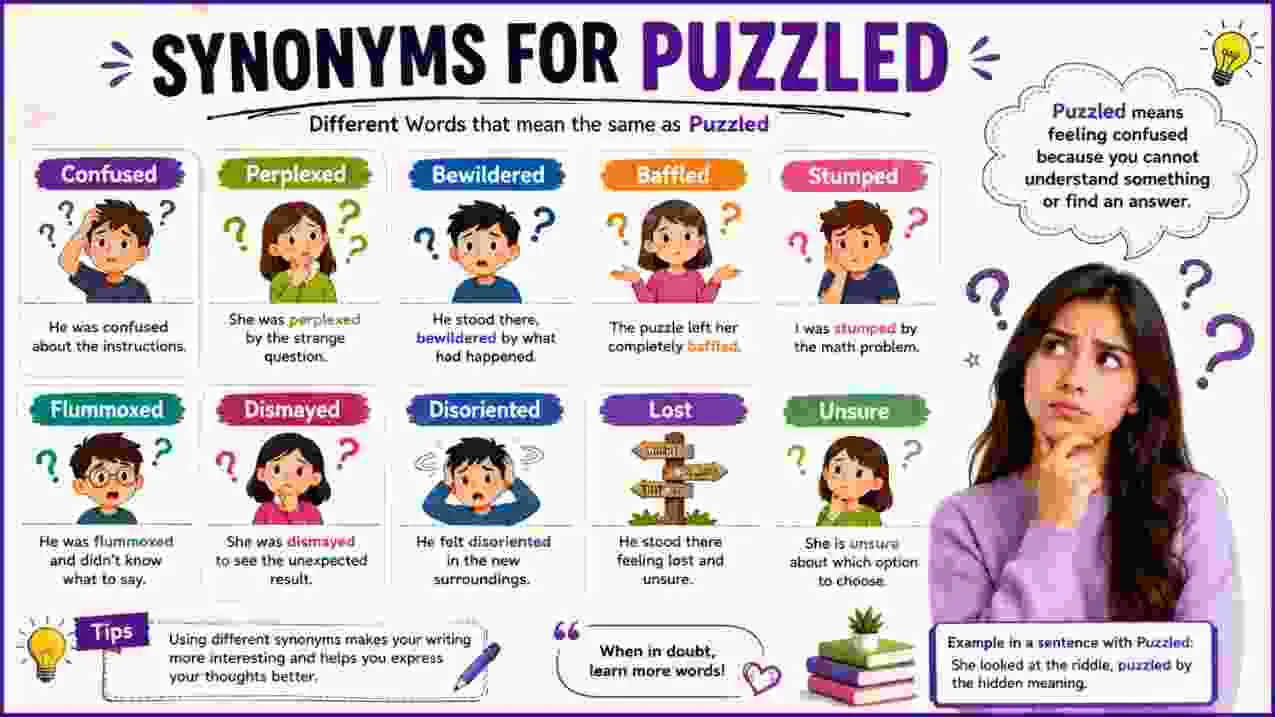
The best synonyms for puzzled include confused, baffled, bewildered, perplexed, mystified, stumped, and flummoxed. Each word describes a moment when something doesn’t make sense. Some are casual, like “lost” or “mixed up,” while others, like “confounded” or “nonplussed,” sound more formal or literary. Choosing the right one depends on your tone and audience.
Puzzled Synonyms at a Glance
| Synonym | Simple Meaning | Best Used For |
| Confused | Not able to understand clearly | Everyday conversation |
| Baffled | Completely unable to explain something | Storytelling, news writing |
| Bewildered | Confused and a little overwhelmed | Descriptive or emotional writing |
| Perplexed | Puzzled by something complicated | Academic and formal writing |
| Mystified | Confused because something seems mysterious | Creative writing |
| Confounded | Surprised and confused at once | Formal or old-fashioned tone |
| Stumped | Unable to find an answer | Casual conversation, quizzes |
| Flummoxed | Totally confused (informal) | Blogs, casual writing |
| Dumbfounded | So confused you can’t speak | Dramatic storytelling |
| Disoriented | Confused about direction or surroundings | Physical or spatial confusion |
| Muddled | Confused and disorganized in thinking | Describing unclear thoughts |
| Nonplussed | So confused you don’t know how to react | Formal or literary writing |
| Bemused | Mildly confused, sometimes amused | Light, reflective writing |
| Clueless | Having no idea at all | Casual, humorous tone |
| Mixed up | Confused about details or order | Everyday conversation |
1. Confused
Meaning: Confused means not able to think clearly or understand something. Examples: I felt confused after reading the instructions twice. She looked confused when the teacher changed the topic.
2. Baffled
Meaning: Baffled means completely unable to explain or understand something surprising. Examples: The detective was baffled by the missing evidence. I’m baffled by how quickly the price changed overnight.
3. Bewildered
Meaning: Bewildered means confused and slightly overwhelmed by too much information. Examples: The tourist looked bewildered by the busy train station. He felt bewildered after hearing three different opinions.
4. Perplexed
Meaning: Perplexed means puzzled by something that seems complicated or hard to solve. Examples: The scientist was perplexed by the strange test results. She stayed perplexed even after reading the manual twice.
5. Mystified
Meaning: Mystified means confused because something feels mysterious or unexplainable. Examples: The audience was mystified by the magician’s final trick. I’m mystified by how the cat escaped the locked room.
6. Confounded
Meaning: Confounded means surprised and confused at the same time, often in a formal way. Examples: The results confounded even the top researchers. He was confounded by the sudden change in weather.
7. Stumped
Meaning: Stumped means unable to find an answer or solution. Examples: This riddle has stumped me for an hour. The interviewer’s question left him completely stumped.
8. Flummoxed
Meaning: Flummoxed is an informal word meaning totally confused. Examples: I was flummoxed by the new coffee machine at work. Her sudden question left him flummoxed for a moment.
9. Dumbfounded
Meaning: Dumbfounded means so shocked and confused that you can’t speak. Examples: We were dumbfounded by the unexpected news. He stood dumbfounded, unsure how to respond.
10. Stymied
Meaning: Stymied means blocked or confused about how to move forward. Examples: The team was stymied by the sudden change in rules. Her plans were stymied by the unexpected delay.
11. Disoriented
Meaning: Disoriented means confused about direction, location, or surroundings. Examples: I felt disoriented after stepping off the long flight. The hikers grew disoriented in the thick fog.
12. Muddled
Meaning: Muddled means confused and unclear in thinking or explanation. Examples: His muddled explanation only made things worse. My thoughts felt muddled after the long meeting.
13. Nonplussed
Meaning: Nonplussed means so surprised and confused that you don’t know how to react. Examples: She seemed nonplussed by the strange comment. The waiter looked nonplussed by the unusual order.
14. Befuddled
Meaning: Befuddled means confused, often in a slightly humorous or gentle way. Examples: Grandpa looked befuddled by the new smartphone. I was befuddled by the confusing road signs.
15. Bemused
Meaning: Bemused means mildly confused, sometimes with a hint of amusement. Examples: She gave a bemused smile at the odd question. He seemed bemused by the toddler’s logic.
16. Discombobulated
Meaning: Discombobulated is a playful word meaning very confused or disorganized. Examples: The sudden schedule change left everyone discombobulated. I felt discombobulated after waking up in a new time zone.
17. Foxed
Meaning: Foxed is a British, slightly old-fashioned word meaning puzzled or tricked by confusion. Examples: The tricky puzzle had him completely foxed. She was foxed by the unusual spelling of his name.
18. Thrown off
Meaning: Thrown off means confused because something unexpected disrupted your thinking. Examples: The last-minute question threw him off during the exam. I was thrown off by the sudden change in plans.
19. Lost
Meaning: In this context, lost means unable to follow or understand what is happening. This is a contextual alternative rather than a perfect synonym, since “lost” often also refers to physical direction. Examples: I got completely lost during the second half of the lecture. She looked lost when the topic suddenly changed.
20. Uncertain
Meaning: Uncertain means not sure or confident about something. This is a near-synonym, since it focuses more on doubt than confusion. Examples: He felt uncertain about which answer was correct. I’m uncertain whether I understood the directions.
21. Doubtful
Meaning: Doubtful means unsure or questioning whether something is true or correct. Examples: She was doubtful about the accuracy of the report. He gave a doubtful look after hearing the explanation.
22. Unsure
Meaning: Unsure means lacking confidence or clarity about something. Examples: I’m unsure how to solve this last question. He seemed unsure about which door to choose.
23. Scratching one’s head
Meaning: This idiom means being confused and trying hard to understand something. Examples: Fans were scratching their heads after the surprising ending. I found myself scratching my head over the strange instructions.
24. In a fog
Meaning: This idiom describes a state of mental confusion, as if your thinking is unclear. Examples: I was in a fog after staying up all night studying. He answered questions in a fog during the meeting.
25. Taken aback
Meaning: Taken aback means surprised and briefly confused by something unexpected. Examples: She was taken aback by the blunt comment. I felt taken aback when he suddenly changed the subject.
26. At sea
Meaning: This idiom means completely confused, as if lost without direction. Examples: New employees often feel at sea during their first week. I was at sea trying to understand the new software.
27. Clueless
Meaning: Clueless is an informal word meaning having no idea or understanding at all. Examples: He was clueless about how the printer worked. I felt clueless during the advanced chemistry lesson.
28. Mixed up
Meaning: Mixed up means confused about details, order, or facts. Examples: I got the dates mixed up and missed the appointment. She felt mixed up after hearing two different stories.
29. Quizzical
Meaning: Quizzical describes a confused or questioning expression, usually on someone’s face. This word works best as a descriptive adjective rather than a direct replacement for puzzled. Examples: He gave a quizzical look when I mentioned the surprise party. The dog tilted its head with a quizzical expression.
30. Vexed
Meaning: Vexed usually means annoyed, but it can also describe a confusing or complicated problem. This is a near-synonym, since it carries extra emotional weight. Examples: The vexed question puzzled the entire committee. She felt vexed trying to solve the confusing puzzle.
See also about synonyms for translucent
How to Choose the Right Synonym for Puzzled
Synonyms rarely mean exactly the same thing. Some are stronger, some are softer, and some fit only certain situations.
- Formal vs. informal: “Perplexed” fits a report; “flummoxed” fits a casual chat.
- Positive vs. negative: “Bemused” can feel light and playful; “confounded” can feel more serious.
- Strong vs. weak: “Unsure” is mild confusion; “dumbfounded” is intense confusion.
- Academic writing: Choose precise words like “perplexed” or “confounded.”
- Business writing: Use clear, professional words like “uncertain” or “unclear.”
- Casual conversation: Words like “confused” or “mixed up” sound natural.
- Creative writing: Try vivid choices like “bewildered” or “in a fog.”
- Social media: Short, relatable words like “clueless” or “lost” work well.
Formal and Informal Synonyms for Puzzled
| Formal Synonym | Informal Synonym | Example Context |
| Perplexed | Confused | Reports vs. daily chats |
| Confounded | Flummoxed | Academic writing vs. blogs |
| Nonplussed | Thrown off | Literature vs. casual talk |
| Disoriented | Mixed up | Formal accounts vs. texting |
| Bewildered | Clueless | Descriptive writing vs. jokes |
Best Synonyms for Different Contexts
Academic Writing Perplexed, confounded, disoriented, muddled, nonplussed — these words sound precise and professional in essays or research papers.
Blog Writing Baffled, flummoxed, bewildered, mystified, confused — these words feel friendly and easy for readers to relate to.
Business Writing Uncertain, unclear, unsure, disoriented, thrown off — these choices stay professional without sounding too casual.
Everyday Conversation Confused, lost, mixed up, clueless, stumped — simple, natural words people use every day.
Creative Writing Bewildered, in a fog, dumbfounded, mystified, at sea — vivid words that add emotion and imagery to stories.
Common Mistakes When Using Synonyms
- Choosing the wrong meaning. “Vexed” can imply annoyance, not just confusion, so it doesn’t always fit.
- Using a formal word in casual speech. Saying “I’m nonplussed” to a friend can sound stiff or odd.
- Swapping words without checking context. “Lost” fits confusion, but it can also mean physically lost, which may confuse readers.
- Changing the tone by accident. “Dumbfounded” sounds dramatic, so it may not fit a calm, simple sentence.
- Overusing synonyms in SEO content. Repeating too many similar words in one paragraph can feel unnatural and forced.
Synonyms vs. Related Words
- True synonyms share almost the same meaning, like confused and baffled.
- Near-synonyms are close in meaning but carry a different tone or strength, like vexed or uncertain.
- Related words connect to the same idea but aren’t direct replacements, like mystery or confusion (the noun form).
- Contextual alternatives only work in specific situations, like lost, which fits confusion only in certain sentences
Frequently Asked Questions About Puzzled
What is another word for puzzled?
Common alternatives include confused, baffled, bewildered, and perplexed. Each word works well depending on how strong or formal you want your writing to sound.
What is the best synonym for puzzled?
“Confused” works well in most situations because it’s simple and widely understood. For more formal writing, “perplexed” is often the better choice.
Which synonym is best for formal writing?
“Perplexed” or “confounded” are strong choices for formal writing, since they sound polished and precise without feeling too casual.
Which synonym is best for everyday conversation?
“Confused,” “mixed up,” and “lost” all sound natural in daily conversation and are easy for most English speakers to understand.
Can I use these synonyms in academic writing?
Yes, especially words like perplexed, confused, disoriented, and muddled. Avoid overly casual choices like “flummoxed” or “clueless” in academic papers.
Are all synonyms exactly the same?
No. Many words are near-synonyms or related words rather than perfect matches. Always check that the word fits the tone and meaning of your sentence.
How can I learn synonyms easily?
Practice by reading example sentences, using new words in your own writing, and reviewing word lists regularly. Flashcards and short quizzes also help build memory.
How can synonyms improve my writing?
Synonyms add variety, prevent repetition, and help express ideas more precisely. They also make writing feel more natural and engaging for readers.
Conclusion
Learning synonyms for puzzled can make your writing clearer, more expressive, and more interesting to read. Whether you’re finishing an essay, writing a blog post, sending an email, or just chatting with friends, these words give you more ways to describe confusion accurately.
Try using a few of these synonyms in your next school assignment, blog post, or conversation. The more you practice, the more naturally they’ll become part of your everyday vocabulary. Keep exploring new words, and your writing will keep getting stronger.

Shahid Imran is an English language and vocabulary specialist at EditorialHut.com, focusing on synonyms, word meanings, alternative words, and practical example sentences. He helps readers discover better words, expand their vocabulary, and communicate more clearly and confidently.