








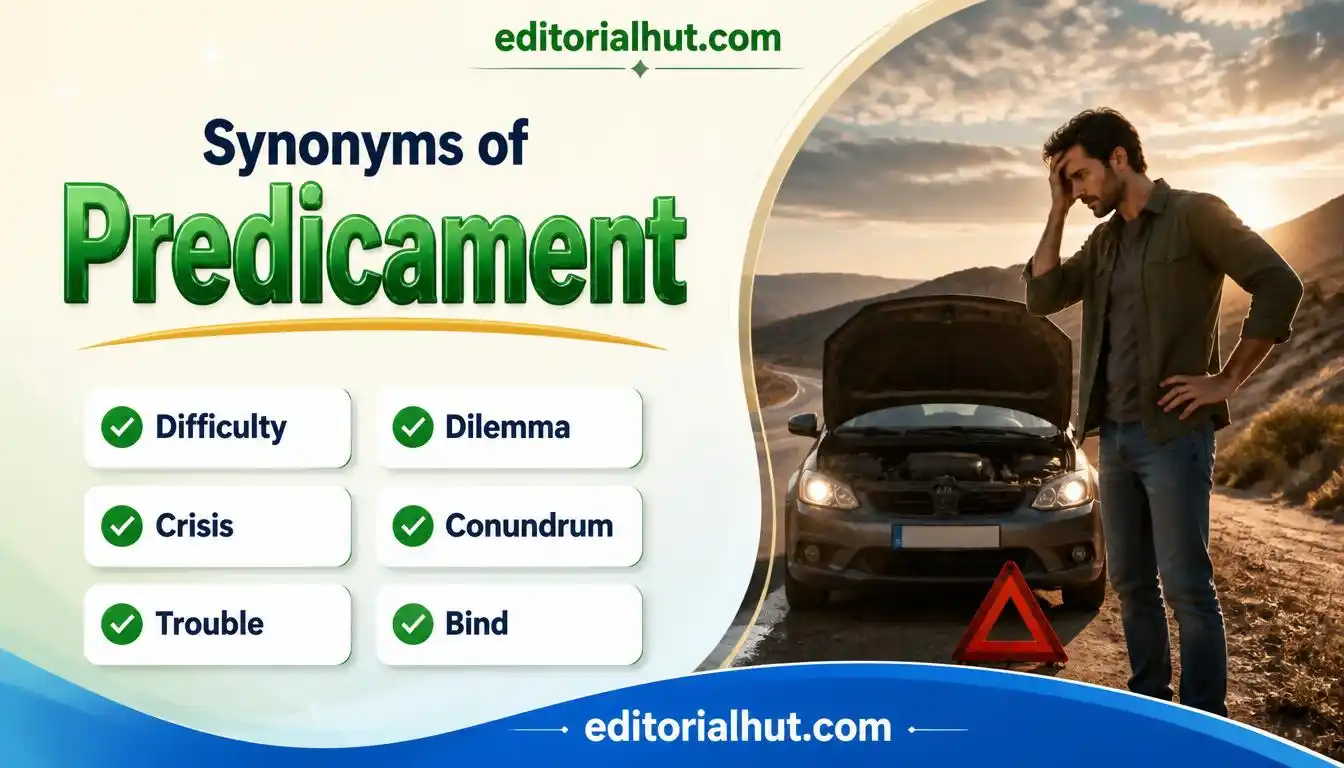
Finding the right synonym for predicament can help you describe a difficult situation with greater accuracy and variety. The word predicament usually refers to an unpleasant, challenging, or complicated situation that may be difficult to escape or resolve. Depending on the context, words such as dilemma, quandary, plight, difficulty, trouble, crisis, bind, and tight spot can express similar ideas, but each has its own shade of meaning. Some suggest a difficult choice, while others emphasize hardship, uncertainty, or being trapped in an uncomfortable situation. In this guide, you’ll discover useful synonyms for predicament, along with their meanings, parts of speech, connotations, pronunciation, word formation, and examples to help you choose the right word for your writing.
What Does “Synonyms for Predicament” Really Mean?
The phrase “synonyms for predicament” means other words or phrases that have a similar meaning to “predicament.”
A predicament is a difficult, unpleasant, or challenging situation, especially one that is hard to escape or solve.
For example:
- I am in a difficult predicament.
- She found herself in a tricky situation.
- He was faced with a serious dilemma.
Depending on the context, useful synonyms for predicament include dilemma, difficulty, problem, trouble, quandary, crisis, bind, plight, and tight spot.
Predicament vs. Its Synonyms
The exact synonym depends on the type of difficulty:
- Dilemma — a situation where you must choose between difficult options.
- Quandary — a state of uncertainty about what to do.
- Plight — a difficult or unfortunate situation.
- Bind — a difficult situation that limits your choices.
- Crisis — a serious situation requiring immediate action.
- Trouble — a general word for problems or difficulties.
- Tight spot — an informal expression for a difficult situation.
- Difficulty — a problem or obstacle that makes something hard.
- Problem — something that needs to be solved or dealt with.
Connotative Meaning
Connotative meaning refers to the feelings, ideas, or associations that a word suggests beyond its basic dictionary definition.
For predicament, the connotation is generally negative. It suggests that someone is stuck in a difficult, uncomfortable, or complicated situation and may have limited ways to escape it.
- Basic meaning: A difficult situation.
- Connotation: Trouble, uncertainty, pressure, helplessness, or being stuck.
- Example: She found herself in a serious predicament.
The word predicament is usually stronger and more specific than simply saying problem.
Word Formation
Word formation explains how a word is built and how it relates to other words in a language.
Predicament is a noun. It is a single established lexical word rather than a modern combination such as problem + situation.
Related forms include:
- Predicament — noun
- Predicamental — adjective, meaning related to a predicament or category
- Predicamentally — adverb, rare and uncommon
In everyday English, predicament is by far the most commonly used form.
Affixation Pattern
Affixation is the process of creating words by adding prefixes or suffixes to a base or root.
For predicament, the historical structure is more complicated than a simple modern prefix + root + suffix pattern.
The ending -ment is a suffix commonly found in nouns, often referring to a result, state, or condition. Examples include:
- develop → development
- improve → improvement
- entertain → entertainment
However, predicament should not be treated as a modern English word formed simply by adding -ment to predicate. Its history comes through Latin and French, so the apparent parts do not represent its straightforward modern word-building process.
Syllables
Syllables are the individual sound units or beats in a word.
Predicament has 4 syllables:
pred-i-ca-ment
The stress falls on the first syllable.
Knowing the syllable count can help with pronunciation, spelling, and speaking fluently.
Pronunciation
Predicament is pronounced differently depending slightly on accent, but the standard English pronunciation has four syllables.
predicament (prih-DIK-uh-muhnt)
The first syllable is stressed, while the remaining syllables are pronounced more lightly.
Etymology
Etymology is the study of a word’s origin and how its meaning and form have developed over time.
Predicament ultimately comes from Latin praedicamentum, meaning a category, class, or something that is predicated. It passed into English through French and was originally associated with a category or classification.
Over time, its meaning developed into the modern sense of a difficult or awkward situation in which someone finds themselves.
What Are the Best Synonyms for Predicament?
Some of the best synonyms for predicament include dilemma, quandary, plight, jam, fix, bind, and tight spot. Each word describes a difficult situation, but the tone can shift from formal (dilemma, quandary) to casual (jam, pickle, fix). Choosing the right one depends on your audience and writing style.
Predicament Synonyms at a Glance
| Synonym | Simple Meaning | Best Used For |
| Dilemma | A hard choice between two options | Formal or academic writing |
| Quandary | A state of confusion about what to do | Formal writing |
| Plight | A serious, often sad situation | News, storytelling |
| Jam | A tricky problem (casual) | Everyday conversation |
| Fix | A tough spot to get out of | Casual speech |
| Bind | Feeling trapped by a problem | Casual writing |
| Pickle | A silly or awkward problem | Informal, playful tone |
| Tight spot | A difficult moment needing a solution | Everyday speech |
| Crisis | A very serious, urgent problem | News, business writing |
| Conundrum | A confusing puzzle-like problem | Academic or clever writing |
| Impasse | A situation with no clear way forward | Business, negotiations |
| Mess | A messy or complicated situation | Casual conversation |
| Trouble | General difficulty or problem | Everyday use |
| Deadlock | A standstill where no side can move forward | Business, politics |
| Ordeal | A painful or exhausting experience | Storytelling, serious writing |
1. Dilemma
Meaning: A dilemma is a situation where you must choose between two difficult options. Examples: She faced a dilemma: take the new job or stay near her family. Choosing between two good friends put him in a real dilemma.
2. Quandary
Meaning: A quandary is a state of not knowing what to do because a situation is confusing. Examples: He was in a quandary about which college to attend. The manager found herself in a quandary over the budget cuts.
3. Plight
Meaning: A plight is a difficult or sad situation, often affecting someone’s wellbeing. Examples: The news covered the plight of families affected by the flood. Her plight after losing her job touched everyone in the community.
4. Difficulty
Meaning: A difficulty is a problem that makes something hard to do or solve. Examples: He explained the financial difficulty his company was facing. The team ran into a difficulty halfway through the project.
5. Situation
Meaning: A situation is the set of conditions or circumstances someone is dealing with. Examples: This is a strange situation, and nobody knows what to do next. They tried to stay calm during the stressful situation.
6. Mess
Meaning: A mess is a confusing or messy problem, often caused by mistakes. Examples: The project turned into a total mess after the deadline changed. She had to clean up the mess left by the previous manager.
7. Jam
Meaning: A jam is an informal word for a tricky or urgent problem. Examples: We’re in a real jam if the flight gets cancelled. He got into a jam when he forgot his wallet at home.
8. Fix
Meaning: A fix, used informally, means a tough situation that is hard to escape. Examples: I’m in a bit of a fix — my car won’t start. They were in a fix when the printer broke before the meeting.
9. Bind
Meaning: A bind describes feeling trapped or stuck between two problems. Examples: She was in a bind, needing money but not wanting to ask her parents. He found himself in a bind between two conflicting deadlines.
10. Pickle
Meaning: A pickle is an informal, slightly playful word for an awkward problem. Examples: We’re in quite a pickle now that the power is out. He laughed about the pickle he got into at the wedding.
11. Tight Spot
Meaning: A tight spot is a difficult moment that needs a quick solution. Examples: The goalie saved the team from a tight spot in the final minute. She talked her way out of a tight spot with her boss.
12. Crisis
Meaning: A crisis is a very serious and urgent problem that needs immediate attention. Examples: The company faced a financial crisis after losing its biggest client. Doctors worked quickly during the health crisis.
13. Conundrum
Meaning: A conundrum is a confusing problem that feels like a puzzle to solve. Examples: Choosing between two job offers became a real conundrum for her. The scientists faced a conundrum they couldn’t explain.
14. Impasse
Meaning: An impasse is a situation where no progress can be made because both sides disagree. Examples: The negotiations reached an impasse after hours of discussion. They hit an impasse when neither side would compromise.
15. Corner
Meaning: Being in a corner means being trapped in a problem with few options. Examples: The lie put him in a corner he couldn’t easily escape. She felt backed into a corner by her tight schedule.
16. Hot Water
Meaning: Being in hot water means being in trouble, often because of a mistake. Examples: He landed in hot water after missing the important deadline. The company was in hot water over the data leak.
17. Scrape
Meaning: A scrape is a minor but annoying difficult situation. Examples: They got into a scrape trying to fix the leaking pipe themselves. She managed to get out of the scrape without any damage.
18. Muddle
Meaning: A muddle is a confused and disorganized situation. Examples: The scheduling turned into a muddle after three changes. He was in a muddle trying to remember which files were updated.
19. Complication
Meaning: A complication is an added problem that makes a situation harder. Examples: A complication with the paperwork delayed the entire process. The surgery had an unexpected complication.
20. Trouble
Meaning: Trouble is a general word for difficulty or a problematic situation. Examples: He was in trouble for arriving late three times. The car started making noises, which meant trouble ahead.
21. Snag
Meaning: A snag is a small but unexpected problem. Examples: We hit a snag when the venue cancelled last minute. The plan worked well until they ran into a snag with permits.
22. Hitch
Meaning: A hitch is a minor problem that slows things down. Examples: The wedding went smoothly except for one small hitch. There was a hitch in the delivery schedule this week.
23. Deadlock
Meaning: A deadlock is a standstill where neither side can move forward. Examples: The two companies reached a deadlock over pricing terms. Talks ended in a deadlock after months of negotiation.
24. Catch-22
Meaning: A catch-22 is a situation where every solution creates a new problem. Examples: It was a catch-22 — she needed experience to get hired, but needed a job to get experience. He faced a catch-22 with the visa requirements.
25. Tough Spot
Meaning: A tough spot is a hard situation that requires a difficult decision. Examples: The coach put the rookie in a tough spot during the final play. She was in a tough spot choosing between two close friends.
26. Hole
Meaning: Being in a hole, used informally, means being in serious trouble, often financial. Examples: The unexpected repair bills put them in a deep hole. He dug himself into a hole by ignoring the warning signs.
27. Mire
Meaning: A mire is a difficult situation someone feels stuck in, often for a long time. Examples: The project sank into a mire of delays and confusion. She felt trapped in a mire of paperwork and approvals.
28. Entanglement
Meaning: An entanglement is a complicated situation involving multiple people or issues. Examples: The legal entanglement took years to resolve. Their business entanglement made the split messy.
29. Imbroglio
Meaning: An imbroglio is a confusing and embarrassing situation, often involving conflict. Examples: The political imbroglio dominated the news for weeks. Their imbroglio over the contract ended in court.
30. Ordeal
Meaning: An ordeal is a painful, difficult, or exhausting experience. Examples: The long surgery recovery was a real ordeal for her. Losing the luggage turned the trip into an ordeal.
How to Choose the Right Synonym for Predicament
Not all synonyms for predicament mean exactly the same thing. Some are formal, like dilemma and quandary. Others are casual, like jam and pickle. Some describe small annoyances, like snag or hitch. Others describe serious problems, like crisis or ordeal.
Think about tone before choosing a word:
- Formal vs. informal: Use impasse in a business report, but jam in a text to a friend.
- Positive vs. negative: Most of these words are negative, but some (like conundrum) can sound playful or intellectual.
- Strong vs. weak: Ordeal feels much stronger than hitch.
- Academic writing: Choose dilemma, quandary, or impasse.
- Business writing: Choose crisis, complication, or deadlock.
- Casual conversation: Choose jam, pickle, or tight spot.
- Creative writing: Choose plight, mire, or ordeal for emotional depth.
- Social media content: Choose short, punchy words like mess or snag.
Picking the wrong word can confuse your reader or make your writing sound off. For example, saying “We reached a pickle in the peace talks” sounds too casual for a serious topic.
Formal and Informal Synonyms for Predicament
| Formal Synonym | Informal Synonym | Example Context |
| Dilemma | Jam | Making a hard choice vs. a quick casual problem |
| Quandary | Pickle | Academic confusion vs. playful trouble |
| Impasse | Tight spot | Business negotiation vs. everyday moment |
| Crisis | Hot water | News report vs. personal trouble |
| Conundrum | Fix | Intellectual puzzle vs. quick mishap |
| Complication | Snag | Medical or legal issue vs. small delay |
Best Synonyms for Different Contexts
Academic Writing Dilemma, quandary, impasse, complication, and conundrum work well in essays and research papers.
Blog Writing Trouble, situation, mess, tight spot, and snag feel natural and easy to read for blog audiences.
Business Writing Crisis, deadlock, complication, impasse, and difficulty sound professional in reports and emails.
Everyday Conversation Jam, pickle, fix, bind, and hot water are perfect for casual talk with friends or family.
Creative Writing Plight, ordeal, mire, imbroglio, and entanglement add emotional weight to stories and novels.
Common Mistakes When Using Synonyms
- Choosing a word with the wrong meaning. “Snag” suggests a small issue, so using it for a life-threatening crisis feels wrong.
- Using a formal word in casual speech. Saying “I’m in a quandary about lunch” sounds overly formal for such a small decision.
- Replacing a word without checking context. “Deadlock” fits negotiations, but not a personal embarrassing moment.
- Using a synonym that changes the tone. “Ordeal” makes a small inconvenience sound like a tragedy.
- Repeating synonyms too much in SEO content. Overusing fancy words like “imbroglio” in every paragraph can confuse readers instead of helping them.
Synonyms vs. Related Words
- True synonyms share almost the same meaning. Predicament and plight are close true synonyms.
- Near-synonyms are similar but carry a different strength or tone. Predicament and ordeal are near-synonyms because ordeal feels more painful.
- Related words connect to the same topic but aren’t direct replacements. Problem is related to predicament but is broader in meaning.
- Contextual alternatives only work in specific situations. Corner only works as a synonym when talking about feeling trapped, not in every sentence.
How to Use Synonyms in Your Writing
Synonyms make writing feel natural instead of repetitive. An essays, they help you avoid repeating the same word in every paragraph. A blog posts, they keep readers interested. In emails, the right synonym can set a professional or friendly tone. The website content, varied vocabulary improves flow and readability.
For stories, synonyms like ordeal or plight add emotional depth. For social media posts, short words like mess or jam keep captions punchy. In school assignments, synonyms show a wider vocabulary range to teachers.
The goal is always clarity. Synonyms should make your writing easier to understand, not harder.
Practice Using These Synonyms
- Fill in the blank: After losing his passport, he was in a real , (informal word for trouble).
- Choose the best synonym: Which word fits a serious news report about a refugee crisis , pickle or plight?
- Rewrite the sentence: “She was in a difficult situation.” Rewrite using a stronger, more formal synonym.
- Pick the formal word: Choose the formal option: jam or dilemma.
- Pick the informal word: Choose the informal option: quandary or fix.
Answer Key:
- Jam (or pickle/fix)
- Plight
- “She was in a dilemma.” or “She faced a quandary.”
- Dilemma
- Fix
Frequently Asked Questions About Predicament
What is another word for predicament?
Common alternatives include dilemma, plight, quandary, and jam, depending on how formal or serious the situation is.
What is the best synonym for predicament?
It depends on context. For formal writing, dilemma or quandary work well. For casual speech, jam or pickle fit better.
Which synonym is best for formal writing?
Dilemma, quandary, and impasse sound professional and are commonly used in academic or business writing.
Which synonym is best for everyday conversation?
Jam, pickle, fix, and tight spot are natural choices for casual, everyday talk.
Can I use these synonyms in academic writing?
Yes, but choose formal options like dilemma, quandary, impasse, or complication rather than casual words like pickle.
Are all synonyms exactly the same?
No. Some are true synonyms, while others are near-synonyms with a different tone or strength, so meaning can shift slightly.
How can I learn synonyms easily?
Read example sentences, practice using new words in your own writing, and group synonyms by tone, such as formal versus informal.
How can synonyms improve my writing?
Synonyms add variety, prevent repetition, and help match the right tone for your audience, making your writing clearer and more engaging.
Conclusion
Learning synonyms for predicament can make your writing, blogging, and speaking much stronger. A wider vocabulary helps you express ideas more clearly and keeps your readers interested. Try using these words in your next email, essay, blog post, school assignment, or everyday conversation.
The more you practice, the more natural these words will feel. Start small, pick a few favorites, and watch your communication skills grow.

Shahid Imran is an English language and vocabulary specialist at EditorialHut.com, focusing on synonyms, word meanings, alternative words, and practical example sentences. He helps readers discover better words, expand their vocabulary, and communicate more clearly and confidently.