








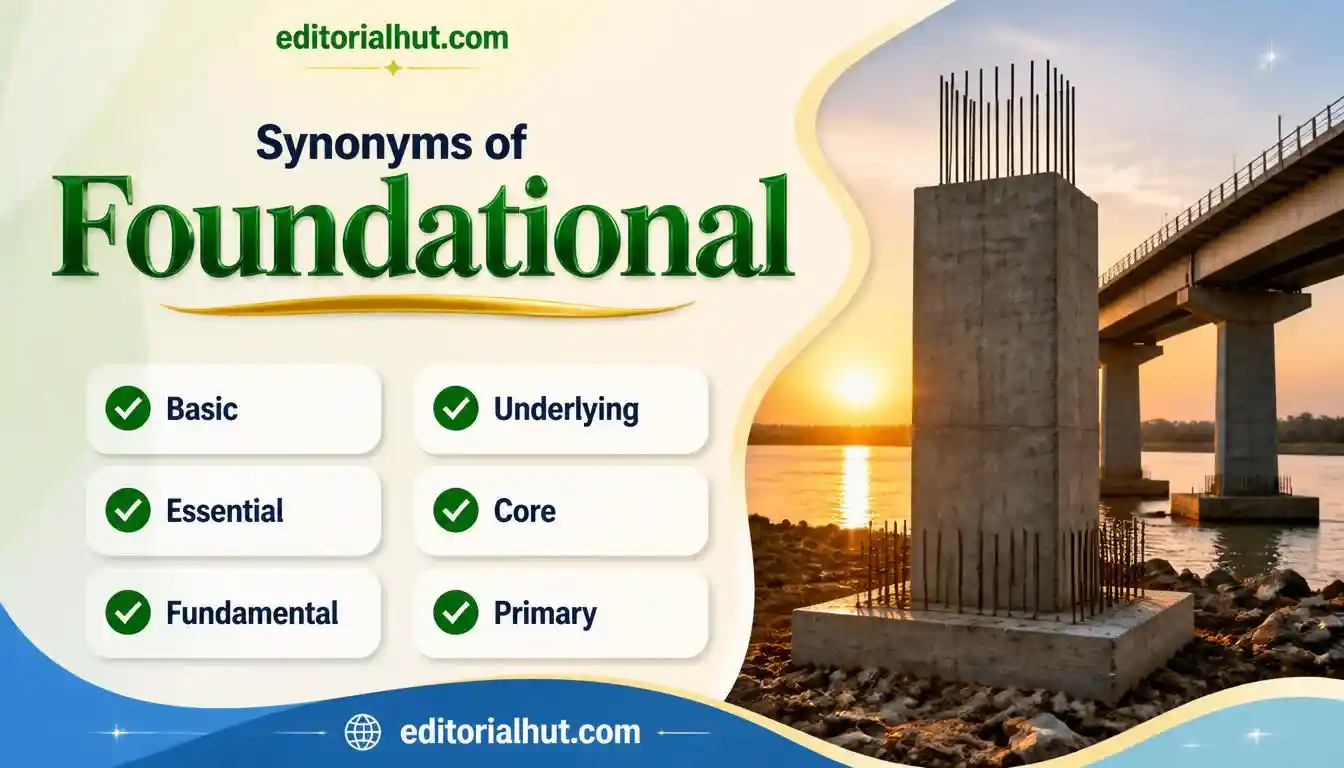
When you need synonyms for foundational, the best choice depends on what you mean by the word. Foundational can describe something that forms the basic support of an idea, system, skill, institution, or process. Depending on the context, alternatives such as fundamental, basic, essential, underlying, core, primary, central, pivotal, or founding may work—but they do not all carry exactly the same meaning.
For example, fundamental usually means something basic and essential, while founding is more closely connected with the creation of an organization, movement, or institution. Choosing the right alternative can make your writing more precise, especially in academic, professional, business, and formal contexts.
Quick Answer
The closest synonyms for foundational include:
- Fundamental — basic and essential to something
- Founding — connected with establishing or creating something
- Underlying — existing beneath or supporting something
- Basic — forming the simplest or most necessary part
- Essential — absolutely necessary
- Core — central or most important
- Primary — first or most important
- Fundamental — essential to the nature or structure of something
- Structural — related to the basic framework of something
- Groundwork — basic preparation or support for future development
The best replacement depends on the sentence. Fundamental is often the closest general alternative, while underlying, core, essential, and founding are better in specific situations.
Closest Synonyms for Foundational
| Alternative | Meaning | Type | Tone | Best Use |
| Fundamental | Basic and essential | Near-synonym | Neutral/Formal | Ideas, principles, skills |
| Founding | Connected with establishing something | Contextual | Formal | Institutions, organizations |
| Underlying | Existing beneath and supporting something | Near-synonym | Formal | Causes, principles, structures |
| Basic | Simple or essential | Near-synonym | Neutral | General explanations |
| Essential | Absolutely necessary | Near-synonym | Neutral/Formal | Requirements, qualities |
| Core | Central or most important | Contextual | Neutral | Ideas, values, concepts |
| Primary | First or most important | Near-synonym | Formal | Factors, objectives, concerns |
| Central | Most important or influential | Contextual | Neutral/Formal | Ideas, themes, issues |
| Structural | Related to the basic framework | Contextual | Formal | Systems, organizations |
| Pivotal | Extremely important to development or outcome | Contextual | Formal | Events, decisions, factors |
| Bedrock | A basic, dependable foundation | Figurative | Strong | Values, principles, beliefs |
| Cornerstone | An essential supporting element | Figurative | Formal | Institutions, arguments, systems |
| Groundwork | Basic preparation or support | Contextual | Neutral/Formal | Projects, development |
| Root | Basic source or cause | Contextual | Neutral | Problems, beliefs, causes |
| Base | Fundamental supporting part | Contextual | Neutral | Structures, systems, knowledge |
Not every word in this table is a perfect synonym. Some describe importance, some describe support, and others refer specifically to the act or process of establishing something.
What Does Foundational Mean?
Foundational is an adjective used to describe something that provides a basic support, principle, structure, or starting point for something else.
For example:
Reading is a foundational skill for academic success.
Here, foundational means that reading provides an important basic skill on which later learning depends.
The word can be used with:
- skills — foundational skills
- principles — foundational principles
- knowledge — foundational knowledge
- ideas — foundational ideas
- beliefs — foundational beliefs
- concepts — foundational concepts
- institutions — foundational institutions
- research — foundational research
The central idea is support or basic importance.
Connotation of Foundational
Foundational generally has a neutral to positive connotation. It often suggests that something is important because other things depend on it.
The word can sound:
- Formal
- Academic
- Professional
- Neutral
- Important
- Structural
For example:
Critical thinking is foundational to good decision-making.
This sounds more formal than:
Critical thinking is important for good decision-making.
The difference is subtle but useful. Important simply expresses significance, whereas foundational suggests that one thing helps provide the basis for another.
Formal Synonyms for Foundational
For formal writing, these alternatives can work well:
Fundamental
Fundamental is probably the most useful general replacement for foundational.
These principles are fundamental to modern economics.
It works especially well when discussing principles, concepts, skills, or ideas.
Underlying
Use underlying when you mean something that exists beneath or supports a larger idea or system.
The study examines the underlying principles of human behavior.
This word emphasizes the deeper basis rather than simply importance.
Structural
Structural is useful when the foundation relates to the organization or framework of something.
The report identifies several structural problems within the organization.
It is especially natural in discussions of systems, institutions, organizations, and frameworks.
Primary
Primary means first in importance, order, or priority.
Safety is a primary concern for the organization.
It can replace foundational in some contexts, but it does not necessarily suggest that something provides a foundation.
Academic Alternatives to Foundational
In academic writing, context matters greatly. Useful alternatives include:
- Fundamental
- Underlying
- Core
- Essential
- Central
- Basic
- Primary
- Structural
For example:
Foundational concepts in biology help students understand more advanced topics.
Could become:
Fundamental concepts in biology help students understand more advanced topics.
Or:
Core concepts in biology help students understand more advanced topics.
Fundamental emphasizes basic importance, while core emphasizes central importance.
Professional Alternatives to Foundational
In business and workplace writing, these alternatives are often natural:
- Core
- Essential
- Fundamental
- Primary
- Central
- Underlying
- Key
- Critical
For example:
Trust is foundational to a successful partnership.
Possible alternatives include:
A Trust is essential to a successful partnership.
Trust is central to a successful partnership.
Trust is a core element of a successful partnership.
The best choice depends on the level of emphasis you want.
Casual Alternatives to Foundational
In everyday English, foundational can sometimes sound more formal than necessary. Simpler options include:
- Basic
- Important
- Essential
- Key
- Core
- Starting
- Built on
For example:
Good communication is foundational to a healthy friendship.
In casual conversation, you might say:
Good communication is key to a healthy friendship.
The second version sounds more natural in everyday speech.
List of synonyms .
1. Fundamental
Meaning: Basic and essential to understanding, developing, or supporting something.
Example:
Understanding grammar is fundamental to learning a new language.
Best use: Use fundamental for principles, concepts, skills, knowledge, and ideas that are basic and essential.
2. Essential
Meaning: Completely necessary or extremely important for something to work or succeed.
Example:
Clear communication is essential for effective teamwork.
Best use: Use essential when you want to emphasize necessity rather than the idea of forming a foundation.
3. Basic
Meaning: Simple, primary, or forming an important starting point.
Example:
Students need basic math skills before studying advanced algebra.
Best use: Use basic for simple skills, knowledge, principles, or information, especially when writing for a general audience.
4. Core
Meaning: The central or most important part of something.
Example:
Trust is a core value of the organization.
Best use: Use core for values, ideas, principles, beliefs, skills, and elements that are central to something.
5. Underlying
Meaning: Existing beneath the surface and providing a deeper basis or cause.
Example:
The researchers examined the underlying causes of the problem.
Best use: Use underlying when discussing causes, principles, assumptions, structures, or ideas that support something beneath the surface.
6. Primary
Meaning: First in importance, priority, or position.
Example:
Customer satisfaction is the company’s primary goal.
Best use: Use primary when you want to identify the most important factor, objective, concern, or purpose.
7. Central
Meaning: Of greatest importance to the main idea, purpose, or structure.
Example:
Creativity is central to the design process.
Best use: Use central for ideas, themes, values, issues, or factors that play an important role in something.
8. Structural
Meaning: Related to the basic framework or organization of something.
Example:
The report identified several structural problems within the education system.
Best use: Use structural when discussing systems, organizations, frameworks, institutions, or arrangements.
9. Founding
Meaning: Connected with establishing or creating an organization, institution, movement, or system.
Example:
She was a founding member of the community organization.
Best use: Use founding when the meaning involves creating or establishing something, rather than simply providing its basis.
10. Pivotal
Meaning: Extremely important because it strongly influences what happens next.
Example:
The discovery was pivotal in the development of modern medicine.
Best use: Use pivotal for events, decisions, discoveries, people, or moments that have a major influence on later developments.
11. Cornerstone
Meaning: An essential part that provides support or helps hold something together.
Example:
Education is a cornerstone of a healthy society.
Best use: Use cornerstone as a figurative alternative when describing a principle, value, practice, or element that is especially important to a larger system.
12. Bedrock
Meaning: A strong and dependable basis on which something is built.
Example:
Honesty is the bedrock of a lasting relationship.
Best use: Use bedrock for strong figurative foundations such as beliefs, principles, trust, values, or institutions. It often creates a more powerful tone than foundational.
13. Groundwork
Meaning: Basic preparation or initial work that makes later development possible.
Example:
The early research laid the groundwork for future discoveries.
Best use: Use groundwork when talking about preparation, research, planning, or early efforts that make future progress possible.
14. Integral
Meaning: Necessary and closely connected to the whole rather than separate from it.
Example:
Collaboration is an integral part of the company’s culture.
Best use: Use integral when something is an essential part of a larger system, process, plan, or structure.
15. Key
Meaning: Extremely important to achieving a result or understanding an issue.
Example:
Practice is key to improving your writing skills.
Best use: Use key when you want a simple, natural, and widely understood alternative, especially in everyday or professional writing.
Stronger or Softer Alternatives to Foundational
There is no single synonym that is always stronger or weaker than foundational. The effect depends on context.
Stronger-sounding alternatives
Critical, indispensable, and essential can emphasize necessity.
Accurate data is essential to the research.
Softer alternatives
Helpful, important, or useful can reduce the strength of the statement.
Accurate data is important to the research.
However, important does not necessarily mean that something forms the foundation of another thing. That distinction matters.
Important Synonym Differences
Foundational vs Fundamental
These words are very close, but they are not always interchangeable.
Foundational emphasizes a basis or support.
Early education provides foundational knowledge.
Fundamental emphasizes something basic and essential.
Students must understand the fundamental principles of mathematics.
If you want to highlight what something is built upon, foundational is often the better choice. If you want to emphasize an essential principle or fact, fundamental often sounds more natural.
Foundational vs Essential
Essential means absolutely necessary.
Communication is essential for effective teamwork.
Foundational suggests that something provides a basis for something else.
Communication skills are foundational to effective teamwork.
The first sentence focuses on necessity. The second focuses on the supporting role of communication skills.
Foundational vs Founding
These words are related but have different uses.
Founding refers to establishing or creating something.
She was a founding member of the organization.
Foundational refers to something that provides a basis or support.
The organization’s founding principles remain influential.
A founding member helps establish an organization; a foundational principle supports its identity or operation.
Foundational vs Underlying
Underlying usually refers to something beneath the surface or behind an issue.
The researchers investigated the underlying causes of the problem.
Foundational usually refers to something that provides a basic support or starting point.
The researchers examined the foundational principles of the theory.
They can overlap, but they emphasize different relationships.
Foundational vs Core
Core means central or most important.
Customer trust is a core value of the company.
Foundational suggests that something provides a basis for development.
Customer trust is foundational to the company’s long-term success.
Both are strong choices, but foundational creates a clearer sense of dependence.
Word Formation of Foundational
Foundational is formed from the noun foundation with the suffix -al.
The structure can be understood broadly as:
foundation + -al → foundational
The base word foundation refers to a supporting base, underlying principle, or established starting point. The suffix -al forms an adjective meaning “related to” or “connected with.”
The related word family includes:
- found
- foundation
- foundational
- founder
- founding
- founded
These words are related historically and semantically, but their grammatical roles and meanings differ.
Affixation Pattern of Foundational
The most useful modern word-formation pattern is:
foundation + -al → foundational
The suffix -al changes the noun foundation into an adjective.
For example:
- foundation → foundational
- profession → professional
- nation → national
- institution → institutional
The exact historical development of the word is more complex than simply adding a suffix in modern English, but this pattern is useful for understanding its present-day form.
Syllables in Foundational
Foundational has 5 syllables:
foun-da-tion-al
The pronunciation may be heard approximately as:
foun-DAY-shuh-nuhl
Pronunciation of Foundational
A common pronunciation is:
US IPA: /faʊnˈdeɪʃənəl/
UK IPA: /faʊnˈdeɪʃənəl/
The word has its main stress on the second syllable, around -day-.
Etymology of Foundational
Foundational is built from foundation, which ultimately comes through French from Latin fundatio, meaning an act of founding or establishing.
The deeper Latin source is connected with fundus, meaning “bottom” or “base.”
This history fits the modern meaning well: something foundational provides a base upon which something else can be established or developed.
The word foundation has long been used both literally for the base of a physical structure and figuratively for a supporting principle, idea, or institution. Foundational developed from that broader concept of a basis or support.
Real-World Examples
Everyday conversation
Learning to manage money is a foundational life skill.
Education
Basic reading ability is foundational to academic learning.
Academic writing
The study explores the foundational principles behind the theory.
Workplace communication
Clear communication is foundational to effective teamwork.
Business
Customer trust is foundational to long-term brand loyalty.
Technology
Data security has become foundational to modern digital systems.
Creative writing
Her childhood experiences became foundational to her later work.
Formal communication
These principles are foundational to the organization’s mission.
Foundational vs Fundamental
| Feature | Foundational | Fundamental |
| Basic meaning | Provides a basis | Basic and essential |
| Emphasis | Support or foundation | Essential nature |
| Tone | Formal | Neutral/Formal |
| Common with | Skills, principles, knowledge, systems | Principles, concepts, truths, skills |
| Interchangeable? | Sometimes | Sometimes |
A useful rule is:
Use “foundational” when you want to show that something supports or forms the basis of something else.
Use “fundamental” when you want to emphasize that something is basic and essential.
Sentence Transformations
Original
Reading is foundational to academic success.
Alternative
Reading is fundamental to academic success.
The alternative works well, but fundamental emphasizes importance rather than the idea of providing a foundation.
Original
Trust is foundational to a strong relationship.
Alternative
Trust is essential to a strong relationship.
Here, essential makes the statement stronger in terms of necessity, while foundational emphasizes trust as a basis for the relationship.
Original
These ideas are foundational to the theory.
Alternative
These ideas form the basis of the theory.
The second sentence is more direct and can sound more natural when explaining a concept to a general audience.
Which Alternative Should You Choose?
| If you want to sound… | Consider… |
| More formal | Fundamental |
| More academic | Fundamental / underlying |
| More professional | Core / essential |
| More conversational | Basic / key |
| More precise about support | Foundational |
| More focused on necessity | Essential |
| More focused on central importance | Core |
| More focused on deeper causes | Underlying |
| More focused on establishment | Founding |
| More focused on framework | Structural |
There is no universally “best” synonym for foundational. The right word depends on what you are trying to emphasize.
Common Phrases With Foundational
Some natural combinations include:
- foundational knowledge
- foundational skills
- foundational principles
- foundational concepts
- foundational beliefs
- foundational ideas
- foundational research
- foundational education
- foundational role
- foundational work
- foundational elements
- foundational theory
- foundational understanding
The word is particularly common in education, academic writing, professional communication, research, and discussions of systems or principles.
Common Mistakes With Foundational
Treating every related word as an exact synonym
Words such as important, central, and essential may overlap with foundational, but they do not always carry the idea of providing a basis.
Using founding when you mean foundational
These words are easy to confuse.
He was a founding member of the company.
This means he helped establish it.
His research was foundational to the field.
This means the research provided an important basis for later development.
Using foundational when simple wording would be clearer
In casual writing, foundational can sometimes sound unnecessarily formal.
Instead of:
Good listening is foundational to a good conversation.
You could simply say:
Good listening is key to a good conversation.
The simpler version may be more natural for everyday readers.
Assuming essential and foundational mean exactly the same thing
Something can be essential without being foundational.
For example, a deadline may be essential to a project, but it is not necessarily the foundation of the project.
Antonyms of Foundational
There is no single direct opposite of foundational in every context. Depending on the meaning, useful contrasts may include:
- secondary
- peripheral
- supplementary
- nonessential
- incidental
- superficial
For example:
Foundational knowledge is necessary for advanced study, while supplementary information provides additional detail.
Secondary and peripheral are especially useful when contrasting something central or foundational with something less important.
Frequently Asked Questions
What is the closest synonym for foundational?
Fundamental is often the closest general synonym. Both can describe something basic and essential, although foundational places more emphasis on providing a basis for something else.
What is another word for foundational?
Depending on the context, alternatives include fundamental, essential, underlying, core, basic, primary, central, structural, and founding.
What is a formal synonym for foundational?
Fundamental, underlying, and structural can work well in formal writing, depending on the sentence.
What is a stronger word than foundational?
There is no universal stronger synonym. Essential, critical, or indispensable can create a stronger sense of necessity, but they change the meaning slightly.
What is a simpler alternative to foundational?
Basic, key, or important may be simpler choices. However, they do not always preserve the idea that something forms a basis.
Can fundamental replace foundational?
Often, yes. For example, “foundational principles” and “fundamental principles” can be interchangeable in many contexts. Still, foundational more strongly suggests that later ideas or developments depend on those principles.
What is the difference between foundational and founding?
Founding relates to establishing or creating something, while foundational describes something that provides a basis or support.
What is the opposite of foundational?
There is no single exact antonym. Depending on context, secondary, peripheral, supplementary, or nonessential may provide a useful contrast.
Final Takeaway
The best synonyms for foundational depend on the relationship you want to describe. Fundamental is usually the closest broad alternative, while essential emphasizes necessity, core emphasizes central importance, underlying highlights something beneath or supporting a larger idea, and founding refers specifically to establishment.
The key is not to replace foundational simply because another word looks similar. Choose the alternative that preserves the intended meaning, tone, and level of importance. In formal and academic writing, that small distinction can make a sentence much more precise.

Shahid Imran is an English language and vocabulary specialist at EditorialHut.com, focusing on synonyms, word meanings, alternative words, and practical example sentences. He helps readers discover better words, expand their vocabulary, and communicate more clearly and confidently.