








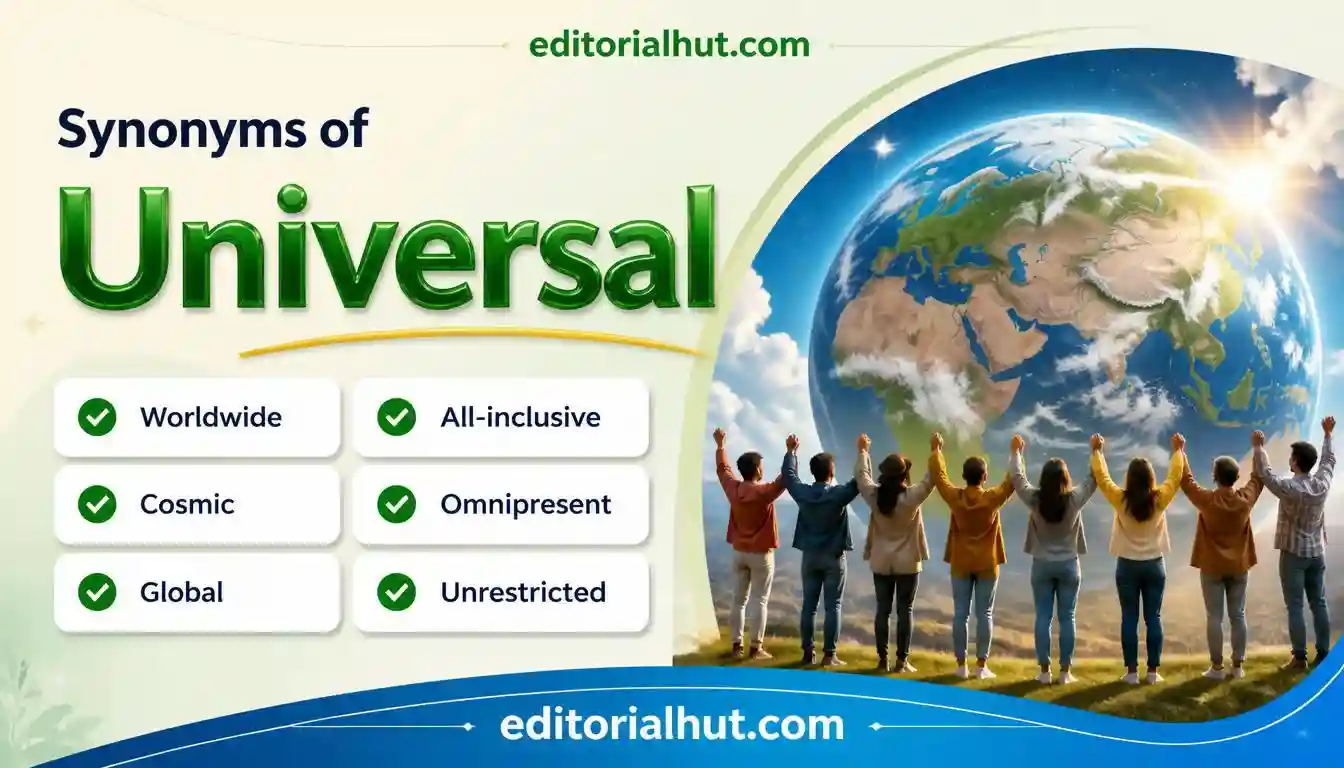
The best synonyms for universal include global, worldwide, common, general, comprehensive, all-encompassing, ubiquitous, and pervasive. However, these words have slightly different meanings.
Global usually refers to the whole world while common describes something shared by many people or found in many situations. Comprehensive means covering all or nearly all relevant parts of a subject.
Choosing the right alternative depends on what you want to express. Whether you are writing an academic paper, a professional report, a business document or everyday English, understanding these differences helps you communicate more precisely.
What Do Synonyms for Universal Really Mean?
Synonyms for universal are words or expressions that have a similar meaning to universal but may be used in different contexts. The word universal generally means applying to everyone or everything within a particular scope. It can also describe something that exists throughout the world or is shared by people across different backgrounds.
The best synonym depends on the intended meaning. For example, global refers to the whole world, general describes something broad rather than specific, and all-encompassing emphasizes including everything within a defined range.
Examples:
- Universal principle: A principle intended to apply to all relevant situations.
- Global concern: An issue that affects or involves the world.
- Common experience: Something experienced by many people.
- Comprehensive guide: A guide that covers all or nearly all important aspects of a subject.
Although these words are related, they are not always interchangeable. Choosing the right alternative makes your writing more accurate and natural.
Etymology of Universal
The word universal entered English through Old French universel and Latin universalis, meaning “of or belonging to all.” It is connected to the Latin word universus, meaning “whole” or “entire.”
The Latin universus is traditionally explained through unus, meaning “one,” and versus, associated with turning. Its historical sense developed around the idea of the whole taken together.
Over time, universal came to describe things that apply broadly to all people or cases, relate to the entire world or include everything within a particular category.
Today, the word appears in philosophy, science, education, technology and everyday English.
Connotative Meaning of Universal
The connotative meaning of universal refers to the feelings, associations or impressions the word creates beyond its basic dictionary definition.
The word often suggests inclusiveness, broad acceptance, fairness or shared human experience. However, its connotation depends on the context.
Positive Connotation
Universal can suggest equality, accessibility and common understanding.
Example: The organization believes in universal access to education.
Here, the word creates a positive impression of equal opportunity.
Neutral Connotation
The word can simply describe something intended to apply broadly.
Example: The device uses a universal connector.
In this sentence, universal describes compatibility or broad applicability without a strong emotional meaning.
Potentially Negative Connotation
Sometimes, universal can suggest an overly broad generalization when differences or exceptions are ignored.
Example: The writer challenged the claim that one teaching method works universally.
Here, the word raises questions about whether a claim applies to every situation.
Denotation and Connotation of Universal
| Term | Meaning | Example |
| Denotation | The direct or dictionary meaning | A universal rule applies to all relevant cases. |
| Connotation | The associations or impressions created by a word | Universal access may suggest fairness and inclusion. |
The denotation explains what the word means. Its connotation explains the impression it may create.
Part of Speech of Universal
Universal is an adjective. An adjective describes a noun or gives information about a person, place, thing, idea or quality.
Examples:
- Universal rule: Describes the type of rule.
- Universal appeal: Describes the broad appeal of something.
- Universal language: Describes a language or system intended to be widely understood.
- Universal principle: Describes a principle intended to apply broadly.
Related Word Forms
- Universal — adjective: A universal principle.
- Universally — adverb: The idea is not universally accepted.
- Universality — noun: The universality of the concept is debated.
- Universalize — verb: To make something universal or apply it more broadly.
- Universalization — noun: The process of making something universal.
These forms are related, but their grammatical functions differ.
Syllables in Universal
The word universal has five syllables.
Syllable division: u-ni-ver-sal
Count: 5 syllables
Breaking the word into syllables can help with pronunciation, spelling and reading.
Pronunciation of Universal
- US pronunciation (IPA): /ˌjuː.nəˈvɝː.səl/
- UK pronunciation (IPA): /ˌjuː.nɪˈvɜː.səl/
The main stress falls on the third syllable: VER.
A simple pronunciation guide is yoo-nuh-VER-suhl. The vowel sounds in the unstressed syllables can vary by accent.
Quick Answer: What Is Another Word for Universal?
The closest alternative depends on the context.
- Global: Relating to the entire world.
- Worldwide: Extending throughout the world.
- General: Applying broadly rather than to a specific case.
- Common: Shared by many people or things.
- All-encompassing: Including everything within a particular scope.
- Ubiquitous: Present or found almost everywhere.
- Comprehensive: Covering all or nearly all relevant aspects.
- Inclusive: Including different people or groups.
- Unrestricted: Not limited by particular conditions.
- Pervasive: Spreading widely throughout an area or system.
For most everyday writing, global, general, and all-encompassing are useful alternatives. The best choice depends on the sentence.
20 Synonyms for Universal With Meanings and Examples
1. Global
Meaning: Relating to the whole world or involving many countries.
Difference: Global emphasizes worldwide reach while universal emphasizes something that applies to everyone or everything within a particular scope.
Example: Climate change is a global concern that affects countries around the world.
Best use: International business, environmental issues, technology and worldwide trends.
2. Worldwide
Meaning: Extending across or involving the entire world.
Difference: Worldwide usually describes geographical reach. Universal can describe an idea or principle that applies across different places and cultures.
Example: The company launched a worldwide campaign to introduce its new product.
Best use: News articles, marketing and international communication.
3. General
Meaning: Applying broadly rather than being restricted to a particular person, thing or situation.
Difference: General is often less absolute than universal. A general rule may have exceptions while a universal rule suggests broader applicability.
Example: The teacher provided general instructions for completing the assignment.
Best use: Everyday conversation, instructions and explanatory writing.
4. Common
Meaning: Shared by many people or occurring frequently.
Difference: Common suggests something widespread or shared rather than something that necessarily applies to everyone.
Example: A desire for friendship is common across many communities.
Best use: Everyday English and descriptions of shared experiences.
5. All-Encompassing
Meaning: Including everything within a particular subject or range.
Difference: This expression emphasizes breadth and completeness. It is often stronger than general.
Example: The report provides an all-encompassing overview of the organization’s activities.
Best use: Detailed reports, comprehensive descriptions and creative writing.
6. Ubiquitous
Meaning: Present or found almost everywhere.
Difference: Ubiquitous describes widespread presence while universal often describes broad applicability.
Example: Smartphones have become ubiquitous in many urban communities.
Best use: Academic writing, technology discussions and formal descriptions.
7. Comprehensive
Meaning: Covering all or nearly all important aspects of a subject.
Difference: Comprehensive focuses on completeness of coverage rather than worldwide application.
Example: The researcher prepared a comprehensive review of the available evidence.
Best use: Research papers, reports, educational materials and business documents.
8. Inclusive
Meaning: Designed to include different people, groups or perspectives.
Difference: Inclusive emphasizes participation and representation. It does not necessarily mean that something applies to everyone.
Example: The school developed an inclusive program for students with different learning needs.
Best use: Education, workplace policies and community initiatives.
9. Pervasive
Meaning: Spreading widely throughout a place, system or group.
Difference: Pervasive often suggests that something is deeply established or difficult to avoid. Universal is not necessarily negative.
Example: The study examined the pervasive influence of digital technology on daily life.
Best use: Academic writing, social analysis and descriptions of widespread influences.
10. Widespread
Meaning: Found across a large area or among many people.
Difference: Widespread describes how extensively something occurs. It does not mean that it applies to every person or situation.
Example: There was widespread support for the proposed changes.
Best use: Journalism, research and everyday communication.
11. Extensive
Meaning: Large in amount, range or scope.
Difference: Extensive emphasizes size or breadth rather than universal applicability.
Example: The team conducted extensive research before making its recommendation.
Best use: Professional reports, research and formal writing.
12. All-Inclusive
Meaning: Including all relevant items, services or components within a defined arrangement.
Difference: All-inclusive often describes a package or arrangement while universal generally describes applicability or scope.
Example: The hotel offers an all-inclusive vacation package.
Best use: Travel, hospitality, services and package descriptions.
13. Broad
Meaning: Covering a wide range of subjects, people or possibilities.
Difference: Broad suggests a wide scope without necessarily including every possible element.
Example: The course provides a broad introduction to environmental science.
Best use: Academic writing, explanations and professional communication.
14. Unrestricted
Meaning: Not limited or controlled by particular restrictions.
Difference: Unrestricted emphasizes freedom from limitations. It is not a direct replacement for universal in every sentence.
Example: Employees were given unrestricted access to the public training materials.
Best use: Policies, permissions and access-related discussions.
15. Far-Reaching
Meaning: Having effects that extend over a large area or influence many people or situations.
Difference: Far-reaching emphasizes consequences or influence rather than universal applicability.
Example: The new policy could have far-reaching effects on local businesses.
Best use: News reports, policy analysis and persuasive writing.
16. Consistent
Meaning: Remaining stable or following the same pattern across different circumstances.
Difference: Consistent describes regularity or agreement. Something can be consistent without being universal.
Example: The company applies consistent standards across its departments.
Best use: Business writing, scientific discussions and performance reviews.
17. Shared
Meaning: Held, experienced or used by more than one person or group.
Difference: Shared highlights common ownership or experience rather than application to everyone.
Example: Respect is a shared value among the members of the organization.
Best use: Relationships, teamwork and discussions of common values.
18. Collective
Meaning: Involving or belonging to a group of people considered together.
Difference: Collective emphasizes a group acting or existing as a whole. Universal refers to a broader scope that may extend beyond a particular group.
Example: The community made a collective decision to improve the local park.
Best use: Community discussions, social sciences and organizational writing.
19. Inherent
Meaning: Existing as a natural or essential part of something.
Difference: Inherent describes an essential characteristic rather than something that necessarily applies everywhere.
Example: Every complex project involves inherent uncertainties.
Best use: Academic writing, philosophy and analytical discussions.
20. Fundamental
Meaning: Basic, essential or central to a subject or system.
Difference: Fundamental emphasizes importance or necessity rather than universal reach.
Example: Clear communication is fundamental to effective teamwork.
Best use: Education, professional writing and explanations of core principles.
What Does Universal Really Mean?
Universal is an adjective that describes something relating to everyone or everything within a relevant scope. It can refer to a principle that applies broadly, an experience shared across cultures or a concept intended to include all people.
For example:
- Universal principle: A principle intended to apply across different situations.
- Universal experience: An experience shared by people across many backgrounds.
- Universal access: Access intended for everyone within the stated scope.
- Universal appeal: The ability to attract or interest a broad range of people.
- Universal rule: A rule intended to apply to every relevant case.
The word does not always mean literally every person or object in existence. Its precise scope depends on the context.
Connotative Meaning of Universal
The word universal generally has a neutral or positive tone. Its connotation changes according to how it is used.
Positive connotation: It can suggest fairness, broad acceptance, shared humanity or equal access.
Example: The organization supports universal access to education.
Neutral connotation: It can describe a rule, feature or principle that applies broadly.
Example: The software uses a universal file format.
Potentially negative connotation: In some discussions, universal claims may sound overly broad if they ignore cultural differences or individual circumstances.
Example: The author questioned the assumption that one teaching method works universally.
Universal is therefore a useful word for expressing broad scope, but it should not be used to imply that something has no exceptions unless the evidence supports that claim.
Formal and Academic Alternatives for Universal
In formal writing, choose an alternative that expresses the exact relationship you mean.
- Comprehensive: Suitable when discussing a review, assessment or explanation that covers the important details.
- All-encompassing: Useful when emphasizing a very broad scope.
- Ubiquitous: Appropriate when something is found almost everywhere.
- Global: Best for worldwide issues or international systems.
- Pervasive: Useful for describing an influence that spreads throughout a system.
- Fundamental: Appropriate when discussing an essential principle rather than universal application.
Example:
Original: The researcher examined the universal effects of the policy.
More precise: The researcher examined the widespread effects of the policy.
The revised sentence avoids implying that every person or situation was affected.
Professional and Business Alternatives
The best business alternative depends on what you are describing.
Global
Use global for international markets, operations or strategies.
Example: The company is developing a global expansion strategy.
Standardized
Use standardized when a process follows the same established requirements across different locations or departments.
Example: The organization introduced a standardized reporting procedure.
Consistent
Use consistent when emphasizing uniform treatment or reliable performance.
Example: The team aims to deliver consistent customer service.
Comprehensive
Use comprehensive when a service, report or plan covers all important components.
Example: The consultant prepared a comprehensive business plan.
Inclusive
Use inclusive when a policy or service is designed to accommodate different people or needs.
Example: The company introduced an inclusive recruitment process.
These alternatives often sound more precise than universal in workplace communication.
Universal vs. Global vs. Ubiquitous
These three words are related but not interchangeable in every sentence.
| Word | Main meaning | Example |
| Universal | Applying to everyone or everything within a scope | The principle is universal. |
| Global | Relating to the entire world | The company has a global presence. |
| Ubiquitous | Found almost everywhere | Online payments are ubiquitous in some markets. |
Choose universal when discussing broad applicability.
Select global when emphasizing worldwide reach.
Choose ubiquitous when describing something that appears almost everywhere.
For example, a principle can be universal without being a physical object found everywhere. A product can have global distribution without being ubiquitous in every country.
Universal vs. General
Universal suggests applicability to all relevant cases while general usually describes something broad rather than specific.
- Universal: The rule applies to every eligible applicant.
- General: The guide provides general advice for new applicants.
The first sentence makes a stronger claim. The second allows for more variation and exceptions.
Use universal when the scope is genuinely comprehensive. Use general when discussing broad guidance or common principles.
Universal vs. Comprehensive
These words describe different qualities.
- Universal concerns who or what something applies to.
- Comprehensive concerns how fully a subject is covered.
Example:
The program offers universal access to a comprehensive collection of learning materials.
Here, universal describes access while comprehensive describes the collection.
This distinction is especially useful in academic and professional writing.
Universal vs. All-Encompassing
Both words can suggest broad coverage, but their emphasis differs.
Universal often concerns applicability to all relevant cases. All-encompassing emphasizes including every relevant part within a defined scope.
Example:
- Universal: The policy establishes a universal requirement for eligible employees.
- All-encompassing: The report provides an all-encompassing overview of the project.
The first describes applicability. The second emphasizes the breadth of the report.
Sentence Transformations: Replacing Universal Naturally
Changing a word can improve clarity when the alternative better matches the intended meaning.
Original: The company developed a universal strategy.
Alternative: The company developed a global strategy.
Global is more precise if the strategy covers international operations.
Original: The report offers a universal overview of the topic.
Alternative: The report offers a comprehensive overview of the topic.
Comprehensive is more natural when the writer means that the report covers the subject in detail.
Original: This is a universal problem in modern workplaces.
Alternative: This is a widespread problem in modern workplaces.
Widespread is more appropriate if the problem affects many workplaces but not necessarily all of them.
Original: The application has a universal presence.
Alternative: The application is ubiquitous in the industry.
Ubiquitous works when the intended meaning is that the application is found almost everywhere in that industry.
Best Word for Different Situations
| If you want to express… | Best alternative |
| Worldwide reach | Global |
| Presence almost everywhere | Ubiquitous |
| Broad applicability | General |
| Shared experiences | Common |
| Complete coverage | Comprehensive |
| Inclusion of all relevant parts | All-encompassing |
| Broad geographical distribution | Widespread |
| Freedom from limitations | Unrestricted |
| Essential importance | Fundamental |
| Group participation | Collective |
| Stable application of standards | Consistent |
| Inclusion of different people | Inclusive |
Natural Phrases and Collocations With Universal
The word universal frequently appears in established combinations. Learning these phrases helps you use it naturally.
- Universal appeal: Interest or attraction that extends across different audiences.
- Universal access: Access intended for everyone within a defined scope.
- Universal language: A language or system intended or claimed to be understood broadly.
- Universal principle: A principle intended to apply across different cases.
- Universal standard: A standard designed for broad or general application.
- Universal truth: A claim regarded as true across different circumstances.
- Universal healthcare: A system designed to provide healthcare coverage to everyone within a defined population.
- Universal design: Design intended to be usable by people with a wide range of abilities and needs.
- Universal agreement: Agreement among all relevant parties or participants.
- Universal recognition: Recognition that extends across a broad range of people or institutions.
Remember that these expressions have context-specific meanings. For example, universal healthcare does not necessarily mean that every treatment is covered without restrictions.
Common Mistakes When Using Universal Synonyms
Using Global When You Mean Applicable to Everyone
Global usually concerns the world or international reach. It does not automatically mean that a principle applies to every individual.
Using Common as an Exact Replacement
Common means shared by many or occurring frequently. It does not necessarily mean universal.
Using Comprehensive to Describe Worldwide Reach
A comprehensive report may cover a subject thoroughly without addressing every country or population.
Using Ubiquitous to Describe a General Principle
Ubiquitous is mainly about presence. A principle that applies to many situations is not necessarily ubiquitous.
Treating Universal as an Absolute Claim Without Evidence
Statements such as “everyone agrees” or “this works in every situation” can be misleading. Use widespread, common or generally applicable when the evidence supports a broad trend rather than a universal rule.
Antonyms of Universal
The opposite of universal depends on the intended meaning.
- Limited: Restricted in amount, range or scope.
- Specific: Relating to a particular person, thing or situation.
- Particular: Referring to one individual case or a defined subset.
- Restricted: Subject to limits or conditions.
- Local: Relating to a particular area rather than the whole world.
- Exclusive: Limited to a particular person or group.
- Individual: Relating to one person or thing rather than a whole group.
- Partial: Including only part of something rather than the whole.
For example, local is a useful contrast when discussing worldwide reach while specific is useful when contrasting a general rule with one particular case.
Frequently Asked Questions
What is the closest synonym for universal?
All-encompassing is a close alternative when universal means including everything within a defined scope. Global is more appropriate when the intended meaning relates to the whole world.
What is another word for universal in academic writing?
Useful academic alternatives include comprehensive, ubiquitous, pervasive, and generally applicable. Choose according to whether you mean complete coverage, widespread presence, broad influence or applicability across cases.
What is a more professional word for universal?
Global, comprehensive, standardized, and consistent can work in professional writing. The right choice depends on whether you are describing international reach, complete coverage or uniform procedures.
What is a simpler word for universal?
General is often a simpler alternative when you mean broad rather than specific. Common works when describing something shared by many people.
Is worldwide a synonym for universal?
Sometimes. Worldwide describes something that extends across the world. Universal often describes something that applies to everyone or everything within a particular scope. Their meanings overlap but are not identical.
What is the difference between universal and ubiquitous?
Universal usually emphasizes applicability to all relevant cases. Ubiquitous means present or found almost everywhere.
What is a stronger word for universal?
All-encompassing can sound stronger when emphasizing complete coverage. However, it is not always interchangeable with universal because it focuses on scope rather than applicability.
What is the opposite of universal?
Common antonyms include limited, specific, particular, and restricted. For geographical meaning, local may be the best contrast.
Can I use comprehensive instead of universal?
Yes, when you mean that something covers all or nearly all important aspects of a subject. It is not a suitable replacement when you mean that a principle applies to everyone.
Is universal a positive or negative word?
Universal is generally neutral and can have positive associations with fairness and inclusion. Its tone depends on context, especially when a universal claim overlooks important exceptions or differences.
Final Takeaway
The best synonyms for universal are not interchangeable in every situation. Global emphasizes worldwide reach. General describes broad applicability. Ubiquitous means present almost everywhere. Comprehensive emphasizes complete coverage while all-encompassing highlights an exceptionally broad scope.
For clearer writing, identify exactly what you mean before choosing an alternative. A precise word communicates your message more effectively than a stronger-sounding word that changes the meaning.

Shahid Imran is an English language and vocabulary specialist at EditorialHut.com, focusing on synonyms, word meanings, alternative words, and practical example sentences. He helps readers discover better words, expand their vocabulary, and communicate more clearly and confidently.