



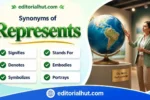



The word represents means to stand for, symbolize, show, describe, or act on behalf of someone or something.
Understanding the synonyms of represents can help you improve your English vocabulary, avoid repetitive words, and choose more precise expressions in speaking and writing.
Common synonyms include symbolizes, signifies, depicts, illustrates, indicates, and embodies. However, each word has a slightly different meaning and works best in particular contexts.For example, a flag symbolizes a country, a painting depicts a scene, and an elected official represents a community.
Meaning of Represents
Definition
Represents (verb): Stands for, depicts, describes, symbolizes, or acts on behalf of a person, group, idea, or thing.
Examples
- The eagle represents freedom and strength in the national emblem.
- Our team captain represents the players during meetings with the coach.
Connotative Meaning
- Positive tone: Represents can suggest leadership, responsibility, identity, or an important ideal.
- Negative tone: It can suggest an unwanted association when something represents danger, injustice, or failure.
- Neutral tone: It can simply describe what a symbol, image, number, or person stands for.
(Connotation means the feeling or association a word can suggest beyond its basic dictionary meaning.)
Etymology
The verb represents comes from represent, which entered English through Old French representer, from Latin repraesentare, meaning to present, show, or make present.
The Latin word combines re-, meaning again or back, with praesentare, meaning to present or bring before someone. The meaning developed to include portraying something, standing for an idea, and acting on behalf of another person.
In modern English, represents is the third-person singular present-tense form of represent. For example, “She represents her school” and “This symbol represents peace.”
Short History
Old English (450-1100)
The exact modern verb represent was not an established Old English form. However, the underlying ideas of showing, describing, and standing for something existed. Old English speakers used other verbs, including forms related to showing and making something known, to express similar meanings.
Middle English (1100-1500)
During the Middle English period, French and Latin influenced English vocabulary, especially in formal, religious, legal, and literary contexts. The verb represent entered English through French influence, although its exact earliest date of use is not certain.
Modern English (1500-Present)
Represent became increasingly common in literature, government, law, education, and everyday communication. Its meanings expanded to include portraying people or events, symbolizing ideas, and acting as an authorized spokesperson. Today, represents is widely used in both formal and informal English.
Pronunciation (US & UK – IPA)
US: /ˌrɛprɪˈzɛnts/
UK: /ˌrep.rɪˈzents/
Syllables
rep-re-sents
Affixation Pattern of Represents
Root: present, from Latin praesentare, meaning to present or make something present. The modern English word represent developed through French and Latin rather than through a simple combination of modern English words.
Prefix: re-, historically associated with meanings such as again or back. Its role in the Latin formation does not always translate into a separate meaning in the modern English verb.
Suffix: -s, the grammatical ending used for the third-person singular present tense, as in “She represents the school.”
The word represents should not be divided into modern English affixes as though every part has an independent, predictable meaning. Its historical development is more complex.
Word Formation
- Represent (verb): To stand for, portray, or act on behalf of someone or something.
- Representation (noun): The act of representing something or the way it is presented.
- Representative (noun): A person who speaks or acts on behalf of others.
- Representative (adjective): Typical of a larger group or characteristic of something.
- Representational (adjective): Relating to the depiction of recognizable people, objects, or scenes.
- Representatively (adverb): In a representative manner, although this form is uncommon.
- Represented (verb): The past-tense and past-participle form of represent.
- Representing (verb): The present-participle form of represent.
- Representable (adjective): Capable of being represented or depicted.
- Representativeness (noun): The quality of accurately reflecting the characteristics of a larger group.
30 Synonyms of Represents
The best synonym depends on whether represents means to symbolize something, describe it, show it, or act on someone’s behalf. The following alternatives cover these common meanings.
1. Symbolizes (verb)
US: /ˈsɪmbəˌlaɪzɪz/
UK: /ˈsɪmbəlaɪzɪz/
Meaning: Represents an idea, quality, or belief through a symbol or symbolic association.
Usage shade: Best for abstract ideas, traditions, objects, and images that stand for something beyond themselves.
Examples:
The dove symbolizes peace in many cultures.
Her graduation ring symbolizes years of dedication and hard work.
2. Signifies (verb)
US: /ˈsɪɡnəˌfaɪz/
UK: /ˈsɪɡnɪfaɪz/
Meaning: Indicates or communicates a particular meaning, idea, or condition.
Usage shade: Often used in formal, academic, and analytical writing when explaining what something means.
Examples:
A red light signifies that drivers must stop.
The final paragraph signifies a change in the author’s argument.
3. Depicts (verb)
US: /dɪˈpɪkts/
UK: /dɪˈpɪkts/
Meaning: Shows or portrays a person, object, scene, or event through an image or description.
Usage shade: Particularly suitable for art, photographs, films, and written descriptions.
Examples:
The mural depicts the history of the local community.
The novel depicts life in a small coastal town.
4. Portrays (verb)
US: /pɔrˈtreɪz/
UK: /pɔːˈtreɪz/
Meaning: Presents a person, character, situation, or idea in a particular way.
Usage shade: Often emphasizes the impression or interpretation created by an artist, writer, actor, or journalist.
Examples:
The documentary portrays the challenges faced by young farmers.
The actor portrays a detective struggling with a difficult case.
5. Illustrates (verb)
US: /ˈɪləˌstreɪts/
UK: /ˈɪləstreɪts/
Meaning: Makes an idea clear through an example, image, or explanation.
Usage shade: Useful in teaching, presentations, essays, and explanations. It often means making something understandable rather than simply standing for it.
Examples:
This experiment illustrates how heat affects metal.
The teacher illustrates the rule with a simple sentence.
6. Denotes (verb)
US: /dɪˈnoʊts/
UK: /dɪˈnəʊts/
Meaning: Indicates or directly identifies a particular meaning, object, or concept.
Usage shade: More formal than means and particularly useful when discussing symbols, words, signs, or technical notation.
Examples:
In this equation, the letter x denotes an unknown value.
The crown denotes royal authority in the painting.
7. Indicates (verb)
US: /ˈɪndɪˌkeɪts/
UK: /ˈɪndɪkeɪts/
Meaning: Shows, suggests, or points to a fact, condition, or possibility.
Usage shade: Often emphasizes evidence or a sign rather than direct symbolic representation.
Examples:
The survey indicates growing interest in online learning.
Dark clouds indicate that rain may be approaching.
8. Expresses (verb)
US: /ɪkˈsprɛsɪz/
UK: /ɪkˈspresɪz/
Meaning: Communicates a feeling, thought, opinion, or idea.
Usage shade: Best when represents refers to communicating an internal feeling or an abstract message.
Examples:
Her poem expresses the pain of losing a close friend.
The design expresses the company’s commitment to simplicity.
9. Reflects (verb)
US: /rɪˈflɛkts/
UK: /rɪˈfleks/
Meaning: Shows, reveals, or corresponds to a quality, condition, belief, or situation.
Usage shade: Often suggests that something reveals the nature of another thing rather than deliberately standing for it.
Examples:
The team’s success reflects months of careful preparation.
Her writing reflects a deep interest in history.
10. Embodies (verb)
US: /ɪmˈbɑdiz/
UK: /ɪmˈbɒdiz/
Meaning: Gives a clear or tangible form to an idea, quality, or principle.
Usage shade: Stronger than represents when a person or object expresses the essential qualities of an idea.
Examples:
The volunteer embodies the spirit of community service.
Her actions embody the values taught by her parents.
11. Exemplifies (verb)
US: /ɪɡˈzɛmplɪˌfaɪz/
UK: /ɪɡˈzɑːmplɪfaɪz/
Meaning: Serves as a clear example of a quality, principle, or type.
Usage shade: Use it when something demonstrates a quality through a specific example rather than merely symbolizing it.
Examples:
Her patience exemplifies effective leadership.
The building exemplifies traditional regional architecture.
12. Signifies (verb)
US: /ˈsɪɡnəˌfaɪz/
UK: /ˈsɪɡnɪfaɪz/
Meaning: Communicates or indicates the presence of a meaning, condition, or idea.
Usage shade: This overlaps with the earlier entry because signifies is a particularly close synonym in meaning-based contexts. It should not be counted as a distinct alternative in a final synonym list.
Examples:
A handshake can signify agreement between two parties.
The change in tone signifies a turning point in the story.
13. Stands for (verb phrase)
US: /stændz fɔr/
UK: /stændz fɔː/
Meaning: Represents an idea, organization, value, or abbreviated term.
Usage shade: A natural and accessible alternative in everyday English. It is also used to ask what a symbol or abbreviation means.
Examples:
The initials stand for the name of the organization.
For many citizens, the monument stands for freedom.
14. Denotes (verb)
US: /dɪˈnoʊts/
UK: /dɪˈnəʊts/
Meaning: Identifies a meaning or reference directly.
Usage shade: This overlaps with the earlier entry and is not a separate synonym. It is most useful in precise, technical explanations.
Examples:
The symbol denotes a change in direction.
In this chart, the dotted line denotes the estimated result.
15. Depicts (verb)
US: /dɪˈpɪkts/
UK: /dɪˈpɪkts/
Meaning: Portrays something visually or through descriptive language.
Usage shade: This repeats the earlier synonym. Its strongest use is when a picture, artwork, or narrative shows a recognizable subject.
Examples:
The photograph depicts a crowded city street.
The children’s book depicts animals living in a forest.
16. Personifies (verb)
US: /pərˈsɑnəˌfaɪz/
UK: /pəˈsɒnɪfaɪz/
Meaning: Represents an abstract quality as a person or gives human qualities to something nonhuman.
Usage shade: More specific than represents. It is especially common in literature, rhetoric, and figurative language.
Examples:
In the story, the character personifies greed.
The poet personifies winter as a tired old traveler.
17. Embodies (verb)
US: /ɪmˈbɑdiz/
UK: /ɪmˈbɒdiz/
Meaning: Expresses an idea or quality in a concrete, recognizable form.
Usage shade: This duplicates an earlier entry. It is particularly appropriate when something strongly demonstrates the essence of a principle.
Examples:
The athlete embodies discipline and perseverance.
The memorial embodies the community’s enduring hope.
18. Depicts (verb)
US: /dɪˈpɪkts/
UK: /dɪˈpɪkts/
Meaning: Shows a subject in an image, scene, or written account.
Usage shade: This is another duplicate and should not be treated as a new synonym.
Examples:
The painting depicts a quiet village at sunrise.
The report depicts the effects of rising housing costs.
19. Portrays (verb)
US: /pɔrˈtreɪz/
UK: /pɔːˈtreɪz/
Meaning: Presents someone or something in a particular way.
Usage shade: This repeats an earlier synonym and is most useful when discussing artistic or narrative interpretation.
Examples:
The film portrays the main character as thoughtful and reserved.
The article portrays the new policy as a major change.
20. Models (verb)
US: /ˈmɑdəlz/
UK: /ˈmɒdəlz/
Meaning: Represents a real or proposed system, process, or situation in a simplified form.
Usage shade: Common in science, mathematics, business, and computing. It emphasizes a structured representation rather than symbolic meaning.
Examples:
The software models traffic patterns during rush hour.
The diagram models the flow of information through the system.
21. Illustrates (verb)
US: /ˈɪləˌstreɪts/
UK: /ˈɪləstreɪts/
Meaning: Demonstrates or clarifies an idea with an example or visual.
Usage shade: This repeats an earlier synonym. It is especially suitable when an example helps explain a general principle.
Examples:
The case study illustrates the value of careful planning.
A simple drawing illustrates how the machine operates.
22. Encapsulates (verb)
US: /ɪnˈkæpsəˌleɪts/
UK: /ɪnˈkæpsjʊleɪts/
Meaning: Expresses the essential features of an idea in a compact or concentrated form.
Usage shade: Often used in analytical or literary writing when one statement, image, or example captures the essence of something.
Examples:
Her final sentence encapsulates the main message of the speech.
The slogan encapsulates the company’s central mission.
23. Summarizes (verb)
US: /ˈsʌməˌraɪzɪz/
UK: /ˈsʌməraɪzɪz/
Meaning: Presents the main points of information in a shorter form.
Usage shade: Suitable when represents means giving a concise account of a larger body of information, not when referring to symbols or representation on behalf of others.
Examples:
The final paragraph summarizes the research findings.
The manager summarizes the discussion before the meeting ends.
24. Describes (verb)
US: /dɪˈskraɪbz/
UK: /dɪˈskraɪbz/
Meaning: Explains the characteristics or details of a person, place, object, or situation.
Usage shade: A broad alternative when represents means giving an account of something. It does not necessarily imply symbolic meaning.
Examples:
The report describes the conditions in rural schools.
Her letter describes the excitement of moving abroad.
25. Shows (verb)
US: /ʃoʊz/
UK: /ʃəʊz/
Meaning: Makes something visible, clear, or understandable.
Usage shade: A simple, flexible alternative for everyday speech. It is less formal and may be less precise than signifies or depicts.
Examples:
The chart shows how sales changed over the year.
His careful work shows a strong commitment to quality.
26. Signals (verb)
US: /ˈsɪɡnəlz/
UK: /ˈsɪɡnəlz/
Meaning: Communicates a message or indicates that something is happening or about to happen.
Usage shade: Often suggests a recognizable sign or message, sometimes one intended to prompt a response.
Examples:
The warning light signals a problem with the engine.
Her decision to resign signals a major shift in the organization.
27. Reflects (verb)
US: /rɪˈflɛkts/
UK: /rɪˈfleks/
Meaning: Reveals or corresponds to a particular quality, belief, or situation.
Usage shade: This repeats an earlier synonym. It is useful when an action or result reveals underlying values or circumstances.
Examples:
The design reflects the owner’s preference for natural materials.
The survey reflects changing attitudes toward remote work.
28. Speaks for (verb phrase)
US: /spiːks fɔr/
UK: /spiːks fɔː/
Meaning: Acts as a spokesperson or expresses the views of another person or group.
Usage shade: Appropriate when represents refers to advocacy or speaking on behalf of others.
Examples:
The elected delegate speaks for the members during negotiations.
Maya speaks for her classmates when presenting their concerns.
29. Acts for (verb phrase)
US: /ækts fɔr/
UK: /ækts fɔː/
Meaning: Performs duties or makes decisions on behalf of another person.
Usage shade: Common in legal, business, and professional settings. It emphasizes taking action for someone rather than merely describing them.
Examples:
The lawyer acts for the client during the proceedings.
An authorized substitute acts for the director when necessary.
30. Corresponds to (verb phrase)
US: /ˌkɔrəˈspɑndz tuː/
UK: /ˌkɒrɪˈspɒndz tuː/
Meaning: Matches, relates to, or represents something in a particular system or context.
Usage shade: Useful in technical and academic writing when one item matches another, such as a symbol representing a value. It is not interchangeable with represents in every sentence.
Examples:
Each number corresponds to a specific item on the list.
The shaded area corresponds to the region shown on the map.
Prototype Meaning
When native English speakers encounter the word represents, they generally think of something standing for, showing, or acting on behalf of something else. A flag may represent a country, a diagram may represent a process, and an elected official may represent a community. The word connects one thing to another through meaning, depiction, identity, or responsibility. It does not necessarily mean that the two things are identical, nor does it always imply an official or symbolic relationship.
Prototype Categorization
Symbolic meaning: symbolizes, signifies, denotes, stands for
Visual representation: depicts, portrays, illustrates, shows
Ideas and qualities: embodies, personifies, encapsulates, exemplifies
Evidence and communication: indicates, signals, expresses, reflects
Explanation and description: describes, summarizes, models
Acting on behalf of others: speaks for, acts for
Grouping synonyms helps writers identify the precise relationship they want to express. A symbol may signify an idea, an artwork may depict a scene, and a spokesperson may speak for a group.
Antonyms of Represents
The opposite of represents depends on the intended meaning. The following verbs express contrasting actions in relevant contexts.
- Misrepresents (verb): Presents someone or something inaccurately or misleadingly.
- Conceals (verb): Keeps something hidden or prevents it from being known.
- Obscures (verb): Makes something difficult to see, understand, or recognize.
- Distorts (verb): Changes the appearance, meaning, or facts of something in an inaccurate way.
- Suppresses (verb): Prevents information, expression, or evidence from being revealed or communicated.
Short Questions and Answers
What does represents mean?
Represents means stands for, depicts, describes, or acts on behalf of someone or something. Its exact meaning depends on the context.
When should represents be used?
Use represents when explaining what a symbol means, what an image portrays, what an idea expresses, or whom a person speaks for. Choose a more specific synonym when you need to clarify the relationship.
Is represents positive or negative?
Represents is generally a neutral word. Its emotional tone depends on what is being represented and the context in which the word is used.
How is it different from similar words?
Symbolizes emphasizes a symbolic meaning, while depicts focuses on showing a subject visually or descriptively. Embodies suggests that something expresses the essential qualities of an idea, whereas indicates points to evidence or a possible condition.
Conclusion
Understanding the meaning of represents and its synonyms helps you express ideas more clearly and accurately.
Words such as symbolizes, signifies, depicts, illustrates, and embodies offer different ways to explain what something stands for, shows, or communicates.
Choosing the right synonym improves your vocabulary, strengthens your writing, and makes everyday communication more natural.
Instead of repeating the same word, select an alternative that matches your intended meaning and context. Practice using these synonyms in your own sentences to develop stronger English vocabulary and communicate with confidence.

Shahid Imran is an English language and vocabulary specialist at EditorialHut.com, focusing on synonyms, word meanings, alternative words, and practical example sentences. He helps readers discover better words, expand their vocabulary, and communicate more clearly and confidently.