










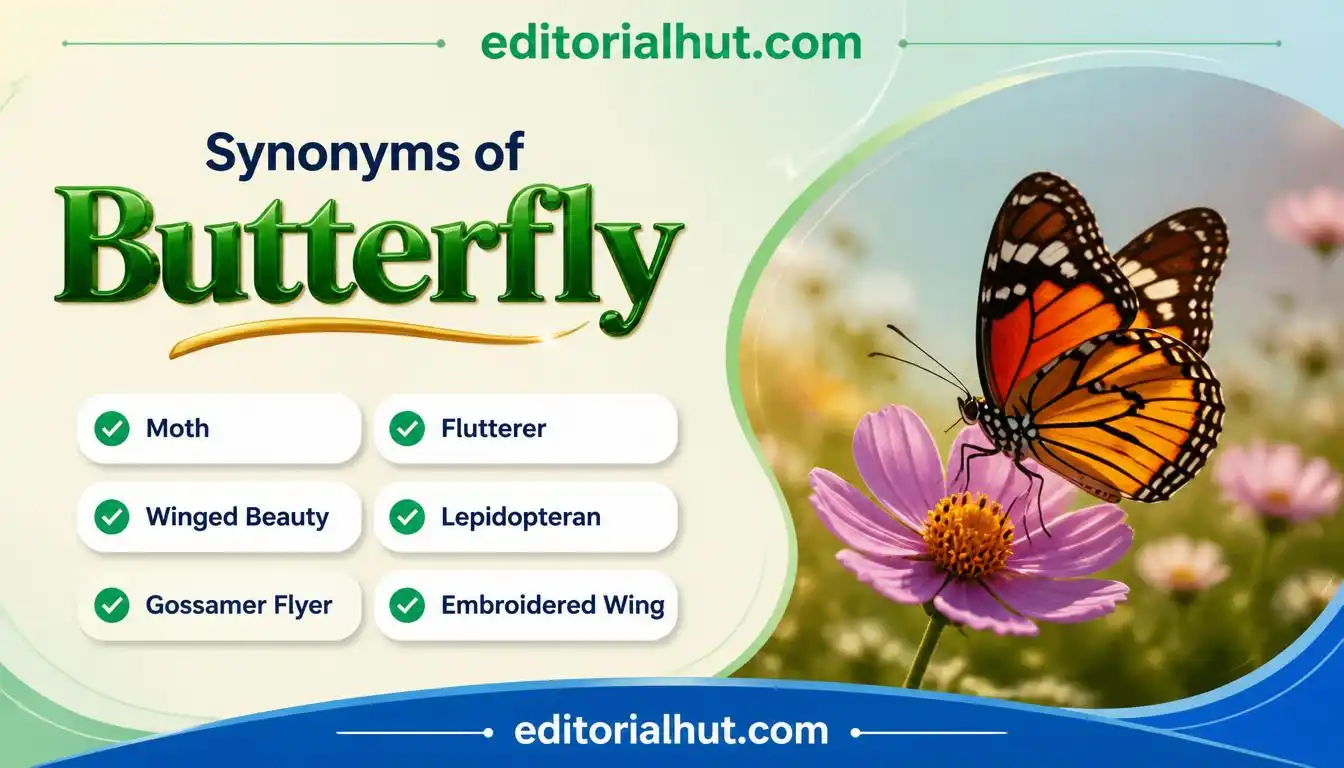
If you are looking for the synonyms of butterfly, you may be surprised to learn that there is no single word that perfectly replaces “butterfly” in every context. The word refers to a colorful, winged insect, but it can also evoke ideas of beauty, freedom, transformation, and delicacy. Depending on your sentence, you might use descriptive terms such as winged insect, lepidopteran, or winged beauty. In this guide, we’ll explore the meaning, connotations, origin, pronunciation, and useful alternatives for “butterfly” so you can choose the right word with confidence.
What Do the Synonyms of “Butterfly” Really Mean?
The synonyms of butterfly are words or expressions that describe a butterfly, its characteristics, movements, appearance, or a similar winged insect. However, there is no perfect synonym for butterfly because the word refers to a specific type of winged insect.
Depending on the context, related words can emphasize different aspects of a butterfly:
- Winged insect — a broad descriptive term for an insect with wings.
- Lepidopteran — a scientific term for an insect belonging to the order Lepidoptera, which includes butterflies and moths.
- Flutterer — an informal descriptive word emphasizing the butterfly’s light, fluttering movement.
- Flying insect — a general term focusing on its ability to fly.
- Winged beauty — a poetic expression highlighting its attractive wings and appearance.
- Pollinator — describes a butterfly by its ecological role when it carries pollen between flowers.
In simple words
“Synonyms of butterfly” means other words or expressions that can describe a butterfly or something closely associated with its appearance, movement, or role in nature. The best alternative depends on the sentence and the meaning you want to emphasize.
Simple Meaning
A butterfly is a flying insect with four delicate wings, usually covered with tiny scales. Butterflies are known for their colorful patterns, graceful flight, and life cycle, which includes transformation from a caterpillar into a winged adult insect.
Synonym Note
There is no exact synonym for butterfly. Depending on context, related descriptive expressions include winged insect, lepidopteran, winged beauty, flutterer, and flying insect. These words do not always have exactly the same meaning, so the appropriate choice depends on the context.
Meaning of Butterfly
Definition
Butterfly (noun): a daytime-flying insect of the order Lepidoptera, typically having a slender body, clubbed antennae, and broad wings that are often colorful or patterned.
Examples
A bright orange butterfly landed on the lavender beside the garden path.
The children watched a butterfly move from flower to flower.
Connotative Meaning
Positive tone: Butterfly often suggests beauty, delicacy, freedom, grace, transformation, and natural charm.
Negative tone: In figurative expressions such as social butterfly, it can sometimes suggest someone who moves lightly from one person or group to another without settling for long.
Neutral tone: When referring to the insect itself, butterfly is normally neutral and descriptive.
(Connotation means the feeling or association a word can suggest beyond its basic dictionary meaning.)
Etymology
The word butterfly comes from Old English buttorflēoge, an early compound corresponding broadly to butter + fly. The exact reason for the name is uncertain. One traditional explanation connects it with the pale yellow color of some butterflies or with an old belief that butterflies were associated with butter or milk. Other historical explanations have also been proposed, so the precise motivation for the original name should not be treated as certain.
The second element, fly, originally referred broadly to a flying insect. Over time, modern English narrowed fly in ordinary usage so that it commonly refers to insects in the order Diptera, while butterfly remained the established name for this particular group of insects.
Short History
Old English (450-1100)
The concept and the compound name are very old in English. Old English used forms such as buttorflēoge for the insect. The structure already reflected the combination of a word related to butter with fly. The precise reason for the first element remains uncertain.
Middle English (1100-1500)
Middle English continued related forms such as boterflye. Other terms for the insect also existed, including forms related to French papillon, but the native Germanic compound developed into the modern English word.
Modern English (1500-Present)
Butterfly became the standard English name for the insect. The word later developed several figurative and specialized meanings. It can describe a person who moves among social groups, the swimming stroke called the butterfly, and various objects or actions whose shape resembles the insect’s wings.
Pronunciation (US & UK – IPA)
US: /ˈbʌtərˌflaɪ/
UK: /ˈbʌtəˌflaɪ/
Syllables
but-ter-fly
Affixation Pattern of Butterfly
Root: butter + fly. The word is an old compound rather than a word formed from a single modern English root.
Prefix: none
Suffix: none
The word should not be analyzed as butter plus an English suffix or prefix. It is historically a compound noun.
Word Formation
butterfly (noun) – a daytime-flying insect of the order Lepidoptera.
butterflies (plural noun) – more than one butterfly.
butterfly (verb) – to cut something, especially food, nearly in half and spread it open so that it resembles butterfly wings.
butterflied (verb/adjective) – cut and spread open in the manner described above.
butterflying (verb) – cutting or preparing something in this way.
butterflylike (adjective) – resembling a butterfly.
There are also many established compound expressions containing butterfly, such as butterfly effect, butterfly stroke, and butterfly net, but these are compounds rather than additional synonyms or basic word-family forms.
30 Synonyms of Butterfly
A factual vocabulary guide should not pretend that butterfly has 30 standard English synonyms. Most words sometimes presented as synonyms are actually broader terms, species names, related insects, translations, or descriptive phrases. The following are the closest useful alternatives and near-equivalents, with their limitations clearly identified.
1. Flutterby (noun)
US: /ˈflʌtərˌbaɪ/
UK: /ˈflʌtəˌbaɪ/
Meaning: A playful or childish term for a butterfly.
Usage shade: This is a genuine informal equivalent, but it is not standard formal vocabulary. It is especially suitable for children’s speech, playful writing, or whimsical contexts.
Examples:
The little boy pointed excitedly at a flutterby resting on the flower.
The children’s story described every flutterby as a tiny visitor from the garden.
2. Lepidopteran (noun)
US: /ˌlɛpɪˈdɑptərən/
UK: /ˌlɛpɪˈdɒptərən/
Meaning: An insect belonging to the order Lepidoptera, which includes butterflies and moths.
Usage shade: This is a scientific term, but it is broader than butterfly. It should not normally replace butterfly when the insect is specifically known to be a butterfly.
Examples:
The researcher carefully identified each lepidopteran collected during the survey.
Butterflies and moths are both lepidopterans.
3. Day-flying lepidopteran (noun)
US: /ˈdeɪˌflaɪɪŋ ˌlɛpɪˈdɑptərən/
UK: /ˈdeɪˌflaɪɪŋ ˌlɛpɪˈdɒptərən/
Meaning: A lepidopteran insect that is active during the day, commonly referring to a butterfly.
Usage shade: This is a descriptive scientific expression rather than a simple synonym. It emphasizes activity during daylight.
Examples:
The field guide described the insect as a day-flying lepidopteran.
Several day-flying lepidopterans appeared when the sun warmed the meadow.
4. Papillon (noun)
US: /ˈpæpɪˌlɑn/
UK: /ˈpæpɪˌlɒn/
Meaning: A French-derived word meaning “butterfly,” especially familiar in historical or foreign-language contexts.
Usage shade: In modern English, papillon normally refers to a small dog breed rather than serving as an ordinary synonym for the insect. It is therefore not a practical replacement for butterfly in contemporary English.
Examples:
The historical text used papillon when referring to a butterfly.
The old poem included a French word meaning butterfly.
5. Winged insect (noun)
US: /wɪŋd ˈɪnˌsɛkt/
UK: /wɪŋd ˈɪnˌsɛkt/
Meaning: An insect that has wings.
Usage shade: This is a broad descriptive phrase, not a precise synonym. Many insects besides butterflies are winged insects.
Examples:
A colorful winged insect settled briefly on the garden wall.
The children watched the winged insect disappear among the flowers.
6. Flying insect (noun)
US: /ˈflaɪɪŋ ˈɪnˌsɛkt/
UK: /ˈflaɪɪŋ ˈɪnˌsɛkt/
Meaning: An insect capable of flying.
Usage shade: This expression is much broader than butterfly and includes bees, flies, beetles, moths, and many other insects.
Examples:
A small flying insect hovered above the wildflowers.
The garden attracts many kinds of flying insects in summer.
7. Day-flyer (noun)
US: /ˈdeɪˌflaɪər/
UK: /ˈdeɪˌflaɪə/
Meaning: Something that flies during the daytime.
Usage shade: This is not a standard exact synonym for butterfly. In context, it can function as an informal descriptive expression, but it lacks the precision of butterfly.
Examples:
The guide identified the creature as a colorful day-flyer.
Several day-flyers appeared above the meadow after sunrise.
8. Lepidoptera insect (noun)
US: /ˌlɛpɪˈdɑptərə ˈɪnˌsɛkt/
UK: /ˌlɛpɪˈdɒptərə ˈɪnˌsɛkt/
Meaning: An insect belonging to the order Lepidoptera.
Usage shade: This scientific expression includes both butterflies and moths, so it is broader than butterfly.
Examples:
The museum displayed a large collection of Lepidoptera insects.
The researcher photographed each Lepidoptera insect before releasing it.
9. Winged creature (noun)
US: /wɪŋd ˈkriːtʃər/
UK: /wɪŋd ˈkriːtʃə/
Meaning: A creature that has wings.
Usage shade: This is poetic and very broad. It can describe birds, insects, bats, and other winged animals.
Examples:
A delicate winged creature rested on the edge of the leaf.
The poet compared the butterfly to a small winged creature of spring.
10. Garden butterfly (noun)
US: /ˈɡɑrdən ˈbʌtərˌflaɪ/
UK: /ˈɡɑːdən ˈbʌtəˌflaɪ/
Meaning: A butterfly commonly seen in or around gardens.
Usage shade: This is a descriptive compound, not a general synonym. It narrows the context to butterflies associated with gardens.
Examples:
A garden butterfly landed beside the rosemary.
The children kept a journal of every garden butterfly they observed.
Why there are not 30 true synonyms
Words such as moth, insect, bug, caterpillar, nymphalid, monarch, painted lady, fritillary, and swallowtail should not be presented as direct synonyms of butterfly. Some are broader categories, some are different insects or life stages, and some name particular kinds of butterflies.
This distinction matters. A moth is a close relative, but it is not a butterfly. A caterpillar is a developmental stage of a butterfly or moth, not another name for the adult insect. A monarch is one particular type of butterfly, so it is a narrower term. A lepidopteran includes moths as well as butterflies.
For accurate English, using the precise word butterfly is usually better than replacing it with an inaccurate “synonym.”
Prototype Meaning
When native English speakers hear butterfly, they usually picture a small, delicate flying insect with broad patterned wings, a slender body, and distinctive antennae. The mental image often includes flowers, gardens, sunlight, or gentle movement through the air. The word commonly carries pleasant associations with beauty and transformation, but these associations are not part of its basic definition. A butterfly does not necessarily have brightly colored wings, live in a garden, or fly slowly. The word identifies a particular group of insects rather than a general symbol of beauty.
Prototype Categorization
Direct or near-equivalent: flutterby
Scientific or broader: lepidopteran, day-flying lepidopteran, Lepidoptera insect
General descriptive: winged insect, flying insect, winged creature
Context-specific descriptive: garden butterfly, day-flyer
Historical or foreign-language equivalent: papillon
Grouping these expressions helps writers recognize an important difference between true synonyms and related descriptions. When precision matters, butterfly is usually the best choice. A broader term such as lepidopteran should be used only when the wider category is intended.
Antonyms of Butterfly
A concrete noun such as butterfly does not have genuine antonyms in the normal sense. An antonym expresses an opposing meaning, but there is no natural opposite of the insect butterfly. Terms such as moth, beetle, bird, or caterpillar are not antonyms. They simply identify different creatures or life stages.
For this reason, inventing five “antonyms” would be misleading. In accurate vocabulary work, butterfly has no standard lexical antonym.
Short Questions and Answers
What does butterfly mean?
A butterfly is a daytime-flying insect of the order Lepidoptera, usually recognized by its slender body, clubbed antennae, and broad wings. Many butterflies have colorful or patterned wings.
When should butterfly be used?
Use butterfly when you are specifically referring to this type of insect. It is the normal word for everyday conversation, education, nature writing, and most scientific or general contexts.
Is butterfly positive or negative?
The literal word is neutral. Figuratively, it can have positive associations with beauty and freedom, although expressions such as social butterfly may describe someone who moves frequently between social groups.
How is it different from similar words?
Flutterby is a playful or childish alternative, while lepidopteran is a broader scientific term that includes moths. Moth refers to a related but different group of insects, so it should not be used as a synonym for butterfly.
Conclusion
Understanding butterfly is more useful than simply memorizing a long list of supposed synonyms. English has very few genuine alternatives for this specific insect, and many commonly suggested words are actually broader terms, species names, related insects, or descriptive phrases. Knowing these distinctions helps learners choose accurate vocabulary instead of forcing an unnatural replacement. The word also offers useful connections to science, nature, literature, and figurative English. Use butterfly when precision matters, and choose a related term only when its narrower or broader meaning is truly intended. Try learning and using one precise new word each day.

Shahid Imran is an English language and vocabulary specialist at EditorialHut.com, focusing on synonyms, word meanings, alternative words, and practical example sentences. He helps readers discover better words, expand their vocabulary, and communicate more clearly and confidently.