








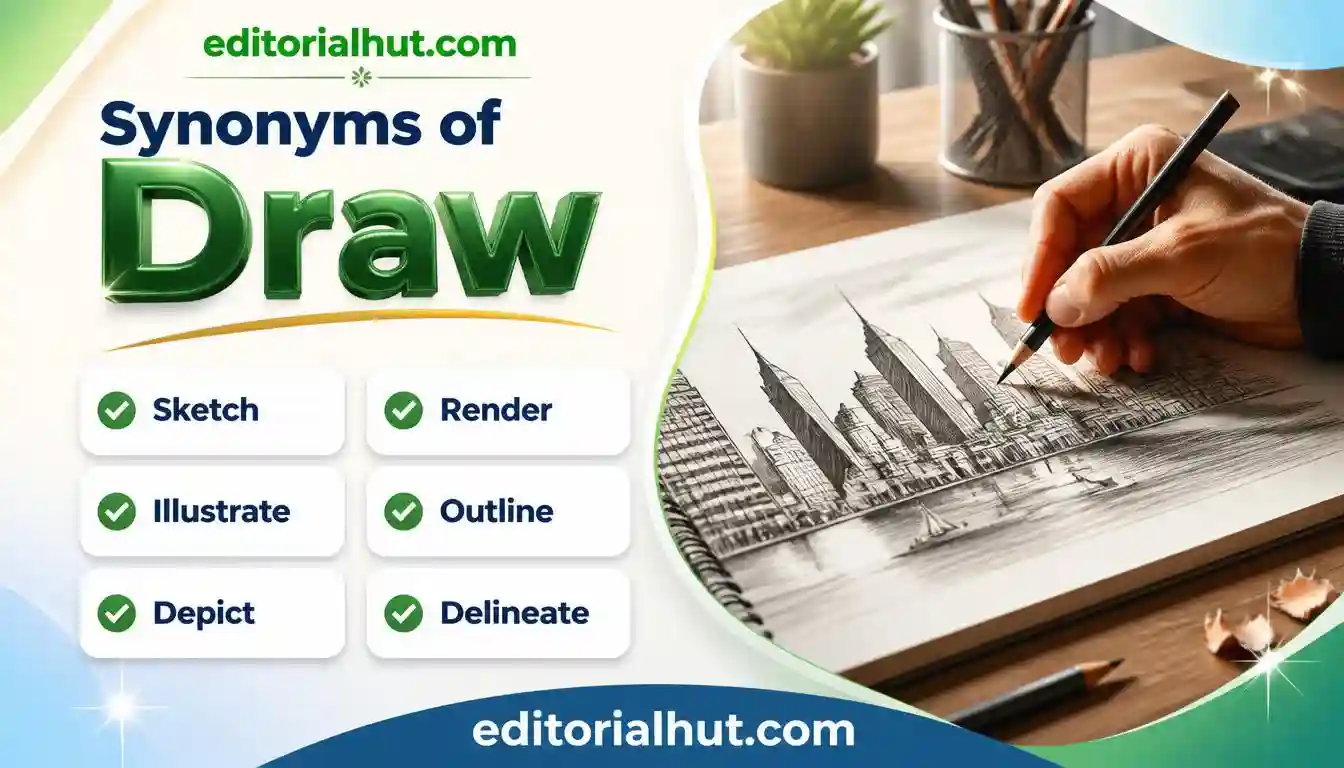
When you search for synonyms for draw you may notice that no single replacement works in every sentence. The word draw has several meanings. Its can describe making a picture. A mean pulling something toward you. It can describe attracting attention. It can also refer to choosing something by chance or ending a game without a winner.
The best synonym depends on the meaning and the situation. Sketching works when drawing means creating a picture. Pull works when something is moved toward you. Attract fits when someone gains attention. Tie can replace a draw when two teams finish with the same score.
Quick Answer
The closest synonym for draw depends on its meaning.
- Sketch means to make a picture with lines.
- Illustrate means to create a picture that explains or decorates something.
- Pull means to move something toward you.
- Drag means to pull something along a surface.
- Attract means to make someone interested or interested in coming closer.
- Invite can mean to encourage someone to come toward something.
- Select can mean to choose something.
- Tie means to finish a competition with the same score.
- Extract can mean to take something out.
- Withdraw can mean to take money out of an account.
- Conclude can sometimes replace draw when draw means reaching an opinion or conclusion.
The most accurate alternative always depends on the sentence.
Core Synonyms for Draw
| Alternative | Meaning | Relationship | Tone | Best Use |
| Sketch | Make a simple picture | Contextual synonym | Neutral | Art and design |
| Illustrate | Explain or decorate through an image | Near synonym | Formal | Books and education |
| Depict | Represent something visually | Near synonym | Formal | Art and writing |
| Portray | Represent a person or idea | Near synonym | Formal | Art and literature |
| Paint | Create an image with paint | Contextual synonym | Neutral | Art |
| Outline | Show the main shape or features | Contextual synonym | Neutral | Art and planning |
| Pull | Move something toward yourself | Direct synonym in one sense | Neutral | Physical movement |
| Drag | Pull something along a surface | Near synonym | Neutral | Physical movement |
| Haul | Pull or carry something heavy | Stronger alternative | Neutral | Heavy objects |
| Attract | Gain attention or interest | Direct synonym in one sense | Neutral | People and attention |
| Engage | Gain and hold attention | Near synonym | Professional | Communication |
| Invite | Encourage someone to come or participate | Contextual alternative | Neutral | Social situations |
| Select | Choose something | Contextual synonym | Formal | Choices and decisions |
| Pick | Choose something | Casual synonym | Casual | Conversation |
| Extract | Take something out | Contextual synonym | Formal | Information and objects |
| Withdraw | Take money out | Meaning-specific synonym | Neutral | Banking |
| Tie | Finish with equal scores | Direct synonym in sports | Neutral | Games and competitions |
| Conclude | Reach a conclusion | Contextual alternative | Formal | Reasoning |
| Extend | Stretch something outward | Near synonym | Neutral | Physical movement |
| Attractiveness | The quality that draws interest | Related noun | Formal | Description and analysis |
Some of these words are only synonyms in a particular sense. That distinction matters because draw is a highly flexible English word.
What Does Draw Really Mean?
Draw is a verb and a noun with several common meanings.
As a verb it can mean to create an image. For example:
Maya likes to draw portraits.
It can mean to pull something.
He drew the curtain across the window.
It can mean to attract attention.
The new exhibition drew thousands of visitors.
It can mean to choose something by chance.
The players drew numbers from a box.
It can describe reaching a conclusion.
We can draw several conclusions from the results.
It can also mean taking money from a bank account.
She drew money from her savings account.
As a noun draw can describe a tied game.
The match ended in a draw.
It can also describe an attraction or something that brings people in.
The museum’s main draw is its ancient collection.
Because of these meanings there is no universal replacement for draw.
Connotative Meaning of Draw
The connotation of draw changes with context.
When it means creating art it feels neutral and practical. It describes an action without suggesting a particular artistic quality.
When it means attracting people it can suggest natural appeal.
The festival draws visitors from nearby towns.
Here draw suggests that something has enough appeal to bring people toward it.
When it means pulling something it has a physical sense.
She drew the chair closer.
In phrases such as draw a conclusion the word has a more analytical feeling. It suggests reaching an idea after considering evidence.
The word itself is generally neutral. Its emotional effect comes mainly from the surrounding sentence.
The Most Useful Synonyms for Draw
Sketch
Sketch is one of the closest alternatives when draw means creating a picture.
A sketch usually suggests a simple or preliminary image. It does not always imply a finished artwork.
The designer sketched a rough idea for the building.
Use sketch when simplicity or an early stage of artistic work matters.
Illustrate
Illustrate means to represent an idea or subject through an image.
It is especially useful for books. Educational material. Articles and presentations.
The diagram illustrates how the machine works.
Unlike draw the word illustrate often emphasizes the purpose of the image.
Depict
Depict means to represent something in a picture or other visual form.
The painting depicts a quiet village.
This word sounds more formal than draw. It works well in academic writing. Art criticism and descriptive writing.
Portray
Portray is often used for people. Characters. Emotions or situations.
The film portrays the character as a thoughtful leader.
It focuses on how someone or something is represented rather than the physical act of drawing.
Pull
Pull is the most natural replacement when draw means moving something toward yourself.
She pulled the door open.
You can often replace draw with pull in physical situations.
He drew the rope toward him.
He pulled the rope toward him.
The second version sounds more conversational.
Drag
Drag means pulling something across a surface.
He dragged the box across the floor.
It often suggests friction. Weight or difficulty.
Because of that extra meaning drag is not always interchangeable with draw.
Haul
Haul describes pulling or carrying something heavy.
The workers hauled the equipment into the warehouse.
It is stronger than pull and often suggests effort.
Attract
Attract is one of the strongest alternatives when draw means bringing attention or people toward something.
The colorful display attracted shoppers.
You could also write:
The colorful display drew shoppers.
Both sentences are natural. Attract puts more emphasis on the power to create interest.
Engage
Engage means gaining and holding someone’s attention.
The speaker engaged the audience with a simple story.
It is useful in professional writing. Marketing. Education and communication.
Invite
Invite can work when something encourages people to approach or participate.
The open design invites visitors to explore the space.
It is softer than attract. It suggests encouragement rather than strong appeal.
Select
Select can replace draw when something is chosen from a group.
The committee selected a name from the list.
This is more formal than saying someone picked a name.
Pick
Pick is the casual alternative to select.
She picked a card from the deck.
It sounds natural in everyday conversation.
Extract
Extract means taking something out.
The researcher extracted useful information from the report.
This word is more precise than draw in technical and academic contexts.
Withdraw
Withdraw is appropriate when draw means taking money from a bank account.
He withdrew cash from the account.
This is much more precise than simply saying draw money.
Tie
Tie is the appropriate alternative when draw refers to a sporting result.
The teams tied 2–2.
You can also say:
The game ended in a draw.
The noun draw and the verb tie are closely connected in this context.
Conclude
Conclude can sometimes replace draw in the phrase draw a conclusion.
The researchers concluded that the treatment was effective.
The meaning is similar. Conclude is often more direct.
Extend
Extend can sometimes replace draw when something is stretched or moved outward.
She extended her hand toward him.
This is not a universal synonym. It works only when the sentence involves reaching or stretching outward.
Formal and Academic Alternatives
When draw appears in formal writing the best replacement depends on the meaning.
A visual representation use:
- Depict
- Portray
- Illustrate
- Represent
The reaching an idea use:
- Conclude
- Infer
- Determine
- Establish
For choosing something use:
- Select
- Designate
- Determine
For attracting attention use:
- Attract
- Engage
- Appeal to
Academic writing benefits from precision. A word such as select may be better than pick. A word such as conclude may be clearer than draw when the intended meaning is reaching a final judgment.
Casual Alternatives
In everyday conversation you may prefer simpler words.
For making a picture:
- Sketch
- Paint
A pulling:
- Pull
- Drag
The choosing:
- Pick
- Choose
For attracting people:
- Bring in
- Attract
For a tied game:
- Tie
These alternatives usually sound more natural in ordinary speech.
Stronger Alternatives
Some alternatives add strength or intensity.
Haul suggests significant physical effort.
Drag can suggest resistance or difficulty.
Captivate suggests very strong interest.
Command attention suggests that something receives attention in a noticeable way.
Attract is usually less intense than captivate.
For example:
The advertisement attracted attention.
This is fairly neutral.
The performance captivated the audience.
This suggests a much stronger emotional response.
Real-World Examples of Draw and Its Alternatives
Everyday Conversation
I drew the chair closer.
I pulled the chair closer.
Here pull sounds more conversational.
Art
She draws animals in her notebook.
She sketches animals in her notebook.
Sketches suggests simpler artwork.
Business
The store drew many new customers.
The store attracted many new customers.
Both work naturally. Attracted emphasizes customer interest.
Education
The teacher drew a diagram on the board.
The teacher illustrated the concept with a diagram.
The second sentence focuses more on explanation.
Academic Writing
A researchers drew a conclusion from the findings.
The researchers reached a conclusion from the findings.
The researchers concluded from the findings that the method was effective.
Each version is possible. The final version is often the most direct.
Sports
The teams drew 1–1.
The teams tied 1–1.
Both communicate an equal score.
Banking
She drew money from her account.
She withdrew money from her account.
Withdrew is the clearer modern choice for banking language.
Draw vs Sketch
These words overlap when talking about art.
Draw is the broader term. It can describe making almost any image with lines.
Sketch usually suggests a quick. Simple or unfinished drawing.
He drew a portrait.
He sketched a portrait.
The first sentence does not tell us whether the picture was rough or detailed. The second suggests a less finished image.
Draw vs Pull
These words overlap when something moves toward you.
Pull is more common in everyday English.
Draw can sound more descriptive or literary.
She pulled the curtains open.
She drew the curtains open.
Both are understandable. Pull sounds more ordinary. Draw can sound slightly more polished depending on the sentence.
Draw vs Attract
These words are closely related when talking about people and attention.
Draw often describes something that brings people or attention toward it.
Attract directly emphasizes appeal.
The concert drew a large crowd.
The concert attracted a large crowd.
Both are natural.
Attract can also describe qualities that create interest.
The product attracted attention.
Draw vs Depict
These words should not be treated as complete replacements.
Draw describes the act of creating an image.
Depict describes what an image represents.
She drew a mountain.
This tells us what she created.
The painting depicts a mountain.
This tells us what the painting represents.
That distinction is important in academic and artistic writing.
Draw vs Tie
In sports these words can describe the same result but their grammar differs.
Draw is commonly used as a noun.
The match ended in a draw.
Tie is commonly used as a verb.
The teams tied.
You can also use draw as a verb.
The teams drew.
The exact preference can vary by sport and regional English.
Sentence Transformations
Example One
Original:
The museum draws many visitors every year.
Alternative:
The museum attracts many visitors every year.
The meaning remains almost unchanged. Attracts places more emphasis on the museum’s appeal.
Example Two
Original:
She drew a picture of the house.
Alternative:
She sketched a picture of the house.
The second sentence suggests that the image may be simple or unfinished.
Example Three
Original:
He drew the box toward him.
Alternative:
He pulled the box toward him.
The alternative sounds more natural in everyday conversation.
Example Four
Original:
The researchers drew a conclusion from the data.
Alternative:
The researchers concluded from the data.
The alternative is shorter and more direct.
Best Word by Situation
| If you want to sound… | Consider |
| Natural in conversation | Pull |
| Simple and casual | Pick |
| Formal | Select |
| Academic | Conclude |
| Artistic | Sketch |
| Descriptive | Depict |
| Literary | Portray |
| Professional | Attract |
| Stronger | Captivate |
| Focused on physical effort | Haul |
| Focused on attention | Attract |
| Focused on equal sports scores | Tie |
Common Collocations With Draw
Some expressions with draw are so common that replacing the word may make the sentence sound less natural.
Draw a picture
The child drew a picture of her family.
Draw attention
The headline drew attention to the issue.
Draw a conclusion
The report allowed readers to draw a conclusion.
Draw a crowd
The event drew a large crowd.
Draw a line
The manager drew a clear line between the two policies.
Draw a comparison
The article draws a comparison between the two systems.
Draw from experience
The writer drew from personal experience.
Draw money
He drew money from his account.
Some of these expressions are fixed or highly established. Replacing draw with a synonym can make the sentence less natural.
Common Mistakes With Draw
Treating Every Synonym as Interchangeable
The biggest mistake is assuming that sketch. pull and attract can all replace draw in any sentence.
They cannot.
The correct alternative depends on the meaning.
Using Depict for the Physical Act
Depict describes representation. It does not normally describe the simple physical act of putting lines on paper.
She drew a cat.
is more natural than:
She depicted a cat.
The second sentence works when the focus is on what an artwork represents.
Using Tie in Every Sports Context
A draw usually means that a competition ends without a winner.
A tie can have the same meaning in many sports. However the terminology used by a particular sport may differ.
Replacing Draw a Conclusion With Infer in Every Case
Infer focuses on reaching an idea from evidence.
Draw a conclusion is broader and more general.
The words overlap but they are not always identical.
Antonyms of Draw
There is no single antonym for every meaning of draw.
A draw means attract the opposite could be:
- Repel
- Discourage
- Deter
- Drive away
The draw means pull toward something the opposite may be:
- Push
- Release
- Move away
When draw means create a picture there is no simple direct antonym.
When draw means choose something the opposite may depend on the context rather than on one fixed word.
This is another reason why the meaning of draw must be identified before selecting an opposite.
Word Formation of Draw
Draw is a basic English verb rather than a modern word created by adding a common prefix or suffix to another English word.
Its historical development is more important than its visible structure.
Related forms include:
- Draw
- Draws
- Drew
- Drawn
- Drawing
These forms show grammatical inflection and derivation rather than a simple prefix plus root pattern.
Affixation Pattern of Draw
The base word draw does not contain a productive prefix or suffix.
Its main grammatical forms are created through English inflection:
draw + s → draws
draw + ing → drawing
The past forms drew and drawn are irregular forms rather than examples of regular suffixation.
Syllables in Draw
Draw — 1 syllable
It is pronounced as one continuous syllable.
Pronunciation of Draw
US IPA: /drɔː/ or /drɔ/
UK IPA: /drɔː/
The vowel may sound slightly different depending on the speaker and regional accent. The word remains a one-syllable pronunciation in both major varieties.
Etymology of Draw
Draw has a very old Germanic history.
The modern English word developed from Old English dragan. The earlier word carried the basic idea of pulling or dragging something.
Over time the meaning expanded.
The physical idea of pulling led to several figurative uses. Something that pulls people toward it can be said to draw a crowd. A person can draw attention. A person can also draw a conclusion by bringing information together mentally.
The word eventually developed a remarkably wide range of meanings in modern English.
Short History of Draw
The oldest sense of draw was connected with physical movement. It described pulling or dragging something.
English later developed many extended meanings from this basic idea.
The concept of pulling something toward you helped produce expressions involving attraction. Attention. Conclusions and choices.
Today draw remains one of the most versatile common verbs in English. Its meaning is usually clear from the words around it.
Frequently Asked Questions
What is the closest synonym for draw?
There is no single closest synonym because draw has several meanings. Sketching is close when it means making a picture. Pull is close when it means moving something toward you. Attract is close when it means gaining attention.
What is another word for drawing in art?
Sketch is a common alternative. Illustrate. Depict and portray can also work depending on the type of artwork and the intended meaning.
What is another word for drawing attention?
Attracting attention is the most natural alternative. Capture attention and command attention can also work when a stronger effect is intended.
What is a formal synonym for draw?
The best formal alternative depends on the meaning. Depict works for visual representation. Select works for choosing. Conclude works for reaching a conclusion. Attract works for gaining attention.
What is a synonym for draw in sports?
Tie is often the closest alternative when draw means a competition that ends with equal scores.
Can pull replace draw?
Yes in some contexts. Pull can replace draw when the word describes moving something toward yourself. The two words are not interchangeable in meanings related to art. Attention or conclusions.
Can sketch replace draw?
Yes when draw refers to making an image. Sketch often suggests a quick or simple drawing rather than a fully developed piece of artwork.
What is the opposite of a draw?
It depends on the meaning. Repel can oppose draw when it means attract. Push can oppose draw when it means pull. There is no universal antonym for every meaning.
Is the draw formal or informal?
Draw is neutral. It is common in conversation. Academic writing. Business writing. Journalism and creative writing.
What is the past tense of draw?
The past tense is drew.
The past participle is drawn.
She drew a picture yesterday.
She has drawn several pictures this week.
Final Takeaway
The most important thing to remember about synonyms for draw is that the word has many meanings.
When you choose a sketch for a simple artistic image. Choosing a depiction when you want to describe what an image represents. Select pull for physical movement. A choose to attract attention or people. Choose select or pick for choosing. Pick a tie for an equal sporting result. Choose to conclude when the meaning involves reaching a conclusion.
A good synonym does more than replace a word. It preserves the original meaning while giving the sentence the right tone and level of precision.

Shahid Imran is an English language and vocabulary specialist at EditorialHut.com, focusing on synonyms, word meanings, alternative words, and practical example sentences. He helps readers discover better words, expand their vocabulary, and communicate more clearly and confidently.