









Finding the right synonyms for food can be harder than it looks. The word food is broad enough to describe anything people or animals eat as well as substances that nourish living things. Depending on the situation you may need a formal word such as nourishment, a culinary term such as cuisine or a casual expression such as grub.
These alternatives are not always interchangeable. Meal usually means food eaten on a particular occasion while fare refers to the food available or served in a particular setting. Provisions often means food stored for future use and sustenance emphasizes nourishment rather than taste.
Understanding these differences helps you choose a word that sounds natural in everyday conversation academic writing, workplace communication creative writing or formal writing.
Quick Answer: What Is Another Word for Food?
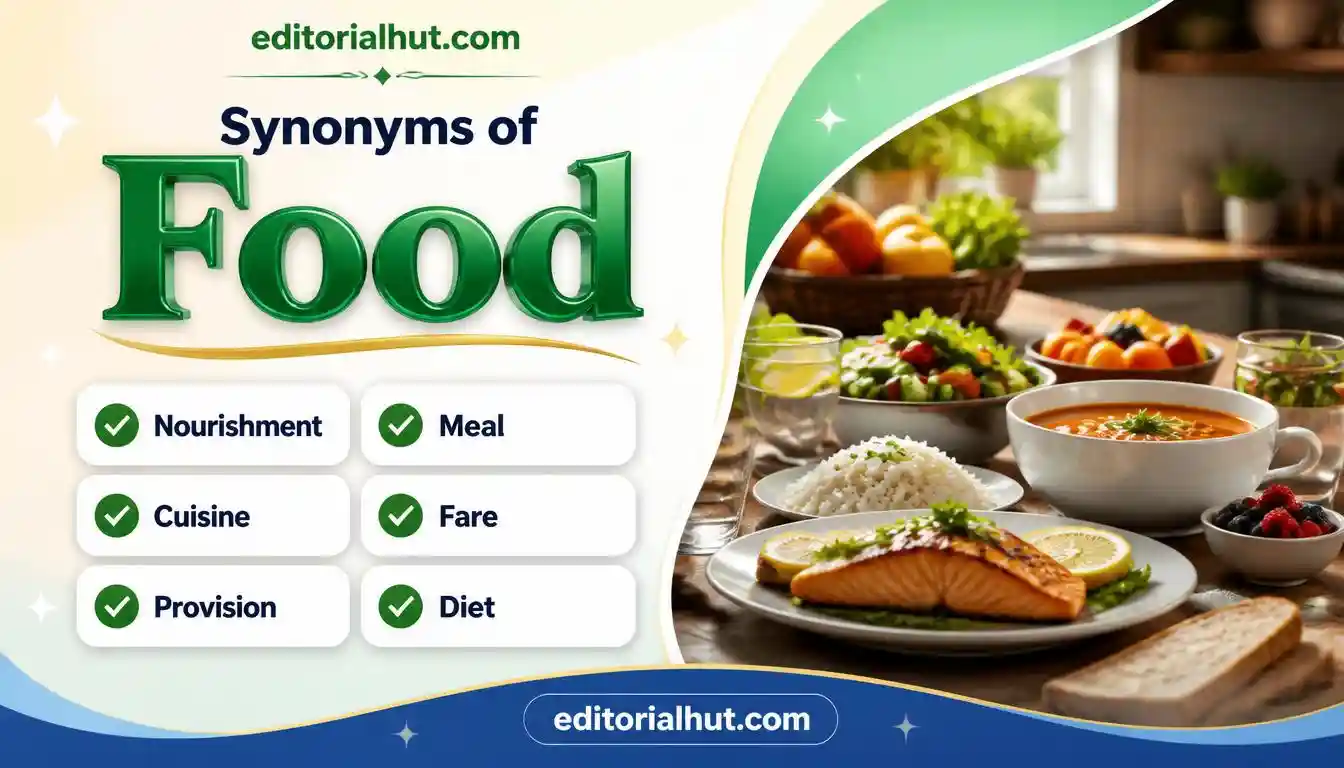
The closest general synonyms for food include nourishment, sustenance, fare, provisions, victuals, nutriment, aliment, edibles, eatables, comestibles, viands, and foodstuffs.
However, each word has a slightly different use.
- Nourishment — emphasizes what supports health and growth.
- Sustenance — emphasizes what keeps someone alive or functioning.
- Fare — refers to the food served or available in a particular place.
- Provisions — usually means a supply of food prepared or obtained for future use.
- Victuals — an old-fashioned or informal word for food.
- Nutriment — a formal word emphasizing nutritional value.
- Edibles — things suitable or intended to be eaten.
- Cuisine — a style or tradition of cooking rather than food in general.
- Meal — food eaten at a particular time.
- Grub — an informal word for food.
Synonyms for Food at a Glance
| Alternative | Meaning | Relationship to Food | Tone | Best Use |
| Nourishment | Food that supports the body | Near-synonym | Neutral | Health and nutrition |
| Sustenance | Something that maintains life | Near-synonym | Formal | Serious or formal writing |
| Fare | Food served or available | Contextual synonym | Neutral | Restaurants and descriptions |
| Provisions | Stored or supplied food | Contextual synonym | Neutral | Travel and preparation |
| Victuals | Food or supplies of food | Near-synonym | Old-fashioned | Historical or colorful writing |
| Nutriment | Nourishing substance | Near-synonym | Formal | Academic writing |
| Aliment | Food or nourishment | Near-synonym | Formal | Literary or technical writing |
| Edibles | Things that can be eaten | Contextual alternative | Neutral | Product and food descriptions |
| Eatable | Something fit to eat | Related alternative | Neutral | Informal or descriptive writing |
| Comestibles | Items intended for eating | Near-synonym | Formal | Formal or humorous writing |
| Viands | Articles of food | Near-synonym | Literary | Formal or literary writing |
| Foodstuffs | Food products or substances | Near-synonym | Formal | Business and industry |
| Meal | Food eaten at one time | Related word | Neutral | Breakfast lunch or dinner |
| Cuisine | A style of cooking | Related concept | Neutral | Culture and cooking |
| Grub | Food | Casual synonym | Informal | Conversation |
| Chow | Food | Casual synonym | Informal | Casual speech |
| Nosh | Food or a small meal | Related alternative | Informal | Casual conversation |
| Rations | A measured food supply | Contextual alternative | Formal | Travel military or emergency settings |
| Diet | Regular pattern of eating | Related concept | Neutral | Nutrition and health |
| Feast | A large or special meal | Context-specific | Neutral | Celebrations |
What Does “Food” Really Mean?
Food is a noun referring broadly to something that people or animals eat to stay alive and support growth and normal bodily functions. It can also describe substances absorbed by plants. Cambridge Dictionary identifies food as a noun that can be countable or uncountable depending on how it is used.
Examples include:
- We need to buy more food.
- The restaurant serves fresh foods from different regions.
- The animals searched for food.
- Fresh food should be stored properly.
The word also appears in figurative expressions. In food for thought, for example, food does not mean something eaten. It refers to something that provides material for thinking.
Part of Speech
Food is primarily a noun.
It can be:
- Uncountable: We need more food.
- Countable: The store sells many different foods.
- Attributive: food safety, food industry, food products.
Its most common grammatical role is as a noun referring to something consumed for nourishment.
Connotative Meaning of Food
The basic or denotative meaning of food is nourishment or something eaten.
Its connotations depend heavily on context.
The family setting food may suggest comfort and togetherness. A restaurant review it may suggest taste and quality. In a scientific context it can suggest nutrition and biological function. In expressions such as food for thought it can suggest intellectual stimulation.
The word itself is generally neutral. The emotional meaning usually comes from the surrounding adjectives and context.
Compare:
- nutritious food — emphasizes health
- comfort food — suggests emotional familiarity
- gourmet food — suggests high-quality or sophisticated preparation
- junk food — usually has a negative association
- homemade food — often suggests freshness or personal preparation
- traditional food — connects food with culture and heritage
The Closest Synonyms for Food
Nourishment
Nourishment focuses on the food or substances that provide what the body needs.
Fresh vegetables provide valuable nourishment.
It is especially useful when discussing health nutrition growth or physical well-being.
Sustenance
Sustenance emphasizes something that keeps a person or living thing alive or functioning.
The travelers carried enough food for basic sustenance.
It sounds more formal than food and is common in serious or descriptive writing.
Fare
Fare refers to the food served or available in a particular place or situation.
The restaurant offers traditional Italian fare.
It works particularly well when describing restaurants regional cooking or menus.
Provisions
Provisions refers to supplies of food and other necessities prepared for future use.
They packed enough provisions for the long journey.
It is not normally the best replacement for food in an ordinary sentence such as “I need some food.”
Victuals
Victuals is an older or less common word for food and supplies.
The sailors stocked the ship with fresh victuals.
It can create a historical rustic or colorful tone.
Nutriment
Nutriment means something that provides nourishment.
The body requires sufficient nutriment for normal growth.
It is much more formal than everyday food and is better suited to technical or academic contexts.
Aliment
Aliment is a formal term for nourishment or food.
The body needs adequate aliment to maintain normal functions.
It is uncommon in everyday conversation but can appear in formal or literary contexts.
Edibles
Edibles refers to things that can be eaten.
The market sells a wide range of packaged edibles.
It emphasizes edibility rather than the general concept of nourishment.
Foodstuffs
Foodstuffs refers to food substances or food products.
The company imports foodstuffs from several countries.
This word is especially useful in business industrial or formal contexts.
Viands
Viands is a formal or literary word for articles of food.
The table was filled with an impressive selection of viands.
It can sound old-fashioned in ordinary modern conversation.
Formal Synonyms for Food
If you need a formal word for food, consider:
- nourishment
- sustenance
- nutriment
- aliment
- provisions
- comestibles
- foodstuffs
- viands
The choice depends on the meaning.
A academic writing nutriment or nourishment may fit better than grub. For a formal description of stored supplies provisions is more precise.
For example:
Basic: The travelers carried enough food.
More formal: The travelers carried sufficient provisions.
The second sentence changes the emphasis from food in general to a prepared supply.
Academic and Professional Alternatives
In academic or professional writing the best alternative depends on the subject.
Nourishment works well in discussions of health and development.
Nutriment emphasizes nutritional support.
Foodstuffs can work when discussing food products or the food industry.
Provisions is useful when discussing supplies.
Diet is appropriate when referring to someone’s regular pattern of eating rather than a single item.
For example:
The study examined the relationship between diet and physical activity.
Here diet cannot simply be replaced with food because the two words express different ideas.
Casual Words for Food
In informal conversation you may hear:
- grub
- chow
- eats
- nosh
- vittles
- tucker
These words can make writing sound relaxed or conversational.
For example:
Let’s grab some grub before the movie.
This sounds much more casual than:
Let’s get some nourishment before the movie.
The second sentence is grammatically possible but unnatural for ordinary conversation.
Fancy and Literary Words for Food
If you need a fancy word for food, the following can work depending on context:
- cuisine
- viands
- comestibles
- fare
- delicacies
- provisions
- nourishment
But these words should not be treated as perfect substitutes.
Cuisine means a style or system of cooking rather than food itself.
French cuisine is famous around the world.
You would not normally replace food with cuisine in:
I need some food.
Likewise delicacies refers to foods considered especially desirable or distinctive rather than ordinary food in general.
Words to Describe Food
If your real goal is to find words to describe food, direct synonyms are only part of the answer.
Taste
- delicious
- tasty
- flavorful
- savory
- sweet
- bitter
- spicy
- tangy
- rich
- mild
Quality
- fresh
- nutritious
- wholesome
- healthy
- homemade
- organic
- natural
- high-quality
Appeal
- appetizing
- delectable
- scrumptious
- mouthwatering
- tempting
- delightful
Words such as delicious and tasty describe the quality or taste of food. They are therefore not direct synonyms for food.
Synonyms for Delicious Food
When people search for delicious food synonyms, they often want adjectives rather than nouns.
Useful choices include:
- tasty
- flavorful
- appetizing
- delectable
- scrumptious
- mouthwatering
- savory
- delightful
- satisfying
- irresistible
For example:
The restaurant served delicious food.
can become:
The restaurant served flavorful dishes.
Here dishes replaces food while flavorful adds information about taste.
Synonyms for Meals and Dishes
Meal and dish are closely related to food but have narrower meanings.
A meal is food eaten at a particular time such as breakfast, lunch or dinner.
We had a quick meal before work.
A dish usually means a particular prepared food.
The curry was the most popular dish.
Other useful words include:
- course
- plate
- serving
- platter
- feast
- banquet
- spread
These should be selected according to context rather than treated as interchangeable with food.
Food Synonyms for Writing
When writing an article essay story or description you can avoid repetition by choosing a more precise word.
Instead of:
The travelers bought food for the journey.
You might write:
The travelers bought provisions for the journey.
Instead of:
The restaurant serves food from Italy.
You could write:
The restaurant serves Italian fare.
Instead of:
The body needs food to survive.
You could write:
The body needs nourishment to survive.
Each replacement changes the emphasis slightly. Good writing is not about replacing every occurrence of food. It is about choosing the word that communicates the intended meaning most precisely.
Food vs Nourishment
Food is the broader everyday term.
Nourishment emphasizes the benefit food provides to the body.
We bought food for dinner.
The meal provided nourishment after a long day.
The two words can overlap but they are not identical in every context.
Food vs Sustenance
Sustenance emphasizes survival or continued functioning.
The hikers carried food for the trip.
The hikers carried enough sustenance to survive several days.
The second sentence sounds more formal and emphasizes survival rather than enjoyment.
Food vs Fare
Fare often refers to the range or type of food served or available.
The restaurant serves traditional food.
The restaurant serves traditional Mediterranean fare.
The second sentence sounds more descriptive and focuses on the style of food.
Food vs Provisions
Provisions means a supply of food or necessities.
We need food for the camping trip.
We need provisions for the camping trip.
The second sentence suggests preparation and stored supplies.
Food vs Cuisine
Cuisine means a particular style or tradition of cooking.
I love Thai food.
I love Thai cuisine.
These sentences can communicate a similar idea in this context. But cuisine is not a general synonym for every use of food.
You can say:
French cuisine is diverse.
You would not normally say:
I bought some cuisine at the grocery store.
Food vs Meal
Food is the general substance people eat.
Meal refers to food eaten at a particular occasion.
There was plenty of food at the party.
We had a wonderful meal at the party.
The words overlap but their grammatical and contextual functions differ.
Sentence Transformations
General
Original:
We need food for the journey.
Alternative:
We need provisions for the journey.
Difference:
Provisions emphasizes supplies prepared for the trip.
Nutrition
Original:
The body needs food to grow.
Alternative:
The body needs nourishment to grow.
Difference:
Nourishment emphasizes the nutritional function of food.
Restaurant
Original:
The restaurant serves excellent food.
Alternative:
The restaurant serves excellent fare.
Difference:
Fare gives the sentence a more descriptive restaurant-focused tone.
Casual
Original:
Let’s get some food.
Alternative:
Let’s grab some grub.
Difference:
Grub makes the sentence informal and conversational.
Best Word by Situation
| If you want to sound… | Consider… |
| Everyday and natural | Food |
| Health-focused | Nourishment |
| Formal | Sustenance |
| Academic | Nutriment |
| Literary | Viands |
| Restaurant-focused | Fare |
| Prepared for travel | Provisions |
| Business-oriented | Foodstuffs |
| Casual | Grub |
| Very informal | Chow |
| Descriptive | Edibles |
| Cultural | Cuisine |
| Meal-specific | Meal |
| Item-specific | Dish |
| Nutritional | Nutriment |
The safest general replacement is usually food itself. A synonym is only better when it communicates something more specific.
Common Collocations With Food
English speakers commonly use food in phrases such as:
- healthy food
- fresh food
- nutritious food
- homemade food
- traditional food
- fast food
- junk food
- organic food
- frozen food
- processed food
- baby food
- pet food
- food products
- food industry
- food supply
- food safety
- food preparation
- food production
- food packaging
- food service
Cambridge also identifies common combinations such as adequate food, amount of food, and basic food.
These combinations are useful because natural vocabulary depends not only on individual words but also on the words that commonly appear around them.
Common Mistakes With Food Synonyms
Treating Every Related Word as an Exact Synonym
Cuisine, meal, dish, and diet are related to food but do not mean exactly the same thing.
Using Formal Words in Casual Conversation
Saying “I need some nutriment” instead of “I need some food” sounds unnatural in ordinary conversation.
Using Provisions for Ordinary Meals
Provisions usually suggests a supply of food rather than one ordinary meal.
Confusing Food With Cuisine
Cuisine describes a style or tradition of cooking.
Using Delicious as a Noun
Delicious is an adjective. It describes food but does not mean food itself.
Replacing Every Repeated Word
Good writing does not require a synonym every time food appears. Sometimes repeating the exact word is clearer and more natural.
Antonyms of Food
There is no single perfect everyday antonym for food.
In some contexts dictionaries identify words associated with harmful substances such as poison or toxin as opposites or near-opposites because they contrast with substances intended to nourish.
However, context matters. Poison is not the direct grammatical opposite of food in ordinary English.
In a phrase such as:
Food keeps the body alive.
the conceptual opposite might be:
A harmful substance can damage the body.
So it is better to avoid presenting one word as the universal antonym of food.
Syllables in Food
Food has one syllable.
It is pronounced as one complete sound:
food
Pronunciation of Food
The standard US pronunciation is:
US IPA: /fuːd/
UK IPA: /fuːd/
Cambridge gives the same pronunciation for both US and UK English.
The long /uː/ sound is similar to the vowel sound in blue.
Word Formation of Food
Food is a simple historical English noun rather than a modern word formed transparently from a common English prefix and suffix.
The word has a long history in English and is related to older Germanic forms associated with feeding and nourishment.
Modern compounds such as:
- food + bank
- food + chain
- food + safety
- food + supply
- food + industry
show how the noun functions productively in contemporary English.
Affixation Pattern of Food
There is no meaningful modern prefix-plus-root-plus-suffix pattern in food.
It is best treated as a basic lexical noun rather than forcing an artificial affixation analysis onto it.
Etymology of Food
The word food has roots in Old English. Collins traces the modern form through Middle English fode and Old English fōda and connects it with older Germanic forms related to feeding.
The word has therefore been part of the English vocabulary for many centuries.
Its modern meaning remains closely connected to nourishment and things consumed by living organisms.
Short History of Food
The concept represented by food is ancient but the English word itself has a long linguistic history.
Older forms referred to nourishment and what was consumed to sustain life. Over time the word developed broader uses. Modern English can use food not only for ordinary nourishment but also for particular categories such as baby food, fast food, and frozen foods.
It can also be used figuratively in expressions such as food for thought, where the idea of nourishment is transferred from the physical body to the mind.
Frequently Asked Questions About Food Synonyms
What is the closest synonym for food?
Nourishment and sustenance are among the closest alternatives when the emphasis is on what supports life. Fare can be a close alternative when discussing food that is served or available.
What is another word for food?
Common alternatives include nourishment, sustenance, fare, provisions, nutriment, aliment, victuals, edibles, foodstuffs, comestibles, viands, meal, and grub.
What is a formal synonym for food?
Nourishment, sustenance, nutriment, aliment, comestibles, and foodstuffs can work in formal contexts. The best choice depends on the sentence.
What is a fancy word for food?
Viands, comestibles, and fare can give writing a more formal or literary tone. Cuisine is appropriate when referring to a particular cooking tradition.
What is a simpler alternative to food?
There usually is no need for a simpler alternative because food is already a common and easy English word.
Can nourishment replace food?
Sometimes. Nourishment works when the focus is on the nutritional or sustaining function of food. It cannot naturally replace food in every sentence.
Is cuisine a synonym for food?
Not exactly. Cuisine refers to a style or tradition of cooking and the foods associated with it. It is a related concept rather than a universal synonym.
Is meal another word for food?
Not exactly. A meal is food eaten at a particular time or occasion. Food is the broader term.
What is a casual word for food?
Grub, chow, eats, and nosh can be used informally, although their naturalness varies by speaker and context.
What is the opposite of food?
There is no single universal antonym. In some contexts poison or another harmful substance can provide a conceptual contrast, but it is not a direct everyday antonym.
Final Takeaway
The best synonyms for food depend on what you want to express.
Use food for the broad everyday meaning. Choose nourishment when you want to emphasize nutrition. Use sustenance when survival or continued functioning is important. Choose fare for food served or available in a particular setting. Use provisions for stored supplies. Nutriment and aliment are more formal. Grub and chow create a casual tone.
The key lesson is that a thesaurus can show you related words but context tells you which one actually belongs in your sentence. The strongest vocabulary choice is not always the fanciest synonym. It is the word that expresses your intended meaning naturally and precisely.

Shahid Imran is an English language and vocabulary specialist at EditorialHut.com, focusing on synonyms, word meanings, alternative words, and practical example sentences. He helps readers discover better words, expand their vocabulary, and communicate more clearly and confidently.