









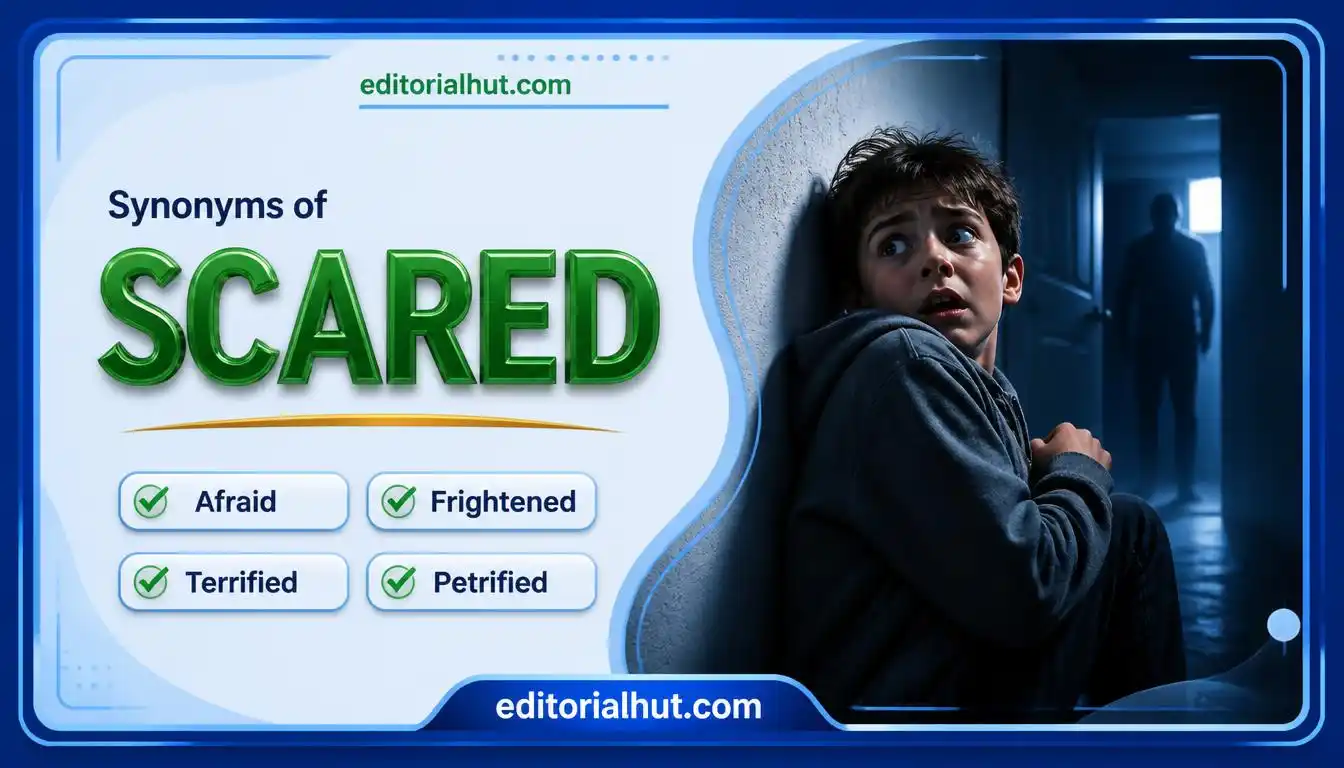
Finding the right synonyms for scared can help you describe fear more clearly and naturally. While scared, afraid, and frightened are close in meaning, other words express different levels or types of fear.
For example, nervous suggests mild worry, alarmed often describes a sudden reaction, and terrified shows intense fear. The right word depends on the situation, your tone, and how strong the feeling is.
Whether you’re writing a story, improving your English, preparing a school assignment, or simply looking for another way to say scared, these alternatives can help you choose a word that fits your meaning.
Quick Answer
Some common synonyms for scared include:
- Frightened — very close in meaning and common in everyday English
- Afraid — feeling fear or expecting something unpleasant
- Fearful — showing or experiencing fear
- Terrified — extremely scared
- Petrified — extremely frightened, often to the point of feeling unable to move
- Panicked — suddenly overwhelmed by fear or anxiety
- Nervous — worried or uneasy, often about something that may happen
- Alarmed — suddenly worried or frightened by a perceived danger
- Startled — suddenly frightened or surprised by something unexpected
- Uneasy — uncomfortable or worried without necessarily feeling strong fear
The closest replacement is often frightened, but the best choice depends on how strong the fear is and why the person feels it.
Closest Synonyms for Scared
| Alternative | Meaning | Tone | Best Use |
| Frightened | Feeling fear | Neutral | Everyday situations |
| Afraid | Feeling fear or expecting danger | Neutral | General conversation |
| Fearful | Experiencing or showing fear | Formal | Writing and descriptions |
| Terrified | Extremely scared | Strong | Intense fear |
| Petrified | Extremely frightened | Very strong | Intense or dramatic fear |
| Panicked | Overcome by sudden fear | Strong | Emergencies or sudden danger |
| Alarmed | Suddenly concerned or frightened | Moderate | Unexpected danger |
| Startled | Suddenly surprised and frightened | Mild | Sudden sounds or movements |
| Nervous | Worried or uneasy | Mild | Future events or uncertainty |
| Uneasy | Uncomfortable or concerned | Mild | Suspicion or uncertainty |
| Frightful | Causing fear | Descriptive | Describing something frightening |
| Apprehensive | Worried about what may happen | Formal | Future situations |
Not all of these words can replace scared in every sentence. For example, startled usually describes a sudden reaction, while terrified describes a much higher level of fear.
What Does Scared Mean?
Scared is an adjective that means feeling fear, worry, or distress because you believe something dangerous, unpleasant, or threatening may happen.
For example:
I was scared when I heard a strange noise outside.
Here, scared describes the person’s emotional response to a possible threat.
The word can describe both real and imagined danger:
She was scared of the dark.
He was scared that he might lose his job.
Scared can also describe a temporary reaction:
The loud explosion scared me.
In this sentence, the explosion caused the feeling of fear.
Scared as an Adjective
The most common use of scared is as an adjective.
- She felt scared.
- The child looked scared.
- I’m scared of heights.
- They were scared by the sudden noise.
It commonly appears with of, by, about, and that.
Connotation of Scared
Scared usually has a neutral and conversational tone. It does not automatically suggest extreme fear.
Compare these sentences:
I was scared when I heard the noise.
I was terrified when I heard the noise.
The first sentence describes fear without telling us that it was overwhelming. The second clearly communicates intense fear.
This difference matters when choosing a synonym. Using terrified for a small concern can make a situation sound more dramatic than intended.
Formal Alternatives to Scared
For formal or polished writing, several alternatives may work better depending on the context.
Fearful
Fearful means experiencing or showing fear. It can sound more formal or literary than scared.
The residents were fearful after the warning was issued.
Apprehensive
Apprehensive describes worry or uneasiness about something that may happen.
She felt apprehensive about starting her new job.
This word often focuses on future uncertainty rather than immediate danger.
Concerned
Concern is softer than scared. It usually expresses worry rather than strong fear.
The manager was concerned about the safety of the workers.
It should not normally replace scared when intense fear is involved.
Academic Alternatives to Scared
Academic writing usually benefits from precise language rather than emotional exaggeration.
Depending on the context, writers may use words such as:
- Fearful
- Apprehensive
- Concerned
- Alarmed
- Distressed
For example:
Participants reported feeling apprehensive about the unfamiliar environment.
This sounds more appropriate in formal research writing than:
Participants said they were scared.
However, the original wording may still be appropriate when reporting someone’s exact experience or using a direct quotation.
Professional Alternatives to Scared
In workplace communication, the best word depends on what you actually mean.
Concerned works when you want to communicate a serious worry without sounding overly emotional.
I’m concerned about the potential safety risks.
Apprehensive works when you are uncertain about a future event.
She was apprehensive about presenting the proposal to the board.
Alarm works when new information creates a sudden sense of danger.
The team became alarmed after discovering the security issue.
These words can communicate concern more precisely than simply saying scared.
Casual Alternatives to Scared
In everyday conversation, natural alternatives include:
- Afraid
- Frightened
- Nervous
- Freaked out
- Spooked
- Startled
Some are much more informal than others.
I was really freaked out by that movie.
This sounds casual and emotional.
The dog got spooked by the thunder.
Here, spooked is informal and often describes a sudden reaction to something unexpected.
Stronger or Softer Alternatives to Scared
Fear exists on a wide scale, so the right synonym depends on intensity.
Softer words
Nervous, uneasy, and worried can describe feelings that are less intense than being scared.
I felt nervous before the interview.
That does not necessarily mean the person expected danger. The feeling may come from uncertainty or pressure.
Similar strength
Afraid and frightened are often close to scared.
I was afraid when I saw the storm.
I was frightened when I saw the storm.
Both sound natural.
Stronger words
Terrified, petrified, and horrified can express much stronger emotional reactions.
She was terrified when the car suddenly lost control.
Petrified can suggest such intense fear that a person feels frozen.
He was petrified when he heard footsteps behind him.
Horrified is slightly different because it often combines shock, disgust, or deep distress with the reaction.
Important Synonym Differences
Scared vs. Afraid
Scared and afraid are very close and can often replace each other.
I’m scared of dogs.
I’m afraid of dogs.
Both are natural.
There can be a small difference in style. Scared often sounds more conversational, while afraid can work in a wider range of expressions.
Scared vs. Frightened
Frightened is one of the closest alternatives to scared.
The child was scared by the noise.
The child was frightened by the noise.
Both sentences communicate almost the same idea.
Frightened can sometimes sound slightly more descriptive or formal.
Scared vs. Terrified
The main difference is intensity.
Scared describes fear in general.
Terrified describes extreme fear.
I was scared during the storm.
I was terrified when lightning struck the tree nearby.
The second sentence communicates a much stronger emotional response.
Scared vs. Nervous
These words are related but not interchangeable in every situation.
Nervous usually involves worry, uncertainty, or anticipation.
I was nervous before my presentation.
Scared usually involves fear of danger, harm, or an unpleasant outcome.
I was scared when the car began to skid.
Scared vs. Startled
Startled describes a sudden reaction to something unexpected.
I was startled when someone knocked loudly on the door.
You may feel scared after being startled, but the two words describe different parts of the experience.
Scared vs. Panicked
Panicked describes a stronger reaction in which fear becomes difficult to control.
She was scared when she couldn’t find her child.
She panicked when she couldn’t find her child for several hours.
The second sentence suggests a more intense and urgent emotional response.
Word Formation of Scared
Scared comes from the verb scare with the past-participle form -ed.
The basic pattern is:
scare + -ed → scared
The verb scare means to cause someone to feel fear.
For example:
The sudden noise scared me.
The adjective scared describes the person experiencing that fear:
I was scared.
This distinction is useful because English learners sometimes confuse scared and scary.
Scared vs. Scary
These words describe different things.
Scared describes the person who feels fear.
The child was scared.
Scary describes something that causes fear.
The movie was scary.
A simple way to remember the difference is:
Scared = feeling fear
Scary = causing fear
Syllables in Scared
Scared — 1 syllable
It is pronounced as one sound unit.
Pronunciation of Scared
US IPA: /skerd/
UK IPA: /skeəd/
The exact vowel quality can vary slightly by accent, but the word has one syllable in both varieties.
Etymology of Scared
Scared comes from the verb scare. English scare developed from an older Scandinavian source, commonly connected with Old Norse skirra, meaning to frighten or deter.
The word has long been associated with causing fear or driving someone away because of fear. Modern English uses scare as both a verb and part of several related forms, including scared and scary.
Real-World Examples
Everyday conversation
I’m scared of flying, but I’m going on the trip anyway.
Here, scared expresses a personal fear.
School
The students were nervous before the exam.
Nervous fits better than terrified because the situation involves anticipation rather than immediate danger.
Workplace
The employees were concerned about the sudden change in safety procedures.
Concerned sounds measured and professional.
Emergency
The passengers panicked when the alarm went off.
Panicked communicates a sudden, intense reaction.
Creative writing
She stood frozen in the doorway, petrified by the sound coming from upstairs.
Petrified creates a stronger and more dramatic image.
Social media
That horror movie seriously freaked me out!
Freaked me out is casual and expressive, making it suitable for informal communication.
Sentence Transformations
Original
I was scared when I heard the strange sound.
Softer
I felt uneasy when I heard the strange sound.
Uneasy suggests discomfort or concern without strong fear.
More formal
I was apprehensive when I heard the strange sound.
This focuses more on worry and uncertainty.
Stronger
I was terrified when I heard the strange sound.
This tells the reader that the fear was intense.
More dramatic
I was petrified when I heard the strange sound.
This suggests overwhelming fear and can create a stronger image in storytelling.
Which Alternative Should You Choose?
| If you want to sound… | Consider… |
| Natural and conversational | Scared |
| Very similar to scared | Frightened |
| General or neutral | Afraid |
| More formal | Fearful |
| Worried about the future | Apprehensive |
| Mildly concerned | Uneasy |
| Worried rather than afraid | Concerned |
| Strongly afraid | Terrified |
| Extremely frightened | Petrified |
| Suddenly overwhelmed by fear | Panicked |
| Suddenly surprised by something | Startled |
| Very casual | Freaked out or spooked |
There is no single replacement that works perfectly in every sentence. Think about why the person feels fear and how intense the feeling is before choosing a synonym.
List of Synonyms
1. Afraid
Meaning: Feeling fear because you think something bad or dangerous may happen.
Example: I was afraid to walk home alone at night.
2. Frightened
Meaning: Feeling fear because something scares you.
Example: The loud noise left the child frightened.
3. Terrified
Meaning: Extremely scared or filled with intense fear.
Example: She was terrified when she heard someone at the door.
4. Fearful
Meaning: Feeling afraid or expecting something bad to happen.
Example: He felt fearful during the storm.
5. Alarmed
Meaning: Suddenly worried or frightened because something unexpected happens.
Example: The strange sound alarmed everyone in the house.
6. Panicked
Meaning: Feeling sudden and powerful fear that makes it difficult to think clearly.
Example: She panicked when she couldn’t find her child.
7. Petrified
Meaning: Extremely frightened, sometimes so scared that you cannot move.
Example: He was petrified when he saw the snake.
8. Horrified
Meaning: Extremely shocked and frightened by something terrible or disturbing.
Example: We were horrified by what we saw.
9. Shaken
Meaning: Upset or frightened after a scary or stressful experience.
Example: She was still shaken after the car accident.
10. Nervous
Meaning: Worried or slightly afraid about something that may happen.
Example: I felt nervous before my first speech.
11. Uneasy
Meaning: Feeling uncomfortable or worried because something does not feel right.
Example: I felt uneasy walking through the empty building.
12. Anxious
Meaning: Feeling worried or nervous about a possible problem or future event.
Example: He was anxious about his exam results.
13. Apprehensive
Meaning: Worried or afraid that something unpleasant might happen.
Example: She felt apprehensive about starting her new job.
14. Intimidated
Meaning: Feeling afraid because someone or something seems powerful, confident, or threatening.
Example: The new student felt intimidated by the large group.
15. Startled
Meaning: Suddenly frightened or surprised by something unexpected.
Example: I was startled by the sudden crash.
16. Spooked
Meaning: Suddenly frightened, especially by something strange or unexpected.
Example: The horse became spooked by the loud fireworks.
17. Scared stiff
Meaning: Extremely frightened and unable to react normally.
Example: The scary movie left me scared stiff.
18. Dreadful
Meaning: Causing or connected with great fear or worry.
Example: They had a dreadful feeling that something was wrong.
19. Daunted
Meaning: Feeling afraid or discouraged because something seems difficult or challenging.
Example: She felt daunted by the amount of work ahead.
20. Timid
Meaning: Shy and lacking confidence because you feel nervous or afraid.
Example: The timid boy was afraid to speak in front of the class.
21. Frightened out of your wits
Meaning: Extremely frightened.
Example: The strange footsteps scared us out of our wits.
22. Hesitant
Meaning: Unsure or nervous about doing something.
Example: He was hesitant to enter the dark room.
23. Worried
Meaning: Thinking about a problem with fear or concern.
Example: Mom was worried when I didn’t come home on time.
24. Concerned
Meaning: Worried that something may be wrong or may cause a problem.
Example: She was concerned about her son’s safety.
25. Distressed
Meaning: Very upset, worried, or troubled by something.
Example: The lost child looked distressed.
26. Panicked
Meaning: Extremely emotional or panicked, often because of fear or distress.
Example: She became Panicked when she thought her dog was missing.
27. Trembling
Meaning: Shaking because of fear, nervousness, cold, or excitement.
Example: He stood trembling after hearing the frightening news.
28. Quaking
Meaning: Shaking strongly because of fear.
Example: The frightened child was quaking with fear.
29. Panic-stricken
Meaning: Completely overwhelmed by sudden and intense fear.
Example: The panic-stricken passengers rushed toward the exit.
30. Fear-stricken
Meaning: Deeply affected or overwhelmed by fear.
Example: The fear-stricken villagers ran to safety.
Common Phrases With Scared
Some natural expressions with scared include:
- scared of something
- scared of someone
- scared to do something
- scared that something might happen
- scared for someone
- scared out of my mind
- scared stiff
- scared to death
Examples:
I’m scared of heights.
She was scared to speak in front of the audience.
He was scared that he had made a serious mistake.
We were scared for our friends during the storm.
Some expressions, such as scared to death, are idiomatic and usually do not mean literal danger or death.
Common Mistakes With Scared
Using scary when you mean scared
Incorrect:
I am scary of spiders.
Correct:
I am scared of spiders.
Scared describes the person. Scary describes the thing that creates fear.
Using terrified for every type of fear
Terrified is strong. It can make a mild situation sound extreme.
Instead of:
I was terrified before my job interview.
You may prefer:
I was nervous before my job interview.
Treating nervous and scared as exact synonyms
A person can feel nervous without being genuinely afraid.
She was nervous before her first day at work.
This does not necessarily mean she believed she was in danger.
Using formal words in casual conversations
Words such as apprehensive and fearful are useful, but they may sound less natural in very casual speech.
I was scared about the test.
sounds more conversational than:
I was apprehensive about the test.
Both can be correct, but the context matters.
Antonyms of Scared
Common opposites of scared include:
- Brave
- Fearless
- Calm
- Confident
- Courageous
- Unafraid
- Secure
The best antonym depends on the meaning.
If scared means experiencing fear, unafraid is a direct opposite.
If you want to describe someone who acts despite fear, brave or courageous may be more appropriate.
Frequently Asked Questions
What is the closest synonym for scared?
Frightened is one of the closest synonyms for scared. Afraid is also very close and can replace scared in many everyday sentences.
What is another word for scared?
Depending on the situation, you can use frightened, afraid, fearful, terrified, nervous, uneasy, alarmed, startled, or panicked.
What is a formal synonym for scared?
Fearful and apprehensive can work in formal writing, depending on the meaning. Concerned is useful when the feeling is more about worry than fear.
What is a stronger word for scared?
Terrified is a common stronger alternative. Petrified can also express extremely intense fear.
What is a simpler alternative to scared?
Afraid is a simple and widely understood alternative. Frightened is also easy to understand.
Can frightened replace scared?
Yes, in many sentences. For example, “The child was scared” and “The child was frightened” have almost the same meaning. The exact choice depends on tone and context.
What is the difference between scared and nervous?
Scared usually describes fear, especially fear connected with danger or harm. Nervous more often describes worry, uncertainty, or tension about something that may happen.
What is the opposite of scared?
Common opposites include unafraid, fearless, brave, calm, confident, and courageous. The right choice depends on the sentence.
Final Takeaway
Scared is a flexible everyday word for feeling fear, but its alternatives can express much more specific shades of emotion. Use frightened or afraid when you want a close replacement. Choose nervous, uneasy, or concerned for milder feelings. Use alarmed for sudden concern, panicked for an intense reaction, and terrified or petrified when the fear is extreme.

Shahid Imran is an English language and vocabulary specialist at EditorialHut.com, focusing on synonyms, word meanings, alternative words, and practical example sentences. He helps readers discover better words, expand their vocabulary, and communicate more clearly and confidently.