










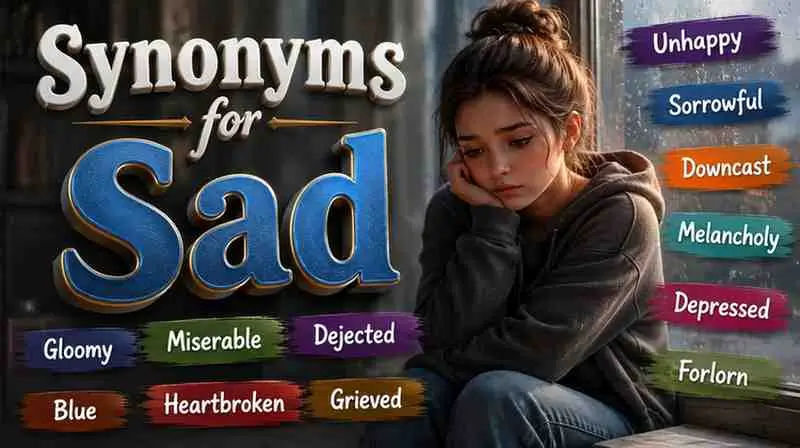
Have you ever wanted to say you feel sad, but that word just didn’t feel strong enough? Maybe you were writing a story, an email, or a school essay, and “sad” felt too plain. That’s a common problem, and learning synonyms for sad can fix it fast.
“Sad” simply means feeling unhappy or down. It’s a word we all know, but English offers many other words that share this feeling with different shades of meaning. Some are soft, like “blue.” Others are strong, like “heartbroken.”
Learning synonyms helps students write better essays, bloggers create more interesting posts, content writers avoid repeating the same word, and ESL learners sound more natural. Even in everyday English, having more words for sad makes conversations feel real and personal. This article gives you 30 clear, useful synonyms for sad, complete with simple meanings and examples you can use right away.
What Are the Best Synonyms for Sad?
The best synonyms for sad include unhappy, sorrowful, downcast, gloomy, miserable, dejected, and heartbroken. Each word expresses a similar feeling but with a different level of strength. “Unhappy” is mild and common, while “heartbroken” shows deep emotional pain. Choosing the right synonym depends on how strong the feeling is and how formal your writing needs to be.
Sad Synonyms at a Glance
| Synonym | Simple Meaning | Best Used For |
| Unhappy | Not feeling good or content | Everyday conversation |
| Sorrowful | Feeling deep sadness | Formal or literary writing |
| Downcast | Looking or feeling low | Describing mood or expression |
| Gloomy | Dark, low mood or feeling | Weather or mood descriptions |
| Miserable | Very unhappy or uncomfortable | Strong emotional situations |
| Dejected | Feeling defeated or discouraged | After failure or disappointment |
| Blue | A casual way to say sad | Informal conversation |
| Heartbroken | Extreme sadness from loss | Relationships, grief |
| Depressed | Feeling very low for a long time | Emotional or mental health topics |
| Melancholy | A quiet, thoughtful sadness | Creative or poetic writing |
| Somber | Serious and sad in tone | Formal or reflective writing |
| Tearful | Close to crying | Emotional moments |
| Grief-stricken | Overwhelmed by loss | Death or major loss |
| Wistful | Sad with a hint of longing | Reflecting on the past |
| Morose | Gloomy and silent | Describing personality or mood |
1. Unhappy
Meaning: Not feeling good, pleased, or satisfied.
Examples: She looked unhappy after hearing the news. He felt unhappy about losing his favorite pen.
2. Sorrowful
Meaning: Feeling or showing deep sadness.
Examples: The sorrowful widow sat quietly at the funeral. His sorrowful eyes told the whole story.
3. Downcast
Meaning: Feeling low, discouraged, or showing sadness in your expression.
Examples: Her downcast face showed she had failed the test. He walked home with a downcast look after the game.
4. Gloomy
Meaning: Feeling or seeming dark, low, and without hope.
Examples: The gloomy weather matched her gloomy mood. He gave a gloomy report about the company’s future.
5. Miserable
Meaning: Extremely unhappy or uncomfortable.
Examples: I felt miserable after catching a bad cold. The lost puppy looked miserable in the rain.
6. Dejected
Meaning: Feeling sad because of failure or disappointment.
Examples: The dejected team walked off the field in silence. She felt dejected after her project was rejected.
7. Blue
Meaning: A casual, everyday word for feeling sad.
Examples: I’ve been feeling a little blue since Monday. Don’t worry, everyone feels blue sometimes.
8. Heartbroken
Meaning: Feeling extreme sadness, often because of loss or love.
Examples: She was heartbroken when her best friend moved away. He felt heartbroken after the breakup.
9. Depressed
Meaning: Feeling very low, hopeless, or without energy, often for a long time. This word can also describe a medical condition, so it should be used carefully outside of clinical contexts.
Examples: He seemed depressed after losing his job. She has felt depressed for the past few weeks.
10. Melancholy
Meaning: A quiet, thoughtful kind of sadness.
Examples: The old song filled her with melancholy. He stared out the window with a melancholy expression.
11. Downhearted
Meaning: Feeling discouraged or low in spirit.
Examples: Don’t be downhearted; you can try again next time. The players were downhearted after the tough loss.
12. Glum
Meaning: Looking or feeling sad and quiet.
Examples: He sat in the corner looking glum all day. She gave a glum smile when asked about the trip.
13. Mournful
Meaning: Feeling or expressing sadness, especially over a loss.
Examples: The mournful music filled the empty hall. Her mournful letter described how much she missed him.
14. Woeful
Meaning: Full of sadness or suffering; often used to describe a sad situation.
Examples: The woeful story made everyone in the room cry. He described his woeful attempt at cooking dinner.
15. Dismal
Meaning: Depressing, gloomy, or discouraging.
Examples: The dismal gray sky made the day feel longer. Sales figures this month were dismal.
16. Crestfallen
Meaning: Suddenly sad or disappointed, often after hoping for something better.
Examples: He looked crestfallen when he saw his test score. The crestfallen puppy dropped its broken toy.
17. Forlorn
Meaning: Sad and lonely, often abandoned or left behind.
Examples: The forlorn cat sat alone in the empty yard. She wore a forlorn expression as the train pulled away.
18. Despondent
Meaning: Feeling a loss of hope along with sadness.
Examples: He grew despondent after months of job searching. The despondent fans left the stadium early.
19. Disheartened
Meaning: Feeling less hopeful or confident because of a setback.
Examples: She felt disheartened after her plan didn’t work. Don’t get disheartened; mistakes help you learn.
20. Low-spirited
Meaning: Lacking energy or joy; feeling sad and tired inside.
Examples: He’s been low-spirited since the surgery. The team felt low-spirited after the long losing streak.
21. Heavy-hearted
Meaning: Feeling a deep, weighed-down sadness.
Examples: She said goodbye with a heavy-hearted sigh. He felt heavy-hearted leaving his childhood home.
22. Distressed
Meaning: Feeling extreme worry, sadness, or emotional pain. This word leans slightly toward anxiety along with sadness.
Examples: The distressed passenger called for help immediately. She sounded distressed on the phone last night.
23. Tearful
Meaning: Close to crying or already crying because of sadness.
Examples: She gave a tearful goodbye at the airport. His tearful voice made the announcement hard to hear.
24. Upset
Meaning: Feeling unhappy or bothered, often because of a specific event. This word can also imply anger, so context matters.
Examples: He was upset about missing the bus. She got upset when her plans were canceled.
25. Troubled
Meaning: Feeling worried and sad, often about a problem. This is a near-synonym, since it leans more toward worry than plain sadness.
Examples: He looked troubled after reading the letter. She had a troubled expression during the meeting.
26. Somber
Meaning: Serious, quiet, and sad in mood or tone.
Examples: A somber mood filled the room after the announcement. The movie ended on a somber note.
27. Wistful
Meaning: Sad in a gentle way, often while thinking about the past.
Examples: She smiled wistfully at old photographs. He felt wistful remembering his college years.
28. Dispirited
Meaning: Having lost enthusiasm or hope; feeling sad and drained.
Examples: The dispirited crew kept working despite the storm. He became dispirited after several failed attempts.
29. Grief-stricken
Meaning: Overwhelmed by sadness, usually because of a major loss such as a death.
Examples: The grief-stricken family gathered at the hospital. She remained grief-stricken for months after the loss.
30. Morose
Meaning: Gloomy, silent, and unfriendly because of sadness.
Examples: He’s been morose ever since the argument. The morose teenager barely spoke at dinner.
How to Choose the Right Synonym for Sad
Synonyms for sad don’t all mean exactly the same thing. Some are stronger, some are softer, and some fit only certain situations.
- Formal vs. informal: “Sorrowful” fits formal writing, while “blue” fits casual talk.
- Positive vs. negative meanings: Most sad synonyms are negative, but words like “wistful” can carry a gentle, almost warm feeling.
- Strong vs. weak meanings: “Unhappy” is mild, while “grief-stricken” is very strong.
- Academic writing: Choose precise words like “despondent” or “melancholy.”
- Business writing: Use neutral words like “disheartened” or “dismal” for results.
- Casual conversation: Use “blue,” “upset,” or “down.”
- Creative writing: Try “wistful,” “forlorn,” or “melancholy” for depth.
- Social media content: Short, relatable words like “sad,” “blue,” or “upset” work best.
Choosing the right word helps your writing sound accurate instead of just different.
Formal and Informal Synonyms for Sad
| Formal Synonym | Informal Synonym | Example Context |
| Sorrowful | Blue | A eulogy vs. a text to a friend |
| Despondent | Down | A report vs. daily conversation |
| Melancholy | Bummed out (mentioned for context only) | A novel vs. casual chat |
| Dejected | Upset | An article vs. a quick message |
| Disheartened | Low | A business update vs. small talk |
Best Synonyms for Different Contexts
Academic Writing Despondent, melancholy, sorrowful, dejected, disheartened
Blog Writing Gloomy, downcast, blue, heavy-hearted, wistful
Business Writing Dismal, disheartened, discouraging (related word), low-spirited, troubled
Everyday Conversation Blue, upset, down, sad, glum
Creative Writing Forlorn, melancholy, wistful, morose, heartbroken
Common Mistakes When Using Synonyms
- Choosing a word with the wrong meaning. “Troubled” suggests worry, not pure sadness.
- Using a formal word in casual speech. Saying “I am despondent” to a friend can sound odd.
- Replacing a word without checking context. “Depressed” implies more than a bad day.
- Using a synonym that changes the tone. “Morose” can sound unfriendly, not just sad.
- Repeating synonyms too much in SEO content. Overusing rare words can confuse readers.
Synonyms vs. Related Words
- True synonyms share almost the exact same meaning, like “sad” and “unhappy.”
- Near-synonyms are close but carry extra meaning, like “troubled,” which adds worry.
- Related words connect to the topic but aren’t direct synonyms, like “sorrow” (a noun) or “cry.”
- Contextual alternatives only work in specific situations, like “somber,” which fits tone more than personal feeling.
How to Use Synonyms in Your Writing
Synonyms add variety and precision to almost anything you write.
- Essays: Avoid repeating “sad” by using “sorrowful” or “despondent.”
- Blog posts: Keep readers interested with words like “gloomy” or “downcast.”
- Emails: Use polite, clear words like “disheartened.”
- Website content: Match the tone of your brand with the right synonym.
- Social media posts: Keep it short and relatable with “blue” or “upset.”
- Stories: Use emotional words like “heartbroken” or “forlorn” to build character depth.
- School assignments: Show vocabulary range with accurate word choices.
Question Answer
What is another word for sad?
Common alternatives include unhappy, sorrowful, downcast, and gloomy. Each works well depending on the tone and formality of your writing.
What is the best synonym for sad?
There isn’t one single “best” word, since it depends on context. For general use, “unhappy” or “downcast” are safe, natural choices.
Which synonym is best for formal writing?
“Sorrowful,” “despondent,” and “melancholy” work well in formal or academic writing because they sound precise and thoughtful.
Which synonym is best for everyday conversation?
“Blue,” “upset,” and “down” are simple, casual words that fit naturally into daily conversation.
Can I use these synonyms in academic writing?
Yes, many of them fit academic writing well, especially words like “despondent,” “melancholy,” and “dejected.” Avoid overly casual words like “blue” in formal essays.
Are all synonyms exactly the same?
No. Many synonyms share a similar meaning but differ in strength, tone, or formality. Always check that a word fits your intended meaning.
How can I learn synonyms easily?
Read example sentences, group words by strength or tone, and practice using new words in your own writing every day.
How can synonyms improve my writing?
Synonyms add variety, prevent repetition, and help you express emotions more precisely, making your writing more engaging and clear.
Dictionary Meaning of Synonyms of Sad
Synonyms of “sad” are words that have the same or similar meaning as “sad.” They are used to describe feelings of unhappiness, sorrow, disappointment, or emotional pain.
Conclusion
Learning synonyms for sad gives you more ways to express real emotions clearly and naturally. Whether you’re writing an essay, a blog post, or just chatting with a friend, the right word makes a difference. Try using a few of these synonyms in your next email, story, or social media post. With practice, choosing the perfect word will start to feel easy and natural.

Shahid Imran is an English language and vocabulary specialist at EditorialHut.com, focusing on synonyms, word meanings, alternative words, and practical example sentences. He helps readers discover better words, expand their vocabulary, and communicate more clearly and confidently.