










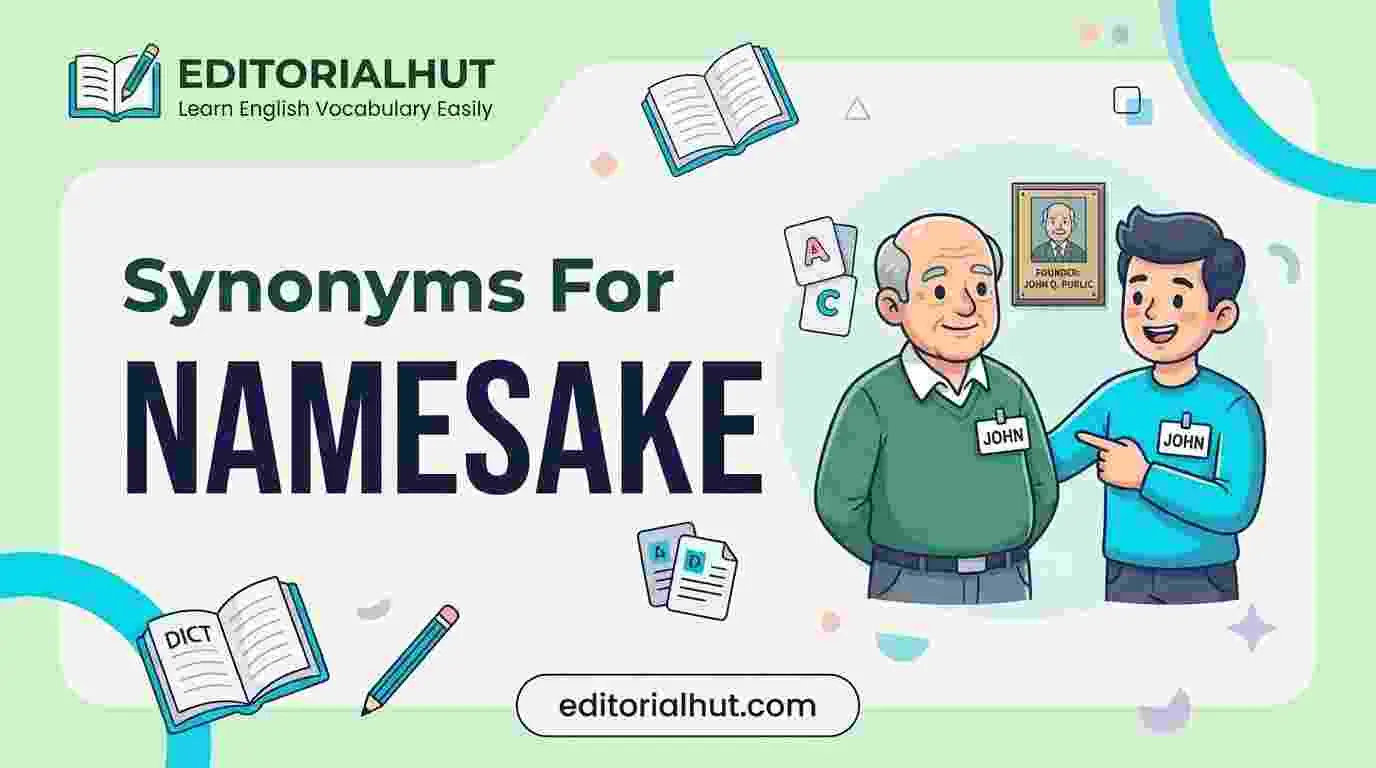
If you’re looking for synonyms for namesake, you may be trying to find a more precise way to describe someone or something that shares another person’s name or is named after them. The word namesake is commonly used for family members, places, buildings, organizations, and other things connected by a name.
Depending on the context, words and phrases such as eponym, name twin, person named after someone, and same-name person may express a similar idea. In this guide, you’ll learn the meaning of namesake, its closest synonyms, pronunciation, etymology, connotation, parts of speech, examples, and the differences between related terms such as namesake and eponym.
What Does “Namesake” Really Mean?
Namesake is a noun that describes a person or thing that has the same name as another person or thing.
For example:
- John was named after his grandfather, so his grandfather is his namesake.
- The school was named after a famous poet, making the poet its namesake.
The word can also describe someone or something named in honor of another person.
Synonyms for Namesake
Here are useful synonyms and closely related terms for namesake:
1. Name Twin
A name twin is someone who shares the same name with another person. It is an informal and modern expression.
Example:
I met my name twin at the conference.
2. Namesake Person
A namesake person is an individual who has the same name as someone else or was given a name in honor of another person.
Example:
He is his grandfather’s namesake.
3. Eponym
Eponym is a more formal word. It refers to a person, place, or thing whose name has been used to name something else.
Example:
The scientist became the eponym of the newly discovered disease.
4. Honoree
Honoree can sometimes relate to namesake when someone or something is named after a person to honor them.
Example:
The building was named after the distinguished honoree.
5. Namesake Equivalent
This phrase can describe a person or thing that corresponds to another because they share the same name.
Example:
The younger writer is the namesake equivalent of his famous grandfather.
6. Person Named After Someone
This is not a single-word synonym, but it is one of the clearest ways to explain namesake.
Example:
She was named after her grandmother, so her grandmother is her namesake.
What Is the Difference Between Namesake and Eponym?
Namesake usually focuses on the person or thing sharing the name.
Eponym focuses on the person or thing whose name gives something else its name.
For example:
Alexander Graham Bell is the namesake of a school named after him.
The school could also be described as being named after Bell.
Namesake Pronunciation
Namesake is pronounced:
/ˈneɪm.seɪk/
It sounds like:
NAYM-sayk
The word has two syllables:
name + sake
Namesake Syllables
The word namesake has 2 syllables:
name-sake
- Name — first syllable
- Sake — second syllable
Namesake Part of Speech
Namesake is primarily a noun.
Example:
My son is his grandfather’s namesake.
It can also be used attributively before another noun in expressions such as namesake school or namesake institution, although these uses are less common.
Namesake Connotation
The word namesake usually has a neutral or positive connotation.
It can suggest:
- Family connection
- Honor
- Tradition
- Respect
- Shared identity
- Being named after someone
For example, calling someone his grandfather’s namesake often suggests a meaningful family tradition.
Namesake Etymology
The word namesake comes from the combination of name + sake.
Here, sake has an older meaning related to “purpose,” “reason,” or “regard.” Thus, the original idea was essentially someone who has another person’s name for the sake of that name.
The modern meaning developed into its current sense of a person or thing sharing another’s name.
Namesake vs. Same Name
These expressions are related but aren’t always identical.
Same name simply means two people or things have identical names.
Namesake can mean that one person or thing is named after another, often with a sense of connection or honor.
Example:
Two students have the same name.
But:
One student is his grandfather’s namesake.
The second sentence gives us more information about the relationship between the names.
Namesake vs. Nickname
A nickname is an informal or alternative name given to someone.
A namesake is someone or something connected through a shared name or being named after another.
Example:
Robert’s nickname is Rob.
Robert is his father’s namesake.
These are completely different concepts.
Namesake vs. Eponymous
Eponymous means that something is named after a particular person.
Example:
The university is eponymous with its founder.
More naturally, you could say:
The university was named after its founder.
Namesake generally refers to the person or thing sharing that name, while eponymous describes something that has been given another person’s name.
Common Phrases With Namesake
Some useful expressions include:
- my namesake
- his namesake
- her namesake
- their namesake
- a famous namesake
- family namesake
- namesake of his grandfather
- namesake of her grandmother
- named after
- share the same name
Examples of Namesake in Sentences
- I was named after my grandfather, so he is my namesake.
- The library is the namesake of a famous author.
- She proudly carries her grandmother’s name as her namesake.
- He discovered that he had a famous namesake.
- The young athlete shares his name with his father and is his father’s namesake.
- The park was named after its founder, who became its namesake.
- My namesake and I have never met.
- The university honors its namesake every year.
Best Synonyms for Namesake at a Glance
The closest useful alternatives depend on context:
- Name twin — someone with the same name
- Eponym — someone whose name is given to something
- Honoree — someone honored by having something named after them
- Person named after someone — the clearest descriptive alternative
- Same-name person — an informal descriptive expression
- Namesake — the most natural and precise word in many situations
List Of synonyms for namesake
Bearer
Meaning: A person who carries or has a particular name.
Examples:
- She is the bearer of a famous family name.
- Every bearer signed the guest book.
Holder
Meaning: A person who has or owns a name or title.
Examples:
- He is the holder of the family name.
- The holder smiled at the announcement.
Owner
Meaning: A person who has a particular name.
Examples:
- The owner of the name laughed.
- She is the proud owner of that surname.
Recipient
Meaning: A person who receives a name or title.
Examples:
- The baby became the recipient of her grandmother’s name.
- Every recipient thanked the family.
Successor
Meaning: A person who comes after another and may share the same name.
Examples:
- He became his father’s successor.
- The successor kept the family tradition alive.
Junior
Meaning: A younger person with the same name as an older family member.
Examples:
- David Junior plays soccer.
- Everyone calls him Junior.
Heir
Meaning: A person who receives a family name or legacy.
Examples:
- She is the heir to the family name.
- The heir honored his grandfather.
Descendant
Meaning: A person from a later generation of a family.
Examples:
- She is a descendant of a famous leader.
- The descendant shared family stories.
Child
Meaning: A son or daughter who may receive a parent’s name.
Examples:
- Their child has the same first name.
- The child smiled proudly.
Son
Meaning: A male child named after his father.
Examples:
- The son shares his dad’s name.
- Everyone knows the son well.
Daughter
Meaning: A female child named after another family member.
Examples:
- The daughter carries her aunt’s name.
- She loves her special name.
Twin
Meaning: A person who shares the same name by coincidence.
Examples:
- My twin in name lives nearby.
- We laughed about our matching names.
Counterpart
Meaning: A person with a similar role or name.
Examples:
- I met my counterpart at work.
- Her counterpart greeted everyone.
Match
Meaning: A person or thing with the same name.
Examples:
- We found a match in the class.
- His match lives next door.
Equivalent
Meaning: A person or thing that is similar in name or role.
Examples:
- She is the equivalent in another town.
- The equivalent helped us.
Duplicate
Meaning: Something or someone that is the same.
Examples:
- The duplicate confused the teacher.
- We found a duplicate record.
Copy
Meaning: Something that closely matches another.
Examples:
- The copy has the same name.
- Everyone noticed the copy.
Replica
Meaning: An almost exact version of another.
Examples:
- The replica kept the original name.
- Visitors admired the replica.
Reflection
Meaning: Something that closely resembles another.
Examples:
- He is a reflection of his father.
- The reflection made everyone smile.
Lookalike
Meaning: A person who looks like another and may share a name.
Examples:
- My lookalike has the same nickname.
- The lookalike waved at us.
Double
Meaning: A person who closely resembles another.
Examples:
- He is my double at school.
- The double surprised everyone.
Identity
Meaning: The name or personal label of someone.
Examples:
- Your identity starts with your name.
- She protects her identity.
Label
Meaning: A name used to identify someone.
Examples:
- That label fits him well.
- The label stayed for years.
Designation
Meaning: An official or given name.
Examples:
- The designation appears on the form.
- Her designation is easy to remember.
Title
Meaning: A name or honor given to someone.
Examples:
- His title sounds impressive.
- She earned the title proudly.
Appellation
Meaning: A name used to call a person or thing.
Examples:
- That appellation is very old.
- The appellation became popular.
Nickname
Meaning: An informal name used by friends or family.
Examples:
- His nickname is Buddy.
- Everyone uses her nickname.
Moniker
Meaning: A casual or popular name.
Examples:
- She writes under a new moniker.
- His moniker became famous.
Alias
Meaning: Another name used by the same person.
Examples:
- The author used an alias.
- She signed with an alias.
Eponym
Meaning: A person whose name is given to someone or something else.
Examples:
- The city is an eponym of its founder.
- The award is an eponym for a scientist.
| Synonym | Meaning | Example Sentence |
| Eponym | A person or thing after which something is named | The city became an eponym for the famous inventor. |
| Namesake | A person or thing sharing the same name | She met her namesake at the conference. |
| Name-bearer | Someone who carries or shares a particular name | He is the name-bearer of a respected family tradition. |
| Namesake person | A person who has the same name as another | My namesake person lives in another state. |
| Same-named person | Someone who has the same name as another person | I found a same-named person online. |
| Honorary namesake | Someone named after another person as an honor | The young athlete was an honorary namesake of the coach. |
| Namesake equivalent | A person or thing with a corresponding name | The two organizations have a namesake equivalent overseas. |
| Dedicatee | A person honored by having something named after them | The scientist became the dedicatee of the new research center. |
| Memorial namesake | Someone whose name is used to honor their memory | The library was built as a memorial namesake for the former mayor. |
| Eponymous person | A person whose name gives rise to the name of something | The eponymous person inspired the creation of the award. |
Short Answer Questions
What is another word for namesake?
Some common alternatives to namesake include eponym, name bearer, honoree, successor (in some family contexts), and junior (for a child with the same name as a parent). The best choice depends on the situation.
What does namesake mean?
A namesake is a person, place, or thing that has the same name as another person or thing. It often refers to someone who was named in honor of another individual.
How do you use “namesake” in a sentence?
Here are two simple examples:
- My son is my grandfather’s namesake.
- The library is the namesake of a famous author.
Is namesake a formal or informal word?
Namesake is a standard English word that can be used in both formal and informal writing. It appears in books, newspapers, academic writing, and everyday conversations.
What is the difference between a namesake and an eponym?
A namesake is someone or something that shares the same name as another. An eponym is the original person whose name is given to someone, something, or a place. Although they are closely related, they are not always interchangeable.
Can a place or building be a namesake?
Yes. A school, hospital, park, street, or city can be a namesake if it is named after a person, historical figure, or another place.
Is “Junior” a synonym for namesake?
Junior is a related term, not a perfect synonym. It usually refers to a son who has the same name as his father, while namesake has a broader meaning and can refer to people, places, or things.
Is “alias” the same as namesake?
No. An alias is an alternative name used by a person, while a namesake is someone or something that shares the same name as another.
What is the opposite of namesake?
There is no exact antonym for namesake, but related opposite expressions include unrelated person, different identity, stranger, or someone with a different name, depending on the context.
Why is learning synonyms for namesake important?
Learning synonyms for namesake improves your English vocabulary and helps you choose the right word in different situations. It also makes your essays, blog posts, emails, business writing, and everyday conversations more natural and engaging.
Can two friends be namesakes?
Yes. If two friends have the same name, they can be described as namesakes, even if they are not related by family.
Is namesake commonly used in American and British English?
Yes. The word namesake is widely used in both American English and British English. It is recognized by major dictionaries and is common in everyday speech, journalism, and formal writing.
Conclusion
Learning synonyms for namesake makes your writing stronger and your English more natural. These words help students, bloggers, writers, and everyday speakers express ideas more clearly. Practice using them in emails, essays, school work, blog posts, and daily conversations. The more you use new vocabulary, the more confident and fluent you will become.

Shahid Imran is an English language and vocabulary specialist at EditorialHut.com, focusing on synonyms, word meanings, alternative words, and practical example sentences. He helps readers discover better words, expand their vocabulary, and communicate more clearly and confidently.