









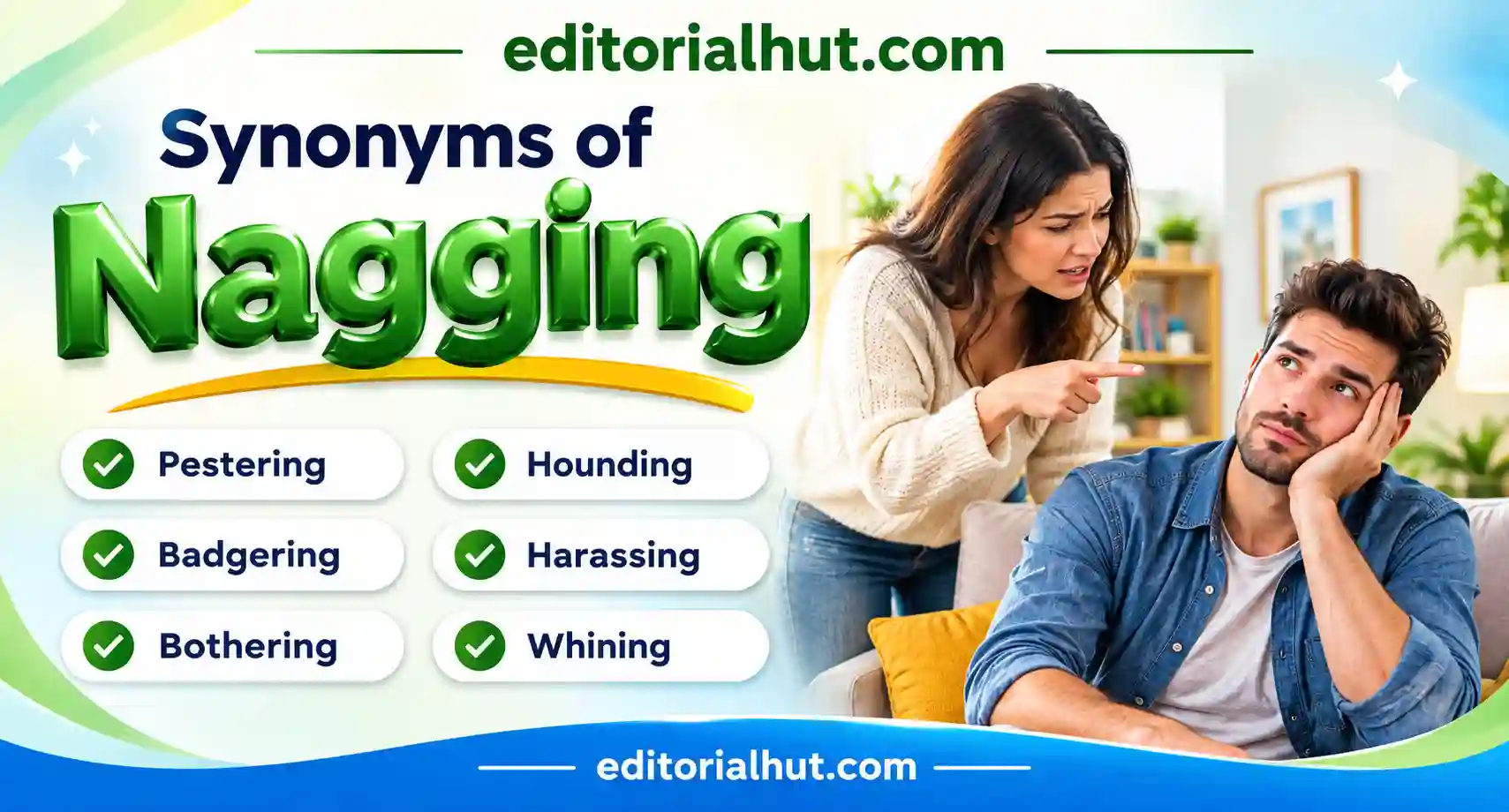
Finding the right synonyms for nagging can help you describe repeated complaints, constant reminders, or persistent pressure with greater accuracy. While nagging often suggests an irritating or negative tone, words such as pestering, badgering, hounding, and pressuring can express slightly different shades of meaning. The best choice depends on the situation, the speaker’s intention, and the level of persistence involved. Whether you are improving your vocabulary, writing more naturally, or searching for a softer or stronger alternative, understanding these related words can help you communicate your meaning clearly and effectively.
What Does “Synonyms for Nagging” Really Mean?
“Synonyms for nagging” means other words or phrases that describe repeatedly complaining, criticizing, reminding, or asking someone to do something in an annoying or persistent way.
The exact synonym depends on the situation and tone.
Simple meaning of “nagging”
Nagging describes behavior that continues again and again, especially when someone keeps telling another person what to do, complaining about something, or asking for the same thing.
Example:
She kept nagging him to clean his room.
This means she repeatedly told or reminded him to clean his room, and her repeated requests became annoying.
The key difference
Not every synonym of nagging has exactly the same meaning.
- Nagging → repeated annoying requests or complaints
- Pestering → repeatedly bothering someone
- Badgering → repeatedly pressuring someone
- Nitpicking → repeatedly criticizing tiny details
- Whining → complaining in an irritating manner
- Reminding → repeating information without necessarily being annoying
- Urging → strongly encouraging someone to act
Connotation
Connotation means the feeling, emotion, or idea that a word suggests beyond its basic dictionary meaning.
For “nagging,” the connotation is generally negative because it suggests that someone is being annoyingly persistent, repeatedly complaining, or constantly asking someone to do something.
Example:
- Reminding: “She reminded him to finish his homework.” → neutral
- Nagging: “She kept nagging him to finish his homework.” → negative, suggests irritation
Connotation of “Nagging”
- Negative: annoying, irritating, persistent
- Critical: constantly pointing out faults
- Pressuring: repeatedly pushing someone to act
- Frustrating: causing annoyance through repetition
Etymology of “Nagging”
Etymology means the history and origin of a word—where it came from and how its meaning developed over time.
The word “nagging” comes from the verb “nag.” English records show nag in the 19th century meaning to scold, irritate, or find fault with someone repeatedly. The exact earlier origin is uncertain, although some etymological sources connect it with older Scandinavian or Germanic words associated with gnawing or irritating.
Over time, nagging developed its modern meaning: repeatedly complaining, criticizing, reminding, or urging someone in an irritating way.
Simple example:
“His constant nagging about the chores became frustrating.”
Here, nagging describes repeated verbal pressure or complaints.
nagging (/ˈnæɡɪŋ/)
Part of Speech of “Nagging”
“Nagging” can function as both a verb form and an adjective, depending on how it is used.
- Verb: She is nagging her brother about his homework.
→ “Nagging” is the present participle of nag. - Adjective: He ignored her nagging voice.
→ “Nagging” describes something that is persistently annoying or irritating. - Noun (gerund): Constant nagging can damage a relationship.
→ “Nagging” refers to the act of repeatedly complaining or urging someone.
Base verb: nag
Present participle: nagging
Past tense: nagged
Syllables in “Nagging”
The word “nagging” has 2 syllables:
NAG • GING
- Syllable 1: nag — stressed
- Syllable 2: ging — unstressed
- Total: 2 syllables
- Stress pattern: NAG-ging
What Are the Best Synonyms for Nagging?
The best synonyms for nagging include pestering, badgering, harping, nitpicking, hounding, and needling. Each word describes repeated complaining, criticizing, or reminding in a slightly different way. Some, like persistent or gnawing, describe a nagging feeling instead of a nagging person, so the right choice depends on your context.
Nagging Synonyms at a Glance
| Synonym | Simple Meaning | Best Used For |
| Pestering | Bothering someone repeatedly | Everyday conversation |
| Badgering | Pressuring someone with repeated demands | Strong criticism |
| Harping | Repeating the same complaint | Casual and creative writing |
| Nitpicking | Focusing on small, unimportant faults | Reviews and feedback |
| Henpecking | Constantly criticizing a partner | Informal, humorous tone |
| Hounding | Following someone with constant requests | Journalism, storytelling |
| Needling | Making small, repeated jabs to annoy | Sibling or friendly teasing |
| Nudging | Gently pushing someone to act | Business, polite reminders |
| Griping | Complaining in a low-key way | Casual conversation |
| Grumbling | Complaining quietly or under one’s breath | Everyday speech |
| Chiding | Mildly scolding someone | Academic or workplace tone |
| Persistent | Continuing without stopping | Describing a feeling, not a person |
| Gnawing | A feeling that keeps bothering you | Nagging worry or doubt |
| Bothersome | Annoying or troublesome | General descriptions |
1. Pestering
Meaning: To bother someone again and again with requests or questions.
Examples: She kept pestering her brother to lend her the car keys. The toddler was pestering his mom for another cookie.
2. Badgering
Meaning: To pressure someone repeatedly and forcefully until they give in.
Examples: The reporters were badgering the mayor with the same question. Stop badgering me about the deadline; I already know.
3. Harping
Meaning: To keep talking about the same complaint or topic over and over.
Examples: He’s always harping on how messy my room is. Our coach keeps harping on the same defensive mistake.
4. Nitpicking
Meaning: To criticize small, unimportant details instead of the bigger picture.
Examples: My editor is nitpicking every comma in this article. Please stop nitpicking my outfit; it’s just a casual dinner.
Note: Nitpicking is a near-synonym. It focuses only on tiny faults, while nagging can involve bigger, repeated concerns too.
5. Henpecking
Meaning: To constantly criticize or control someone, often used about a spouse or partner. Examples: Friends joked that she was henpecking her husband about his diet. He complained that his wife was henpecking him over small chores.
Note: This word is informal and often used humorously, so it fits casual writing better than formal contexts.
6. Hounding
Meaning: To follow or pressure someone constantly, almost like chasing them.
Examples: Debt collectors were hounding him with daily phone calls. Fans hounded the singer for autographs outside the hotel.
7. Needling
Meaning: To repeatedly annoy someone with small comments or jabs.
Examples: His brother kept needling him about his grades. She needled her coworker with little jokes about his typos.
8. Prodding
Meaning: To push or urge someone to take action, sometimes repeatedly.
Examples: His teacher kept prodding him to turn in the assignment. She had to prod her roommate to clean the kitchen.
9. Harassing
Meaning: To bother or trouble someone in a persistent and often serious way.
Examples: The company was accused of harassing customers with endless calls. He felt he was being harassed by constant emails from the salesman.
Note: This word is stronger than nagging and often carries a serious, even legal, tone, so use it carefully.
10. Berating
Meaning: To criticize someone angrily and at length.
Examples: The manager berated the team for missing the deadline. She berated herself for forgetting the appointment.
11. Scolding
Meaning: To tell someone off, often for doing something wrong.
Examples: The teacher scolded the students for talking during the test. Mom scolded him for leaving the door unlocked.
12. Carping
Meaning: To complain about small things in an unpleasant way.
Examples: Critics were carping about minor flaws in the film. He’s always carping about the weather, even on sunny days.
13. Griping
Meaning: To complain in a mild, ongoing way, often about small annoyances.
Examples: Employees were griping about the slow office Wi-Fi. She griped about the long line at the coffee shop.
14. Grumbling
Meaning: To complain quietly, often while feeling annoyed.
Examples: He grumbled about doing the dishes again. The passengers grumbled when the flight was delayed.
15. Fussing
Meaning: To worry or complain about small, unimportant things.
Examples: Stop fussing over every little detail of the party. The baby was fussing because she was tired.
16. Criticizing
Meaning: To point out faults or mistakes, often repeatedly.
Examples: He felt his father was always criticizing his choices. She criticized the plan without offering any solutions.
Note: Criticizing is a broader, related word. It doesn’t always involve repetition the way nagging does.
17. Reproaching
Meaning: To express disapproval or disappointment toward someone.
Examples: She reproached him gently for missing the meeting. His coach reproached the team for a lack of effort.
18. Chiding
Meaning: To scold someone mildly, often in a caring way.
Examples: The nurse chided him for skipping his medication. Grandma chided us for staying up too late.
19. Bugging
Meaning: An informal word for bothering someone repeatedly.
Examples: Quit bugging me about my homework, I’ll finish it soon. My little sister keeps bugging me to play video games.
20. Nudging
Meaning: To gently encourage or remind someone to do something.
Examples: She kept nudging her friend to apply for the job. He nudged his coworker to submit the report on time.
Note: Nudging is milder and more positive than nagging. It suggests gentle encouragement rather than annoyance.
21. Lecturing
Meaning: To talk at length, often giving unwanted advice or warnings.
Examples: Dad started lecturing us about saving money again. Her manager lectured the team about being late.
22. Preaching
Meaning: To give repeated moral advice, often in an annoying way.
Examples: He’s always preaching about eating healthy. Stop preaching to me about exercise; I already go to the gym.
23. Harrying
Meaning: A slightly formal or literary word meaning to trouble someone constantly.
Examples: The knight was harried by enemy scouts throughout the journey. Reporters harried the politician with questions all afternoon.
24. Hectoring
Meaning: To talk to someone in a bossy, bullying way. Examples: The coach’s hectoring tone made the players nervous. He hectored his assistant until the report was finished.
25. Annoying
Meaning: Causing mild anger or irritation, often through repetition.
Examples: The dripping faucet was annoying everyone in the house. His constant tapping on the desk was annoying his coworkers.
26. Irritating
Meaning: Causing frustration or slight anger, often over time.
Examples: The scratchy tag on my shirt is irritating my neck. Her constant interruptions were irritating during the meeting.
27. Persistent
Meaning: Continuing firmly without stopping, often used to describe feelings or problems. Examples: He had a persistent cough that wouldn’t go away. She felt a persistent worry about the upcoming exam.
Note: This is a contextual alternative. It fits “nagging pain” or “nagging doubt” better than a nagging person.
28. Gnawing
Meaning: A feeling that keeps bothering you, like a small worry that won’t stop.
Examples: A gnawing feeling told her something was wrong. He couldn’t shake the gnawing doubt about his decision.
Note: Gnawing describes a nagging sensation or emotion, not a nagging person.
29. Lingering
Meaning: Staying longer than expected, often used for feelings or pain.
Examples: A lingering headache made it hard to focus. She felt a lingering sadness after the trip ended.
Note: This word matches “nagging pain” or “nagging memory,” so it works only in that specific sense.
30. Bothersome
Meaning: Causing trouble or annoyance, often repeatedly.
Examples: The bothersome fly kept landing on his sandwich. Her bothersome habit of interrupting made meetings longer.
How to Choose the Right Synonym for Nagging
Not all synonyms for nagging mean exactly the same thing. Some are stronger, some are gentler, and some only work in certain situations.
- Formal vs. informal: “Reproaching” fits a formal report, while “bugging” fits a text to a friend.
- Positive vs. negative: “Nudging” sounds encouraging, while “badgering” sounds harsh.
- Strong vs. weak: “Harassing” is intense, while “fussing” is mild.
- Academic writing often needs neutral, precise words like “persistent” or “reproaching.”
- Business writing benefits from softer words like “prodding” or “nudging.”
- Casual conversation works well with “bugging,” “griping,” or “nitpicking.”
- Creative writing can use vivid words like “hounding,” “gnawing,” or “harrying.”
- Social media content often uses short, relatable words like “annoying” or “bugging.”
Choosing the wrong synonym can change the tone of a sentence completely. Calling a coworker’s feedback “badgering” instead of “nudging,” for example, makes the situation sound much more negative than it may be.
Formal and Informal Synonyms for Nagging
| Formal Synonym | Informal Synonym | Example Context |
| Reproaching | Bugging | A manager reproaching an employee in a review vs. a friend bugging you to reply |
| Chiding | Griping | A teacher gently chiding a student vs. coworkers griping about deadlines |
| Berating | Grumbling | A coach berating the team after a loss vs. grumbling about the weather |
| Hectoring | Nitpicking | A boss hectoring staff about numbers vs. nitpicking small typos |
| Lecturing | Nudging | A parent lecturing about safety vs. nudging a friend to hurry |
Best Synonyms for Different Contexts
Academic Writing Persistent, Reproaching, Chiding, Berating, Hectoring — these words sound precise and controlled, which fits research papers, essays, and formal reports.
Blog Writing Pestering, Nitpicking, Bugging, Grumbling, Annoying — these keep a friendly, conversational tone that readers enjoy scrolling through.
Business Writing Prodding, Reproaching, Lecturing, Persistent, Nudging — these sound professional while still describing repeated pressure or reminders.
Everyday Conversation Griping, Nudging, Fussing, Annoying, Irritating — these are natural, common words people use with friends and family.
Creative Writing Gnawing, Lingering, Hounding, Harrying, Needling — these add vivid detail and emotion to stories, poems, and descriptions.
Common Mistakes When Using Synonyms
- Choosing a word with the wrong meaning. “Gnawing” works for a feeling, not for a person who keeps reminding you of something.
- Using a formal word in casual speech. Saying “My mom keeps hectoring me” sounds odd in a text to a friend.
- Replacing a word without checking context. “Harassing” is far too strong to describe a parent’s gentle reminder.
- Changing the tone by accident. Swapping “nudging” for “badgering” turns a helpful reminder into a harsh criticism.
- Repeating the same synonym too often in SEO content. Overusing one word, even a synonym, can make writing sound robotic instead of natural.
Synonyms vs. Related Words
- True synonyms share almost the same meaning. “Pestering” and “badgering” both describe repeated bothering.
- Near-synonyms are close but slightly different. “Nitpicking” focuses only on small details, while nagging can be broader.
- Related words connect to the idea but aren’t direct replacements. “Criticizing” and “complaining” relate to nagging but don’t always involve repetition.
- Contextual alternatives only work in specific situations. “Gnawing” and “lingering” fit a nagging feeling, not a nagging person.
How to Use Synonyms in Your Writing
Synonyms make writing feel fresh instead of repetitive. An essays, they help you avoid repeating the same word in every paragraph. A blog posts, they keep readers interested. In emails, choosing the right synonym can soften or strengthen your message. The website content, varied vocabulary improves readability. The social media posts, short, punchy synonyms grab attention quickly. In stories, vivid words like “hounding” or “gnawing” add emotion. In school assignments, synonyms show a stronger vocabulary range.
The goal is always clarity first. Synonyms should make your writing easier to understand, not more confusing.
Practice Using These Synonyms
1. Fill in the blank: My little brother keeps , me about borrowing my headphones. (pestering / lingering)
2. Choose the best synonym: Which word best replaces “nagging” in “She had a nagging feeling something was wrong”? a) Badgering b) Gnawing c) Bugging
3. Rewrite the sentence: “He kept nagging his sister to clean her room.” Rewrite using a different synonym.
4. Pick the formal word: Which word fits a formal workplace report , “griping” or “reproaching”?
5. Pick the informal word: Which word fits a casual text to a friend , “hectoring” or “bugging”?
Answer Key:
- Pestering
- b) Gnawing
- Example: “He kept prodding his sister to clean her room.”
- Reproaching
- Bugging
Frequently Asked Questions About Synonyms for Nagging
What is another word for nagging?
Common alternatives include pestering, badgering, and harping. Each describes repeated bothering, though the strength and tone vary slightly between words.
What is the best synonym for nagging?
“Pestering” is one of the most versatile choices since it works in both casual and semi-formal writing. For a nagging feeling instead of a person, “persistent” is often the best fit.
Which synonym is best for formal writing?
“Reproaching” or “chiding” work well in formal contexts, such as academic essays or workplace reports, because they sound controlled and professional rather than harsh.
Which synonym is best for everyday conversation?
“Bugging,” “griping,” and “nitpicking” are common, natural choices for casual conversations with friends or family.
Can I use these synonyms in academic writing?
Yes, but choose carefully. Words like “persistent,” “reproaching,” and “chiding” fit academic tone, while informal words like “bugging” or “henpecking” should be avoided.
Are all synonyms exactly the same?
No. Some are true synonyms, some are near-synonyms, and some only fit specific contexts, like a nagging pain versus a nagging person. Always check the meaning before swapping words.
How can I learn synonyms easily?
Reading example sentences, keeping a small vocabulary notebook, and practicing with real sentences all help synonyms stick in memory faster than memorizing lists alone.
How can synonyms improve my writing?
Synonyms add variety, prevent repetition, and help match the right tone for each piece of writing, whether it’s a formal report or a casual message.
Conclusion
Learning synonyms for nagging can make your writing clearer and more interesting. Whether you’re working on an essay, a blog post, an email, or just chatting with friends, the right word choice makes a real difference in tone and meaning. Try using a few of these synonyms in your next school assignment, message, or piece of content. With a little practice, your vocabulary , and your writing , will keep growing stronger every day.

Shahid Imran is an English language and vocabulary specialist at EditorialHut.com, focusing on synonyms, word meanings, alternative words, and practical example sentences. He helps readers discover better words, expand their vocabulary, and communicate more clearly and confidently.