









When you need synonyms for literally, the best replacement depends on what you mean. In its traditional sense, it literally means that something is true in an exact, non-figurative way. For example, “She literally walked ten miles” means she actually walked ten miles. In everyday speech, however, literally is also often used as an intensifier, as in “I literally couldn’t stop laughing.”
That difference matters because words such as actually, exactly, genuinely, truly, really, word-for-word, and verbatim are not interchangeable in every sentence. Some emphasize factual truth, while others describe exact wording or strengthen an emotional statement.
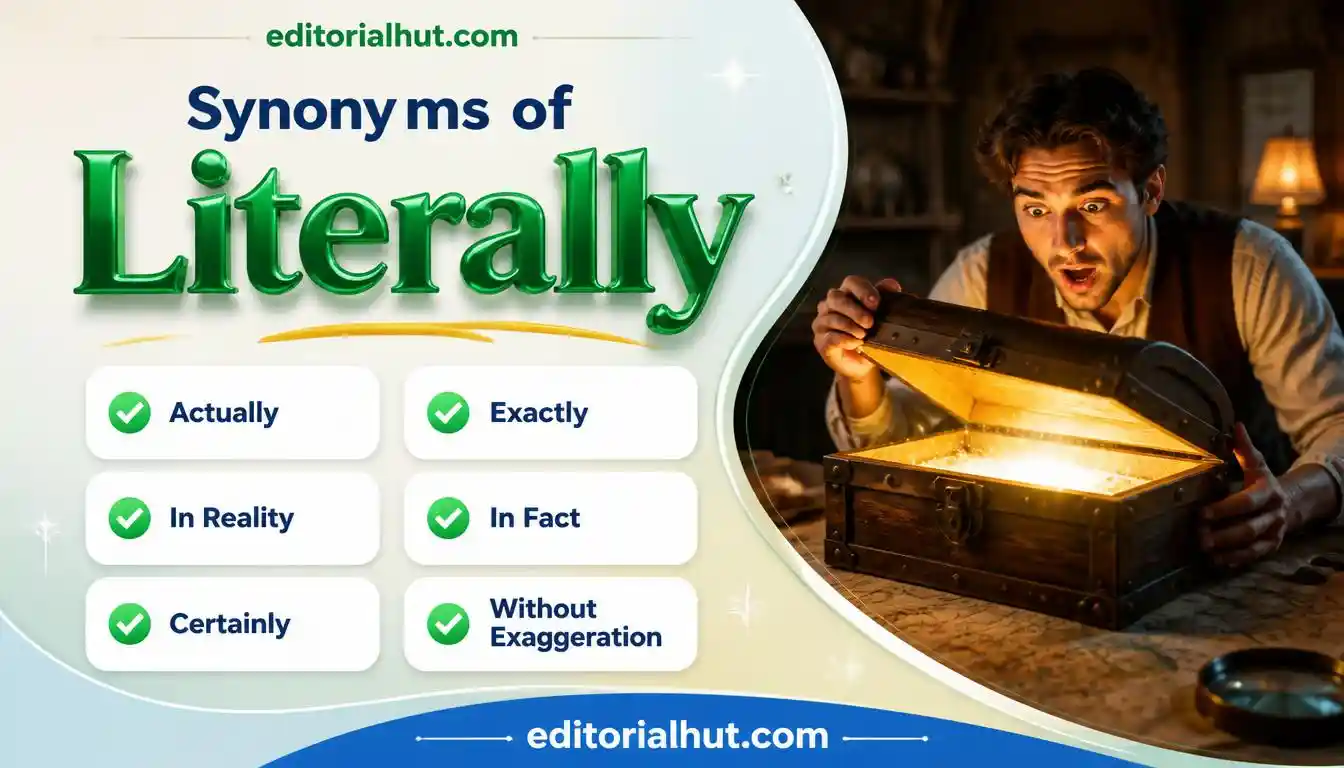
Quick Answer: What Are the Best Synonyms for Literally?
The closest alternative depends on context:
- Actually — emphasizes that something is genuinely true.
- In fact — reinforces a factual statement.
- Exactly — emphasizes precise accuracy.
- Precisely — stresses exactness or correctness.
- Really — common in casual speech, especially as an intensifier.
- Truly — emphasizes sincerity or genuine truth.
- Genuinely — emphasizes that something is real or sincere.
- Word-for-word — means using exactly the same words.
- Verbatim — means exactly as spoken or written.
- In the literal sense — useful when you want to remove ambiguity.
The important point is that literally has two modern uses: its traditional literal meaning and its increasingly common emphatic use.
Core Synonym Resource
| Alternative | Meaning | Relationship to “literally” | Tone | Best Use |
| Actually | In reality; truly | Near-synonym | Neutral | Factual statements |
| In fact | As a matter of fact | Contextual alternative | Neutral/formal | Clarifying facts |
| Exactly | In a precise or complete way | Near-synonym | Neutral | Accuracy |
| Precisely | Exactly; with precision | Near-synonym | Formal | Precise writing |
| Really | In reality; genuinely; very | Context-dependent | Casual/neutral | Conversation |
| Truly | Genuinely; sincerely | Near-synonym | Neutral/formal | Emphasis or sincerity |
| Genuinely | Truly; sincerely | Contextual alternative | Neutral | Authenticity |
| Word-for-word | Using the exact words | Meaning-specific | Neutral | Repetition or translation |
| Verbatim | Exactly as originally spoken/written | Meaning-specific | Formal | Quotes and records |
| In the literal sense | In the non-figurative sense | Phrase alternative | Formal | Clarifying meaning |
What Does “Literally” Really Mean?
Literally is an adverb meaning in the exact or original sense of a word or statement, without metaphor, exaggeration, or figurative interpretation.
For example:
The bottle literally broke into three pieces.
Here, the statement is intended to be understood exactly as stated.
The word can also emphasize that something really happened:
He literally ran from the building.
In informal modern English, literally can also be used for emphasis even when the statement is figurative:
I literally died laughing.
The speaker normally does not mean that they physically died. Here, literally functions as an intensifier rather than its traditional non-figurative meaning.
This second use is common in informal English, but it can be controversial in formal writing because some readers may consider it imprecise.
Connotative Meaning of “Literally”
The basic meaning of literally is relatively neutral. Its connotation depends strongly on how it is used.
In its traditional sense, it can suggest precision, factual accuracy, and a desire to distinguish reality from figurative language.
For example:
The warning was literally written on the door.
In casual speech, the word can add emphasis, surprise, excitement, frustration, or exaggeration:
I literally had no idea what was happening.
When used as an intensifier, literally can make a sentence sound energetic and conversational. In formal writing, however, it is usually better to use a more precise word when one is available.
Closest Synonyms for Literally
Actually
Actually is one of the most useful alternatives when it literally means “in reality” or “in fact.”
She literally lives next door.
can become:
She actually lives next door.
The two sentences are close, but actually focus more directly on the truth of the statement.
Exactly
Exactly works when the intended meaning involves precision.
That is literally what he said.
Depending on context, this could become:
That is exactly what he said.
Here, exactly makes the idea of precise wording especially clear.
Precisely
Precisely is a more formal alternative to exactly.
The problem is literally the same one we discussed yesterday.
A more formal version could be:
The problem is precisely the same one we discussed yesterday.
Precisely is particularly useful in academic, technical, professional, and analytical writing.
In Fact
In fact is a phrase rather than a single-word synonym, but it can replace literally when the goal is to emphasize factual reality.
He literally completed the project in two days.
Depending on the intended meaning:
In fact, he completed the project in two days.
The second sentence gives the statement a more factual, explanatory feel.
Formal Alternatives to Literally
For formal or academic writing, choose the replacement according to the specific meaning.
Useful options include:
- actually
- in fact
- precisely
- exactly
- in the literal sense
- strictly speaking
These are not identical, so context matters.
For example:
The phrase is literally translated as “a house of books.”
A more precise academic version might be:
The phrase is translated literally as “a house of books.”
Or:
In the literal sense, the phrase means “a house of books.”
When precision matters, in the literal sense can be especially useful because it clearly tells the reader how the word is being interpreted.
Casual Alternatives to Literally
In everyday conversation, people often use literally as an intensifier. In those situations, possible alternatives include:
- really
- actually
- seriously
- truly
- honestly
- genuinely
For example:
I literally couldn’t believe it.
Depending on the speaker’s intended tone:
I really couldn’t believe it.
or:
I honestly couldn’t believe it.
These alternatives may sound more natural in some conversational situations.
However, seriously, honestly, and really do not always preserve the exact meaning of literally. They often change the emphasis rather than simply replacing the word.
Alternatives When Literally Means “Exactly”
When literally refers to exact wording or an exact reproduction, more specific alternatives are usually better.
Word-for-word
Use word-for-word when something is repeated or translated using the same words.
She translated the sentence literally.
Depending on context:
She translated the sentence word-for-word.
This emphasizes the method of translation.
Verbatim
Verbatim means exactly as spoken or written, without changing the wording.
The reporter quoted him literally.
If the intended meaning is exact quotation:
The reporter quoted him verbatim.
Verbatim is particularly useful for interviews, transcripts, legal records, reports, and quotations.
Alternatives for Emphasis
When literally is being used informally to intensify a statement rather than describe something literally true, these alternatives may work:
- really
- truly
- seriously
- genuinely
- honestly
- actually
Consider:
I literally couldn’t sleep last night.
Possible alternatives include:
I really couldn’t sleep last night.
I genuinely couldn’t sleep last night.
I honestly couldn’t sleep last night.
The best choice depends on whether you want emphasis, sincerity, or factual confirmation.
Stronger or More Precise Alternatives
If your goal is to make writing more precise rather than more dramatic, choose words based on the exact idea.
For factual emphasis:
actually, in fact, genuinely
For precision:
exactly, precisely
For exact wording:
word-for-word, verbatim
For non-figurative meaning:
in the literal sense
This approach is more useful than simply replacing literally with the same synonym everywhere.
Literally vs Actually
These words overlap, but they answer slightly different questions.
| Word | Main idea | Typical use |
| Literally | In the exact, non-figurative sense | Clarifying literal meaning |
| Actually | In reality; in truth | Confirming or correcting a fact |
Compare:
The temperature literally reached 40°C.
This emphasizes that the stated temperature was real.
The temperature actually reached 40°C.
This can emphasize that the fact was surprising or contrary to expectation.
Actually is often the better choice when you are correcting an assumption.
Literally vs Really
Really is broader and more conversational.
I literally love this song.
In casual speech, the speaker may simply mean:
I really love this song.
But really does not specifically communicate the traditional meaning of literally. It is mainly an intensifier here.
Use literally when exact, non-figurative meaning matters. Use really when you simply want natural conversational emphasis.
Literally vs Exactly
Literally and exactly can overlap, but they are not interchangeable in every situation.
Literally contrasts literal meaning with figurative meaning.
Exactly emphasizes accuracy, agreement, or precision.
For example:
He literally said, “I am leaving.”
means the words were actually spoken.
He said exactly, “I am leaving.”
sounds less natural in ordinary English, although exactly can work in contexts emphasizing precise wording.
A natural alternative is:
He said those exact words.
Literally vs Precisely
Precisely is often more formal than literally when the intended meaning is exactness.
That is literally the problem.
That is precisely the problem.
The second sentence is usually more polished in formal or analytical writing.
However, precisely does not automatically mean “not figuratively.” It primarily communicates exactness.
Literally vs Figuratively
These words are opposites in an important sense.
Literally means the words should be understood in their actual or non-figurative sense.
Figuratively signals that the words are being used metaphorically or non-literally.
Compare:
She literally broke the glass.
She physically broke it.
She figuratively broke the glass ceiling.
The second statement uses broke metaphorically to describe overcoming a barrier.
Sentence Transformations
Factual Meaning
Original:
He literally climbed to the top of the mountain.
Alternative:
He actually climbed to the top of the mountain.
Nuance:
Actually emphasizes that the event genuinely happened.
Exact Wording
Original:
The translator rendered the phrase literally.
Alternative:
The translator rendered the phrase word-for-word.
Nuance:
Word-for-word focuses specifically on reproducing the original wording.
Formal Precision
Original:
This is literally the same issue.
Alternative:
This is precisely the same issue.
Nuance:
Precisely gives the sentence a more formal and analytical tone.
Exact Quotation
Original:
The witness repeated the statement literally.
Alternative:
The witness repeated the statement verbatim.
Nuance:
Verbatim clearly communicates that the wording was reproduced exactly.
Best Word by Situation
| If you want to sound… | Consider… |
| More factual | actually |
| More formal | precisely |
| More precise | exactly |
| More academic | in fact / precisely |
| More conversational | really |
| More sincere | genuinely / truly |
| Clear about non-figurative meaning | in the literal sense |
| Clear about exact wording | word-for-word / verbatim |
| Strongly emphatic | really / seriously |
Collocations and Natural Phrases With Literally
Some common patterns include:
- literally mean
- literally translated
- literally speaking
- literally true
- take something literally
- interpret something literally
- literally happened
- literally impossible
- literally thousands
- literally overnight
A particularly important expression is take literally.
Don’t take the comment literally.
This means that the speaker does not intend the words to be understood in their strict, literal sense.
Another useful expression is literally speaking, which signals that the speaker is focusing on the exact meaning of the words.
Common Mistakes With Literally
Using Literally When You Mean Figuratively
A common issue is:
I literally exploded with anger.
Unless the speaker physically exploded, this is figurative language.
In casual speech, such usage is common as an intensifier, but it can create ambiguity. In formal writing, consider:
I was extremely angry.
Treating Every Alternative as an Exact Synonym
Actually, really, exactly, precisely, and verbatim have different functions.
For example, verbatim cannot normally replace literally simply because both can involve exactness. Verbatim specifically concerns reproducing words exactly.
Overusing Literally for Emphasis
Repeatedly using literally as an intensifier can make writing sound exaggerated or informal.
Instead of:
The meeting was literally incredibly long.
a clearer sentence might be:
The meeting was exceptionally long.
Confusing Literally With Exactly
Literally concerns literal meaning, while exactly primarily concerns precision.
They can overlap, but they are not interchangeable in every sentence.
Antonyms of Literally
The most direct conceptual opposite of literally is figuratively when discussing how language should be interpreted.
Other contextual opposites may include:
- metaphorically
- symbolically
- approximately — when contrasting exactness
- loosely — when describing non-exact wording
These are not universal antonyms. The correct opposite depends on which sense of literally is being used.
Word Formation of Literally
Literally is formed from the adjective literal plus the adverb-forming suffix -ly.
A simple modern English formation pattern is:
literal + -ly → literally
The adjective literal ultimately traces back to Latin litteralis, meaning “of letters” or “literal,” from littera, meaning “letter.”
Affixation Pattern of Literally
The useful modern pattern is:
literal + -ly
Here:
- literal = base adjective
- -ly = suffix that forms an adverb
The deeper historical development of literal is more complex because the adjective entered English through historical borrowing and developed from Latin roots.
Syllables in Literally
lit-er-al-ly — 4 syllables
The word is commonly pronounced with four syllables in both American and British English.
Pronunciation of Literally
US IPA: /ˈlɪt̬ərəli/
UK IPA: /ˈlɪtərəli/
The American pronunciation may use a flap sound for the t in the middle of the word, while the British pronunciation generally retains a clearer /t/.
Etymology of Literally
Literally comes from literal, which entered English through French from Latin litteralis, meaning “of letters” or “relating to letters.”
The Latin noun littera meant “letter.” Over time, the idea of something relating directly to the letters or words themselves developed into the modern concept of literal meaning something expressed according to its exact or primary sense.
The adverb literally was then formed from literal with -ly.
Short History of Literally
The historical idea behind literally is closely connected with interpreting words according to their direct meaning rather than a figurative one.
For centuries, the word has been used to distinguish literal interpretation from metaphorical interpretation. In modern informal English, however, literally has also developed a widely recognized emphatic use in which speakers use it to strengthen an expression, even when the statement is not literally true.
This dual use is why the word can sometimes create disagreement about whether a sentence should be interpreted strictly or rhetorically.
How to Choose the Right Alternative
When replacing literally, first ask what you actually mean.
If you mean “in reality,” choose actually or in fact.
If you mean “with exact precision,” choose exactly or precisely.
If you mean “using the same words,” choose word-for-word or verbatim.
If you mean “genuinely or sincerely,” choose truly or genuinely.
If literally is simply being used as a casual intensifier, really may be the most natural replacement.
If you need to make clear that something is not metaphorical, in the literal sense is often the clearest choice.
Frequently Asked Questions
What is the closest synonym for literally?
Actually is often the closest general alternative when literally means “in reality.” However, exactly or precisely may be better when the intended meaning is exactness.
What is another word for literally?
Depending on context, another word for literally can be actually, exactly, precisely, truly, genuinely, or really. For exact wording, verbatim or word-for-word may be more accurate.
What is a formal synonym for literally?
Precisely, in fact, and in the literal sense can work in formal writing, depending on the sentence. There is no single formal replacement that works in every context.
What is a simpler alternative to literally?
Actually is often a simple and natural alternative when you mean “in reality.” Really is also common in everyday conversation when literally is being used for emphasis.
What is a stronger word than literally?
There is not one universally stronger synonym. For emphasis, really, truly, or seriously may work conversationally. For precision, exactly or precisely is more appropriate.
Can actually replace literally?
Sometimes. Actually works when literally means that something is genuinely or factually true. It does not replace literally when the word refers specifically to non-figurative interpretation or exact wording.
Is really a synonym for literally?
Really can function as a contextual alternative when literally is being used as an informal intensifier. It is not an exact synonym because really has a broader range of meanings.
What is the difference between literally and figuratively?
Literally indicates that words are being used in their direct, non-figurative sense. Figuratively indicates that the expression should be understood metaphorically or symbolically.
What is the difference between literally and exactly?
Literally emphasizes literal or non-figurative meaning, while exactly emphasizes accuracy or precision. They overlap in some contexts but cannot always replace each other.
What is the opposite of literally?
Figuratively is the clearest opposite when discussing literal versus non-literal language. Metaphorically can serve a similar role in many contexts.
Final Takeaway
The best synonyms for literally depend on the job the word is doing. Use actually when you mean “in reality,” exactly or precisely when you mean “with accuracy,” and verbatim or word-for-word when you mean that wording was reproduced exactly. For casual emphasis, really, truly, or genuinely may sound more natural.

Shahid Imran is an English language and vocabulary specialist at EditorialHut.com, focusing on synonyms, word meanings, alternative words, and practical example sentences. He helps readers discover better words, expand their vocabulary, and communicate more clearly and confidently.