









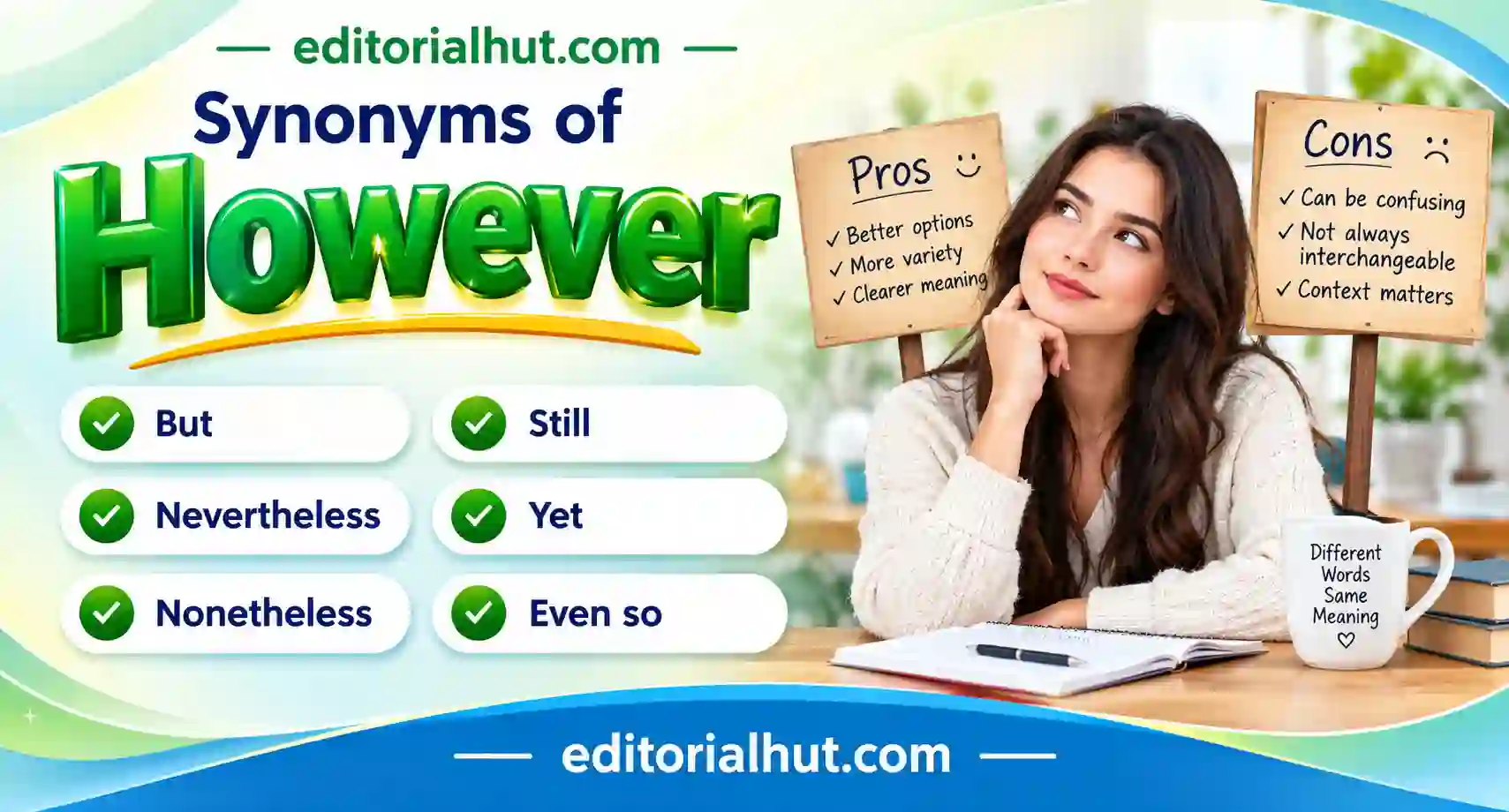
Looking for the right synonyms for however can make your writing clearer, smoother, and more expressive. Although “however” is commonly used to introduce a contrast, different alternatives can add slightly different meanings, tones, and levels of formality. Words such as but, nevertheless, nonetheless, still, yet, and even so may work in certain situations, but they are not always interchangeable. Understanding these differences can help you choose the most natural word for an email, essay, conversation, academic paper, or everyday sentence. In this guide, you’ll discover useful synonyms for however, their meanings, examples, connotations, pronunciation, syllables, parts of speech, and the situations where each alternative works best.
“Synonyms for however” means other words or phrases you can use instead of “however”, depending on the sentence and meaning.
What does “however” really mean?
However, it usually means “but,” “nevertheless,” or “despite that.” It introduces a contrast between two ideas.
Example:
I wanted to go outside. However, it started raining.
Here, however, shows that the second idea contrasts with the first.
Common synonyms for “however”
- But — introduces a simple contrast
I was tired, but I finished my work. - Nevertheless — means despite what was just mentioned
The task was difficult. Nevertheless, she completed it. - Nonetheless — very similar to nevertheless
It was expensive. Nonetheless, we bought it. - Still — shows that something remains true despite another fact
It was raining. Still, we went for a walk. - Yet — introduces an unexpected contrast
He is young, yet he is very experienced. - Even so — means despite that
The weather was cold. Even so, they stayed outside. - On the other hand — presents a contrasting point or perspective
The apartment is small. On the other hand, it is very affordable.
The important point
Not every synonym works in every sentence. “However” is mainly a contrast word, so the best replacement depends on whether you want a simple “but,” a formal contrast, or an “despite that” meaning.
Sure. Here are the terms explained in simple English, using “however” as the example.
1. Connotative Meaning
Connotative meaning is the feeling, idea, or association a word suggests beyond its basic dictionary meaning.
For however, the connotation is usually contrast, disagreement, limitation, or an unexpected difference.
Example:
I wanted to buy the car. However, it was too expensive.
Here, however, creates a feeling of “this is true, but there is another problem.”
2. Etymology
Etymology means the history and origin of a word—where it came from and how its meaning or form developed.
However, it comes from the combination of “how” + “ever.” It developed in English as a word used to express ideas such as “in whatever way” and later became widely used as a contrastive connector, similar to “but” or “nevertheless.”
3. Part of Speech
Part of speech tells us what grammatical role a word plays in a sentence.
However can function mainly as an adverb, especially a conjunctive adverb when it connects contrasting ideas.
Example:
She studied hard. However, she did not pass the exam.
Here, however, connects two contrasting statements.
It can also mean “in whatever way”:
However you solve the problem, show your work.
In this use, it means “in whatever way.”
4. Pronunciation
Pronunciation means how a word is spoken aloud.
For however, the main pronunciation is:
/haʊˈɛvər/
The stress is usually on the second syllable.
however (/haʊˈɛvər/)
5. Syllables
A syllable is one beat or sound unit in a spoken word.
However has three syllables:
how – ev – er
So:
- Syllable count: 3
- First: how
- Second: ev
- Third: er
- Stressed syllable: usually the second syllable
What Are the Best Synonyms for However?
The best synonyms for however include but, yet, nevertheless, nonetheless, still, though, on the other hand, in contrast, despite this, and notwithstanding. Each word shows a contrast between two ideas, but some are more formal, while others fit casual speech. Choosing the right one depends on your tone and writing style.
However Synonyms at a Glance
| Synonym | Simple Meaning | Best Used For |
| But | Shows a simple contrast | Everyday writing and speech |
| Yet | Shows surprise despite something | Casual and creative writing |
| Nevertheless | Despite what was just said | Formal and academic writing |
| Nonetheless | Despite what was just said | Formal and business writing |
| Still | Even so, in spite of that | Conversation and informal writing |
| Though | Shows a mild contrast | Casual speech and blog posts |
| On the other hand | Presents an opposite view | Comparisons and essays |
| In contrast | Highlights a clear difference | Academic and business writing |
| Despite this | Shows something happened anyway | Formal and semi-formal writing |
| Notwithstanding | In spite of that fact | Legal and academic writing |
| Regardless | No matter what happened | Business and everyday writing |
| That said | Shifts to a different point | Conversation and blog writing |
1. But
Meaning: A short, simple word that shows a contrast between two ideas.
Examples:
- I wanted pizza, but my friend wanted tacos.
- She studied hard, but the test was still difficult.
2. Yet
Meaning: Shows a surprising contrast, often stronger than “but.”
Examples:
- The plan was risky, yet it worked perfectly.
- He was exhausted, yet he kept running.
3. Nevertheless
Meaning: A formal word meaning “despite what was just said.”
Examples:
- The weather was terrible; nevertheless, the game continued.
- Sales dropped last quarter; nevertheless, the company stayed profitable.
4. Nonetheless
Meaning: Very similar to nevertheless, used to show a fact remains true despite something else.
Examples:
- The hike was long and tiring; nonetheless, the view was worth it.
- Critics disliked the film; nonetheless, it earned a huge audience.
5. Still
Meaning: A simple, informal way to say something remains true despite a contrast.
Examples:
- It was raining, but we still went outside.
- She made a mistake, but she is still a great teacher.
6. Though
Meaning: A casual word that softens a contrast, often placed at the end of a sentence.
Examples:
- The movie was long. It was interesting, though.
- I don’t like coffee. I’ll try it, though.
7. Although
Meaning: A near-synonym used to connect two contrasting ideas within one sentence, rather than starting a new sentence like “however.” It is a conjunction, not a transition word.
Examples:
- Although it was raining, we went for a walk.
- She passed the exam, although she barely studied.
8. Even So
Meaning: Means “despite that,” used to show a fact stays true anyway.
Examples:
- The road was closed. Even so, we found a way home.
- He apologized. Even so, she stayed upset.
9. That Said
Meaning: A conversational phrase used to add a contrasting point after agreeing with something.
Examples:
- The restaurant is pricey. That said, the food is excellent.
- I respect his opinion. That said, I disagree with him.
10. That Being said
Meaning: A slightly more formal version of “that said,” used the same way.
Examples:
- The project is behind schedule. That being said, the quality is impressive.
- Traffic was awful today. That being said, we still arrived on time.
11. On the Other Hand
Meaning: Introduces an opposite idea or a different point of view.
Examples:
- I love the beach. On the other hand, my sister prefers the mountains.
- The job pays well. On the other hand, the hours are long.
12. Conversely
Meaning: A formal word meaning “in an opposite way.”
Examples:
- Prices rose sharply in the city. Conversely, rural prices stayed flat.
- He performs well under pressure. Conversely, his teammate struggles in big moments.
13. In Contrast
Meaning: Points out a clear difference between two things.
Examples:
- The first chapter was slow. In contrast, the second was thrilling.
- My brother loves spicy food. In contrast, I can barely handle mild salsa.
14. Despite This
Meaning: Shows that something happened even though a problem existed.
Examples:
- The team lost their best player. Despite this, they won the match.
- Funding was cut. Despite this, the program continued successfully.
15. In Spite of This
Meaning: Very close to “despite this,” slightly more formal in tone.
Examples:
- The instructions were confusing. In spite of this, most students finished the task.
- The economy slowed down. In spite of this, the company kept hiring.
16. Notwithstanding
Meaning: A formal word meaning “in spite of” something, often used in legal or academic writing.
Examples:
- Notwithstanding the risks, the investors approved the deal.
- The committee, notwithstanding its concerns, approved the new policy.
17. Regardless
Meaning: Means “no matter what,” showing something is unaffected by other facts.
Examples:
- Regardless of the weather, the wedding will happen outdoors.
- She stayed calm, regardless of the chaos around her.
18. All the Same
Meaning: An informal phrase meaning “despite that” or “even so.”
Examples:
- I know you’re busy. Thanks all the same for trying.
- The plan was risky. All the same, we decided to try it.
19. Be That as It May
Meaning: A somewhat formal, slightly old-fashioned phrase meaning “even if that is true.”
Examples:
- Be that as it may, we still need to finish the report.
- Be that as it may, the rules apply to everyone equally.
20. On the Contrary
Meaning: Used to strongly disagree with or reject a previous statement, stronger than a simple contrast.
Examples:
- Some thought the plan would fail. On the contrary, it succeeded brilliantly.
- I’m not upset. On the contrary, I’m thrilled about the news.
21. Alternatively
Meaning: A near-synonym that introduces a different option, rather than a direct contrast.
Examples:
- You can take the bus. Alternatively, you could walk if it’s nice out.
- We could meet on Monday. Alternatively, Tuesday might work better.
22. Whereas
Meaning: A conjunction used to directly compare two contrasting facts within one sentence.
Examples:
- My sister loves cats, whereas I prefer dogs.
- The old model was slow, whereas the new one is fast.
23. While
Meaning: A conjunction similar to “whereas,” often used in everyday speech to show contrast.
Examples:
- While I understand your point, I still disagree.
- She enjoys hiking, while her husband prefers relaxing at home.
24. Admittedly
Meaning: Used to acknowledge a point before offering a contrasting idea.
Examples:
- Admittedly, the plan has flaws, but it’s our best option.
- Admittedly, I was late, but traffic was terrible.
25. Just the Same
Meaning: An informal phrase meaning “even so” or “despite that.”
Examples:
- I didn’t need the help. Thanks just the same.
- The trip was tiring. Just the same, it was worth it.
26. At the Same Time
Meaning: Shows two contrasting ideas can both be true together.
Examples:
- I want to travel more. At the same time, I need to save money.
- He is confident. At the same time, he stays humble.
27. In Any Event
Meaning: Means “regardless of what happens,” used to move past a contrast.
Examples:
- The forecast looks bad. In any event, we’ll continue with the picnic.
- Plans might change. In any event, please arrive by nine.
28. Having Said That
Meaning: A conversational phrase used to introduce a contrasting thought, similar to “that said.”
Examples:
- The hotel was noisy. Having said that, the staff were wonderful.
- I understand the risk. Having said that, I want to try it.
29. For All That
Meaning: A slightly literary phrase meaning “despite everything mentioned.”
Examples:
- The book was long and slow. For all that, it taught me a lot.
- He made mistakes early on. For all that, he became a great leader.
30. Even Though
Meaning: A conjunction that joins two contrasting ideas in one sentence, similar in meaning to “although.”
Examples:
- Even though it was cold, the kids played outside.
- She smiled, even though she was nervous.
How to Choose the Right Synonym for However
Not every synonym for however means exactly the same thing. Some words are stronger, some are softer, and some fit only certain situations.
Here are a few things to think about:
- Formal vs. informal: “Notwithstanding” fits a legal document, while “still” fits a text message.
- Positive vs. negative: “On the contrary” often signals disagreement, while “that said” often softens a point.
- Strong vs. weak: “On the contrary” is stronger than “though,” which feels light and casual.
- Academic writing: Words like “nevertheless” and “notwithstanding” sound polished and precise.
- Business writing: “Nonetheless” and “regardless” sound clear and professional.
- Casual conversation: “Still,” “though,” and “even so” feel natural when speaking.
- Creative writing: “Yet,” “all the same,” and “for all that” can add rhythm and style.
- Social media content: Short words like “but” or “still” keep posts easy to read.
For example, saying “Notwithstanding the delay, we finished on time” in a text message to a friend would sound stiff. But in a business report, it works well.
Formal and Informal Synonyms for However
| Formal Synonym | Informal Synonym | Example Context |
| Nevertheless | But | Explaining a decision despite a setback |
| Notwithstanding | Even so | Describing an exception to a rule |
| Conversely | On the other hand | Comparing two casual choices |
| Whereas | While | Contrasting two everyday facts |
| That being said | That said | Softening an opinion in conversation |
Best Synonyms for Different Contexts
Academic Writing Nevertheless, nonetheless, notwithstanding, conversely, and whereas work well in essays and research papers because they sound precise and formal.
Blog Writing But, on the other hand, still, that said, and in contrast keep blog posts friendly and easy to read while still showing contrast clearly.
Business Writing Nevertheless, nonetheless, regardless, that being said, and in contrast sound professional and confident in emails, reports, and proposals.
Everyday Conversation But, still, though, even so, and just the same feel natural when speaking with friends, family, or coworkers.
Creative Writing Yet, all the same, for all that, despite this, and even so add variety and a touch of style to stories and poems.
Common Mistakes When Using Synonyms
- Choosing a word with the wrong meaning. “Alternatively” suggests an option, not a direct contrast like “however.”
- Using a formal word in casual speech. Saying “notwithstanding” in a text message can sound odd or overly stiff.
- Replacing a word without checking the sentence structure. “Although” and “though” often need to sit inside a sentence, unlike “however.”
- Using a synonym that changes the tone. “On the contrary” can sound argumentative when a softer word was meant.
- Repeating the same synonym too often in SEO content. Overusing “nevertheless” can feel just as repetitive as overusing “however.”
Synonyms vs. Related Words
It helps to understand the difference between these categories:
- True synonyms share almost the exact same meaning, such as “nevertheless” and “nonetheless.”
- Near-synonyms are close in meaning but not identical, such as “although,” which works as a conjunction rather than a standalone transition word.
- Related words connect to the same idea but serve a slightly different purpose, such as “alternatively,” which introduces an option instead of a contrast.
- Contextual alternatives only work well in certain situations, such as “notwithstanding,” which fits formal or legal writing better than casual chat.
How to Use Synonyms in Your Writing
Synonyms for however can make many types of writing feel more natural:
- Essays: Varying your transition words keeps academic writing engaging.
- Blog posts: Fresh words help readers stay interested.
- Emails: The right synonym can set a professional or friendly tone.
- Website content: Natural wording keeps visitors reading longer.
- Social media posts: Short, simple synonyms fit tight spaces well.
- Stories: Creative synonyms add rhythm and personality.
- School assignments: Teachers often notice strong, varied vocabulary.
Remember, synonyms should make your writing clearer, not more confusing. Choose words you understand well and that fit the sentence naturally.
Frequently Asked Questions About Synonyms for However
What is another word for however?
Common alternatives include but, yet, nevertheless, nonetheless, and still. Each one shows contrast, though some feel more formal than others.
What is the best synonym for however?
It depends on context. “Nevertheless” works well for formal writing, while “but” or “still” fit casual conversation better.
Which synonym is best for formal writing?
Nevertheless, nonetheless, notwithstanding, and conversely all sound polished and professional in essays, reports, and business documents.
Which synonym is best for everyday conversation?
Simple words like but, still, though, and even so sound natural when speaking or texting with friends and family.
Can I use these synonyms in academic writing?
Yes. Words like nevertheless, nonetheless, whereas, and notwithstanding are common in academic essays and research papers.
Are all synonyms for however exactly the same?
No. Some, like nonetheless, match closely. Others, like although or while, are near-synonyms that need to fit inside a sentence differently.
How can I learn synonyms easily?
Read a variety of books and articles, keep a small vocabulary notebook, and practice using new words in your own sentences.
How can synonyms improve my writing?
Synonyms add variety, prevent repetition, and help you match your tone to your audience, whether formal, casual, or creative.
Conclusion
Learning synonyms for however can make a real difference in your writing and speaking. It helps you avoid repetition, match your tone, and express contrast with confidence. Whether you’re writing an essay, a blog post, or a quick email, these 30 words give you plenty of natural options to choose from.
Try using a few of these synonyms today. Practice them in your emails, essays, blog posts, school assignments, and daily conversations. The more you use them, the more naturally they will come to you.

Shahid Imran is an English language and vocabulary specialist at EditorialHut.com, focusing on synonyms, word meanings, alternative words, and practical example sentences. He helps readers discover better words, expand their vocabulary, and communicate more clearly and confidently.