










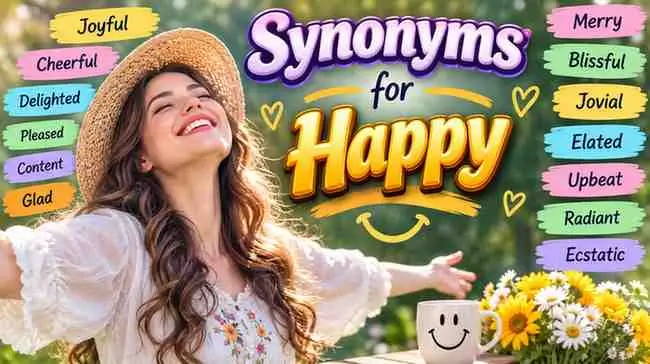
Have you ever written the word “happy” three times in one paragraph and felt stuck? You’re not alone. It’s one of the first words we learn, but it’s also one of the most overused words in English writing.
That’s where synonyms for happy come in handy. A synonym is simply a word that means almost the same thing as another word. Using different synonyms for happy helps your writing sound fresh instead of repetitive.
This matters whether you’re a student writing an essay, a blogger crafting a post, a content writer polishing an article, an ESL learner building vocabulary, or just someone who wants to sound more natural in daily conversation. Learning synonyms for happy gives you more tools to express joy, comfort, and excitement in exactly the right way.
What Are the Best Synonyms for Happy?
The best synonyms for happy include glad, joyful, cheerful, content, pleased, and delighted. Stronger options like elated, thrilled, and ecstatic work well for intense excitement, while calmer words like content and peaceful suit quiet satisfaction. Choosing the right synonym for happy depends on tone, strength, and context.
Happy Synonyms at a Glance
| Synonym | Simple Meaning | Best Used For |
| Glad | Pleased about something | Everyday conversation |
| Joyful | Full of joy | Celebrations, storytelling |
| Cheerful | Bright and positive mood | Daily life, casual writing |
| Content | Calmly satisfied | Reflective or personal writing |
| Pleased | Satisfied with a result | Formal or polite contexts |
| Delighted | Very pleased | Formal writing, invitations |
| Elated | Extremely happy | Big achievements |
| Thrilled | Very excited and happy | Casual, energetic tone |
| Satisfied | Happy with an outcome | Reviews, feedback |
| Jubilant | Openly triumphant and joyful | Victories, group celebrations |
| Ecstatic | Overwhelmingly happy | Strong emotional moments |
| Merry | Cheerful, often festive | Holidays, celebrations |
| Blissful | Peacefully and deeply happy | Poetic or romantic writing |
| Upbeat | Positive and optimistic in mood | Casual, motivational tone |
| Radiant | Glowing with happiness | Descriptive writing |
1. Glad
Meaning: Feeling pleased or happy about something specific. Examples: I’m so glad you called me today. She was glad to see her old friend at the party.
2. Joyful
Meaning: Full of great happiness and delight. Examples: The wedding was a joyful celebration for everyone. He felt joyful watching his daughter graduate.
3. Cheerful
Meaning: Noticeably happy and full of positive energy. Examples: Our new neighbor has a cheerful smile every morning. The cheerful music made the whole room feel lighter.
4. Content
Meaning: Calmly satisfied with life or a situation, without needing more. Examples: After the long trip, she was content to just relax at home. He seemed content with his simple, quiet lifestyle.
5. Pleased
Meaning: Satisfied or happy about something that happened. Examples: The manager was pleased with the team’s performance. We are pleased to announce the new product launch.
6. Delighted
Meaning: Feeling great pleasure or happiness, often about good news. Examples: I was delighted to receive your invitation. She looked delighted when she opened the gift.
7. Elated
Meaning: Extremely happy and excited, usually after good news. Examples: He was elated after passing his final exam. The team felt elated when they won the championship.
8. Thrilled
Meaning: Very excited and happy about something. Examples: We were thrilled to hear about your promotion. The kids were thrilled to visit the amusement park.
9. Satisfied
Meaning: Happy because expectations or needs have been met. Examples: The customer was satisfied with the quick service. I feel satisfied after finishing all my tasks today.
10. Jubilant
Meaning: Openly joyful and triumphant, often after a win or success. Examples: The jubilant crowd cheered as the fireworks began. Fans were jubilant when their team scored the winning goal.
11. Ecstatic
Meaning: Feeling extremely happy, almost overwhelmed with joy. Examples: She was ecstatic when she found out she got the job. He became ecstatic the moment his song went viral.
12. Merry
Meaning: Cheerful and full of fun, often linked to holidays. Examples: The family had a merry celebration on Christmas Eve. Everyone raised their glasses with a merry toast.
13. Blissful
Meaning: Feeling deep, peaceful happiness. Examples: They spent a blissful afternoon by the lake. The couple looked blissful on their wedding day.
14. Upbeat
Meaning: Having a positive, optimistic, and energetic mood. Examples: Her upbeat attitude made the meeting more enjoyable. The coach stayed upbeat even after the tough loss.
15. Radiant
If you are looking synonym for good
Meaning: Showing happiness clearly through one’s face or energy. Examples: The bride looked radiant walking down the aisle. His radiant smile lit up the entire room.
16. Gleeful
Meaning: Full of playful, sometimes mischievous joy. Examples: The children gave a gleeful laugh as they opened presents. She had a gleeful look after winning the board game.
17. Overjoyed
Meaning: Extremely happy, often beyond normal excitement. Examples: They were overjoyed to welcome their new baby. I was overjoyed when I heard the good news.
18. Chipper
Meaning: Lively and cheerful, especially in casual conversation. Examples: You seem pretty chipper this morning! Despite the rain, she stayed chipper all day.
19. Sunny
Meaning: Having a naturally bright, positive personality or mood. Examples: He greeted everyone with a sunny disposition. Her sunny attitude made customers feel welcome.
20. Buoyant
Meaning: Cheerful and full of confident energy. Examples: The team had a buoyant mood after the successful launch. Her buoyant spirit helped the group stay motivated.
21. Contented
Meaning: Peacefully happy and free of worry. Examples: The cat lay contented in the warm sunlight. He gave a contented sigh after the big meal.
22. Exhilarated
Meaning: Feeling very happy and full of energy, often from excitement. Examples: She felt exhilarated after finishing her first marathon. The riders were exhilarated after the roller coaster ride.
23. Lighthearted
Meaning: Cheerful, carefree, and free from serious worry. Examples: The movie had a lighthearted and funny tone. Their lighthearted conversation eased the tension in the room.
24. Jovial
Meaning: Friendly, warm, and full of good humor. Examples: The jovial host welcomed every guest with a joke. Grandpa is always jovial during family dinners.
25. Tickled
Meaning: (Informal) Amused and pleased, often in a lighthearted way. Examples: She was tickled by the surprise party her friends planned. He was tickled pink when he saw his old photo online.
26. On Cloud Nine
Meaning: (Idiom, contextual alternative) Extremely happy, as if floating with joy. This is not a single word but a common idiom used the same way as “happy.” Examples: After the proposal, she was on cloud nine for days. He’s been on cloud nine since he got accepted into college.
27. Beaming
Meaning: Showing happiness through a big, bright smile. Examples: The teacher was beaming with pride at graduation. He came home beaming after acing his interview.
28. Grateful
Meaning: (Near-synonym) Feeling thankful, which often brings happiness even though the core meaning is thankfulness, not happiness itself. Examples: I’m grateful for such supportive friends and family. She felt grateful and happy after receiving the scholarship.
29. Peaceful
Meaning: (Near-synonym) Calm and free from stress, which can lead to a quiet form of happiness. Examples: He felt peaceful walking through the quiet garden. Their peaceful morning routine set a happy tone for the day.
30. Optimistic
Meaning: (Near-synonym) Hopeful and positive about the future, closely linked to happiness but focused on expectation rather than current feeling. Examples: She stayed optimistic about her job search results. His optimistic outlook made the team feel happier about the project.
How to Choose the Right Synonym for Happy
Synonyms rarely mean the exact same thing. Each one carries its own strength, tone, and mood.
- Formal vs. informal: “Pleased” fits a business email; “chipper” fits a text to a friend.
- Positive vs. negative: All synonyms for happy are positive, but some (like “tickled”) feel more playful than serious.
- Strong vs. weak: “Glad” is mild. “Ecstatic” is intense. Don’t use “ecstatic” for small, everyday happiness.
- Academic writing: Choose neutral, precise words like “content” or “satisfied.”
- Business writing: Use professional tones like “pleased” or “delighted.”
- Casual conversation: Words like “chipper” or “thrilled” sound natural among friends.
- Creative writing: Descriptive words like “radiant” or “blissful” add imagery.
- Social media: Short, expressive words like “thrilled” or “buoyant” work well.
Choosing the right word helps your message match your intended tone exactly.
Formal and Informal Synonyms for Happy
| Formal Synonym | Informal Synonym | Example Context |
| Pleased | Glad | Replying to an email vs. texting a friend |
| Delighted | Thrilled | A formal invitation vs. sharing exciting news |
| Satisfied | Chipper | A performance review vs. casual small talk |
| Content | Tickled | A reflective essay vs. a funny story |
| Jubilant | Merry | A news report vs. a holiday greeting |
Best Synonyms for Different Contexts
Academic Writing: content, satisfied, pleased, optimistic, grateful
Blog Writing: cheerful, upbeat, delighted, radiant, thrilled
Business Writing: pleased, satisfied, delighted, content, optimistic
Everyday Conversation: glad, happy, chipper, thrilled, sunny
Creative Writing: blissful, radiant, jubilant, exhilarated, beaming
Common Mistakes When Using Synonyms
- Choosing the wrong strength. Saying you’re “ecstatic” about a minor thing sounds exaggerated.
- Using a formal word casually. Telling a friend you’re “delighted” to see them can sound stiff.
- Ignoring context. “Jovial” fits a person’s personality, not a single quick event.
- Changing the tone unintentionally. Swapping “content” for “thrilled” changes a calm sentence into an energetic one.
Synonyms vs. Related Words
- True synonyms share nearly identical meanings, like “glad” and “pleased.”
- Near-synonyms are close but not identical, like “content,” which leans toward calm satisfaction rather than active joy.
- Related words connect in meaning but aren’t direct synonyms, like “smile” or “laughter.”
- Contextual alternatives only work in certain situations, like the idiom “on cloud nine.”
Understanding these differences helps you pick words that truly fit your sentence.
How to Use Synonyms in Your Writing
Synonyms add variety and precision across many types of writing:
- Essays: Avoid repeating “happy” in every paragraph.
- Blog posts: Keep readers engaged with fresh vocabulary.
- Emails: Match the right tone for professional or personal messages.
- Website content: Improve readability and flow.
- Social media posts: Make short captions more expressive.
- Stories: Add emotional depth to characters.
- School assignments: Show a stronger vocabulary range.
Frequently Asked Questions About Synonyms for Happy
What is another word for happy?
Common alternatives include glad, joyful, cheerful, and pleased. Each carries a slightly different tone, so choose based on formality and intensity.
What is the best synonym for happy?
There isn’t one single “best” synonym — it depends on context. “Glad” works well for everyday use, while “delighted” suits formal writing.
Which synonym is best for formal writing?
“Pleased,” “delighted,” and “satisfied” work well in formal writing, such as emails, reports, or academic essays.
Which synonym is best for everyday conversation?
Words like “glad,” “chipper,” and “thrilled” sound natural in casual, everyday conversation with friends or family.
Can I use these synonyms in academic writing?
Yes, but choose neutral, precise words like “content,” “satisfied,” or “pleased” rather than casual terms like “tickled” or “chipper.”
Are all synonyms exactly the same?
No. Synonyms often share a similar core meaning but differ in strength, tone, or formality. Some, like “grateful” or “peaceful,” are near-synonyms rather than exact matches.
How can I learn synonyms easily?
Read regularly, keep a small vocabulary notebook, and practice using new words in real sentences. Reviewing synonym lists like this one also helps.
How can synonyms improve my writing?
Synonyms make writing more precise, varied, and interesting. They help avoid repetition and let you match tone more accurately to your audience.
Conclusion
Learning synonyms for happy makes your writing and speaking more expressive and precise. Whether you’re crafting an essay, writing a blog post, sending an email, or just chatting with friends, the right word makes your message clearer and more natural.
Try using a few of these synonyms today in your own emails, essays, or conversations. The more you practice, the more naturally they’ll come to you.

Shahid Imran is an English language and vocabulary specialist at EditorialHut.com, focusing on synonyms, word meanings, alternative words, and practical example sentences. He helps readers discover better words, expand their vocabulary, and communicate more clearly and confidently.