










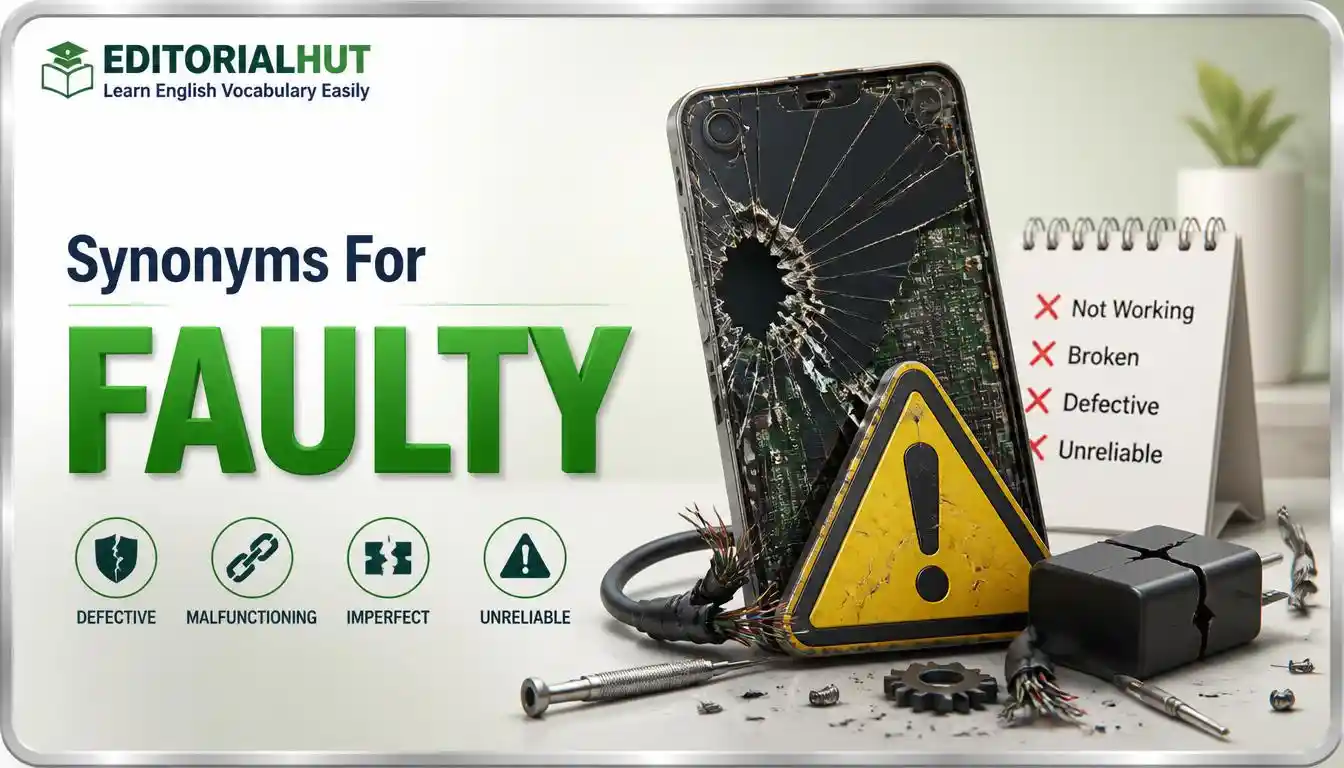
Finding the right synonyms for faulty can help you describe something that is defective, incorrect, unreliable, or not working as it should with greater precision. Whether you are writing about a faulty machine, a flawed argument, a defective product, or an incorrect decision, choosing the right alternative can make your writing clearer and more effective.
Common synonyms for faulty include defective, flawed, broken, imperfect, incorrect, unreliable, malfunctioning, erroneous, and unsound. However, each word carries a slightly different meaning and tone, so understanding the context is important when selecting the best synonym.
What Does “Synonyms for Faulty” Really Mean?
“Synonyms for faulty” means other words that have a similar meaning to “faulty.”
The word faulty usually describes something that is not working correctly, has a defect, contains an error, or does not function as it should.
For example:
- Faulty machine → a machine that does not work properly.
- Faulty wiring → wiring that has a defect or problem.
- Faulty reasoning → reasoning that contains an error.
- Faulty product → a defective or damaged product.
Common Synonyms for Faulty
Some useful alternatives include:
Defective, flawed, broken, damaged, malfunctioning, imperfect, incorrect, erroneous, unsound, inaccurate, unreliable, and faulty.
The best synonym depends on the context. For example, “defective” works well for products, while “incorrect” or “erroneous” is better for information or reasoning.
Connotative Meaning of “Faulty”
The connotative meaning of faulty refers to the feelings, ideas, or associations the word suggests beyond its basic dictionary definition.
Faulty generally has a negative connotation. It can suggest that something is poorly made, unreliable, defective, mistaken, or not good enough.
Examples:
- Faulty product → suggests the product is defective or unreliable.
- Faulty judgment → suggests someone made a poor or mistaken decision.
- Faulty reasoning → suggests the thinking is incorrect or unsound.
Simple Explanation
Denotative meaning: Something is defective, incorrect, or not working properly.
Connotative meaning: It may suggest poor quality, unreliability, mistakes, or disappointment.
Synonyms with similar negative connotations: defective, flawed, broken, unreliable, incorrect, unsound, imperfect.
Etymology of “Faulty”
The word faulty comes from the noun fault, meaning a defect, mistake, or imperfection.
- Fault → from Old French faute, meaning “fault, defect, mistake, or lack.”
- It ultimately comes from Latin fallita, related to fallere, meaning “to deceive, fail, or be mistaken.”
- The suffix -y was added to fault to form faulty, meaning “having a fault or defect.”
Simple Meaning
Faulty = having a fault, defect, mistake, or problem.
Example:
The technician replaced the faulty computer part because it was not working properly.
Pronunciation (IPA):
Faulty (/ˈfɔːlti/)
Syllables
Faulty has 2 syllables:
Fault-y → 2 syllables
Affixation Pattern
The word faulty is formed by adding the suffix -y to the noun fault.
Pattern:
fault + -y → faulty
- Base word: fault
- Suffix: -y
- Word class: Noun → Adjective
- Meaning: Having a fault, defect, or problem.
What Are the Best Synonyms for Faulty?
The strongest synonyms for faulty include defective, flawed, broken, malfunctioning, imperfect, unsound, deficient, and impaired. Each carries a slightly different shade of meaning: “defective” and “malfunctioning” work well for products and machines, “flawed” and “unsound” suit arguments or plans, and “broken” is the most casual, everyday choice. Picking the right synonym depends on whether you’re describing a physical object, a piece of reasoning, or a system.
Faulty Synonyms at a Glance
| Synonym | Meaning | Best Context |
| Defective | Having a manufacturing flaw or missing a needed part | Products, appliances, machinery |
| Flawed | Containing a weakness or imperfection | Arguments, plans, logic, character |
| Broken | Not working; damaged | Everyday objects, casual speech |
| Malfunctioning | Failing to operate as intended | Electronics, machines, systems |
| Imperfect | Not fully correct or complete | General, mild criticism |
| Unsound | Not structurally or logically solid | Reasoning, buildings, financial plans |
| Deficient | Lacking a necessary quality or amount | Diets, skills, systems |
| Impaired | Weakened in function | Health, senses, abilities |
| Glitchy | Prone to small technical errors | Software, apps, devices (informal) |
| Damaged | Physically harmed or worn | Objects, materials |
| Erroneous | Containing a factual mistake | Data, statements, calculations |
| Substandard | Below an acceptable quality level | Products, workmanship |
Detailed Synonyms
Defective
Meaning: Having a flaw, usually from manufacturing or design, that prevents proper function. Best used when: Describing products, appliances, or parts that don’t work as they should straight out of the box.
Example: The store offered a refund because the toaster was defective.
Usage note: Common in consumer, legal, and technical contexts (e.g., “defective merchandise”).
Flawed
Meaning: Containing a weakness, mistake, or imperfection that undermines the whole.
Best used when: Talking about arguments, plans, characters, or ideas rather than physical objects.
Example: Her reasoning was flawed because it relied on outdated data.
Usage note: Works for abstract things as much as physical ones; slightly more formal than “broken.”
Broken
Meaning: Damaged and no longer functioning. Best used when: Speaking casually about everyday items. Example: My phone screen is broken after I dropped it. Usage note: Informal and very common in conversation; less suited to formal or technical writing.
Malfunctioning
Meaning: Operating incorrectly or failing to perform its intended function. Best used when: Describing machines, electronics, or systems, especially in technical or professional contexts. Example: The elevator was malfunctioning, so we took the stairs. Usage note: More formal and precise than “broken”; often used in maintenance or technical reports.
Imperfect
Meaning: Not entirely correct, complete, or free of faults. Best used when: You want a gentler, less critical way to describe something that isn’t ideal. Example: It’s an imperfect solution, but it will work for now. Usage note: A near-synonym rather than an exact match — it implies mild shortcomings, not serious failure.
Unsound
Meaning: Not structurally, logically, or financially solid. Best used when: Discussing reasoning, buildings, investments, or plans. Example: Engineers found the bridge structurally unsound. Usage note: Formal; frequently paired with words like “structurally” or “financially.”
Deficient
Meaning: Lacking something necessary in quantity or quality. Best used when: Describing systems, diets, skills, or processes missing a required element. Example: The report was deficient in supporting evidence. Usage note: Formal and academic in tone.
Impaired
Meaning: Weakened or reduced in normal function. Best used when: Talking about health, senses, or abilities rather than objects. Example: His vision was impaired after the accident. Usage note: Near-synonym; used mainly for physical or cognitive function, not machines or objects.
Glitchy
Meaning: Prone to small, unpredictable technical errors. Best used when: Describing software, apps, or digital devices in casual conversation. Example: The app is glitchy and keeps freezing during video calls. Usage note: Informal and modern; not appropriate for formal writing.
Damaged
Meaning: Physically harmed, worn, or weakened. Best used when: Describing objects or materials that have suffered physical harm. Example: The package arrived with a damaged corner. Usage note: Focuses on physical harm rather than design flaws.
Erroneous
Meaning: Containing a factual or logical mistake. Best used when: Describing data, statements, or calculations that are wrong. Example: The invoice included an erroneous total. Usage note: Formal; best for written, technical, or academic contexts.
Substandard
Meaning: Falling below an acceptable or expected level of quality. Best used when: Criticizing the quality of work, materials, or products. Example: The contractor used substandard materials for the roof. Usage note: Carries a stronger note of disapproval than “flawed” or “imperfect.”
See more about synonyms for compliant
How to Choose the Right Synonym for Faulty
Synonyms for “faulty” aren’t fully interchangeable — swapping one for another can shift your meaning or tone. Consider:
- Meaning: “Defective” points to a manufacturing flaw, while “unsound” points to a structural or logical problem. They aren’t describing the same kind of failure.
- Strength: “Imperfect” is mild; “substandard” and “defective” are stronger criticisms.
- Formality: “Broken” and “glitchy” suit casual speech; “deficient” and “unsound” suit formal or technical writing.
- Subject: Some words only fit certain subjects — “impaired” fits health, not appliances; “malfunctioning” fits machines, not arguments.
For example, saying “the plan was broken” sounds casual and vague, while “the plan was flawed” sounds more precise and appropriate for a business report.
Synonyms for Different Contexts
Academic Writing: Use unsound, deficient, or erroneous — these describe flaws in logic, data, or research with precision and formality.
The Business Writing: Use defective, substandard, or malfunctioning — these are standard in product descriptions, complaints, and quality reports.
For Everyday Conversation: Use broken or glitchy — natural, simple words people use daily.
A Creative Writing: Use flawed or impaired — these add emotional or character depth, such as a “flawed hero” or “impaired judgment.”
Common Mistakes When Using Faulty Synonyms
- Using “impaired” for objects: “Impaired” fits people’s abilities or senses, not machines — say “malfunctioning printer,” not “impaired printer.”
- Using “broken” in formal writing: It reads as too casual for reports or professional documents; “defective” or “malfunctioning” is a better fit.
- Treating “imperfect” as equal to “defective”: “Imperfect” is much milder and doesn’t imply a serious problem.
- Overusing “unsound” outside logic or structure: It sounds odd applied to something like a phone or a toy — reserve it for reasoning, finances, or buildings.
How to Use These Synonyms in Your Writing
Varying your word choice makes writing feel more precise and less repetitive. In emails or reports, terms like defective or deficient sound professional. An essays, flawed or unsound strengthen your critique of an argument. In casual conversation or texts, broken or glitchy keep things natural. Matching the word to the context — not just the meaning , is what makes your writing sound confident and clear.
Frequently Asked Questions About Faulty
What is another word for faulty?
Common alternatives include defective, flawed, broken, and malfunctioning, depending on what you’re describing.
What is the best synonym for faulty in formal writing?
“Defective,” “deficient,” or “unsound” work well in formal or technical contexts.
Which synonym sounds natural in everyday English?
“Broken” and “glitchy” are the most common in casual conversation.
Are all synonyms for faulty interchangeable?
No. Each word carries a different shade of meaning, strength, or formality, so context determines the best choice.
What’s the difference between faulty and flawed?
“Faulty” often implies something doesn’t function correctly, while “flawed” can describe a weakness in reasoning, character, or design, not just mechanical failure.
What’s the difference between faulty and defective?
“Defective” specifically points to a manufacturing or design problem, while “faulty” is a broader, more general term.
Practice Using These Synonyms
Choose the best synonym to complete each sentence.
- The washing machine kept stopping mid-cycle, so the technician said it was ______.
- His argument was ______ because it ignored key evidence.
- My umbrella is ______ — it won’t open all the way.
- The report was ______ in detail and needed more research.
Answer Key:
- Malfunctioning
- Flawed
- Broken
- Deficient
Conclusion
“Faulty” is a useful word, but it’s not always the most precise one. Words like defective, flawed, malfunctioning, and unsound let you describe problems with more accuracy , whether you’re talking about a broken appliance, a weak argument, or a structural issue. The key is matching the synonym’s meaning, strength, and formality to your specific context. With practice, choosing the right word becomes second nature.

Shahid Imran is an English language and vocabulary specialist at EditorialHut.com, focusing on synonyms, word meanings, alternative words, and practical example sentences. He helps readers discover better words, expand their vocabulary, and communicate more clearly and confidently.