










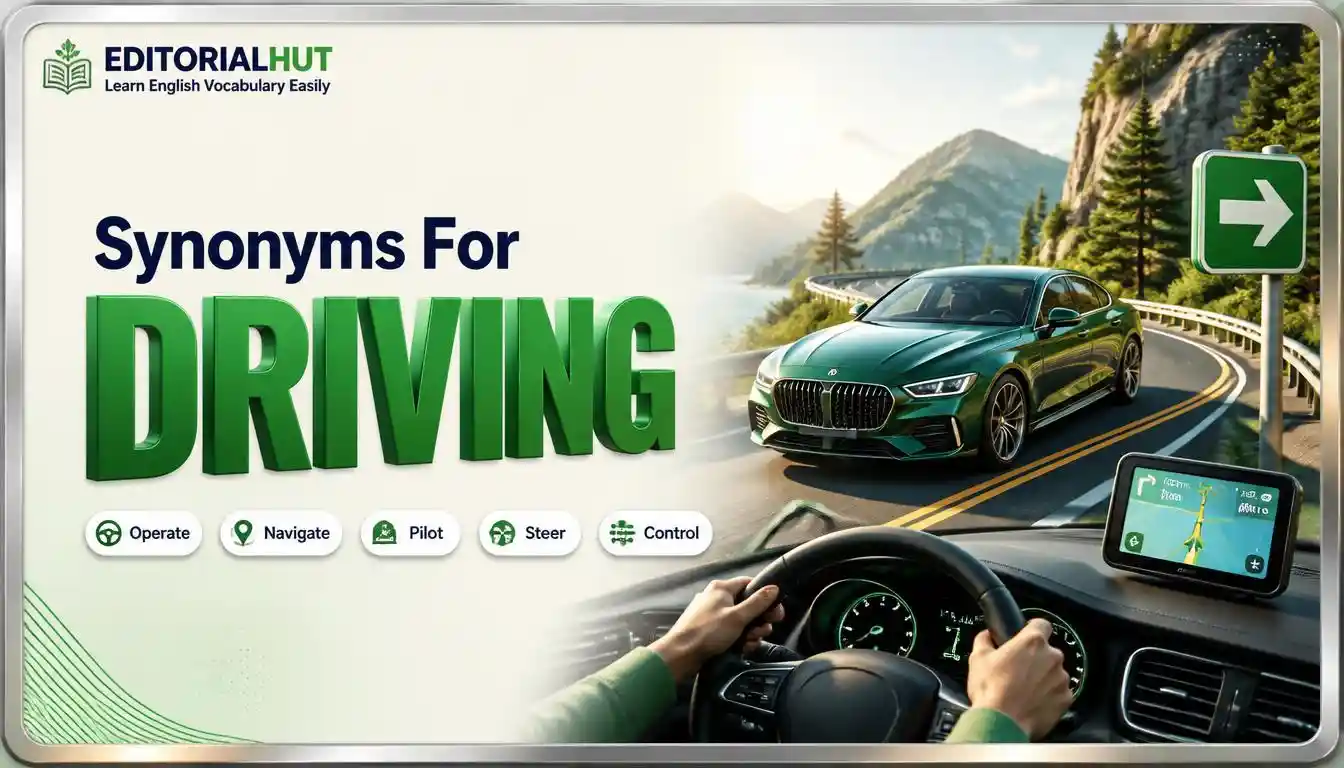
The word “driving” is commonly associated with controlling and operating a vehicle, but its meaning can extend far beyond getting from one place to another. Depending on the context, driving can describe moving, pushing, motivating, influencing, or causing something to happen. This is why understanding the right synonyms for driving can help you choose more precise and natural words in writing and everyday conversation. In this guide, we’ll explore the meaning, connotative meaning, etymology, pronunciation, syllables, affixation pattern, and useful synonyms for driving, along with examples to help you understand how each word differs in context.
What Do “Synonyms for Driving” Really Mean?
The phrase “synonyms for driving” refers to words or expressions that can replace driving, depending on its meaning and context. The word driving has several meanings, so its synonyms can change significantly.
For example:
- Driving a car → operating, steering, piloting
- Driving someone somewhere → transporting, taking, chauffeuring
- Driving force → motivating, compelling, influential
- Driving change → promoting, advancing, pushing
1. Meaning of “Driving”
Driving is the present participle or gerund form of drive.
Its most common meaning is controlling and moving a vehicle:
She is driving to work.
But driving can also describe the act of causing, motivating, or pushing something forward:
Innovation is driving economic growth.
In this sentence, driving does not involve a vehicle. It means causing or strongly influencing something.
Common synonyms for driving
| Meaning | Synonyms |
| Operating a vehicle | operating, steering, piloting |
| Taking someone somewhere | transporting, chauffeuring, conveying |
| Moving something forward | propelling, pushing, advancing |
| Causing something | causing, producing, generating |
| Motivating | motivating, inspiring, encouraging |
| Forcing progress | compelling, pushing, advancing |
| Controlling a vehicle | maneuvering, steering, handling |
2. Connotative Meaning of “Driving”
Connotative meaning refers to the feelings, associations, or additional ideas a word can suggest beyond its basic dictionary definition.
The word driving often has a sense of movement, control, energy, determination, or forward progress.
Positive connotations
In phrases such as:
Driving innovation
“driving” can suggest:
- ambition
- progress
- leadership
- energy
- determination
- forward movement
Similarly:
A driving force behind success
suggests someone or something that provides strong motivation and momentum.
Neutral connotations
When driving refers simply to operating a vehicle, it is usually neutral:
He is driving home.
Negative connotations
In some contexts, driving can suggest pressure, force, or irritation:
The constant noise is driving me Silly.
Here, driving conveys the idea of pushing someone toward an emotional state, usually frustration or annoyance.
In simple words
Driving often carries the connotation of making something move, progress, happen, or change.
3. Etymology of “Driving”
The word driving comes from the verb drive, which has a very old Germanic history.
Drive comes from Old English drīfan, meaning roughly “to drive, force, compel, or move forward.”
It is related to words in other Germanic languages, including forms found in Old Norse and other Germanic languages.
The original idea was not specifically about automobiles. The word existed long before cars were invented.
Historically, drive could mean:
- to force something forward
- to push
- to move animals
- to compel someone
- to cause something to happen
The modern meaning involving automobiles developed much later.
Historical development
A simplified semantic development looks like this:
force/move → cause to move → control a vehicle → cause/provoke → motivate or propel
That is why modern English can use driving in both physical and metaphorical contexts.
For example:
He is driving a car.
and:
Technology is driving innovation.
Both meanings preserve the underlying idea of causing movement or progress.
4. Pronunciation (IPA)
The pronunciation of driving is:
driving (ˈdraɪ.vɪŋ)
The main stress falls on the first syllable.
5. Syllables
Driving has two syllables:
driv-ing
Syllable breakdown
- driv — first syllable
- ing — second syllable
The first syllable receives the primary stress.
The word comes from:
drive + -ing → driving
Notice that the final e in drive is removed before adding -ing.
6. Affixation Pattern
The word driving is formed from the verb drive plus the suffix -ing.
Structure
drive → driv + ing → driving
More accurately, English spelling drops the final silent e before adding -ing:
drive + -ing → driving
Base word
drive
Suffix
-ing
Function of -ing
The suffix -ing can form a present participle:
She is driving.
It can also form a gerund when the activity functions as a noun:
Driving requires concentration.
Therefore, the morphological pattern is:
Verb + -ing → present participle / gerund
7. “Driving” vs. Its Synonyms
Not every synonym can be substituted into every sentence.
Driving a car
She is driving the car.
Possible alternatives:
- operating the car
- steering the car
- maneuvering the car
- piloting the vehicle
But motivating would not work here.
Driving progress
Technology is driving progress.
Possible alternatives:
- advancing progress
- promoting progress
- propelling progress
- accelerating progress
- fueling progress
Here, operating would obviously be incorrect.
Driving change
Young people are driving change.
Possible alternatives:
- promoting change
- encouraging change
- advancing change
- pushing change
- accelerating change
8. Key Takeaway
“Driving” fundamentally expresses the idea of causing or controlling movement. Its meaning can be physical, such as operating a vehicle, or metaphorical, such as motivating progress or causing change.
- Meaning: operating, moving, causing, motivating, or propelling
- Connotation: movement, energy, control, progress, or force
- Etymology: from Old English drīfan, associated with driving, forcing, and moving forward
- IPA: shown above
- Syllables: 2
- Affixation: drive + -ing → driving
- Common synonyms: operating, steering, propelling, motivating, advancing, promoting, compelling, transporting
What Are the Best Synonyms for Driving?
The strongest synonyms for driving include operating, steering, motoring, cruising, piloting, navigating, wheeling, and chauffeuring. Each of these words describes controlling or moving a vehicle, but they carry different tones. “Operating” sounds formal and technical, “cruising” feels relaxed and casual, “piloting” suggests skill or control, and “chauffeuring” implies driving someone else around, often as a job or favor. Not every synonym fits every sentence, so understanding these small differences helps you pick the word that matches your meaning and tone.
Driving Synonyms at a Glance
| Synonym | Meaning | Best Context |
| Operating | Controlling a vehicle or machine | Formal, technical, or legal writing |
| Steering | Guiding the direction of a vehicle | Describing control or direction, often literal |
| Motoring | Traveling by car | Slightly old-fashioned or lighthearted writing |
| Cruising | Driving in a relaxed, unhurried way | Casual writing, leisure trips |
| Piloting | Skillfully controlling a vehicle | Emphasizing skill or responsibility |
| Navigating | Finding and following a route while driving | Describing direction-finding, not just movement |
| Wheeling | Driving, often informally or with flair | Very casual, conversational speech |
| Chauffeuring | Driving someone else as a service | Describing driving others, formal or humorous |
| Commuting | Driving regularly to and from work | Routine, everyday travel |
| Road-tripping | Driving on a long, often recreational trip | Casual, travel-related writing |
Detailed Synonym Guide
Operating
Meaning: Controlling and running a vehicle, often used in technical or legal contexts.
Best used when: You’re writing formally, especially about rules, safety, or machinery. Example: “The company requires all employees to complete a safety course before operating a forklift.”
Usage note: Formal. Common in legal, workplace, and technical writing rather than everyday conversation.
Steering
Meaning: Guiding the direction of a vehicle using the wheel.
Best used when: You want to focus on the act of controlling direction rather than the trip itself. Example: “She kept both hands on the wheel, carefully steering through the narrow mountain road.”
Usage note: Near-synonym. It emphasizes direction and control more than the general act of driving.
Motoring
Meaning: Traveling by car or motor vehicle.
Best used when: You want a slightly old-fashioned or playful tone.
Example: “They spent the afternoon motoring along the coastal highway.”
Usage note: Somewhat dated in everyday American English, but still used in travel writing for charm.
Cruising
Meaning: Driving at a steady, relaxed pace, often without a strict destination.
Best used when: Describing leisurely or unhurried driving.
Example: “We were just cruising around town with the windows down.
” Usage note: Informal and conversational. Not suitable for formal or technical writing.
Piloting
Meaning: Skillfully controlling and guiding a vehicle.
Best used when: You want to highlight skill, precision, or responsibility.
Example: “He piloted the delivery van through heavy downtown traffic without a single wrong turn.
” Usage note: Slightly stronger than “driving.” Often associated with planes or boats, but works well for cars in a figurative sense.
Navigating
Meaning: Finding and following a route while driving.
Best used when: The focus is on direction-finding, not just the physical act of driving. Example: “She navigated the unfamiliar streets using her phone’s GPS
.” Usage note: Near-synonym. It’s about route-finding more than the general act of driving.
Wheeling
Meaning: Driving, often used casually or with a sense of energy or flair.
Best used when: You want a very informal, conversational tone.
Example: “He came wheeling into the parking lot right on time.
” Usage note: Informal. Best for spoken English or casual storytelling, not professional writing.
Chauffeuring
Meaning: Driving someone else as a service or favor.
Best used when: The sentence involves driving another person, not traveling alone.
Example: “My uncle spent the weekend chauffeuring relatives to and from the airport.
” Usage note: Can be formal (referring to a professional driver) or lightly humorous when used about a friend or family member.
Commuting
Meaning: Driving regularly, usually between home and work.
Best used when: Describing routine, repeated travel rather than a single trip.
Example: “She spends almost an hour commuting to the office every morning.”
Usage note: Near-synonym. It refers specifically to routine travel, not driving in general.
Road-tripping
Meaning: Driving on a long trip, often for leisure or adventure.
Best used when: Describing extended, often recreational driving.
Example: “They spent the summer road-tripping across three states.
” Usage note: Informal. Common in travel blogs and casual conversation.
How to Choose the Right Synonym for Driving
Synonyms for driving are not always interchangeable, even when they seem similar at first glance. Before choosing one, consider a few things:
- Meaning: Does the word describe the act of driving itself, or something more specific, like direction (“steering”) or routine (“commuting”)?
- Tone: Is the sentence formal, like a workplace policy, or casual, like a text to a friend?
- Strength: Some words, like “piloting,” suggest more skill or control than a plain word like “driving.”
- Audience: A technical report calls for “operating,” while a story might call for “cruising” or “wheeling.”
- Grammar: Make sure the word fits the sentence structure. “She operated the car” and “She cruised down the highway” both work, but they set very different tones.
For example, “He was driving to work” is neutral and simple. Swap in “He was commuting to work,” and the sentence now emphasizes routine. Swap in “He was cruising to work,” and it suggests he wasn’t in a hurry. The core action is similar, but the meaning shifts depending on the word.
Synonyms for Different Contexts
For Academic or Technical Writing
Use operating or piloting. These words sound precise and professional, which fits reports, manuals, or research papers about vehicles or machinery.
For Business Writing
Operating and commuting work well here, especially in policies, safety guidelines, or discussions of employee travel.
For Everyday Conversation
Cruising, wheeling, and plain driving feel natural in casual speech. They’re relaxed and easy to say without sounding stiff.
For Creative Writing
Motoring, cruising, and piloting can add personality and rhythm to a sentence, helping avoid repeating “drove” or “driving” too often in a story.
For Travel or Lifestyle Content
Road-tripping and cruising fit naturally when describing vacations, scenic routes, or leisure travel.
Common Mistakes When Using Driving Synonyms
- Using “piloting” for routine errands. It works for skillful or notable driving, but sounds exaggerated for something like “piloting to the grocery store.”
- Using “commuting” for a single trip. Commuting implies a repeated routine, not a one-time drive.
- Using “operating” in casual conversation. It’s accurate but feels overly formal among friends or family.
- Assuming “steering” and “driving” mean exactly the same thing. Steering refers specifically to controlling direction, while driving covers the whole activity.
- Overusing “cruising” in serious contexts. Its relaxed tone doesn’t fit safety reports or formal writing about vehicle operation.
Synonyms vs. Related Words
Some words are true synonyms for driving, meaning they can often replace it directly, such as operating or motoring. Others are near-synonyms, sharing meaning in specific situations but not always interchangeable, such as steering (focused on direction) or commuting (focused on routine). Still others are related words that connect to driving without meaning the same thing, such as traveling or transporting, which describe broader movement rather than the specific act of controlling a vehicle. Recognizing this difference helps you avoid using a related word where a true synonym is needed.
How to Use These Synonyms in Your Writing
Varying your word choice around “driving” can make writing feel more natural and less repetitive, whether you’re writing:
- Essays or school assignments, where “operating” or “navigating” can sound more precise
- Emails or business reports, where “commuting” or “operating” fit professional tone
- Creative writing, where “cruising” or “motoring” can add rhythm and variety
- Everyday conversation, where simple words like “driving” or “cruising” keep things natural
- Travel content, where “road-tripping” captures a specific, relatable experience
The goal isn’t to replace every instance of “driving” with a fancier word. Instead, use synonyms when they add precision, avoid repetition, or better match your tone.
Frequently Asked Questions About Driving Synonyms
What is another word for driving?
Common alternatives include operating, steering, motoring, cruising, and commuting, depending on the context.
What is the best synonym for driving in formal writing?
“Operating” is generally the best choice for formal, technical, or legal writing.
Which synonym sounds most natural in everyday conversation?
“Cruising” and plain “driving” are the most natural choices for casual speech.
Are all synonyms for driving interchangeable?
No. Words like “commuting” and “steering” have more specific meanings and don’t always work as direct substitutes.
What is the difference between driving and commuting?
Driving is the general act of controlling a vehicle, while commuting refers specifically to regular travel between two places, like home and work.
What is the difference between driving and piloting?
Piloting suggests more skill or control and is often used for a notable or difficult driving task, while driving is neutral and general.
Practice Using These Synonyms
Try choosing the best synonym for each sentence below.
- She spends 45 minutes ______ to work every day. (commuting / cruising)
- The technician must complete training before ______ the machine. (operating / wheeling)
- They spent the weekend ______ along the coast with no set plan. (commuting / cruising)
- He carefully ______ the car through the flooded street. (steered / commuted)
Answer Key:
- commuting
- operating
- cruising
- steered
Conclusion
“Driving” is a simple, useful word, but it isn’t the only option. Words like operating, steering, cruising, piloting, and commuting each bring their own shade of meaning, from formal and technical to relaxed and conversational. The right choice depends on your tone, audience, and exactly what you’re trying to say. With a clearer sense of these differences, you can pick the word that fits naturally, whether you’re writing an email, a story, or just chatting about your day.

Shahid Imran is an English language and vocabulary specialist at EditorialHut.com, focusing on synonyms, word meanings, alternative words, and practical example sentences. He helps readers discover better words, expand their vocabulary, and communicate more clearly and confidently.